










Founder Mode is a series uncovering how founders and early leaders operate at today's standout startups.
Founder Steven Tey transformed a part-time experiment with edge computing into Dub, a modern, powerful, and reliable link attribution platform. By prioritizing design and building transparently in public, Dub has attracted big customers like Twilio and Vercel, while staying true to its open-source roots.
Dub actually started as a side project while I was at Vercel. It began as a way for me to experiment with the technologies we were shipping, primarily edge functions and middleware. I wanted to create something fast and low-latency, which led to the idea of a link shortener running close to users.
When I launched Dub as an open-source alternative to Bitly, it gained traction quite quickly. I was only coding part-time on nights and weekends, but people were organically discovering and subscribing to it. That growth felt like we might have product-market fit, and I began considering Dub's potential as a company.
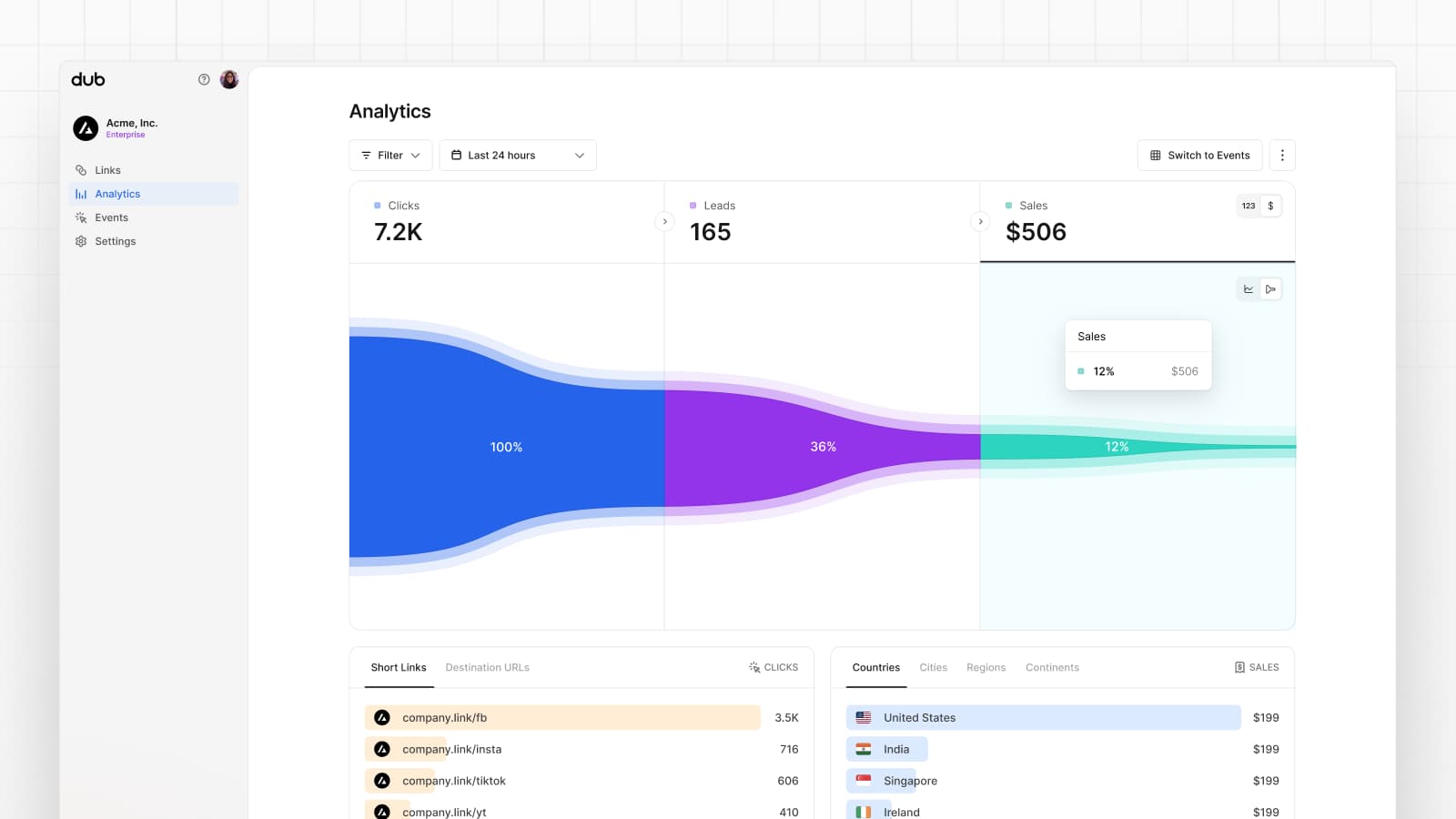
What really caught my attention was how many people were using it for affiliate link tracking. Having run an affiliate-revenue-driven company before Vercel, I knew firsthand how legacy that software was. It also made sense from a product evolution standpoint for Dub — what happens after a user clicks on a link? Do they sign up for your product? Do they expand and invite teammates or do they churn after the first month?
This desire to understand the user journey drove Dub's evolution from a simple link shortener into an end-to-end marketing attribution platform.
While I'm not a designer by trade, I believe that exceptional design is critical for your product. Even with the strongest architecture, if your product has a terrible frontend, users won't care to try it.
This design focus set Dub apart from the start, especially in open-source where polish often takes a backseat. In the beginning, we worked with a great freelance designer who shaped our foundation, but as we grew, it became clear we needed someone to fully own the brand and its future.
With our high bar for design, finding our founding designer took six months. We weren't just looking for a strong portfolio or lots of experience. We needed someone eager to experiment with new ideas and ready to iterate on feedback, rather than impose pre-existing notions.
In the beginning, I naturally didn't want to spend anything on marketing since it was a side project. But if you're thinking about time as money, we spent the most resources on creating content.
Posting about our progress in public, sharing how we shipped features, and letting people explore our codebase—this type of content complemented our open-source platform nicely, all of which helped create a viral word-of-mouth engine.
That openness is actually how we got our first big clients. The head of engineering at Twilio first discovered us through our GitHub repo.
Now that we're scaling Dub up, we're formalizing our marketing strategy to understand what is most repeatable and worthy of further investment.
We're dividing marketing into a few big buckets:
It's definitely tricky being in the weeds of day-to-day development while also thinking about marketing and sales strategy.
The key has been carving out dedicated time blocks in my week to focus exclusively on critical tasks, whether that's development or GTM activities.
Also, even if it's not another co-founder, you should always have someone you can trust to bounce ideas for GTM. I actually lean on my wife a lot—she's not a marketer by trade, but she's an incredible sounding board for how to tell Dub's story compellingly.
I believe deeply in drawing inspiration from and contributing back to the community—a rising tide lifts all ships.
We naturally gravitate toward products with exceptional design like Linear and Mintlify, and when we see something that works well, we are quick to learn from it. Rather than reinventing the wheel for some elements, we focus energy on adapting proven patterns and adding our own spin.
This open philosophy extends to how we share our own work. Part of building in public and sharing our approach is to help others take inspiration as well.
Finally, there's an important balance between building beautiful designs and actually converting users. While we love our site's aesthetics, we're constantly measuring and A/B testing (using our own conversion tracking API) to ensure it performs as well as it looks.
Ready for more Founder Mode? Drop us a line @mintlify with topics you'd like to hear about and stay tuned.
此内容由惯性聚合(RSS阅读器)自动聚合整理,仅供阅读参考。 原文来自 — 版权归原作者所有。