


惯性聚合 高效追踪和阅读你感兴趣的博客、新闻、科技资讯
阅读原文 在惯性聚合中打开

推荐订阅源

G
GRAHAM CLULEY
T
Tenable Blog
Know Your Adversary
Know Your Adversary
C
CXSECURITY Database RSS Feed - CXSecurity.com
P
Privacy International News Feed
S
Security Affairs
NISL@THU
NISL@THU
O
OpenAI News
Attack and Defense Labs
Application and Cybersecurity Blog
Hacker News: Ask HN
Hacker News: Ask HN
Webroot Blog
Webroot Blog
Schneier on Security
S
SegmentFault 最新的问题
S
Schneier on Security
G
Google Developers Blog
V
V2EX
C
Check Point Blog
U
Unit 42
Google DeepMind News
T
Threatpost
阮一峰的网络日志
阮一峰的网络日志
T
The Exploit Database - CXSecurity.com
Recent Announcements
M
MIT News - Artificial intelligence
S
Secure Thoughts
博客园 - 司徒正美
Recorded Future
Recorded Future
P
Proofpoint News Feed
Spread Privacy
Spread Privacy
K
Kaspersky official blog
Cyber Security Advisories - MS-ISAC
AI
AI
博客园 - 聂微东
N
News and Events Feed by Topic
SecWiki News
SecWiki News
钛媒体:引领未来商业与生活新知
钛媒体:引领未来商业与生活新知
V
Vulnerabilities – Threatpost
P
Palo Alto Networks Blog
OSCHINA 社区最新新闻
OSCHINA 社区最新新闻
Engineering at Meta
Engineering at Meta
Recent Commits to openclaw:main
奇客Solidot–传递最新科技情报
奇客Solidot–传递最新科技情报
酷 壳 – CoolShell
酷 壳 – CoolShell
WordPress大学
WordPress大学
The Hacker News
The Hacker News
The Last Watchdog
The Last Watchdog
Project Zero
Project Zero
W
WeLiveSecurity
博客园 - Franky

Mintlify Blog

22 UX improvements to the web editor Introducing the Mintlify Help Center Starter Kit Introducing the collaborative editor built for teams and agents Workflows, rebuilt Is your documentation agent-ready? Mintlify raises $45M Series B led by Andreessen Horowitz and Salesforce Ventures 5 things you didn't know you could do in the Mintlify web editor The improved Mintlify CLI Docs on autopilot: From zero to self-maintaining with Mintlify The state of agent traffic in documentation (March 2026) We Replaced Our Internal Wiki With a Slack Bot. You Should Too. 8 ways teams use Mintlify to keep docs updated automatically Documentation is your AI interface What three years of watching AI in production taught us Bridging two JSX runtimes: How we solved Astro's React children problem AI agents are shipping faster than anyone can document Knowledge management systems for technical teams Workflows: Automate documentation maintenance Mintlify acquires Helicone to redefine AI knowledge infrastructure Why more product managers are switching to Mintlify Auto-generating documentation sites from GitHub repos Your docs, your frontend, our content engine Take control of your documentation system Almost half your docs traffic is AI, time to understand the agent experience @mintlify for better docs, faster Mintlify for Enterprise Real llms.txt examples from leading tech companies (and what they got right) Mintlify + Claude Opus 4.6: Powering AI-native knowledge management Declaring Clankruptcy: An experiment in agent orchestration Analytics for AI and agent traffic A better way to edit and publish in Mintlify Improved agent experience with llms.txt and content negotiation Your docs are now discoverable by agents Why do we need MCP if skills exist now? skill.md: An open standard for agent skills install.md: A Standard for LLM-Executable Installation Why documentation is one of the most important surfaces for marketers How I built our knowledge base in an afternoon Closing the loop between user questions and documentation 2025: A Year in Review Mintlify Security Event - November 2025 Inside our effort to improve the Mintlify assistant Introducing the next step towards self-updating docs How we eliminated cold starts for 72M monthly page views with edge caching 10 UI fixes I shipped in 10 days The Mintlify agent, now in your dashboard Impact of SHA1-Hulud: The Second Coming on the Mintlify CLI Documentation is dead. Long live documentation. What I shipped in my first 60 days at Mintlify Terminal agents are the future - We're launching mint new How we’re making Mintlify documentation more accessible Building an LSP for your docs The role of good code blocks in documentation The /api Namespace is Now Open Introducing the Mintlify Agent to write documentation with AI We built our coding agent for Slack instead of the terminal Top 7 ways to blend SEO with GEO for explosive brand growth How Mintlify uses Claude Code as a technical writing assistant AI Documentation Trends: What's Changing in 2025 Debugging a mysterious HTTP streaming issue How Pinecone writes documentation How to generate llms.txt Mintlify acquires Trieve to improve RAG search in documentation Behind Replit's Documentation Transformation How often do LLMs visit llms.txt? How Claude's memory and MCP work (and when to use each) Introducing AI Assistant: Turning docs into your product expert My quick formula for docs that convert It's not a race How to hire your first technical writer GEO guide to optimize writing for LLMs How Windsurf writes docs How Anaconda writes documentation Should you generate docs from your API schema? The value of llms.txt: Hype or real? Why we sunsetted mcpt How to use MCP servers to generate docs AI can write your docs, but should it? What is llms.txt? Breaking down the skepticism mcpt: The curated registry for MCP servers Why I joined Mintlify How to audit and overhaul your software documentation What is MCP and how to get started Generate MCP servers from your docs Mintlify vs. Readme: A 2025 Comparison How Generative Engine Optimization is Reshaping Docs Should you build or buy an API documentation tool? When do you really need a monorepo? Fireside Chats: Gong's Approach to Software Documentation The Next Chapter of Mintlify Themes New Devs Don't Read Docs? Maybe It's Not Their Fault Founder Mode: Dub's journey from side project to enterprise link attribution platform Refactoring mint.json into docs.json Breaking down common documentation mistakes What makes good API documentation? Best tools and examples 2024 in Review: Getting Ship Done Five changelog principles from best-in-class developer brands Founder Mode: How Windsurf builds product, from 0 to 1M users Introducing AI Assistant Simplifying docs for AI with /llms.txt
How we built a virtual filesystem for our Assistant
Dens Sumesh · 2026-03-24 · via Mintlify Blog

RAG is great, until it isn't.

Our assistant could only retrieve chunks of text that matched a query. If the answer lived across multiple pages, or the user needed exact syntax that didn't land in a top-K result, it was stuck. We wanted it to explore docs the way you'd explore a codebase.

Agents are converging on filesystems as their primary interface because grep, cat, ls, and find are all an agent needs. If each doc page is a file and each section is a directory, the agent can search for exact strings, read full pages, and traverse the structure on its own. We just needed a filesystem that mirrored the live docs site.

The obvious way to do this is to just give the agent a real filesystem. Most harnesses solve this by spinning up an isolated sandbox and cloning the repo. We already use sandboxes for asynchronous background agents where latency is an afterthought, but for a frontend assistant where a user is staring at a loading spinner, the approach falls apart. Our p90 session creation time (including GitHub clone and other setup) was ~46 seconds.

Beyond latency, dedicated micro-VMs for reading static documentation introduced a serious infrastructure bill:

$0$50k$100k$150k$200k0357101215Average session duration (minutes)Additional annual compute cost

SandboxChromaFs

At 850,000 conversations a month, even a minimal setup (1 vCPU, 2 GiB RAM, 5-minute session lifetime) would put us north of $70,000 a year based on Daytona's per-second sandbox pricing ($0.0504/h per vCPU, $0.0162/h per GiB RAM). Longer session times double that. (This is based on a purely naive approach, a true production workflow would probably have warm pools and container sharing, but the point still stands)

We needed the filesystem workflow to be instant and cheap, which meant rethinking the filesystem itself.

The agent doesn't need a real filesystem; it just needs the illusion of one. Our documentation was already indexed, chunked, and stored in a Chroma database to power our search, so we built ChromaFs: a virtual filesystem that intercepts UNIX commands and translates them into queries against that same database. Session creation dropped from ~46 seconds to ~100 milliseconds, and since ChromaFs reuses infrastructure we already pay for, the marginal per-conversation compute cost is zero.
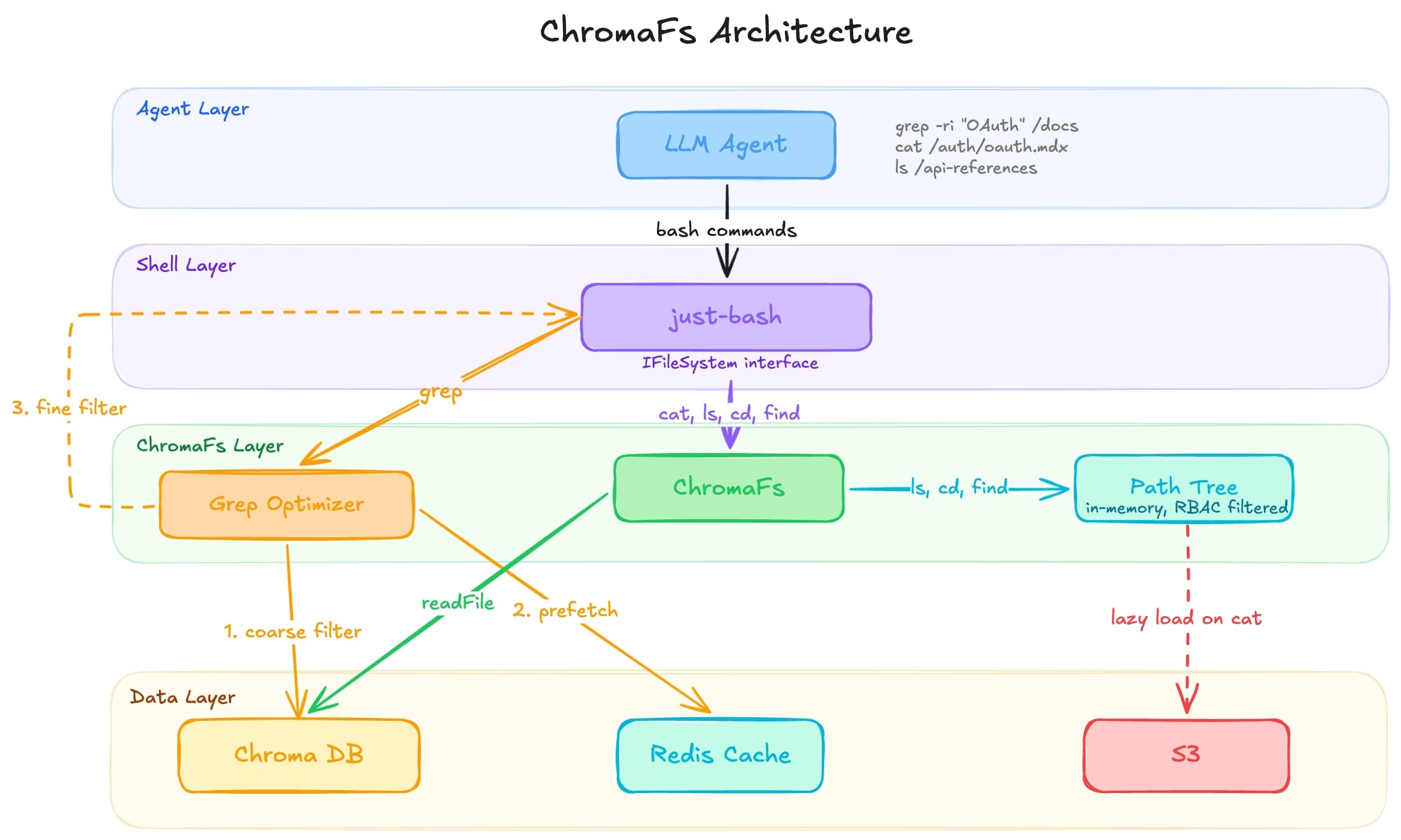
ChromaFs Architecture

MetricSandboxChromaFs
P90 Boot Time~46 seconds~100 milliseconds
Marginal Compute Cost~$0.0137 per conversation~$0 (reuses existing DB)
Search MechanismLinear disk scan (Syscalls)DB Metadata Query
InfrastructureDaytona or similar providersProvisioned DB

ChromaFs is built on just-bash by Vercel Labs (shoutout Malte!), a TypeScript reimplementation of bash that supports grep, cat, ls, find, and cd. just-bash exposes a pluggable IFileSystem interface, so it handles all the parsing, piping, and flag logic while ChromaFs translates every underlying filesystem call into a Chroma query.

How it works

Bootstrapping the Directory Tree

ChromaFs needs to know what files exist before the agent runs a single command. We store the entire file tree as a gzipped JSON document (__path_tree__) inside the Chroma collection:

{
  "auth/oauth": { "isPublic": true, "groups": [] },
  "auth/api-keys": { "isPublic": true, "groups": [] },
  "internal/billing": { "isPublic": false, "groups": ["admin", "billing"] },
  "api-reference/endpoints/users": { "isPublic": true, "groups": [] }
}

On init, the server fetches and decompresses this document into two in-memory structures: a Set<string> of file paths and a Map<string, string[]> mapping directories to children.

Once built, ls, cd, and find resolve in local memory with no network calls. The tree is cached, so subsequent sessions for the same site skip the Chroma fetch entirely.

Access Control

Notice the isPublic and groups fields in the path tree. Before building the file tree, ChromaFs prunes slugs using the current user's session token and applies a matching filter to all subsequent Chroma queries. If a user lacks access to a file, that file is excluded from the tree entirely, so the agent can't access or even reference a path that was pruned.

In a real sandbox, this level of per-user access control would require managing Linux user groups, chmod permissions, or maintaining isolated container images per customer tier. In ChromaFs it's a few lines of filtering before buildFileTree runs.

Reassembling Pages from Chunks

Pages in Chroma are split into chunks for embedding, so when the agent runs cat /auth/oauth.mdx, ChromaFs fetches all chunks with a matching page slug, sorts by chunk_index, and joins them into the full page. Results are cached so repeated reads during grep workflows never hit the database twice.

Not every file needs to exist in Chroma. We register lazy file pointers that resolve on access for large OpenAPI specs stored in customers' S3 buckets. The agent sees v2.json in ls /api-specs/, but the content only fetches when it runs cat.

Every write operation throws an EROFS (Read-Only File System) error. The agent explores freely but can never mutate documentation, which makes the system stateless with no session cleanup and no risk of one agent corrupting another's view.

cat and ls are straightforward to virtualize, but grep -r would be far too slow if it naively scanned every file over the network. We intercept just-bash’s grep, parse the flags with yargs-parser, and translate them into a Chroma query ($contains for fixed strings, $regex for patterns).

Chroma acts as a coarse filter that identifies which files might contain the hit, and we bulkPrefetch those matching chunks into a Redis cache. From there, we rewrite the grep command to target only the matched files and hand it back to just-bash for fine filter in-memory execution, which means large recursive queries complete in milliseconds.

ChromaFs powers the documentation assistant for hundreds of thousands of users across 30,000+ conversations a day. By replacing sandboxes with a virtual filesystem over our existing Chroma database, we got instant session creation, zero marginal compute cost, and built-in RBAC without any new infrastructure.

Try it on any Mintlify docs site, or at mintlify.com/docs.