






What's the actual ROI of tokenmaxxing?
Every company using AI is now paying for tokens. At Mintlify, we package tokens into Credits. The unit isn't the point. The point is that whatever you're paying for, you're paying for a solution to various problems and everyone is scrambling to understand: is the spend worth it?
The challenge a lot of teams have right now is that they can't draw a clean line between AI spend and business outcomes. They look at the invoice and can't draw a clean line to ROI in the categories that matter: engineering output, support cost, customer retention, or new revenue.
That's not because the ROI doesn't exist. It's because no one's figured out how to draw it cleanly so buyers can make an informed decision on their AI spend.
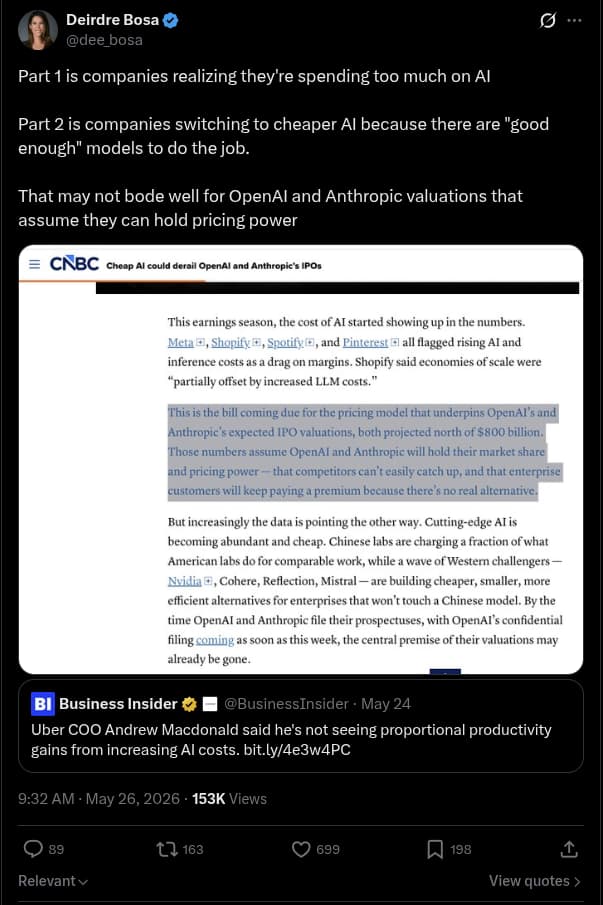
To summarize:
We have watched this arc play out quickly across Mintlify customers. So, what happens next?
If the spend doesn't show up in faster growth, better margins, reduced costs elsewhere in the business, or, ideally, in multiple categories, the final outcome is fairly predictable.
Here's how we think about our own spend at Mintlify, which is instructive for how we build, how we sell, and the value we deliver to our customers. The evaluation framework is simple. Credits map to well understood P&L categories: R&D, COGS, S&M (CAC), and Retention (NRR).
Token spend doesn't all go into one accounting bucket.
It's several costs doing fundamentally different jobs, and each one should be evaluated with a different ROI lens. The same way you wouldn't lump headcount, ad spend, and cloud infrastructure into one budget line, you shouldn't lump Credits together.
Credits should map to the P&L categories finance teams already understand.
Some Credits make your engineering team faster. Think usage spend on tools like Claude Code and Cursor.
In the Mintlify product suite, the equivalents are docs writing Agent and Workflows. Those products auto-document pull requests, sync changelogs, and keep your knowledge base current as the product changes underneath it.
On paper, this increases cost per engineer. In practice, it increases output per engineer. And unlike most developer tools, the returns compound. Every incremental improvement to your internal or external knowledge base makes every future query against it more accurate. A developer asking your docs a question in month six gets a better answer than the same question in month one, because the underlying content has been kept in sync automatically.
Measure it the way you'd measure any engineering productivity tool. Did documentation lag decrease? Are engineers spending less time writing and updating docs? Is the knowledge base more complete and more current than it was before? If yes, the Credits are ROI positive.
Some Credits serve your end users directly. When someone visits your documentation and asks the Mintlify Assistant a question, or when a customer files a support ticket and the Support Agent picks it up before a human does, that exchange costs Credits. This is the cost of delivering the product.
The ROI math here is the most straightforward of the four categories. If your customer's current cost per support interaction is $X, and the Assistant or Support Agent resolves the same question for a fraction of $X, the margin improvement is immediate and measurable. You're looking at deflection rate, cost per resolution compared to what you're paying for human support or an alternative solution today, and the gross margin impact over time.
This is where the value proposition is most concrete for support-heavy use cases. A help center powered by Mintlify's Assistant and Support Agent doesn't just reduce ticket volume. It shifts the cost structure from a variable, headcount-driven model to a predictable, Credits-driven one. For most companies, that's a better margin profile.
Some Credits acquire customers. This is the least obvious category and potentially the most valuable.
When a developer lands on your docs and asks the Mintlify Assistant a deep integration question, that interaction is a signal. It tells you that someone is actively evaluating your product, trying to understand whether it fits their use case, and engaging with your content at a level that suggests real intent.
The Assistant API extends this further. Companies plugging Mintlify's Assistant into their own tools can surface these high-intent interactions programmatically, route them to sales teams as product-qualified leads, or use them to trigger conversion flows for self-serve signups. The value of Credits generating pipeline and closed-won deals should not be overlooked.
Measure these Credits the way you'd measure any demand generation channel. Cost per lead, lead-to-opportunity conversion rate, CAC payback period. The difference is that unlike a paid ad or a sponsored event, the lead generation happens inside the product. The developer isn't being marketed to (which they famously hate). They're trying to solve a problem, and the Assistant is helping them do it.
Some Credits keep your existing customers from leaving. This is the category that most teams miss entirely.
When the Mintlify Assistant and Support Agent make self-service better for your customer's end users, those users file fewer support tickets. They find answers faster. They adopt, activate, and expand usage of your products and feature releases. They don't churn because of a bad onboarding experience or an unanswered question at 2am in a timezone your support team doesn't cover.
These Credits don't acquire a new customer. They don't deflect a support ticket from this quarter's COGS. They make the customer stickier. They improve NPS, reduce churn risk, and increase the likelihood of expansion. The ROI shows up in net revenue retention, not in this month's cost savings.
This is also where the compounding effect of the R&D Credits becomes visible downstream. The more accurate and current your knowledge base is (because Workflows kept it in sync), the better the Assistant performs for your end users. The better the Assistant performs, the more value your customer gets from the product. The more value they get, the more likely they are to renew and expand.
The problem with tracking Credits spend as a single number is that you lose the ability to make good decisions about it. You can't tell whether you're over-investing or under-investing because you don't know which Credits are generating value and which aren't. The goal shouldn't be to cap spend. It should be to leverage Credits to accelerate value creation.
The framework:
| P&L category | What the Credits do | Product surface | How to measure ROI |
|---|---|---|---|
| R&D | Keep docs accurate, automate engineering documentation | Workflows | Engineering hours saved, doc freshness, KB accuracy over time |
| COGS | Serve end-user queries, deflect support | Assistant, Support Agent | Cost per resolution vs. current, deflection rate, gross margin impact |
| S&M (CAC) | Generate PQLs, convert doc readers to signups | Assistant, Assistant API | Cost per lead, lead-to-opp rate, CAC payback |
| Retention (NRR) | Reduce friction, improve self-service, prevent churn | Assistant, Support Agent | NRR, churn rate, ticket volume, NPS |
Once you have this breakdown, evaluate each category with the ROI framework that already exists for it. R&D Credits get measured like dev tools. COGS Credits get measured like infrastructure. CAC Credits get measured like demand gen. Retention Credits get measured like customer success programs.
The math isn't new. The input is.
If you're evaluating Mintlify, don't start with "what does it cost?" Start with "where does the value land and do the unit economics make sense?"
Map your Credits usage to the four categories. Build a simple model for each one using the metrics your team already tracks. Then make the investment decision the same way you'd make any other: does the return in each category justify the spend?
For most companies we work with, the answer is yes in at least two categories and obviously yes in one. That's enough to justify the investment. The rest is upside.
If you need help, get in touch.
此内容由惯性聚合(RSS阅读器)自动聚合整理,仅供阅读参考。 原文来自 — 版权归原作者所有。