

惯性聚合 高效追踪和阅读你感兴趣的博客、新闻、科技资讯
阅读原文 在惯性聚合中打开

推荐订阅源

Y
Y Combinator Blog
GbyAI
GbyAI
U
Unit 42
WordPress大学
WordPress大学
Last Week in AI
Last Week in AI
P
Proofpoint News Feed
D
DataBreaches.Net
N
Netflix TechBlog - Medium
H
Hackread – Cybersecurity News, Data Breaches, AI and More
freeCodeCamp Programming Tutorials: Python, JavaScript, Git & More
C
Check Point Blog
Martin Fowler
Martin Fowler
月光博客
月光博客
MongoDB | Blog
MongoDB | Blog
MyScale Blog
MyScale Blog
The Cloudflare Blog
Apple Machine Learning Research
让小产品的独立变现更简单 - ezindie.com
M
MIT News - Artificial intelligence
云风的 BLOG
云风的 BLOG
罗磊的独立博客
B
Blog RSS Feed
J
Java Code Geeks
The GitHub Blog
The GitHub Blog

Mintlify Blog

22 UX improvements to the web editor Introducing the Mintlify Help Center Starter Kit Introducing the collaborative editor built for teams and agents Workflows, rebuilt Is your documentation agent-ready? Mintlify raises $45M Series B led by Andreessen Horowitz and Salesforce Ventures 5 things you didn't know you could do in the Mintlify web editor The improved Mintlify CLI The state of agent traffic in documentation (March 2026) How we built a virtual filesystem for our Assistant We Replaced Our Internal Wiki With a Slack Bot. You Should Too. 8 ways teams use Mintlify to keep docs updated automatically Documentation is your AI interface What three years of watching AI in production taught us Bridging two JSX runtimes: How we solved Astro's React children problem AI agents are shipping faster than anyone can document Knowledge management systems for technical teams Workflows: Automate documentation maintenance Mintlify acquires Helicone to redefine AI knowledge infrastructure Why more product managers are switching to Mintlify Auto-generating documentation sites from GitHub repos Your docs, your frontend, our content engine Take control of your documentation system Almost half your docs traffic is AI, time to understand the agent experience @mintlify for better docs, faster Mintlify for Enterprise Real llms.txt examples from leading tech companies (and what they got right) Mintlify + Claude Opus 4.6: Powering AI-native knowledge management Declaring Clankruptcy: An experiment in agent orchestration Analytics for AI and agent traffic
Docs on autopilot: From zero to self-maintaining with Min...
Peri Langlois · 2026-04-03 · via Mintlify Blog

Docs go stale and nobody can keep up. Your engineering team ships a feature, nobody updates the docs, and three weeks later a user opens an issue asking why the API reference doesn't match the actual behavior. The people who know the code best don't have time to write about it, and the people responsible for docs are always playing catch-up.

We built workflows to make documentation maintain itself, and with auto-generated docs from Mintlify you can eliminate the blank page problem entirely. Together, they turn documentation from a thing that's always behind into something that runs on its own.

Every merged PR is a potential source of drift between what your docs say and what your code does. Workflows fix this by letting you define recurring agent tasks that watch your codebase and update your docs automatically.
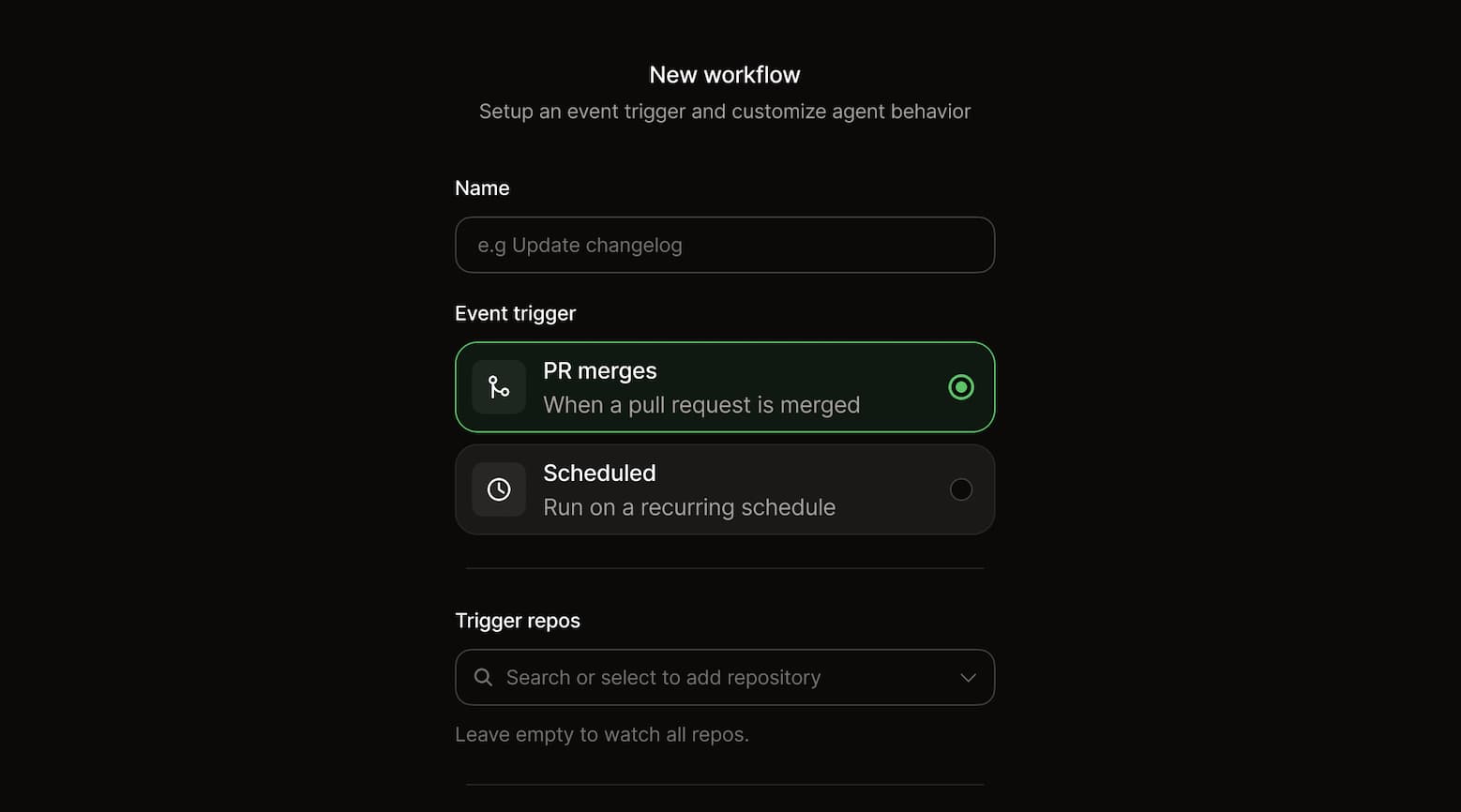
Workflow creation in the dashboard

When the trigger occurs, the Mintlify agent clones the relevant repos for context, follows your prompt, and either opens a pull request or pushes changes directly to your docs.

Some common setups:

  • Sync docs on every push. When code merges to main, the agent reads the diff, identifies what changed, and updates the corresponding docs pages.
  • Auto-generate changelogs. After each release, the agent compiles merged PRs into a changelog entry with the right formatting and context.
  • Scheduled audits. Run a weekly review that checks for broken links, outdated code examples, or pages that reference deprecated features.
  • Draft docs for new features. When a PR adds a new endpoint or module, the agent generates a first-draft docs page so it's ready to review alongside the code.

Workflows keep docs accurate, but what if you don't have docs to begin with?

Some teams that come to us aren't dealing with stale docs, they have no docs at all. The codebase exists, the APIs work, users are integrating, but nobody has had time to write documentation from scratch. Starting feels like a project that will take weeks.

Mintlify can generate a complete docs site directly from your GitHub repo. The flow is simple: swap github.com for mintlify.com in your repo URL, and Mintlify reads your codebase to produce structured docs, including API references, getting-started guides, and configuration pages.

# Before
https://github.com/your-org/your-repo

# After
https://mintlify.com/your-org/your-repo

You get a publishable docs site that reflects what your code actually does today.

Here are a few repos where you can see what auto-generated docs look like:

  • facebook/react - The library for web and native user interfaces. 243k stars on GitHub.
  • microsoft/vscode - Visual Studio Code. 182k stars.
  • n8n-io/n8n - Fair-code workflow automation platform with native AI capabilities. 176k stars.
  • anomalyco/opencode - The open source coding agent. 108k stars.
  • expo/expo - Open-source framework for making universal native apps with React. 47.4k stars.
  • ghostty-org/ghostty - A fast, cross-platform terminal emulator built in Zig. 44.2k stars.

Browse more at mintlify.com/explore.

The full loop: generate, then maintain

The real power is in combining both. Here's what the end-to-end flow looks like:

  1. Generate your docs from code. Swap github.com for mintlify.com and get your initial docs site generated automatically from your repo.
  2. Review and publish. You get a v1 that's structurally sound and reflects your actual codebase. Make any tweaks you want, then ship it.
  3. Set up workflows. Create workflows that define how your docs should stay in sync. Common starting points: sync on push, changelog generation, and weekly audits.
  4. Ship features, not docs. From here, every code change that affects documentation gets handled automatically. The agent opens PRs, you review and merge.

Your docs go from nonexistent to self-maintaining in a single setup session.

This works for teams at every stage, but you'll get different benefits depending on where you are:

If you have no docs at all: Auto-generated docs are the fastest path to a real documentation site. Founders, side projects, and teams that have been shipping without docs can go from zero to published in minutes. No writing, no setup beyond connecting a repo.

If your docs exist but drift: Workflows catch the drift before your users do. Every push to main triggers a review. Every release gets a changelog. The docs stay accurate without anyone remembering to update them.

If you want docs that scale with your engineering velocity: The combination means your documentation throughput scales with your shipping speed. Every change gets a docs update so nothing falls through the cracks.

Try it now by visiting mintlify.com and connecting a repo. Once your docs are generated, add your first workflow by following the Workflows guide.

Your codebase already contains everything your docs need. Let it write them.