



Replit is one of the hottest AI startups for creating and deploying AI applications.
In the past six months, they've 10x'd their ARR and crossed $100M. With that kind of scale, the team had to confront a familiar but urgent challenge: how to help users succeed in parallel with their rapid product development.
So Replit completely overhauled their documentation—rewriting nearly every page, rethinking the architecture, and introducing automations to maintain quality as they scaled.
We sat down with Matt Palmer, who leads Developer Relations at Replit, to learn how the team approached the overhaul and what systems they put in place to make documentation a durable extension of the product.
In the fall of 2024, Replit made a major pivot towards AI with the launch of Agent.
The problem? Their documentation was built for professional developers in a pre-AI world—not for the new wave of vibe coders and AI agents.
As a YC W18 company, Replit had years of carefully crafted docs that suddenly felt dated. Most documentation was written for a much different audience, one before vibe coding and agents.
A significant amount of docs debt was introduced overnight. But the velocity of AI also made it hard to prioritize incremental docs improvements.
Eventually, the team made a call: rather than patching around the edges, it was time to start fresh.
Replit kicked off a full rebuild. They brought on full-time resources and partnered closely with engineering to prioritize the highest-leverage pages.
“We started by looking at the funnel. What's the first thing someone sees? If they land on the docs and can't immediately answer 'What is Replit?', that's a failure.”
The “Getting started” flow and core concepts came first, followed by quickstarts, product tutorials, and eventually longer-tail features like billing and trust settings.
Not everything needed to be done at once, but the most visible surfaces had to be right.
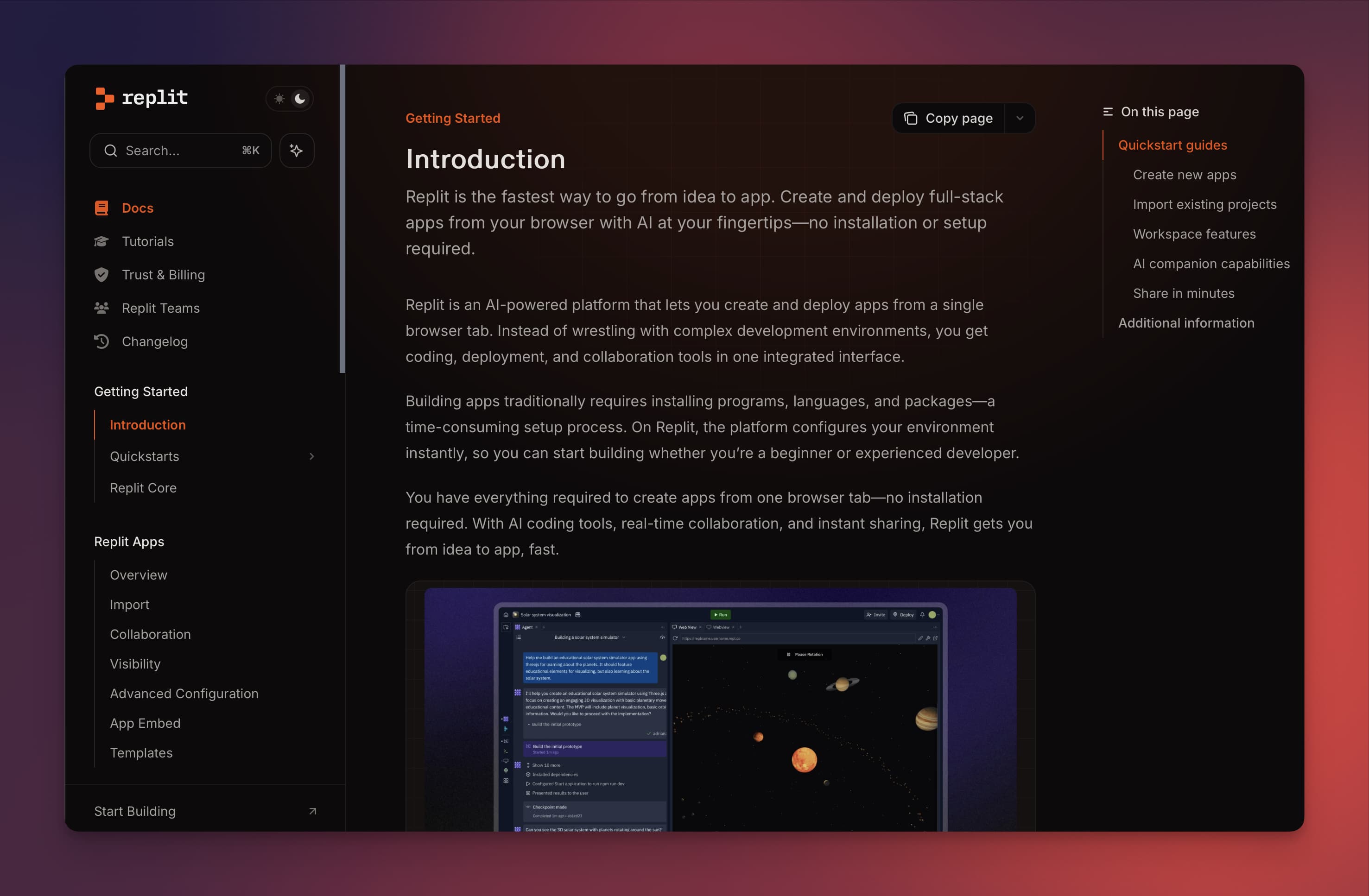
Replit's documentation after a complete refresh with Mintlify
One of the biggest challenges wasn't just updating content, it was figuring out how to make the docs navigable and discoverable.
Over the years, content had accumulated organically, but not in a clear mental model that matched the user journey.
In the overhaul, the team made a deliberate decision to organize docs based on content type, such as separating out tutorials vs. reference material.
“It sounds simple, but writing based on user intent makes a huge difference in how they can find and process the right information.”
That decision mirrors the structure of the Diátaxis framework, a common approach to organizing docs. If you're unfamiliar with it, here's a quick primer.
The Diátaxis framework is a simple but powerful way to structure documentation based on user intent. It breaks content into four types, each serving a different purpose:
Defining content types upfront makes it easier to plan, write, and maintain docs. It ensures each page has a clear purpose and helps users find the right information based on where they are in their journey.
For more information about Diataxis and content types, check out our technical writing guide.
A successful overhaul isn't just about what gets rewritten, it's about maintaining quality over time.
To prevent docs from going stale again, Matt put guardrails in place:
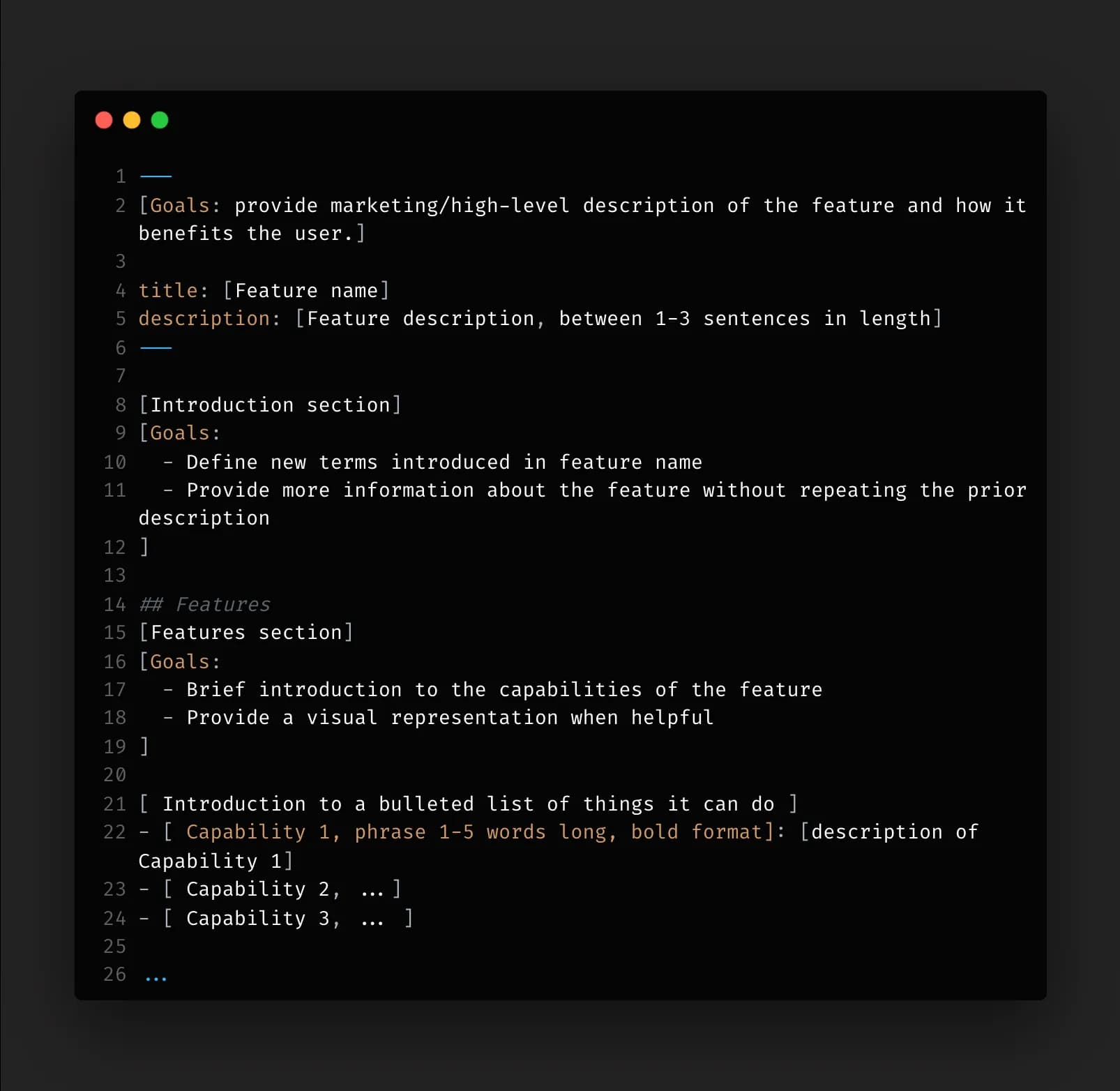
Template that lives inside Replit's docs repo
These systems reduce overhead across the board—making it faster to update docs, easier to enforce consistency, and less dependent on any one person to maintain quality over time.
Beyond infrastructure, Matt and his team embrace AI tooling to speed up writing.
“If we're moving towards a world where AI can write 80% of the scaffolding, how do we make it as easy as possible to integrate AI into our documentation process?”
The key, he says, is writing documentation for your documentation.
Replit maintains internal Markdown files for:
Those files act as promptable context. With vibe coding AI tools, Matt can feed in a spec and generate a strong first draft that matches Replit's style and voice.
Once the initial draft is generated, editing becomes more about polish and accuracy than building from scratch. It saves time, creates consistency, and enables anyone to move faster.
“We're moving toward a world where AI writes the draft, and humans can focus on brand voice, content, and polish.”
One of the most impactful wins wasn't about writing better docs; it was about writing less of them.
Replit's changelogs are now largely automated. Engineers share their work in Slack, and those updates are aggregated weekly by an internal LLM-powered workflow that generates a draft PR. Screenshots, embeds, and changelog copy are included out of the box.
“Changelogs are 90% automated. I just ensure updates match our brand and push them live. That published content flows into our docs, social channels, and monthly updates.”
By automating the tedious work, Matt frees up time to focus on higher-leverage initiatives like content strategy, proactive education, and product tutorials.
The best docs are up-to-date docs, but staying current takes more than good intentions. It needs infrastructure, ownership, and above all, team participation.
“Docs aren't a one-and-done project. They need to evolve with the product, and that means making it easy for everyone to contribute.”
Partnering with Mintlify made that collaboration significantly easier. With git sync, preview deployments for staging changes, and a WYSIWYG editing experience, contributors across engineering, product, and marketing can all work in the same system without bottlenecks.
“Docs used to feel brittle—like if you touched them, something might break. Now, with Mintlify and the systems we've built around it, contributing is safe and fast for anyone on the team.”
By combining thoughtful architecture, automation, and AI, Replit has turned their docs into a scalable support system that helps users succeed faster.
Inspired to level up your own systems? Get in touch with one of Mintlify's documentation experts.
—
Follow along Matt's journey on LinkedIn, X, or YouTube.
此内容由惯性聚合(RSS阅读器)自动聚合整理,仅供阅读参考。 原文来自 — 版权归原作者所有。