
惯性聚合 高效追踪和阅读你感兴趣的博客、新闻、科技资讯
阅读原文 在惯性聚合中打开

推荐订阅源

Attack and Defense Labs
N
News and Events Feed by Topic
L
LINUX DO - 热门话题
PCI Perspectives
PCI Perspectives
www.infosecurity-magazine.com
爱范儿
爱范儿
D
DataBreaches.Net
Simon Willison's Weblog
S
Secure Thoughts
S
SegmentFault 最新的问题
博客园 - 【当耐特】
钛媒体:引领未来商业与生活新知
钛媒体:引领未来商业与生活新知
博客园 - 叶小钗
P
Proofpoint News Feed
The Hacker News
The Hacker News
T
ThreatConnect
N
News and Events Feed by Topic
T
Threatpost
The Register - Security
WordPress大学
WordPress大学
博客园 - Franky
Recorded Future
Recorded Future
Threat Intelligence Blog | Flashpoint
Project Zero
Project Zero
大猫的无限游戏
大猫的无限游戏
freeCodeCamp Programming Tutorials: Python, JavaScript, Git & More
cs.CV updates on arXiv.org
罗磊的独立博客
Stack Overflow Blog
Stack Overflow Blog
腾讯CDC
F
Future of Privacy Forum
F
Full Disclosure
Cyberwarzone
Cyberwarzone
J
Java Code Geeks
李成银的技术随笔
Schneier on Security
Know Your Adversary
Know Your Adversary
H
Hacker News: Front Page
人人都是产品经理
人人都是产品经理
博客园_首页
Scott Helme
Scott Helme
Google DeepMind News
美团技术团队
Malwarebytes
Malwarebytes
Last Week in AI
Last Week in AI
T
Tailwind CSS Blog
T
The Exploit Database - CXSecurity.com
G
GRAHAM CLULEY
Recent Announcements
C
CXSECURITY Database RSS Feed - CXSecurity.com

CSS-Tricks

Revealing Text With CSS letter-spacing | CSS-Tricks Technical Writing in the AI Age | CSS-Tricks Cross-Document View Transitions: Scaling Across Hundreds of Elements | CSS-Tricks Cross-Document View Transitions: Scaling Across Hundreds of Elements | CSS-Tricks The State of CSS Centering in 2026 | CSS-Tricks Stack Overflow: When We Stop Asking | CSS-Tricks Cross-Document View Transitions: The Gotchas Nobody Mentions | CSS-Tricks What’s !important #11: 3D Voxel Scenes, Flying Focus, CSS Syntaxes, and More | CSS-Tricks Computing and Displaying Discounted Prices in CSS | CSS-Tricks rotateX() | CSS-Tricks rotateY() | CSS-Tricks rotateZ() | CSS-Tricks rotate() | CSS-Tricks Soon We Can Finally Banish JavaScript to the ShadowRealm | CSS-Tricks Using CSS corner-shape For Folded Corners | CSS-Tricks A Scrollytelling Gift for Mum on Mother’s Day 2026 | CSS-Tricks Google’s Prompt API | CSS-Tricks Making Zigzag CSS Layouts With a Grid + Transform Trick | CSS-Tricks Fixed-Height Cards: More Fragile Than They Look | CSS-Tricks What’s !important #10: HTML-in-Canvas, Hex Maps, E-ink Optimization, and More | CSS-Tricks The Importance of Native Randomness in CSS | CSS-Tricks contrast() | CSS-Tricks contrast-color() | CSS-Tricks Let’s Use the Nonexistent ::nth-letter Selector Now | CSS-Tricks Quick Hit #126 Recreating Apple’s Vision Pro Animation in CSS | CSS-Tricks Quick Hit #125 Enhancing Astro With a Markdown Component | CSS-Tricks Quick Hit #124 Markdown + Astro = ❤️ | CSS-Tricks Quick Hit #123 What’s !important #9: clip-path Jigsaws, View Transitions Toolkit, Name-only Containers, and More | CSS-Tricks A Well-Designed JavaScript Module System is Your First Architecture Decision | CSS-Tricks hypot() | CSS-Tricks The Radio State Machine | CSS-Tricks 7 View Transitions Recipes to Try | CSS-Tricks Quick Hit #122 Quick Hit #121 Selecting a Date Range in CSS | CSS-Tricks saturate() | CSS-Tricks justify-self | CSS-Tricks Quick Hit #120 Alternatives to the !important Keyword | CSS-Tricks Quick Hit #119 New CSS Multi-Column Layout Features in Chrome | CSS-Tricks Quick Hit #118 Making Complex CSS Shapes Using shape() | CSS-Tricks Quick Hit #117 Front-End Fools: Top 10 April Fools’ UI Pranks of All Time | CSS-Tricks Sniffing Out the CSS Olfactive API | CSS-Tricks What’s !important #8: Light/Dark Favicons, @mixin, object-view-box, and More | CSS-Tricks Quick Hit #116 Form Automation Tips for Happier User and Clients | CSS-Tricks Quick Hit #115 Generative UI Notes | CSS-Tricks Quick Hit #114 Quick Hit #113 Experimenting With Scroll-Driven corner-shape Animations | CSS-Tricks Quick Hit #112 JavaScript for Everyone: Destructuring | CSS-Tricks Quick Hit #111 Quick Hit #110 What’s !important #7: random(), Folded Corners, Anchored Container Queries, and More | CSS-Tricks 4 Reasons That Make Tailwind Great for Building Layouts | CSS-Tricks Quick Hit #109 Quick Hit #108 Abusing Customizable Selects | CSS-Tricks Quick Hit #107 The Value of z-index | CSS-Tricks Quick Hit #106 The Different Ways to Select <html> in CSS Quick Hit #105 Popover API or Dialog API: Which to Choose? Quick Hit #104 What’s !important #6: :heading, border-shape, Truncating Text From the Middle, and More Yet Another Way to Center an (Absolute) Element An Exploit ... in CSS?! Quick Hit #103 A Complete Guide to Bookmarklets Quick Hit #102 Loading Smarter: SVG vs. Raster Loaders in Modern Web Design Potentially Coming to a Browser :near() You Quick Hit #101 Distinguishing "Components" and "Utilities" in Tailwind Quick Hit #100 Spiral Scrollytelling in CSS With sibling-index() Interop 2026 Quick Hit #99 What’s !important #5: Lazy-loading iframes, Repeating corner-shape Backgrounds, and More Quick Hit #98 Making a Responsive Pyramidal Grid With Modern CSS Approximating contrast-color() With Other CSS Features Quick Hit #97 Trying to Make the Perfect Pie Chart in CSS Quick Hit #96 Quick Hit #95 CSS Bar Charts Using Modern Functions Quick Hit #94 No Hassle Visual Code Theming: Publishing an Extension Quick Hit #93
In Defense of a Fussy Website
CSS-Tricks · 2020-06-27 · via CSS-Tricks

The other day I was doom-scrolling twitter, and I saw a delightful article titled “The Case for Fussy Breakfasts.” I love food and especially breakfast, and since the pandemic hit I’ve been using my breaks in between meetings (or sometimes on meetings, shh) to make a full bacon, poached egg, vegetable plate, so I really got into the article. This small joy of creating a bit of space for myself for the most important meal of the day has been meaningful to me — while everything else feels out of control, indulging in some ceremony has done a tiny part to offset the intensity of our collective situation.

It caused me to think of this “fussiness” as applied to other inconsequential joys. A walk. A bath. What about programming?

While we’re all laser-focused on shipping the newest feature with the hottest software and the best Lighthouse scores, I’ve been missing a bit of the joy on the web. Apps are currently conveying little care for UX, guidance, richness, and — well, for humans trying to communicate through a computer, we’re certainly bending a lot to… the computer.

I’m getting a little tired of the web being seen as a mere document reader, and though I do love me a healthy lighthouse score, some of these point matrixes seem to live and die more by our developer ego in this gamification than actually considering what we can do without incurring much weight. SVGs can be very small while still being impactful. Some effects are tiny bits of CSS. JS animations can be lazy-loaded. You can even dazzle with words, color, and layout if you’re willing to be a bit adventurous, no weight at all!
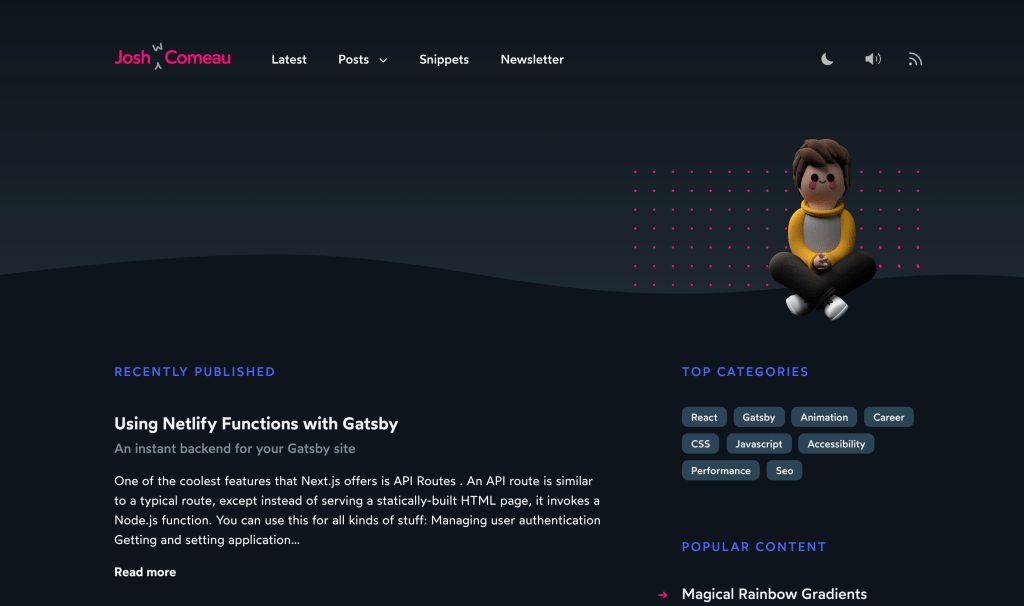
A few of my favorite developer sites lately have been Josh Comeau, Johnson Ogwuru and Cassie Evans. The small delights and touches, the little a-ha moments, make me STAY. I wander around the site, exploring, learning, feeling actually more connected to each of these humans rather than as if I’m glancing at a PDF of their resume. They flex their muscles, show me the pride they have in building things, and it intrigues me! These small bits are more than the fluff that many portray any “excess” as: they do the job that the web is intending. We are communicating using this tool- the computer- as an extension of ourselves.

Nuance can be challenging. It’s easy as programmers to get stuck in absolutes, and one of these of late has been that if you’re having any bit of fun, any bit of style, that must mean it’s “not useful.” Honestly, I’d make the case that the opposite is true. Emotions attach to the limbic system, making memories easier to recall. If your site is a flat bit of text, how will anyone remember it?

Don’t you want to build the site that teams in companies the world over remember and cite as an inspiration? I’ve been at four different companies where people have mentioned Stripe as a site they would aspire to be like. Stripe took chances. Stripe told stories. Stripe engaged the imagination of developers, spoke directly to us.

I’m sad acknowledging the irony that after thinking about how spot on Stripe was, most of those companies ignored much of what they learned while exploring it. Any creativity, risk, and intention was slowly, piece by piece, chipped away by the drumbeat of “usefulness,” missing the forest for the trees.

When a site is done with care and excitement you can tell. You feel it as you visit, the hum of intention. The craft, the cohesiveness, the attention to detail is obvious. And in turn, you meet them halfway. These are the sites with the low bounce rates, the best engagement metrics, the ones where they get questions like “can I contribute?” No gimmicks needed.

What if you don’t have the time? Of course, we all have to get things over the line. Perhaps a challenge: what small thing can you incorporate that someone might notice? Can you start with a single detail? I didn’t start with a poached egg in my breakfast, one day I made a goofy scrambled one. It went on from there. Can you challenge yourself to learn one small new technique? Can you outsource one graphic? Can you introduce a tiny easter egg? Say something just a little differently from the typical corporate lingo?

If something is meaningful to you, the audience you’ll gather will likely be the folks that find it meaningful, too.