




惯性聚合 高效追踪和阅读你感兴趣的博客、新闻、科技资讯
阅读原文 在惯性聚合中打开

推荐订阅源

T
Tailwind CSS Blog
S
Secure Thoughts
D
Darknet – Hacking Tools, Hacker News & Cyber Security
T
Tor Project blog
T
Tenable Blog
Know Your Adversary
Know Your Adversary
Webroot Blog
Webroot Blog
V
Vulnerabilities – Threatpost
WordPress大学
WordPress大学
S
Security @ Cisco Blogs
J
Java Code Geeks
S
SegmentFault 最新的问题
A
Arctic Wolf
Simon Willison's Weblog
T
Threatpost
Forbes - Security
Forbes - Security
爱范儿
爱范儿
T
The Blog of Author Tim Ferriss
S
Securelist
MongoDB | Blog
MongoDB | Blog
酷 壳 – CoolShell
酷 壳 – CoolShell
cs.CV updates on arXiv.org
月光博客
月光博客
Blog — PlanetScale
Blog — PlanetScale
博客园 - 【当耐特】
cs.CL updates on arXiv.org
SecWiki News
SecWiki News
aimingoo的专栏
aimingoo的专栏
腾讯CDC
U
Unit 42
Google DeepMind News
奇客Solidot–传递最新科技情报
奇客Solidot–传递最新科技情报
大猫的无限游戏
大猫的无限游戏
Latest news
Latest news
I
InfoQ
V2EX - 技术
V2EX - 技术
The Cloudflare Blog
V
V2EX
The Register - Security
博客园 - Franky
Security Archives - TechRepublic
Security Latest
Security Latest
OSCHINA 社区最新新闻
OSCHINA 社区最新新闻
云风的 BLOG
云风的 BLOG
Jina AI
Jina AI
Microsoft Security Blog
小众软件
小众软件
N
Netflix TechBlog - Medium
量子位
M
MIT News - Artificial intelligence

Show HN

GitHub - villagesql/villagesql-skills: Agent skills for VillageSQL - gemini-cli-extension; claude-code-plugin GitHub - flightdeckhq/flightdeck: Observability and control plane for AI agents. CSP Radar GitHub - Light-Heart-Labs/DreamServer: Turn your PC, Mac, or Linux box into an AI server. LLM inference, chat UI, voice, agents, workflows, RAG, and image generation. GitHub - Diplomat-ai/diplomat-agent-ts: What can your TypeScript AI agent do to the real world? Scan your code. See which tool calls have zero checks Code Block Selector - Visual Studio Marketplace Prometheus dependency graph — interactive showcase | Riftmap Show HN: I made a vi-like modal keyboard plugin for Figma GitHub - run-llama/liteparse: A fast, helpful, and open-source document parser GitHub - dalemyers/Roar: A macOS CLI tool for notifications GitHub - district-solutions/open-agent-tools-coder: Enables small-to-large self-hosted ai models to use local source code when running tool-calling agentic workloads. We actively data mine 20,900+ (2+ TB) popular github repos using large and small ai models to create reuseable: json, markdown and parquet files for local-first tool-calling models. GitHub - progapandist/stripeek: A local TUI proxy for real-time Stripe API debugging, built for navigating complex payloads fast. GitHub - sir1st/hermes-desktop: All-in-one cross-platform desktop app for Hermes Agent — bundles Python + hermes-agent + hermes-web-ui GitHub - astefanutti/shaderbang: Shebang for Shaders Show HN: Generate Claude Code Workflows using Spec Driven Development approach GitHub - nixys/nxs-universal-chart: The Helm chart you can use to install any of your applications into Kubernetes/OpenShift Show HN: AI agents for UK GDAD PCF roles and their skills The Two Pillars: Mixer Mode and Meta-Software in the Reorganization of Software Work After AI GitHub - JaiCode08/teleport-env What 1,000+ Harness Experiments Taught Me About Self-Improving Agents Show HN: Liiists, a Markdown-first, iOS and CLI list app SwiperTab – Get this Extension for 🦊 Firefox (en-US) GitHub - kouhxp/fftext: Summarize, explain, fact-check, or translate any text, URL, or file. No GPU. No cloud. One command GitHub - sweetpad-dev/sweetpad: Develop Swift/iOS projects using VSCode GitHub - dogmaticdev/IRON: IRON a.k.a. Intermediate Representation Object Notation is a Interpreter/Database that is used to create Programming Languages. GitHub - sjhalani7/vaen: Package your AI coding harness into a portable .agent file, and share it across repos, teams, & the community without ever having to copy-paste instructions, skills, MCP config, or secrets. Show HN: Gandalf the Grader Show HN: Citadeld – replay any CI failure locally from a single file GitHub - tdortman/cuSBF: High-Performance GPU Super Bloom Filter coral-ai/claude-code-token-xray at main · Coral-Bricks-AI/coral-ai GitHub - ulyssestenn/funes: Funes is a Git-based framework for LLM-managed knowledge work: an AI Librarian ingests raw sources, builds an interlinked Markdown knowledge base, and uses it to produce cited reports, analyses, and other outputs. GitHub - ThatXliner/gah: Git Add Hunk, built for agents to use GitHub - harmont-dev/harmont-cli: Command-line client for the Harmont CI platform GitHub - brooksmcmillin/mcp-authflow: OAuth 2.0 Authorization Server framework for MCP servers GitHub - javaid-codes/audit-supply-chain-agents GitHub - amorey/gochan: A small library of common channel architectures for Go, inspired by Rust GitHub - arifozgun/OpenGem: Free, Open-Source AI API Gateway with Gemini, OpenAI & Anthropic Compatibility in 1 file GitHub - Pranesh950/BioPetals: 🌸 Run BIOxAI models at home, BitTorrent-style. Fine-tuning and inference up to 10x faster than offloading GitHub - cnguyen14/bounty-doctor: Diagnose a GitHub bounty issue before you waste hours: detects honeypot scam repos, AI-bot attempt swarms, and stale contests. Show HN: CoreMCP – MCP Server for On-Prem DBs Show HN: KittyHTML – Render HTML/CSS as an inline image in your terminal GitHub - bingud/filemat: Web-based file manager Show HN: TruthLens – Free multi-signal deepfake image detector GitHub - apexlocal-jz/claude-usage-tray: Windows system-tray app showing your Claude Code rate-limit usage at a glance. Zero deps, ~300 lines of PowerShell. Cross-IDE (works regardless of VS Code, Cursor, plain terminal). Release v0.1.2.1 · kouhxp/yapsnap GitHub - noopolis/moltnet: Self-hostable chat network for AI agents. Pre-built bridges for Claude Code, Codex, and the Claws. Rooms, DMs, history. No Slack bots, no Matrix, no glue code. GitHub - tamerh/enju: Coordinating Humans, AI Agents, and Compute as Peers on a Shared Workflow Graph Show HN: Continuity-auth – Respect-weighted rate limits for the open web GitHub - luml-ai/luml: AI lifecycle platform where engineers and agents track experiments, train models, and ship to production. GitHub - mrdanielcasper/CoreTex: A UNIX-inspired, biomimetic, flat-file AI harness and knowledge engine. GitHub - clemg/pierre-github: Pierre's diffs.com and trees.software for Github GitHub - lyriks-io/unspaghettit: Behavior-driven AI development without prompt spaghetti. GitHub - sofumel/claude-handoff-revive: Resume Claude Code work after rate/usage/context limits without replaying the prior transcript. Auto-saves at 90%/95% usage. Plugin-installable, 10 languages. GitHub - dotexorg/saferpc: Typed, end-to-end encrypted RPC over any bidirectional channel. GitHub - BeeZeeAgent/beezee: Agent harness orchestration Legato Next.js Boilerplate for Internal Tools · CoreUI GitHub - clark-labs-inc/clark-hash: Clark Hash, 32x smaller searchable sketches for embeddings GitHub - ZeroPointRepo/youtube-mcp: The fastest YouTube transcript + YouTube search MCP for AI agents. Try for free. Typing Mastery — climb toward 100+ WPM, deliberately GitHub - Andebugulin/Awareen GitHub - fayzan123/claude-workflow-composer: Visual desktop app for composing multi-agent coding workflows. Drag agents, attach skills and MCPs, wire handoffs, export to .claude/ GitHub - harshaneel/humanize: Best static AI text humanizer. Two research-grounded skills that work in any LLM (Claude, ChatGPT, Gemini, Codex): humanize beats perplexity-based detectors, ai-check produces forensic scoring with evidence-quoted flags. Nine levers, 50+ peer-reviewed sources, 2024-2026 detection literature. GitHub - StackOneHQ/stack-nudge GitHub - nodes-app/swift-markdown-engine: A native AppKit Markdown editor for macOS, built on TextKit 2 and bridged to SwiftUI. We hardened an LLM agent. Each defense we added made it more exploitable. GitHub - alkait/WhatsKept: Agent-queryable WhatsApp history from an iOS backup — a single Go binary. GitHub - octelium/cordium: Open-source, general-purpose sandbox platform for devs and AI agents that provides identity-based secure access to infrastructure without credentials. WAR.GOV/UFO Microfilm5 GitHub - scosman/videowright: Build animated explainer videos with your coding agent GitHub - dipankar/dscode: The code editor you can take apart. GitHub - zoharbabin/web-researcher-mcp: MCP server (Go) for AI assistants: web search, content extraction, academic/patent/news research. Multi-provider routing, 4-tier scraping, search lenses. Works with Claude, Cursor, and any MCP client. GitHub - ruvnet/RuView: π RuView turns commodity WiFi signals into real-time spatial intelligence, vital sign monitoring, and presence detection — all without a single pixel of video. GitHub - scanaislop/aislop: Catch the slop AI coding agents leave in your code: narrative comments, swallowed exceptions, as-any casts, dead code, oversized functions. 50+ rules across 7 languages (TypeScript, JavaScript, Python, Go, Rust, Ruby, PHP). Sub-second, deterministic, no LLM at runtime. MIT-licensed. GitHub - kouhxp/cheap-im: CPU-only voice agent approximating Thinking Machines' Interaction Models demo GitHub - unprovable/OrchidMantis: Orchid Mantis — standalone framework for Zero-Knowledge Proofs of eXploit (ZKPoX). GitHub - MarcellM01/TinySearch: Shrink the web for your local LLMs! GitHub - TangibleResearch/Halgorithem: A Algo designed to detect AI Hallucitions GitHub - DO-SAY-GO/freelang: I love freelang GitHub - CarpseDeam/Aura-IDE: An AI coding harness that shaped itself - Planner/Worker agents, repo awareness, surgical edits, validation, recovery, and safe diff approvals. GitHub - chojs23/concord: A feature-rich TUI client for Discord GitHub - tommyjepsen/awesome-ux-skills: UX & AI Product designs skills you can use today in Claude Code GitHub - aerf-spec/aerf: Agent Evidence Receipt Format (AERF) — an open specification for tamper-evident, independently verifiable records of AI agent actions. GitHub - kklimuk/docx-cli: CLI for AI agents (Claude, Codex) to read, edit, and comment on .docx files with full format fidelity. GitHub - Jwrede/tokentoll: Catch LLM cost changes in code review. Infracost for LLM spend. GitHub - samchon/ttsc: A `typescript-go` toolchain for compiler-powered plugins and type-safe execution + 500x faster lint integrated into compiler GitHub - Higangssh/homebutler: 🏠 Manage your homelab from chat. Single binary, zero dependencies. GitHub - olalie/tapmap: See where your computer connects and what stands out on a live world map. GitHub - matisiekpl/neond: DX-focused control plane for Postgres dedicated to non-critical workloads. Your postgres:latest replacement 🐘 GitHub - Diplomat-ai/diplomat-agent: What can your AI agent do to the real world? Scan your code. See which tool calls have zero checks GitHub - Bajusz15/beacon: Open-source agent for secure remote access, monitoring, and deploys across home-lab and self-hosted machines like Raspberry Pi, N100, or any Linux server. Open web based TTY or tunnel Home Assistant and other local services securely without opening ports. BigTech AI News - Chrome 应用商店 GitHub - vinhnx/VTCode: VT Code is an open-source coding agent with LLM-native code understanding and robust shell safety. Supports multiple LLM providers with automatic failover and efficient context management. GitHub - michaelaz774/decision-engine: A decision operating system for startup founders, powered by Claude Code. Synthesizes wisdom from 25+ legendary founders and investors into interactive AI-driven decision frameworks. GitHub - Chrilleweb/dotenv-diff: Validate environment variable usage in your codebase GitHub - Lumen-Labs/brainapi2: BrainAPI is a knowledge graph–powered AI memory layer that transforms unstructured data into structured knowledge, enabling intelligent search, recommendations, and contextual memory for AI agents and applications. GitHub - familiar-software/familiar: Let AI watch you work. Familiar lets your AI update its memory, skills, and knowledge by watching your screen. GitHub - skorotkiewicz/rudo: A small, elegant dock for Wayland GitHub - muxshed/shed: One stream in, or many. Every destination, simultaneously. No cloud middleman, no per-channel fees, no limits. make sidebar/address bar rounded corner toggleable
GitHub - theramkm/dspyer: A transpiler from stateful imperative workflows to declarative DSPy programs
ramkm · 2026-06-25 · via Show HN

Reliable, optimizable LLM steps with zero DSPy boilerplate: typed outputs, automatic self-correction, and one-call prompt tuning.

CI Build Documentation Python 3.10-3.14 Open in Colab


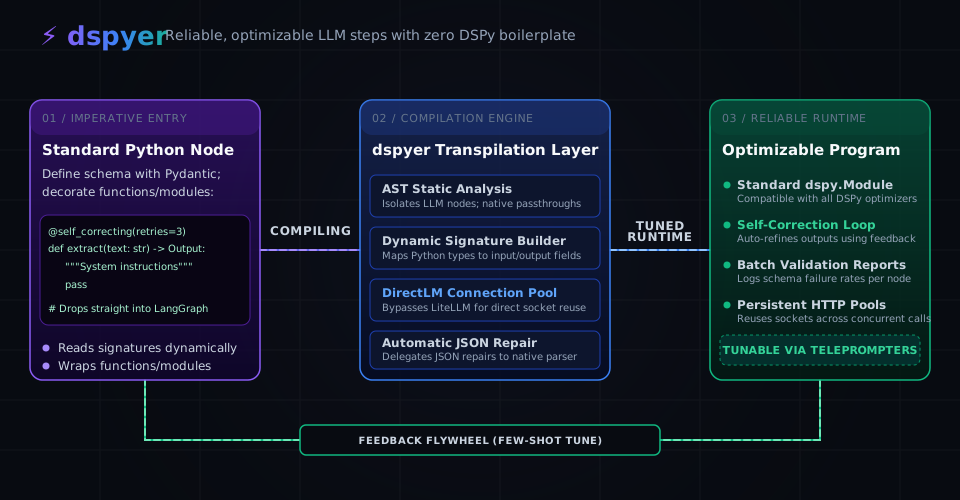
dspyer Architecture Flow


Why dspyer?

If you are building production agents with LangChain, LangGraph, or custom LLM API loops, you face three primary challenges:

  1. Prompt Decay: When you upgrade models (e.g., from GPT-4o to Claude 3.5 Sonnet), your carefully engineered prompt strings fail. They need manual, tedious re-tuning.
  2. Brittle Validations: You write verbose try/except loops and custom logic to catch malformed JSON and missing fields from the LLM.
  3. No Systematic Tuning: There is no simple way to optimize prompts programmatically or automatically select the best few-shot exemplars for your specific tasks.

Stanford DSPy solves this by treating prompts as parameters that can be compiled and optimized against a dataset. However, adopting DSPy directly requires learning a complex new syntax (Signatures, Predictors, Modules) and rewriting your entire codebase.

dspyer acts as an ergonomic bridge: it transpiles standard Python functions, Pydantic schemas, and agent graphs into optimized dspy.Module instances under the hood, allowing you to drop them straight back into your existing orchestrator. You write standard, PEP 484 type-hinted Python functions; dspyer compiles them into optimizable dspy.Module objects you can hand to any DSPy teleprompter.


Key Benefits

  • No vendor lock-in: Compiles to a standard dspy.Module; use any DSPy optimizer and dspy.save/load.
  • Self-correction loops: Failed Pydantic validation auto-generates feedback and re-queries the model until it conforms.
  • Telemetry and validation reports: OpenTelemetry spans plus per-node failure summaries.
  • Dataset flywheel: Successful self-corrections are logged as input/output pairs you can replay as a trainset.
  • DirectLM runtime: Bypasses LiteLLM with persistent pooled HTTP connections.

Each is shown with runnable code under Core Capabilities.


Install

Install standard releases directly from PyPI:

pip install dspyer
# or using uv:
uv add dspyer

Alternatively, install the latest pre-release directly from GitHub:

pip install git+https://github.com/theramkm/dspyer.git
# or using uv:
uv add git+https://github.com/theramkm/dspyer.git

Quickstart: Self-Correction in 30 Seconds (No API Key)

This runs completely offline using a mock model backend. The node contract requires an answer with at least one citation. The mock "forgets" the citation on the first try, fails validation, receives the correction feedback, and successfully repairs itself.

import dspy
from pydantic import BaseModel, Field, field_validator
from dspyer import AgentTranspiler, Graph, MockCompletionResult, StatefulNode

# 1. Describe the schema contract you want the LLM to honor
class Query(BaseModel):
    query: str

class RAGResponse(BaseModel):
    answer: str = Field(description="Answer referencing the sources")
    citations: list[str] = Field(description="Sources cited, e.g. ['doc_1']")

    @field_validator("citations")
    @classmethod
    def must_cite(cls, v):
        if not v:  # Ensure we cite at least one source
            raise ValueError("Answer must cite at least one source.")
        return v

# 2. Define an optimizable, self-correcting node
node = StatefulNode(
    "Synthesizer", Query, RAGResponse,
    instructions="Answer the query and cite sources.",
    max_retries=3,
)
graph = Graph()
graph.add_node(node)
graph.set_entry_point("Synthesizer")
program = AgentTranspiler.compile(graph)

# 3. Offline mock: configuration and run
# (Hiding MockLM details for readability; click below to expand)
Click to view MockLM configuration (for offline testing)
class MockLM(dspy.LM):
    def __init__(self): super().__init__(model="mock")
    def forward(self, prompt=None, messages=None, **kw):
        saw_feedback = "feedback" in str(prompt or messages)
        good = '{"answer": "Apache-2.0 [doc_1].", "citations": ["doc_1"]}'
        bad  = '{"answer": "Apache-2.0.", "citations": []}'
        return MockCompletionResult(good if saw_feedback else bad, "mock")

dspy.configure(lm=MockLM())
r = program(query="What license is dspyer under?")

print("Answer:   ", r.answer)                                   # Apache-2.0 [doc_1].
print("Citations:", r.citations)                                # ['doc_1']
print("Self-correction loops:", r["_metadata"]["refinement_steps_taken"])  # 1
  • Live Run: Run python examples/quickstart.py to run this against a live provider (OpenAI, Gemini, Ollama, Anthropic).
  • Offline Example: Try python examples/run_rag_verifier.py to test detailed verification logic.

Core Capabilities

1. Zero-Boilerplate Decorator

Wrap any plain typed Python function. The parameters map to inputs, the docstring acts as instructions, and the return annotation defines the schema:

from dspyer import self_correcting
from pydantic import BaseModel

class SolverOutput(BaseModel):
    answer: str
    steps: list[str]

# Both synchronous (def) and asynchronous (async def) functions are fully supported!
@self_correcting(max_retries=3)
async def solve(question: str) -> SolverOutput:
    """Answer the question and outline the logic steps."""
    # Body is intentionally empty; dspyer generates the call from the signature
    pass

# Await the call naturally in async environments:
result = await solve(question="What is the capital of France?")

You can also decorate standard dspy.Module classes to automatically wrap nested predictors:

@self_correcting(schema=SolverOutput, max_retries=3)
class Solver(dspy.Module):
    def __init__(self):
        super().__init__()
        self.solve = dspy.Predict("question -> answer, steps")

    def forward(self, question):
        return self.solve(question=question)

2. Prompt Optimization (Tune, Save, Load)

Compile your transpiled program, optimize against a dataset using any DSPy teleprompter, and save the serialized config to JSON:

from dspy.teleprompt import BootstrapFewShot

def metric(example, pred, trace=None) -> bool:
    return example.sentiment.lower() == pred.sentiment.lower()

optimizer = BootstrapFewShot(metric=metric, max_bootstrapped_demos=2)
optimized = optimizer.compile(program, trainset=trainset)

# Save prompts
optimized.save_prompts("agent_config.json")

# Load in production
production_program.load_prompts("agent_config.json")

On a bundled sentiment benchmark (examples/benchmark.py, run with a simulated backend), optimization lifts accuracy 60% → 90%, tuning only the reasoning node.

3. Orchestrator Integration (LangGraph)

You do not need to replace your orchestrator. You can compile individual dspyer nodes and invoke them inside existing LangGraph nodes:

compiled_agent = AgentTranspiler.compile(graph)

def run_agent_node(state):
    pred = compiled_agent(query=state["user_query"])
    return {"agent_response": pred.answer, "citations": pred.citations}

Alternatively, scaffold an entire LangGraph StateGraph topology into a dspyer.Graph automatically. Non-LLM nodes are preserved as native Python passthroughs:

from dspyer import from_langgraph

node_mappings = {
    "Clean": StatefulNode("Clean", CleanInput, CleanOutput, instructions="Normalize the query"),
    "Solve": StatefulNode("Solve", SolveInput, SolveOutput, instructions="Answer the query"),
}
graph = from_langgraph(builder, node_mappings=node_mappings)
program = AgentTranspiler.compile(graph)

4. Telemetry & Validation Reporting

Enable validation logging to capture production failure metadata:

program = AgentTranspiler.compile(graph, validation_log_path="logs/validation.jsonl")

Generate a summary report detailing per-node error rates and failing Pydantic fields:

from dspyer import generate_validation_report

print(generate_validation_report("logs/validation.jsonl"))

Example report:

==================================================
           dspyer Batch Validation Report
==================================================

Node: Synthesizer
--------------------------------------------------
  Total Runs: 10
  Successful Runs: 8 (80.0%)
  Failed Runs: 2 (20.0%)
  Retry Rate: 40.0% (4/10 runs required retries)
  Average Retries: 0.80 per run
  Top Failing Pydantic Fields:
    - citations: 4 errors (66.7% of total errors)
    - answer: 2 errors (33.3% of total errors)

==================================================

5. Self-Correction Dataset Flywheel

Configure dataset_log_path on either the @self_correcting decorator or during transpilation compilation to capture successful self-correction runs (saving the initial input and the final corrected output):

program = AgentTranspiler.compile(graph, dataset_log_path="logs/flywheel.jsonl")

Then, load the logged executions using load_logged_dataset to dynamically generate a clean training dataset of dspy.Example objects:

from dspyer import load_logged_dataset

# We must specify which keys act as model inputs
trainset = load_logged_dataset(
    dataset_log_path="logs/flywheel.jsonl",
    input_keys=["query"]
)

6. Escape Hatch Node Decorator (@dspyer_node)

Avoid brittle AST static analysis on complex node callables by using the @dspyer_node decorator. It explicitly defines a node contract, instructions, and schemas directly on functions:

from dspyer import dspyer_node

class ExtractorInput(BaseModel):
    query: str

class ExtractorOutput(BaseModel):
    entities: list[str]

@dspyer_node(
    input_model=ExtractorInput,
    output_model=ExtractorOutput,
    instructions="Extract named entities from the user query."
)
def extract_entities_node(state):
    # This node is explicitly registered with its typing contract
    # Bypasses AST static analysis during LangGraph conversion
    pass

7. Async & Streaming Pipelines

For concurrent web environments (like FastAPI), compile programs to execute asynchronously via aforward or stream intermediate events via astream:

program = AgentTranspiler.compile(graph, output_model=ExtractorOutput)

# 1. Async forward call
result = await program.aforward(query="Alice and Bob went to Paris")
print(result.entities)

# 2. Async event streaming
async for event in program.astream(query="Alice and Bob went to Paris"):
    print(f"Event: {event['event']} | Node: {event.get('node')}")

8. Pluggable Storage Adapters

Register custom thread-safe storage engines for production dataset logging and validation reporting using the BaseStorageAdapter interface. By default, it falls back to a thread-pooled, non-blocking FileStorageAdapter:

from dspyer import BaseStorageAdapter, set_storage_adapter

class CustomDatabaseAdapter(BaseStorageAdapter):
    def append_line(self, target: str, line: str) -> None:
        # Custom synchronous DB write
        db.insert(target, line)

    async def append_line_async(self, target: str, line: str) -> None:
        # Custom non-blocking async DB write
        await db.async_insert(target, line)

# Register custom adapter globally
set_storage_adapter(CustomDatabaseAdapter())

Additional References

Feature Summary
use_cot=True Injects chain-of-thought rationales dynamically without polluting output schemas.
ImmutableState.merge() Standard merge policies (last_write_wins, combine_lists, raise) to reconcile parallel branches.
StatefulNode parameters Per-node max_retries and custom refine_instructions configurations.
@dspyer_node Bypasses graph AST parsing with explicit input/output schema metadata declarations.
aforward / astream Non-blocking async execution and fine-grained graph step streaming.
Copy-on-Write (COW) High-speed dictionary state patching that preserves untouched branches.
Pluggable Storage Thread-safe database and custom file adapters for production telemetry log sinks.

Project Status

Stable release (0.3.3), actively developed. Green CI across Python 3.10 to 3.14, fully type-checked (mypy) and linted (ruff), with a 69-case test suite. Issues and PRs are welcome.

License

Apache License 2.0.