



惯性聚合 高效追踪和阅读你感兴趣的博客、新闻、科技资讯
阅读原文 在惯性聚合中打开

推荐订阅源

钛媒体:引领未来商业与生活新知
钛媒体:引领未来商业与生活新知
Application and Cybersecurity Blog
H
Help Net Security
罗磊的独立博客
博客园 - Franky
小众软件
小众软件
博客园 - 三生石上(FineUI控件)
博客园 - 叶小钗
爱范儿
爱范儿
月光博客
月光博客
博客园 - 聂微东
奇客Solidot–传递最新科技情报
奇客Solidot–传递最新科技情报
量子位
GbyAI
GbyAI
freeCodeCamp Programming Tutorials: Python, JavaScript, Git & More
大猫的无限游戏
大猫的无限游戏
Y
Y Combinator Blog
Martin Fowler
Martin Fowler
Hugging Face - Blog
Hugging Face - Blog
The GitHub Blog
The GitHub Blog
T
Threat Research - Cisco Blogs
Spread Privacy
Spread Privacy
Hacker News: Ask HN
Hacker News: Ask HN
B
Blog RSS Feed
Know Your Adversary
Know Your Adversary
T
Troy Hunt's Blog
I
InfoQ
L
Lohrmann on Cybersecurity
Recent Announcements
H
Hacker News: Front Page
Scott Helme
Scott Helme
Jina AI
Jina AI
云风的 BLOG
云风的 BLOG
Engineering at Meta
Engineering at Meta
The Register - Security
C
CERT Recently Published Vulnerability Notes
MongoDB | Blog
MongoDB | Blog
Help Net Security
Help Net Security
MyScale Blog
MyScale Blog
F
Fortinet All Blogs
Project Zero
Project Zero
cs.CV updates on arXiv.org
J
Java Code Geeks
AWS News Blog
AWS News Blog
阮一峰的网络日志
阮一峰的网络日志
T
Threatpost
D
Darknet – Hacking Tools, Hacker News & Cyber Security
Apple Machine Learning Research
B
Blog
Cloudbric
Cloudbric

Show HN

GitHub - villagesql/villagesql-skills: Agent skills for VillageSQL - gemini-cli-extension; claude-code-plugin GitHub - flightdeckhq/flightdeck: Observability and control plane for AI agents. CSP Radar GitHub - Light-Heart-Labs/DreamServer: Turn your PC, Mac, or Linux box into an AI server. LLM inference, chat UI, voice, agents, workflows, RAG, and image generation. GitHub - Diplomat-ai/diplomat-agent-ts: What can your TypeScript AI agent do to the real world? Scan your code. See which tool calls have zero checks Code Block Selector - Visual Studio Marketplace Prometheus dependency graph — interactive showcase | Riftmap Show HN: I made a vi-like modal keyboard plugin for Figma GitHub - run-llama/liteparse: A fast, helpful, and open-source document parser GitHub - dalemyers/Roar: A macOS CLI tool for notifications GitHub - district-solutions/open-agent-tools-coder: Enables small-to-large self-hosted ai models to use local source code when running tool-calling agentic workloads. We actively data mine 20,900+ (2+ TB) popular github repos using large and small ai models to create reuseable: json, markdown and parquet files for local-first tool-calling models. GitHub - progapandist/stripeek: A local TUI proxy for real-time Stripe API debugging, built for navigating complex payloads fast. GitHub - sir1st/hermes-desktop: All-in-one cross-platform desktop app for Hermes Agent — bundles Python + hermes-agent + hermes-web-ui GitHub - astefanutti/shaderbang: Shebang for Shaders Show HN: Generate Claude Code Workflows using Spec Driven Development approach GitHub - nixys/nxs-universal-chart: The Helm chart you can use to install any of your applications into Kubernetes/OpenShift Show HN: AI agents for UK GDAD PCF roles and their skills The Two Pillars: Mixer Mode and Meta-Software in the Reorganization of Software Work After AI GitHub - JaiCode08/teleport-env What 1,000+ Harness Experiments Taught Me About Self-Improving Agents Show HN: Liiists, a Markdown-first, iOS and CLI list app SwiperTab – Get this Extension for 🦊 Firefox (en-US) GitHub - kouhxp/fftext: Summarize, explain, fact-check, or translate any text, URL, or file. No GPU. No cloud. One command GitHub - sweetpad-dev/sweetpad: Develop Swift/iOS projects using VSCode GitHub - dogmaticdev/IRON: IRON a.k.a. Intermediate Representation Object Notation is a Interpreter/Database that is used to create Programming Languages. GitHub - sjhalani7/vaen: Package your AI coding harness into a portable .agent file, and share it across repos, teams, & the community without ever having to copy-paste instructions, skills, MCP config, or secrets. Show HN: Gandalf the Grader Show HN: Citadeld – replay any CI failure locally from a single file GitHub - tdortman/cuSBF: High-Performance GPU Super Bloom Filter coral-ai/claude-code-token-xray at main · Coral-Bricks-AI/coral-ai GitHub - ulyssestenn/funes: Funes is a Git-based framework for LLM-managed knowledge work: an AI Librarian ingests raw sources, builds an interlinked Markdown knowledge base, and uses it to produce cited reports, analyses, and other outputs. GitHub - ThatXliner/gah: Git Add Hunk, built for agents to use GitHub - harmont-dev/harmont-cli: Command-line client for the Harmont CI platform GitHub - brooksmcmillin/mcp-authflow: OAuth 2.0 Authorization Server framework for MCP servers GitHub - javaid-codes/audit-supply-chain-agents GitHub - amorey/gochan: A small library of common channel architectures for Go, inspired by Rust GitHub - arifozgun/OpenGem: Free, Open-Source AI API Gateway with Gemini, OpenAI & Anthropic Compatibility in 1 file GitHub - Pranesh950/BioPetals: 🌸 Run BIOxAI models at home, BitTorrent-style. Fine-tuning and inference up to 10x faster than offloading GitHub - cnguyen14/bounty-doctor: Diagnose a GitHub bounty issue before you waste hours: detects honeypot scam repos, AI-bot attempt swarms, and stale contests. Show HN: CoreMCP – MCP Server for On-Prem DBs Show HN: KittyHTML – Render HTML/CSS as an inline image in your terminal GitHub - bingud/filemat: Web-based file manager Show HN: TruthLens – Free multi-signal deepfake image detector GitHub - apexlocal-jz/claude-usage-tray: Windows system-tray app showing your Claude Code rate-limit usage at a glance. Zero deps, ~300 lines of PowerShell. Cross-IDE (works regardless of VS Code, Cursor, plain terminal). Release v0.1.2.1 · kouhxp/yapsnap GitHub - noopolis/moltnet: Self-hostable chat network for AI agents. Pre-built bridges for Claude Code, Codex, and the Claws. Rooms, DMs, history. No Slack bots, no Matrix, no glue code. GitHub - tamerh/enju: Coordinating Humans, AI Agents, and Compute as Peers on a Shared Workflow Graph Show HN: Continuity-auth – Respect-weighted rate limits for the open web GitHub - luml-ai/luml: AI lifecycle platform where engineers and agents track experiments, train models, and ship to production. GitHub - mrdanielcasper/CoreTex: A UNIX-inspired, biomimetic, flat-file AI harness and knowledge engine. GitHub - clemg/pierre-github: Pierre's diffs.com and trees.software for Github GitHub - lyriks-io/unspaghettit: Behavior-driven AI development without prompt spaghetti. GitHub - sofumel/claude-handoff-revive: Resume Claude Code work after rate/usage/context limits without replaying the prior transcript. Auto-saves at 90%/95% usage. Plugin-installable, 10 languages. GitHub - dotexorg/saferpc: Typed, end-to-end encrypted RPC over any bidirectional channel. GitHub - BeeZeeAgent/beezee: Agent harness orchestration Legato Next.js Boilerplate for Internal Tools · CoreUI GitHub - clark-labs-inc/clark-hash: Clark Hash, 32x smaller searchable sketches for embeddings GitHub - ZeroPointRepo/youtube-mcp: The fastest YouTube transcript + YouTube search MCP for AI agents. Try for free. Typing Mastery — climb toward 100+ WPM, deliberately GitHub - Andebugulin/Awareen GitHub - fayzan123/claude-workflow-composer: Visual desktop app for composing multi-agent coding workflows. Drag agents, attach skills and MCPs, wire handoffs, export to .claude/ GitHub - harshaneel/humanize: Best static AI text humanizer. Two research-grounded skills that work in any LLM (Claude, ChatGPT, Gemini, Codex): humanize beats perplexity-based detectors, ai-check produces forensic scoring with evidence-quoted flags. Nine levers, 50+ peer-reviewed sources, 2024-2026 detection literature. GitHub - StackOneHQ/stack-nudge GitHub - nodes-app/swift-markdown-engine: A native AppKit Markdown editor for macOS, built on TextKit 2 and bridged to SwiftUI. We hardened an LLM agent. Each defense we added made it more exploitable. GitHub - alkait/WhatsKept: Agent-queryable WhatsApp history from an iOS backup — a single Go binary. GitHub - octelium/cordium: Open-source, general-purpose sandbox platform for devs and AI agents that provides identity-based secure access to infrastructure without credentials. WAR.GOV/UFO Microfilm5 GitHub - scosman/videowright: Build animated explainer videos with your coding agent GitHub - dipankar/dscode: The code editor you can take apart. GitHub - zoharbabin/web-researcher-mcp: MCP server (Go) for AI assistants: web search, content extraction, academic/patent/news research. Multi-provider routing, 4-tier scraping, search lenses. Works with Claude, Cursor, and any MCP client. GitHub - ruvnet/RuView: π RuView turns commodity WiFi signals into real-time spatial intelligence, vital sign monitoring, and presence detection — all without a single pixel of video. GitHub - scanaislop/aislop: Catch the slop AI coding agents leave in your code: narrative comments, swallowed exceptions, as-any casts, dead code, oversized functions. 50+ rules across 7 languages (TypeScript, JavaScript, Python, Go, Rust, Ruby, PHP). Sub-second, deterministic, no LLM at runtime. MIT-licensed. GitHub - kouhxp/cheap-im: CPU-only voice agent approximating Thinking Machines' Interaction Models demo GitHub - unprovable/OrchidMantis: Orchid Mantis — standalone framework for Zero-Knowledge Proofs of eXploit (ZKPoX). GitHub - MarcellM01/TinySearch: Shrink the web for your local LLMs! GitHub - TangibleResearch/Halgorithem: A Algo designed to detect AI Hallucitions GitHub - DO-SAY-GO/freelang: I love freelang GitHub - CarpseDeam/Aura-IDE: An AI coding harness that shaped itself - Planner/Worker agents, repo awareness, surgical edits, validation, recovery, and safe diff approvals. GitHub - chojs23/concord: A feature-rich TUI client for Discord GitHub - tommyjepsen/awesome-ux-skills: UX & AI Product designs skills you can use today in Claude Code GitHub - aerf-spec/aerf: Agent Evidence Receipt Format (AERF) — an open specification for tamper-evident, independently verifiable records of AI agent actions. GitHub - kklimuk/docx-cli: CLI for AI agents (Claude, Codex) to read, edit, and comment on .docx files with full format fidelity. GitHub - Jwrede/tokentoll: Catch LLM cost changes in code review. Infracost for LLM spend. GitHub - samchon/ttsc: A `typescript-go` toolchain for compiler-powered plugins and type-safe execution + 500x faster lint integrated into compiler GitHub - Higangssh/homebutler: 🏠 Manage your homelab from chat. Single binary, zero dependencies. GitHub - olalie/tapmap: See where your computer connects and what stands out on a live world map. GitHub - matisiekpl/neond: DX-focused control plane for Postgres dedicated to non-critical workloads. Your postgres:latest replacement 🐘 GitHub - Diplomat-ai/diplomat-agent: What can your AI agent do to the real world? Scan your code. See which tool calls have zero checks GitHub - Bajusz15/beacon: Open-source agent for secure remote access, monitoring, and deploys across home-lab and self-hosted machines like Raspberry Pi, N100, or any Linux server. Open web based TTY or tunnel Home Assistant and other local services securely without opening ports. BigTech AI News - Chrome 应用商店 GitHub - vinhnx/VTCode: VT Code is an open-source coding agent with LLM-native code understanding and robust shell safety. Supports multiple LLM providers with automatic failover and efficient context management. GitHub - michaelaz774/decision-engine: A decision operating system for startup founders, powered by Claude Code. Synthesizes wisdom from 25+ legendary founders and investors into interactive AI-driven decision frameworks. GitHub - Chrilleweb/dotenv-diff: Validate environment variable usage in your codebase GitHub - Lumen-Labs/brainapi2: BrainAPI is a knowledge graph–powered AI memory layer that transforms unstructured data into structured knowledge, enabling intelligent search, recommendations, and contextual memory for AI agents and applications. GitHub - familiar-software/familiar: Let AI watch you work. Familiar lets your AI update its memory, skills, and knowledge by watching your screen. GitHub - skorotkiewicz/rudo: A small, elegant dock for Wayland GitHub - muxshed/shed: One stream in, or many. Every destination, simultaneously. No cloud middleman, no per-channel fees, no limits. make sidebar/address bar rounded corner toggleable
Snake in Hardware | Simten
Charles Harris · 2026-06-16 · via Show HN

Pixels & Memory

The screen is just memory. One byte per pixel across an 8×8 grid, and setting a byte to 1 lights that pixel up. The catch: the game has to write pixels while the display reads them, at the same time. A DualPortRAM gives us exactly that, two independent windows into one block of memory. Port A is where game logic reads and writes; port B feeds the Screen, which scans the addresses to draw the grid.

Addresses run left to right, top to bottom: 0 is top-left, 7 is top-right, 63 is bottom-right. The pattern below draws a border.

Toggle write-enable, set an address and data, then Tick to write a pixel; the HexDisplay shows what reads back. Snake runs this same cycle every frame.


From Coordinates to Pixels

The snake moves on a 2D grid, but the framebuffer is a flat array of 64 bytes. We convert (X, Y) to a linear address: address = (Y « 3) + X.

Multiplying by 8 is a left shift by 3, and in hardware a constant shift costs zero gates. It’s just wiring. Each bit of Y connects three places higher, the low three bits tied to zero. The only real gate is the final Adder for X.

Change X and Y below. At (3, 2) you get address 19, row 2 column 3.


Decoding Player Input

Arrow keys produce scan codes: Up 72, Down 80, Left 75, Right 77. The circuit turns these into movement deltas deltaX and deltaY, each −1, 0, or +1.

Four Comparators check the code against each direction. Their outputs feed a Mux tree that picks the delta: Left sets deltaX to 255 (−1 in unsigned 8-bit), Right sets it to 1, otherwise 0. deltaY works the same for Up and Down.

Set the key code below to 72, 75, 77, or 80 and watch the two delta displays flip between −1, 0, and +1.


Moving a Pixel

Now make a pixel move. Two Registers hold the head position, headX and headY, both starting at 4. Each tick adds the deltas to get the next position.

The grid wraps: walk off the right edge and you reappear on the left. That comes for free by keeping only the lowest 3 bits of each coordinate, which forces it back into the 0–7 range. Column 7 + 1 wraps to 0; column 0 − 1 wraps to 7 (0 − 1 = 255, and 255 & 0b111 = 7). The part doing it is a BitSlice, and there’s no edge-case check anywhere; the wrap falls out of the arithmetic.

The wrapped coordinates become a pixel address (Y×8+X) written to the framebuffer. Flip enable on, set a direction code, and tick to walk the pixel across the screen.


Multi-Step Operations

A RAM port does one thing per cycle: read or write, at one address. But moving the snake needs four memory operations: read the tail’s address, clear that pixel, write the new head to the body buffer, draw the new head pixel. So we run four phases.

A 2-bit register counts the phase, ticking 0 → 1 → 2 → 3 and back to 0. It only holds two bits, so it wraps after 3 on its own (a BitSlice keeping the low two bits). Comparators watch the count and switch on the right RAM operation for each phase.

Toggle enable and tick to watch the counter cycle; each LED marks its phase. In the full game, the four ticks make one complete “game step.”


Eating Food

When the head lands on the food, the snake grows by one segment and the food respawns. To catch that, compare head X to food X and head Y to food Y. If both match, it’s a hit.

Two Comparators produce equality flags; an And gate combines them into a collision signal that drives a “grow” flag, 1 on a hit and 0 otherwise.

In the full game, grow suppresses the tail for one step: the head advances, the tail stays, so the snake gets one longer. Match the coordinates below (or don’t) and watch the collision LED.


The Full Snake Game

Everything from the sections above is one circuit now: framebuffer, addressing, the phase pipeline, collision detection, the lot. The full Snake circuit is about 300 lines of TypeScript, compiled and running in your browser.

The body is a circular buffer of pixel addresses in RAM 64–127. The four phases: phase 0 reads the tail address, phase 1 clears the tail pixel, phase 2 writes the new head address, phase 3 draws the new head. Eating food suppresses the tail clear, so the snake grows.

In case you want to play again…

Loading Snake game circuit...

Fair warning: it has bugs. The snake can turn back the way it came and run straight into itself, and you’ll find other rough edges if you go looking. That’s part of the charm of building a game out of gates instead of code.

Want to take it apart? Open the whole circuit in the editor to trace every wire, change it, and break it however you like.


From Browser to FPGA

The same TypeScript you’ve been poking at runs on silicon too. Export it to Verilog, synthesize it, and it runs on an actual FPGA. Here it is on a ULX3S (Lattice ECP5), drawing to a monitor over HDMI, steered with the board’s buttons.
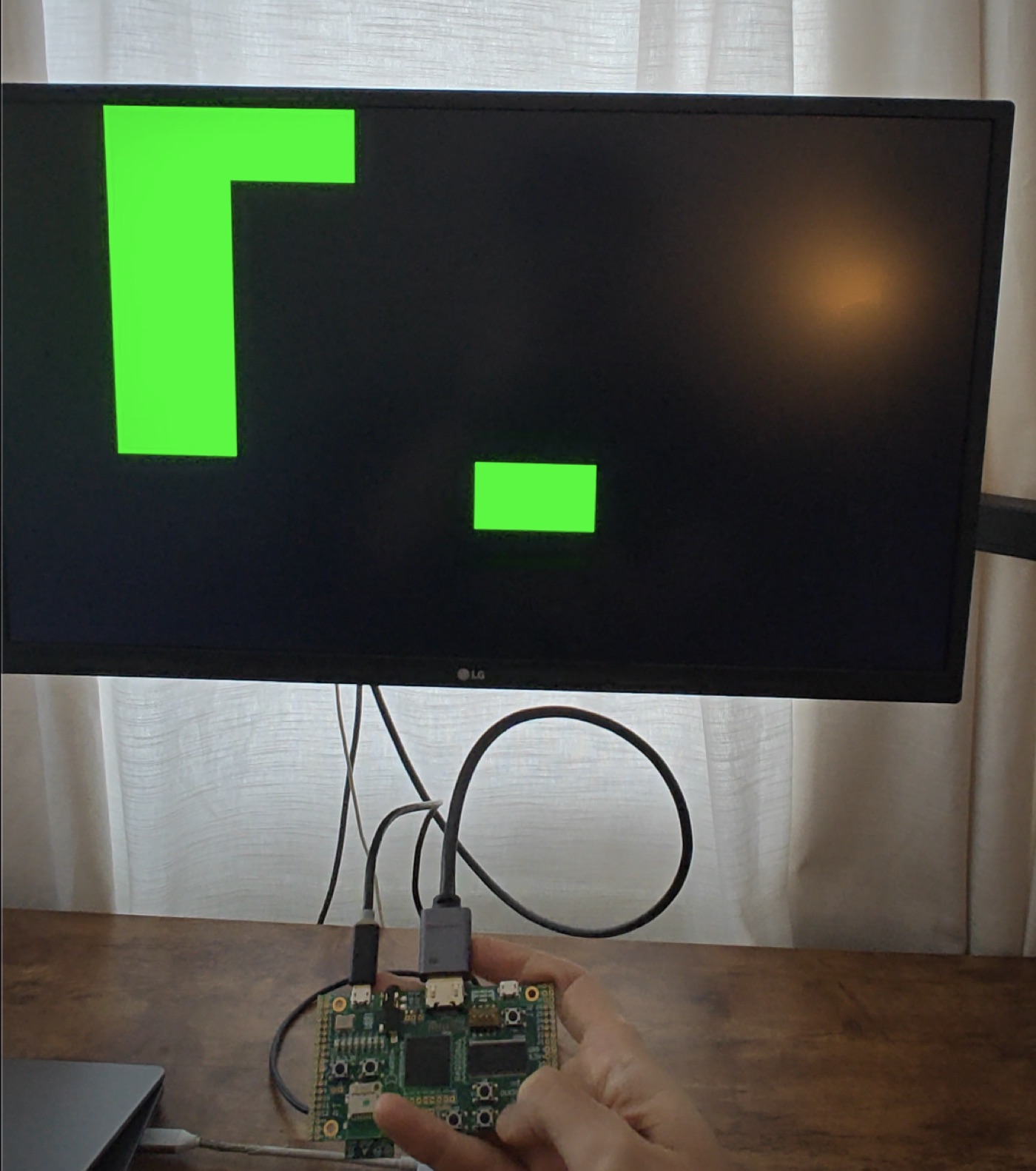
The Snake circuit running on a ULX3S FPGA, drawn on a monitor over HDMI
The same circuit from the demo above, synthesized onto a ULX3S (ECP5) and running over HDMI.

This isn’t a Verilog rewrite of Snake. The game logic and framebuffer are byte-for-byte the circuit you just played, and a CI check fails the build if the browser version and the bitstream ever drift apart.

The video is generated logic too, no display chip in the path. A TMDS encoder turns each pixel into the 10-bit DVI signaling the monitor expects. That, plus the pixel clock and button inputs, is plain Verilog wrapped around the generated core, the same plumbing any ULX3S video project uses. The game is the generated part; this is just the wiring to get it on a screen.

The flow is open the whole way: Verilog → Yosys (synth_ecp5) → nextpnr → ecppack → bitstream. About 100 nodes of logic, and nextpnr closes timing with plenty of headroom over the 25 MHz the design actually runs at.

Run it on your own board

Got an FPGA? The Snake core is plain Verilog, so it synthesizes for any board. The repo has a complete ULX3S (ECP5) build to copy from, plus a README on running it there and porting it elsewhere: you swap the wrapper, the constraints, and the toolchain target, while the game logic stays the same.