



惯性聚合 高效追踪和阅读你感兴趣的博客、新闻、科技资讯
阅读原文 在惯性聚合中打开

推荐订阅源

N
Netflix TechBlog - Medium
O
OpenAI News
腾讯CDC
博客园 - Franky
阮一峰的网络日志
阮一峰的网络日志
The Cloudflare Blog
钛媒体:引领未来商业与生活新知
钛媒体:引领未来商业与生活新知
WordPress大学
WordPress大学
人人都是产品经理
人人都是产品经理
T
Tailwind CSS Blog
酷 壳 – CoolShell
酷 壳 – CoolShell
小众软件
小众软件
量子位
M
MIT News - Artificial intelligence
Martin Fowler
Martin Fowler
美团技术团队
博客园 - 三生石上(FineUI控件)
aimingoo的专栏
aimingoo的专栏
A
About on SuperTechFans
S
Security Affairs
K
KPMG report finds enterprise disconnect between AI and its ROI | CIO
Google Online Security Blog
Schneier on Security
cs.AI updates on arXiv.org
S
Security @ Cisco Blogs
G
GRAHAM CLULEY
T
The Exploit Database - CXSecurity.com
H
Heimdal Security Blog
S
Schneier on Security
B
Blog RSS Feed
J
Java Code Geeks
罗磊的独立博客
V
Visual Studio Blog
P
Proofpoint News Feed
OSCHINA 社区最新新闻
OSCHINA 社区最新新闻
T
The Blog of Author Tim Ferriss
Cyber Security Advisories - MS-ISAC
Webroot Blog
Webroot Blog
The Last Watchdog
The Last Watchdog
T
Tor Project blog
Hugging Face - Blog
Hugging Face - Blog
U
Unit 42
MongoDB | Blog
MongoDB | Blog
C
Cyber Attacks, Cyber Crime and Cyber Security
www.infosecurity-magazine.com
Attack and Defense Labs
Simon Willison's Weblog
D
Docker
Microsoft Azure Blog
The Hacker News
The Hacker News

Show HN

GitHub - steveking-gh/firmion: Firmion is DSL and engine for firmware image generation. GitHub - villagesql/villagesql-skills: Agent skills for VillageSQL - gemini-cli-extension; claude-code-plugin GitHub - flightdeckhq/flightdeck: Observability and control plane for AI agents. CSP Radar GitHub - Light-Heart-Labs/DreamServer: Turn your PC, Mac, or Linux box into an AI server. LLM inference, chat UI, voice, agents, workflows, RAG, and image generation. GitHub - Diplomat-ai/diplomat-agent-ts: What can your TypeScript AI agent do to the real world? Scan your code. See which tool calls have zero checks Code Block Selector - Visual Studio Marketplace Prometheus dependency graph — interactive showcase | Riftmap Show HN: I made a vi-like modal keyboard plugin for Figma GitHub - run-llama/liteparse: A fast, helpful, and open-source document parser GitHub - dalemyers/Roar: A macOS CLI tool for notifications GitHub - district-solutions/open-agent-tools-coder: Enables small-to-large self-hosted ai models to use local source code when running tool-calling agentic workloads. We actively data mine 20,900+ (2+ TB) popular github repos using large and small ai models to create reuseable: json, markdown and parquet files for local-first tool-calling models. GitHub - progapandist/stripeek: A local TUI proxy for real-time Stripe API debugging, built for navigating complex payloads fast. GitHub - sir1st/hermes-desktop: All-in-one cross-platform desktop app for Hermes Agent — bundles Python + hermes-agent + hermes-web-ui GitHub - astefanutti/shaderbang: Shebang for Shaders Show HN: Generate Claude Code Workflows using Spec Driven Development approach GitHub - nixys/nxs-universal-chart: The Helm chart you can use to install any of your applications into Kubernetes/OpenShift Show HN: AI agents for UK GDAD PCF roles and their skills The Two Pillars: Mixer Mode and Meta-Software in the Reorganization of Software Work After AI GitHub - JaiCode08/teleport-env What 1,000+ Harness Experiments Taught Me About Self-Improving Agents Show HN: Liiists, a Markdown-first, iOS and CLI list app SwiperTab – Get this Extension for 🦊 Firefox (en-US) GitHub - kouhxp/fftext: Summarize, explain, fact-check, or translate any text, URL, or file. No GPU. No cloud. One command GitHub - sweetpad-dev/sweetpad: Develop Swift/iOS projects using VSCode GitHub - dogmaticdev/IRON: IRON a.k.a. Intermediate Representation Object Notation is a Interpreter/Database that is used to create Programming Languages. GitHub - sjhalani7/vaen: Package your AI coding harness into a portable .agent file, and share it across repos, teams, & the community without ever having to copy-paste instructions, skills, MCP config, or secrets. Show HN: Gandalf the Grader Show HN: Citadeld – replay any CI failure locally from a single file GitHub - tdortman/cuSBF: High-Performance GPU Super Bloom Filter coral-ai/claude-code-token-xray at main · Coral-Bricks-AI/coral-ai GitHub - ulyssestenn/funes: Funes is a Git-based framework for LLM-managed knowledge work: an AI Librarian ingests raw sources, builds an interlinked Markdown knowledge base, and uses it to produce cited reports, analyses, and other outputs. GitHub - ThatXliner/gah: Git Add Hunk, built for agents to use GitHub - harmont-dev/harmont-cli: Command-line client for the Harmont CI platform GitHub - brooksmcmillin/mcp-authflow: OAuth 2.0 Authorization Server framework for MCP servers GitHub - javaid-codes/audit-supply-chain-agents GitHub - amorey/gochan: A small library of common channel architectures for Go, inspired by Rust GitHub - arifozgun/OpenGem: Free, Open-Source AI API Gateway with Gemini, OpenAI & Anthropic Compatibility in 1 file GitHub - Pranesh950/BioPetals: 🌸 Run BIOxAI models at home, BitTorrent-style. Fine-tuning and inference up to 10x faster than offloading GitHub - cnguyen14/bounty-doctor: Diagnose a GitHub bounty issue before you waste hours: detects honeypot scam repos, AI-bot attempt swarms, and stale contests. Show HN: CoreMCP – MCP Server for On-Prem DBs Show HN: KittyHTML – Render HTML/CSS as an inline image in your terminal GitHub - bingud/filemat: Web-based file manager Show HN: TruthLens – Free multi-signal deepfake image detector GitHub - apexlocal-jz/claude-usage-tray: Windows system-tray app showing your Claude Code rate-limit usage at a glance. Zero deps, ~300 lines of PowerShell. Cross-IDE (works regardless of VS Code, Cursor, plain terminal). Release v0.1.2.1 · kouhxp/yapsnap GitHub - noopolis/moltnet: Self-hostable chat network for AI agents. Pre-built bridges for Claude Code, Codex, and the Claws. Rooms, DMs, history. No Slack bots, no Matrix, no glue code. GitHub - tamerh/enju: Coordinating Humans, AI Agents, and Compute as Peers on a Shared Workflow Graph Show HN: Continuity-auth – Respect-weighted rate limits for the open web GitHub - luml-ai/luml: AI lifecycle platform where engineers and agents track experiments, train models, and ship to production. GitHub - mrdanielcasper/CoreTex: A UNIX-inspired, biomimetic, flat-file AI harness and knowledge engine. GitHub - clemg/pierre-github: Pierre's diffs.com and trees.software for Github GitHub - lyriks-io/unspaghettit: Behavior-driven AI development without prompt spaghetti. GitHub - sofumel/claude-handoff-revive: Resume Claude Code work after rate/usage/context limits without replaying the prior transcript. Auto-saves at 90%/95% usage. Plugin-installable, 10 languages. GitHub - dotexorg/saferpc: Typed, end-to-end encrypted RPC over any bidirectional channel. GitHub - BeeZeeAgent/beezee: Agent harness orchestration Legato Next.js Boilerplate for Internal Tools · CoreUI GitHub - clark-labs-inc/clark-hash: Clark Hash, 32x smaller searchable sketches for embeddings GitHub - ZeroPointRepo/youtube-mcp: The fastest YouTube transcript + YouTube search MCP for AI agents. Try for free. Typing Mastery — climb toward 100+ WPM, deliberately GitHub - Andebugulin/Awareen GitHub - fayzan123/claude-workflow-composer: Visual desktop app for composing multi-agent coding workflows. Drag agents, attach skills and MCPs, wire handoffs, export to .claude/ GitHub - harshaneel/humanize: Best static AI text humanizer. Two research-grounded skills that work in any LLM (Claude, ChatGPT, Gemini, Codex): humanize beats perplexity-based detectors, ai-check produces forensic scoring with evidence-quoted flags. Nine levers, 50+ peer-reviewed sources, 2024-2026 detection literature. GitHub - StackOneHQ/stack-nudge GitHub - nodes-app/swift-markdown-engine: A native AppKit Markdown editor for macOS, built on TextKit 2 and bridged to SwiftUI. We hardened an LLM agent. Each defense we added made it more exploitable. GitHub - alkait/WhatsKept: Agent-queryable WhatsApp history from an iOS backup — a single Go binary. GitHub - octelium/cordium: Open-source, general-purpose sandbox platform for devs and AI agents that provides identity-based secure access to infrastructure without credentials. WAR.GOV/UFO Microfilm5 GitHub - scosman/videowright: Build animated explainer videos with your coding agent GitHub - dipankar/dscode: The code editor you can take apart. GitHub - zoharbabin/web-researcher-mcp: MCP server (Go) for AI assistants: web search, content extraction, academic/patent/news research. Multi-provider routing, 4-tier scraping, search lenses. Works with Claude, Cursor, and any MCP client. GitHub - ruvnet/RuView: π RuView turns commodity WiFi signals into real-time spatial intelligence, vital sign monitoring, and presence detection — all without a single pixel of video. GitHub - scanaislop/aislop: Catch the slop AI coding agents leave in your code: narrative comments, swallowed exceptions, as-any casts, dead code, oversized functions. 50+ rules across 7 languages (TypeScript, JavaScript, Python, Go, Rust, Ruby, PHP). Sub-second, deterministic, no LLM at runtime. MIT-licensed. GitHub - kouhxp/cheap-im: CPU-only voice agent approximating Thinking Machines' Interaction Models demo GitHub - unprovable/OrchidMantis: Orchid Mantis — standalone framework for Zero-Knowledge Proofs of eXploit (ZKPoX). GitHub - MarcellM01/TinySearch: Shrink the web for your local LLMs! GitHub - TangibleResearch/Halgorithem: A Algo designed to detect AI Hallucitions GitHub - DO-SAY-GO/freelang: I love freelang GitHub - CarpseDeam/Aura-IDE: An AI coding harness that shaped itself - Planner/Worker agents, repo awareness, surgical edits, validation, recovery, and safe diff approvals. GitHub - chojs23/concord: A feature-rich TUI client for Discord GitHub - tommyjepsen/awesome-ux-skills: UX & AI Product designs skills you can use today in Claude Code GitHub - aerf-spec/aerf: Agent Evidence Receipt Format (AERF) — an open specification for tamper-evident, independently verifiable records of AI agent actions. GitHub - kklimuk/docx-cli: CLI for AI agents (Claude, Codex) to read, edit, and comment on .docx files with full format fidelity. GitHub - Jwrede/tokentoll: Catch LLM cost changes in code review. Infracost for LLM spend. GitHub - samchon/ttsc: A `typescript-go` toolchain for compiler-powered plugins and type-safe execution + 500x faster lint integrated into compiler GitHub - Higangssh/homebutler: 🏠 Manage your homelab from chat. Single binary, zero dependencies. GitHub - olalie/tapmap: See where your computer connects and what stands out on a live world map. GitHub - Diplomat-ai/diplomat-agent: What can your AI agent do to the real world? Scan your code. See which tool calls have zero checks GitHub - Bajusz15/beacon: Open-source agent for secure remote access, monitoring, and deploys across home-lab and self-hosted machines like Raspberry Pi, N100, or any Linux server. Open web based TTY or tunnel Home Assistant and other local services securely without opening ports. BigTech AI News - Chrome 应用商店 GitHub - vinhnx/VTCode: VT Code is an open-source coding agent with LLM-native code understanding and robust shell safety. Supports multiple LLM providers with automatic failover and efficient context management. GitHub - michaelaz774/decision-engine: A decision operating system for startup founders, powered by Claude Code. Synthesizes wisdom from 25+ legendary founders and investors into interactive AI-driven decision frameworks. GitHub - Chrilleweb/dotenv-diff: Validate environment variable usage in your codebase GitHub - Lumen-Labs/brainapi2: BrainAPI is a knowledge graph–powered AI memory layer that transforms unstructured data into structured knowledge, enabling intelligent search, recommendations, and contextual memory for AI agents and applications. GitHub - familiar-software/familiar: Let AI watch you work. Familiar lets your AI update its memory, skills, and knowledge by watching your screen. GitHub - skorotkiewicz/rudo: A small, elegant dock for Wayland GitHub - muxshed/shed: One stream in, or many. Every destination, simultaneously. No cloud middleman, no per-channel fees, no limits. make sidebar/address bar rounded corner toggleable
Prela: A Compositional & Controllable Query Language
remywang · 2026-06-15 · via Show HN

"The calculus of relations has an intrinsic charm and beauty which makes it a source of intellectual delight to all who become acquainted with it." —Alfred Tarski

Prela is an embedded query language focusing on compositionality and control. Its queries are concise, clear, and fast. It is implemented as a library of query combinators (think parser combinators), allowing the user to freely intermix queries with code in the host programming language. The implementation follows continuation-passing style, resulting in a core engine under 1k lines of code that compiles to efficient columnar execution. Unlike almost all SQL databases, Prela does not come with its query optimizer, and queries are executed exactly as they are written. This gives the user complete control over all aspects of query planning, including join ordering, operator pushdown, materialization, and selection of physical data structures. Nevertheless, the most idiomatic way to write a query already performs well in our experiments.

Note

Prela is a research prototype in early development. Expect constant and sweeping changes to both language design and implementation.

Example

Consider Join Order Benchmark 22a:

movie.with(info.select(Info::ty.eq("countries")
                  .and(Info::info.is_in(["Germany", "German", "USA", "American"])))
      .and(keyword.is_in(["murder", "murder-in-title", "blood", "violence"]))
      .and(production_year.gt(2008))
      .and(kind.is_in(["movie", "episode"])))
   .select(title
      .and(data.with(Data::text.lt("7.0")
                .and(Data::ty.eq("rating"))).text())
      .and(company.with(Company::note.nrx(r"\(USA\)")
                   .and(Company::note.rx(r"\(200.*\)"))
                   .and(country.ne("[us]"))
                   .and(Company::ty.eq("production companies"))).name()))

Intuitively, the query looks for movies satisfying several conditions:

  • It's German or American
  • It's a thriller
  • It's produced after 2008
  • It's a movie or a TV series episode (which we'll also just call a "movie")

Then, for each such movie, output the following attributes:

  • Its title
  • Its rating, if lower than 7
  • Its production company, if satisfying further conditions

In SQL's way of thinking, movie would be in the FROM clause (along with other tables involved), with corresponds to the WHERE clause,1 and select corresponds to the SELECT clause. But unlike SQL, Prela can freely interleave predicates and outputs, resulting in more natural queries as shown above. You can also think of data.with(...).text() and company.with(...).name() parts as subqueries which require special syntax in SQL, but are just subexpressions in Prela. And instead of explicit conditions, joins in Prela are reflected by the structure of the query in a navigational style.

Data Model and Simple Queries

To understand what's going on under the hood, we should first clarify the data model used by Prela. The theoretical foundation of Prela is a formalism of relations 100 years older than the familiar relational algebra, called (confusingly) relation algebra. To avoid confusion, I will call it Tarski's Algebra of Relations (TAR) after the logician responsible for its modern formalization. In TAR (and therefore Prela), everything is a binary relation, and a query is built up with operators that take in and produce binary relations, which I call relation combinators. One way to think about this is a very extreme form of normalization: every table with k columns is "shredded" into k binary tables, one per column.

Let us consider a simplified version of the query above:

movie.with(production_year.gt(2008)).select(title)

Here, title and production_year are both attributes of the same table in the original schema, but in Prela, each of them becomes a binary relation, mapping every movie (ID) to its title and production year, respectively. movie is also a binary relation, albeit a little special: it corresponds to the primary-key ID column of the original table, and is the identity relation over the IDs; in other words, movie contains (i, i) for every ID i in the table. Overall, each "column table" can be thought of as a map from the primary key to its corresponding value.

Comparisons like .gt() and .is_in() are regular Rust methods on relations. For example, production_year.gt(2008) returns a binary relation that's a subset of production_year, such that the second column (the "value" column) contains only values greater than 2008.

Next, .with() is the restriction combinator: r.with(s) restricts the last column of the r with the first column of the s; i.e., it is exactly a left-semijoin. In this example, movie.with(production_year.gt(2008)) semijoins movie with the filterd-out production_year relation, and since movie is the identity relation, we're left with the IDs for movies made after 2008.

The .select() combinator is relational composition. It is the workhorse of both Prela and TAR. The key to understanding relational composition is to view relations as a generalization of functions: a binary relation of type (X, Y) generalizes a function of type X -> Y by allowing multiple different "output" (Y) values per "input" (X). For this reason, we will abuse X -> Y to denote the type of a binary relation.

From this perspective, it is then natural to see select as a generalization of the function composition (\(f \circ g\)): r.select(s) first "applies" r to each x to get a bunch of y, then for each y, apply s to get a bunch of z.

In math: \(R \circ S = \lbrace (x, z) \mid \exists y . (x, y) \in R \land (y, z) \in S \rbrace\). In standard relational algebra: \(R \circ S = \pi_{x, z}(R \Join_{R.y = S.y} S)\) where R's schema is over x and y, and S's schema is over y and z.

Going back to our example, .select() takes two inputs:

  • movie.with(production_year.gt(2008)), which has all movies after 2008 and is of type Movie -> Movie
  • title which has type Movie -> String

Their composition then produces an output of type Movie -> String, namely, a mapping from each qualifying movie to its title.

Another (perhaps more natural) way to think about all these is to pretend every movie is a JSON object called movie, and its attributes like title and production_year are JSON attributes, then .select() will feel like field access, and .with() lets you specify filters.

There is one more construct in our original example, namely the product combinator .and(). It takes two relations of types X -> Y and X -> Z, and joins them on X to produce an output of type X -> (Y, Z). When used as a conjunction in the with clause, product allows us to combine different predicates:

      .and(production_year.gt(2008))
      .and(kind.is_in(["movie", "episode"])))

When used in select, it combines different columns in the output: in the full example, we output title, data (with additional filters), and company name - the last because company.with(...).name() computes a relation of type Movie -> String mapping each movie to its company's name.

CTEs, UDFs, and Aggregation

Since Prela is directly embedded in the host language, we can borrow many constructs from the host to get many features that are considered advanced in other query languages, for free. Consider TPCH q21:

let late = lineitem.with(commitdate.and(receiptdate).filt(|(c, r)| c < r));

// EXISTS another supplier on the order (across all lineitems)
let multi_supp = Lineitem::supplier.group_by(order).count_distinct().gt(1);
// NOT EXISTS another LATE supplier (only L1 is late)
let only_late = (&late).select(Lineitem::supplier)
    .group_by((&late).select(order))
    .count_distinct().eq(1);

let saudi = supplier.and(Supplier::nation.eq("SAUDI ARABIA"));
let f_ords = orders.and(Order::status.eq("F"));
let qualifying = (&late)
    .with(Lineitem::supplier.select(saudi)
     .and(order.select(f_ords.and(multi_supp).and(only_late))));

let counts = qualifying.group_by(Lineitem::supplier).fold(0_i64, |a, _| a + 1);

The let bindings assign sub-queries to variables — which would require CTEs in SQL, but is simply a variable binding in Prela/Rust. Where SQL needs a UDF, Prela passes an ordinary closure, e.g., the predicate in .filt(|(c, r)| c < r) and the accumulator |a, _| a + 1 passed to fold.

The next new Prela construct excercised by this query is group-by aggregation. Let's focus on the expression Lineitem::supplier.group_by(order).count_distinct().gt(1). You can probably guess it corresponds to the SQL query:

  SELECT order, supplier
    FROM lineitem
GROUP BY order
  HAVING COUNT DISTINCT(supplier) > 1

In SQL, GROUP BY, HAVING, and COUNT must all come together, and missing a clause triggers a parse error. But in our Prela query, .group_by(), count_distinct(), and .gt() are just regular Rust functions, so how do we make sure all of them are called together? We don't.

To understand how things work, we shall first introduce one more combinator, the inverse .inv(): it just flips the columns of R, so if R: X -> Y, then R': Y -> X, like how you invert a function.

Now, back to the query: s.group_by(r) is short hand for "compose with inverse": Lineitem::supplier.group_by(order) means order.inv().select(Lineitem::supplier). Here, the order relation has type Li -> Order, so its inverse has type Order -> Li and maps each order to the lineitem. Then, Lineitem::supplier has type Li -> Supplier, so the composition has type Order -> Supplier, mapping each order to its supplier. Next, each aggregation operator, .fold(), .buf_fold(), .count_distinct(), groups its receiver by the first column, and computes the aggregate over the second column using the supplied function. In our case, we group the suppliers by order, then count the number of distinct suppliers per group. Finally, .gt(1) works as before and filters the relation to keep the orders that are supplied by more than 1 distinct suppliers, which corresponds to the HAVING clause in SQL but requires no special treatment in Prela. Grouping may appear limiting as it "can only group by one attribute", but that is not true - grouping by multiple attributes can be achieved by grouping by a product! I'll leave that as an excercise for the reader.

Implementation

If implemented naively, Prela would be pretty slow. Indeed, the first prototype was around 100x slower than DuckDB! The naive implementation literally had each combinator take in and produce relations, which leads to a lot of materialized intermediates that are only filtered down later on. There are two standard solutions in DB to this problem: implement the iterator model and vectorize it to make it fast, or compile the query into low-level code running tight loops. Both approach involve significant effort. To be honest, I almost gave up at that point, because building a vectorized or compiled DB is much too large of a scope. Until I remembered some dark magic I picked up from my functional programming days - continuation-passing style (CPS). Actually, I never really understood CPS until working on Prela, and when it clicked, I literally cried because the idea was so beautiful! I've written more about it here. Long story short, CPS allows each combinator to be implemented in a few lines in a modular way, yet compiling to code that recovers efficient columnar execution.

Performance

Some consider the query optimizer to be the heart of a database, transforming high-level queries into fast, executable code. I've also spent my graduate school years working on query optimizers, so it's probably quite surprising that Prela doesn't have one. In other words, a Prela query is also a query plan. Each query will be executed exactly as it is written, giving the programmer complete control over every aspect of query performance. Physical data structures can be selected with type annotations, and materialization points specified by calls to .collect(). I will write more about that later, but for now, treat yourself to the queries here: see rust/src/queries/ for all 113 JOB queries, and rust/src/tpch/common.rs for TPC-H.

The plots below compare Prela against DuckDB 1.5.3 (1 thread) as baseline, over TPC-H and the Join Order Benchmark. On JOB, Prela runs the 113 queries in 5.2s vs DuckDB's 15.3s (3.0× faster, winning 99 of 113). On TPC-H SF=1, idiomatic Prela is within ~1.4× of DuckDB's vectorized engine (1.18s vs 0.86s), and an optimized variant beats it by ~1.6× (0.55s).
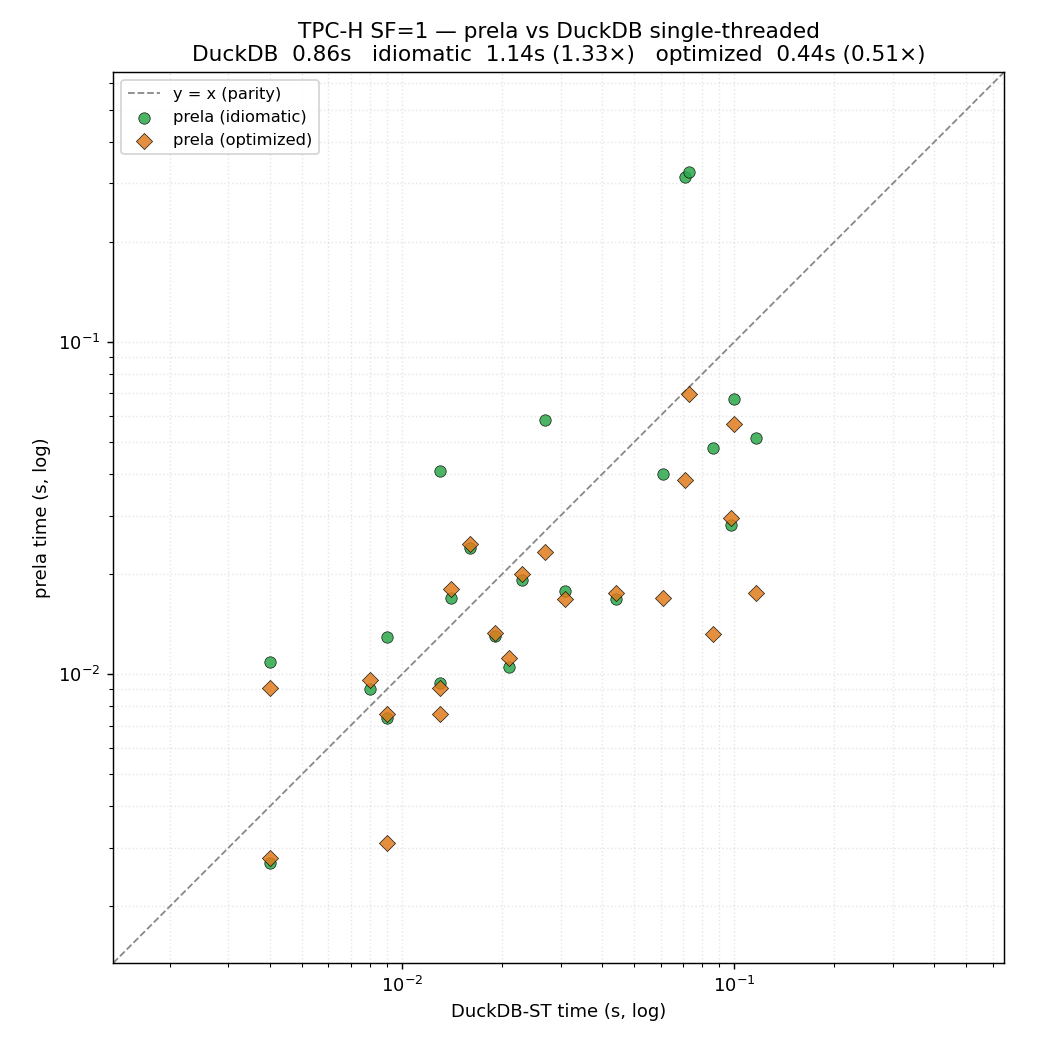
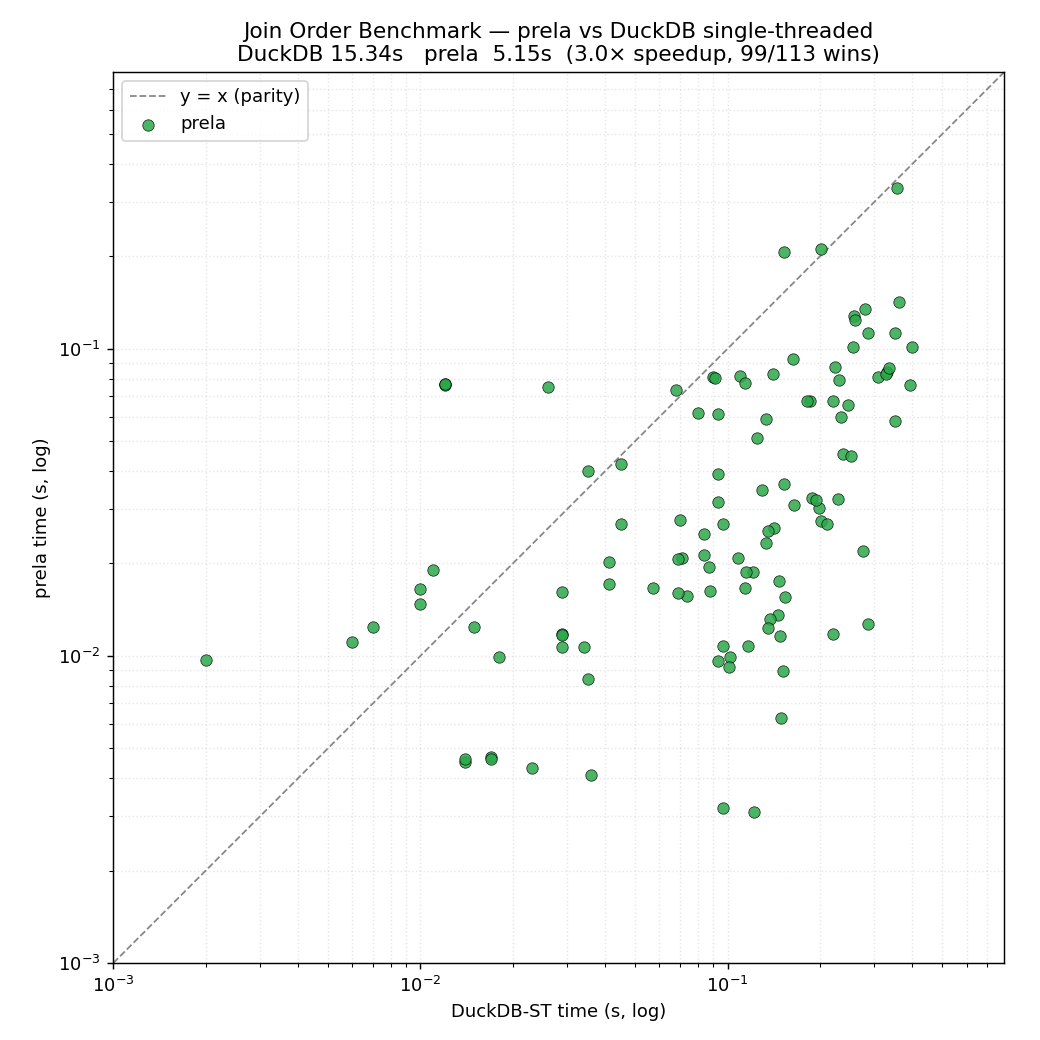
TPC-H SF=1 JOB


  1. Sadly where is reserved in Rust.↩︎