惯性聚合 高效追踪和阅读你感兴趣的博客、新闻、科技资讯
阅读原文 在惯性聚合中打开

推荐订阅源

The GitHub Blog
The GitHub Blog
K
Kaspersky official blog
Stack Overflow Blog
Stack Overflow Blog
Blog — PlanetScale
Blog — PlanetScale
Recorded Future
Recorded Future
Engineering at Meta
Engineering at Meta
U
Unit 42
D
Docker
I
InfoQ
D
DataBreaches.Net
Google DeepMind News
N
Netflix TechBlog - Medium
C
Check Point Blog
The Cloudflare Blog
美团技术团队
V
Vulnerabilities – Threatpost
博客园_首页
T
Threat Research - Cisco Blogs
Google DeepMind News
Attack and Defense Labs
A
Arctic Wolf
IT之家
IT之家
让小产品的独立变现更简单 - ezindie.com
Exploit-DB.com RSS Feed
T
Troy Hunt's Blog
cs.CL updates on arXiv.org
人人都是产品经理
人人都是产品经理
C
Cyber Attacks, Cyber Crime and Cyber Security
钛媒体:引领未来商业与生活新知
钛媒体:引领未来商业与生活新知
Security Archives - TechRepublic
S
Schneier on Security
Apple Machine Learning Research
MyScale Blog
MyScale Blog
P
Privacy International News Feed
云风的 BLOG
云风的 BLOG
Recent Commits to openclaw:main
T
The Blog of Author Tim Ferriss
GbyAI
GbyAI
The Last Watchdog
The Last Watchdog
D
Darknet – Hacking Tools, Hacker News & Cyber Security
aimingoo的专栏
aimingoo的专栏
P
Proofpoint News Feed
The Register - Security
博客园 - 三生石上(FineUI控件)
Forbes - Security
Forbes - Security
NISL@THU
NISL@THU
Y
Y Combinator Blog
T
Threatpost
Microsoft Azure Blog
L
Lohrmann on Cybersecurity

Show HN

GitHub - steveking-gh/firmion: Firmion is DSL and engine for firmware image generation. GitHub - villagesql/villagesql-skills: Agent skills for VillageSQL - gemini-cli-extension; claude-code-plugin GitHub - flightdeckhq/flightdeck: Observability and control plane for AI agents. CSP Radar GitHub - Light-Heart-Labs/DreamServer: Turn your PC, Mac, or Linux box into an AI server. LLM inference, chat UI, voice, agents, workflows, RAG, and image generation. GitHub - Diplomat-ai/diplomat-agent-ts: What can your TypeScript AI agent do to the real world? Scan your code. See which tool calls have zero checks Code Block Selector - Visual Studio Marketplace Prometheus dependency graph — interactive showcase | Riftmap Show HN: I made a vi-like modal keyboard plugin for Figma GitHub - run-llama/liteparse: A fast, helpful, and open-source document parser GitHub - dalemyers/Roar: A macOS CLI tool for notifications GitHub - district-solutions/open-agent-tools-coder: Enables small-to-large self-hosted ai models to use local source code when running tool-calling agentic workloads. We actively data mine 20,900+ (2+ TB) popular github repos using large and small ai models to create reuseable: json, markdown and parquet files for local-first tool-calling models. GitHub - progapandist/stripeek: A local TUI proxy for real-time Stripe API debugging, built for navigating complex payloads fast. GitHub - sir1st/hermes-desktop: All-in-one cross-platform desktop app for Hermes Agent — bundles Python + hermes-agent + hermes-web-ui GitHub - astefanutti/shaderbang: Shebang for Shaders Show HN: Generate Claude Code Workflows using Spec Driven Development approach GitHub - nixys/nxs-universal-chart: The Helm chart you can use to install any of your applications into Kubernetes/OpenShift Show HN: AI agents for UK GDAD PCF roles and their skills The Two Pillars: Mixer Mode and Meta-Software in the Reorganization of Software Work After AI GitHub - JaiCode08/teleport-env What 1,000+ Harness Experiments Taught Me About Self-Improving Agents Show HN: Liiists, a Markdown-first, iOS and CLI list app SwiperTab – Get this Extension for 🦊 Firefox (en-US) GitHub - kouhxp/fftext: Summarize, explain, fact-check, or translate any text, URL, or file. No GPU. No cloud. One command GitHub - sweetpad-dev/sweetpad: Develop Swift/iOS projects using VSCode GitHub - dogmaticdev/IRON: IRON a.k.a. Intermediate Representation Object Notation is a Interpreter/Database that is used to create Programming Languages. GitHub - sjhalani7/vaen: Package your AI coding harness into a portable .agent file, and share it across repos, teams, & the community without ever having to copy-paste instructions, skills, MCP config, or secrets. Show HN: Gandalf the Grader Show HN: Citadeld – replay any CI failure locally from a single file GitHub - tdortman/cuSBF: High-Performance GPU Super Bloom Filter coral-ai/claude-code-token-xray at main · Coral-Bricks-AI/coral-ai GitHub - ulyssestenn/funes: Funes is a Git-based framework for LLM-managed knowledge work: an AI Librarian ingests raw sources, builds an interlinked Markdown knowledge base, and uses it to produce cited reports, analyses, and other outputs. GitHub - ThatXliner/gah: Git Add Hunk, built for agents to use GitHub - harmont-dev/harmont-cli: Command-line client for the Harmont CI platform GitHub - brooksmcmillin/mcp-authflow: OAuth 2.0 Authorization Server framework for MCP servers GitHub - javaid-codes/audit-supply-chain-agents GitHub - amorey/gochan: A small library of common channel architectures for Go, inspired by Rust GitHub - arifozgun/OpenGem: Free, Open-Source AI API Gateway with Gemini, OpenAI & Anthropic Compatibility in 1 file GitHub - Pranesh950/BioPetals: 🌸 Run BIOxAI models at home, BitTorrent-style. Fine-tuning and inference up to 10x faster than offloading GitHub - cnguyen14/bounty-doctor: Diagnose a GitHub bounty issue before you waste hours: detects honeypot scam repos, AI-bot attempt swarms, and stale contests. Show HN: CoreMCP – MCP Server for On-Prem DBs Show HN: KittyHTML – Render HTML/CSS as an inline image in your terminal GitHub - bingud/filemat: Web-based file manager Show HN: TruthLens – Free multi-signal deepfake image detector GitHub - apexlocal-jz/claude-usage-tray: Windows system-tray app showing your Claude Code rate-limit usage at a glance. Zero deps, ~300 lines of PowerShell. Cross-IDE (works regardless of VS Code, Cursor, plain terminal). Release v0.1.2.1 · kouhxp/yapsnap GitHub - noopolis/moltnet: Self-hostable chat network for AI agents. Pre-built bridges for Claude Code, Codex, and the Claws. Rooms, DMs, history. No Slack bots, no Matrix, no glue code. GitHub - tamerh/enju: Coordinating Humans, AI Agents, and Compute as Peers on a Shared Workflow Graph Show HN: Continuity-auth – Respect-weighted rate limits for the open web GitHub - luml-ai/luml: AI lifecycle platform where engineers and agents track experiments, train models, and ship to production. GitHub - mrdanielcasper/CoreTex: A UNIX-inspired, biomimetic, flat-file AI harness and knowledge engine. GitHub - clemg/pierre-github: Pierre's diffs.com and trees.software for Github GitHub - lyriks-io/unspaghettit: Behavior-driven AI development without prompt spaghetti. GitHub - sofumel/claude-handoff-revive: Resume Claude Code work after rate/usage/context limits without replaying the prior transcript. Auto-saves at 90%/95% usage. Plugin-installable, 10 languages. GitHub - dotexorg/saferpc: Typed, end-to-end encrypted RPC over any bidirectional channel. GitHub - BeeZeeAgent/beezee: Agent harness orchestration Legato Next.js Boilerplate for Internal Tools · CoreUI GitHub - clark-labs-inc/clark-hash: Clark Hash, 32x smaller searchable sketches for embeddings GitHub - ZeroPointRepo/youtube-mcp: The fastest YouTube transcript + YouTube search MCP for AI agents. Try for free. Typing Mastery — climb toward 100+ WPM, deliberately GitHub - Andebugulin/Awareen GitHub - fayzan123/claude-workflow-composer: Visual desktop app for composing multi-agent coding workflows. Drag agents, attach skills and MCPs, wire handoffs, export to .claude/ GitHub - harshaneel/humanize: Best static AI text humanizer. Two research-grounded skills that work in any LLM (Claude, ChatGPT, Gemini, Codex): humanize beats perplexity-based detectors, ai-check produces forensic scoring with evidence-quoted flags. Nine levers, 50+ peer-reviewed sources, 2024-2026 detection literature. GitHub - StackOneHQ/stack-nudge GitHub - nodes-app/swift-markdown-engine: A native AppKit Markdown editor for macOS, built on TextKit 2 and bridged to SwiftUI. We hardened an LLM agent. Each defense we added made it more exploitable. GitHub - alkait/WhatsKept: Agent-queryable WhatsApp history from an iOS backup — a single Go binary. GitHub - octelium/cordium: Open-source, general-purpose sandbox platform for devs and AI agents that provides identity-based secure access to infrastructure without credentials. WAR.GOV/UFO Microfilm5 GitHub - scosman/videowright: Build animated explainer videos with your coding agent GitHub - dipankar/dscode: The code editor you can take apart. GitHub - zoharbabin/web-researcher-mcp: MCP server (Go) for AI assistants: web search, content extraction, academic/patent/news research. Multi-provider routing, 4-tier scraping, search lenses. Works with Claude, Cursor, and any MCP client. GitHub - ruvnet/RuView: π RuView turns commodity WiFi signals into real-time spatial intelligence, vital sign monitoring, and presence detection — all without a single pixel of video. GitHub - scanaislop/aislop: Catch the slop AI coding agents leave in your code: narrative comments, swallowed exceptions, as-any casts, dead code, oversized functions. 50+ rules across 7 languages (TypeScript, JavaScript, Python, Go, Rust, Ruby, PHP). Sub-second, deterministic, no LLM at runtime. MIT-licensed. GitHub - kouhxp/cheap-im: CPU-only voice agent approximating Thinking Machines' Interaction Models demo GitHub - unprovable/OrchidMantis: Orchid Mantis — standalone framework for Zero-Knowledge Proofs of eXploit (ZKPoX). GitHub - MarcellM01/TinySearch: Shrink the web for your local LLMs! GitHub - TangibleResearch/Halgorithem: A Algo designed to detect AI Hallucitions GitHub - DO-SAY-GO/freelang: I love freelang GitHub - CarpseDeam/Aura-IDE: An AI coding harness that shaped itself - Planner/Worker agents, repo awareness, surgical edits, validation, recovery, and safe diff approvals. GitHub - chojs23/concord: A feature-rich TUI client for Discord GitHub - tommyjepsen/awesome-ux-skills: UX & AI Product designs skills you can use today in Claude Code GitHub - aerf-spec/aerf: Agent Evidence Receipt Format (AERF) — an open specification for tamper-evident, independently verifiable records of AI agent actions. GitHub - kklimuk/docx-cli: CLI for AI agents (Claude, Codex) to read, edit, and comment on .docx files with full format fidelity. GitHub - Jwrede/tokentoll: Catch LLM cost changes in code review. Infracost for LLM spend. GitHub - samchon/ttsc: A `typescript-go` toolchain for compiler-powered plugins and type-safe execution + 500x faster lint integrated into compiler GitHub - Higangssh/homebutler: 🏠 Manage your homelab from chat. Single binary, zero dependencies. GitHub - olalie/tapmap: See where your computer connects and what stands out on a live world map. GitHub - Diplomat-ai/diplomat-agent: What can your AI agent do to the real world? Scan your code. See which tool calls have zero checks GitHub - Bajusz15/beacon: Open-source agent for secure remote access, monitoring, and deploys across home-lab and self-hosted machines like Raspberry Pi, N100, or any Linux server. Open web based TTY or tunnel Home Assistant and other local services securely without opening ports. BigTech AI News - Chrome 应用商店 GitHub - vinhnx/VTCode: VT Code is an open-source coding agent with LLM-native code understanding and robust shell safety. Supports multiple LLM providers with automatic failover and efficient context management. GitHub - michaelaz774/decision-engine: A decision operating system for startup founders, powered by Claude Code. Synthesizes wisdom from 25+ legendary founders and investors into interactive AI-driven decision frameworks. GitHub - Chrilleweb/dotenv-diff: Validate environment variable usage in your codebase GitHub - Lumen-Labs/brainapi2: BrainAPI is a knowledge graph–powered AI memory layer that transforms unstructured data into structured knowledge, enabling intelligent search, recommendations, and contextual memory for AI agents and applications. GitHub - familiar-software/familiar: Let AI watch you work. Familiar lets your AI update its memory, skills, and knowledge by watching your screen. GitHub - skorotkiewicz/rudo: A small, elegant dock for Wayland GitHub - muxshed/shed: One stream in, or many. Every destination, simultaneously. No cloud middleman, no per-channel fees, no limits. make sidebar/address bar rounded corner toggleable
Cable Detective — what's actually plugged into each port.
Franz Enzenhofer · 2026-06-02 · via Show HN

Cable Detective icon

Cable Detective reads the macOS I/O Kit registry and tells you exactly what your USB-C, Thunderbolt, and MagSafe ports are doing right now. Check your cables.

Free. No subscription. No account. No cloud.

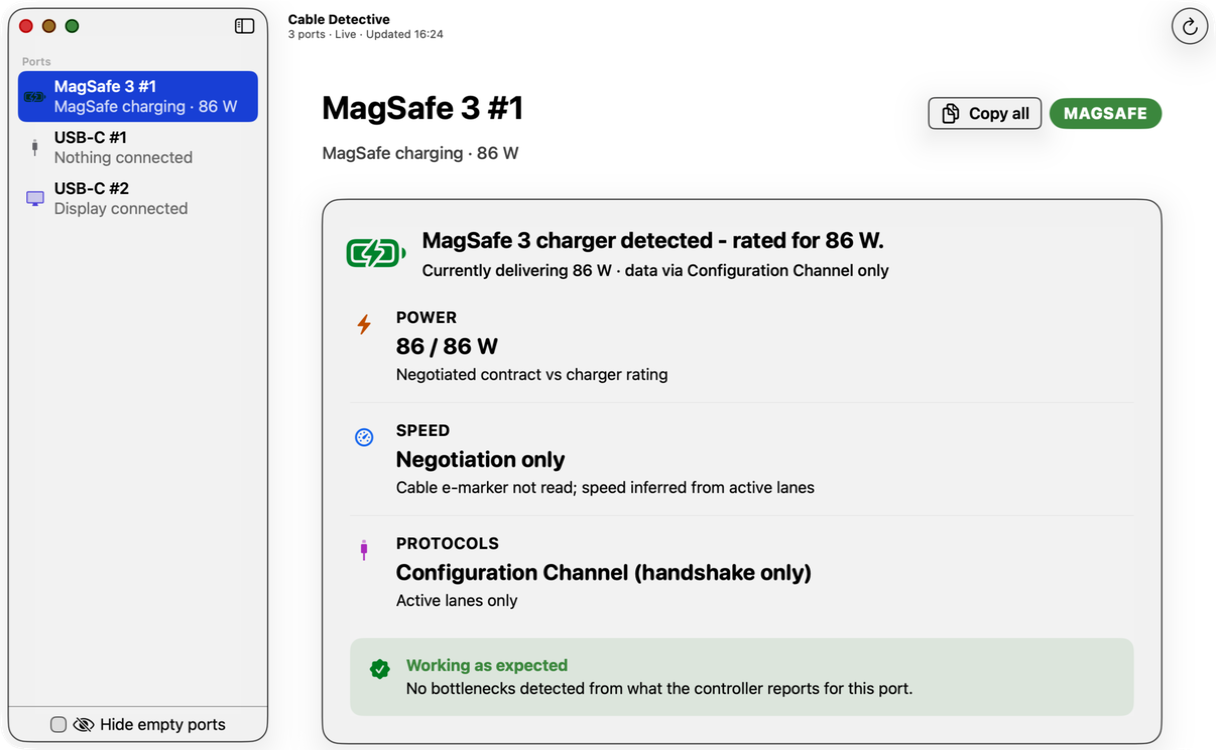
Cable Detective showing a MagSafe 3 port charging at 86 W, with cable e-marker, power, speed, and protocol details.

Plug it in. See what it really is.

USB-C ports look identical. They behave wildly differently. Cable Detective shows the truth for each one.

  • Power direction and wattageWho's charging whom, and at what negotiated wattage. PD contract source, advertised PDOs, charger rating.
  • DisplayPort lane stateHow many lanes are running, at what link rate. Whether DP-Alt Mode is actually active.
  • Cable identitySOP / SOP' / SOP" e-marker reads. Vendor IDs decoded. No invented specs when the cable doesn't answer.
  • USB transportUSB 2.0 vs 3.x SuperSpeed vs USB4 vs Thunderbolt. The lane state, not the marketing on the box.
  • Plain-English explanationOptional Apple Intelligence layer that summarises the report. Off by default. On-device only.

Every port. Every detail.

A live walkthrough of one MacBook Air. Four physically identical USB-C ports doing four very different jobs - and the Local AI panel that explains each one in plain English, on-device.

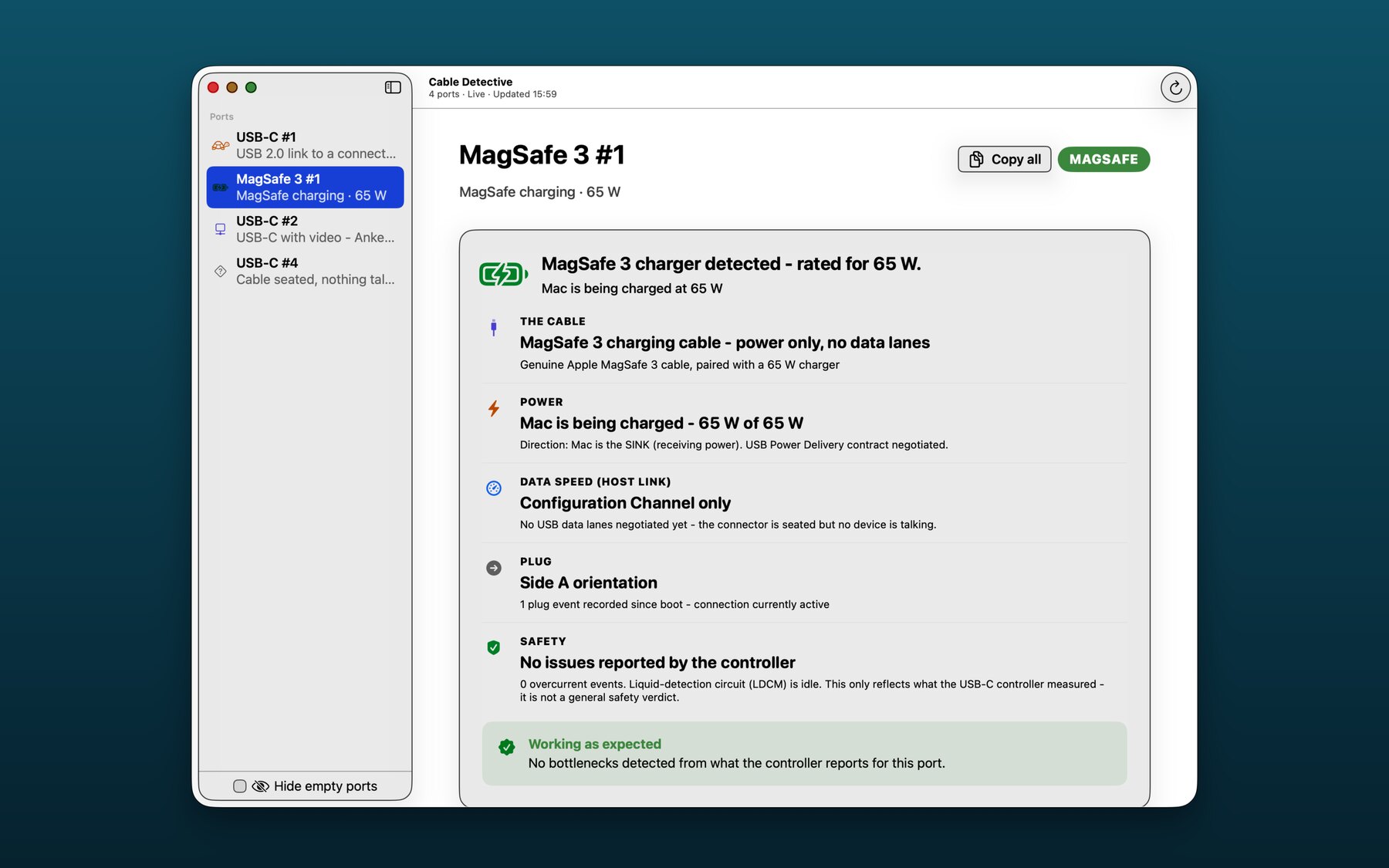
Cable Detective showing MagSafe 3 #1 charging at 65 W. The hero card decodes the cable as a genuine Apple MagSafe 3 charging cable paired with a 65 W charger.

MagSafe 3 - Power-only cable, 65 W of 65 W negotiated, USB Power Delivery contract decoded, no overcurrent events.

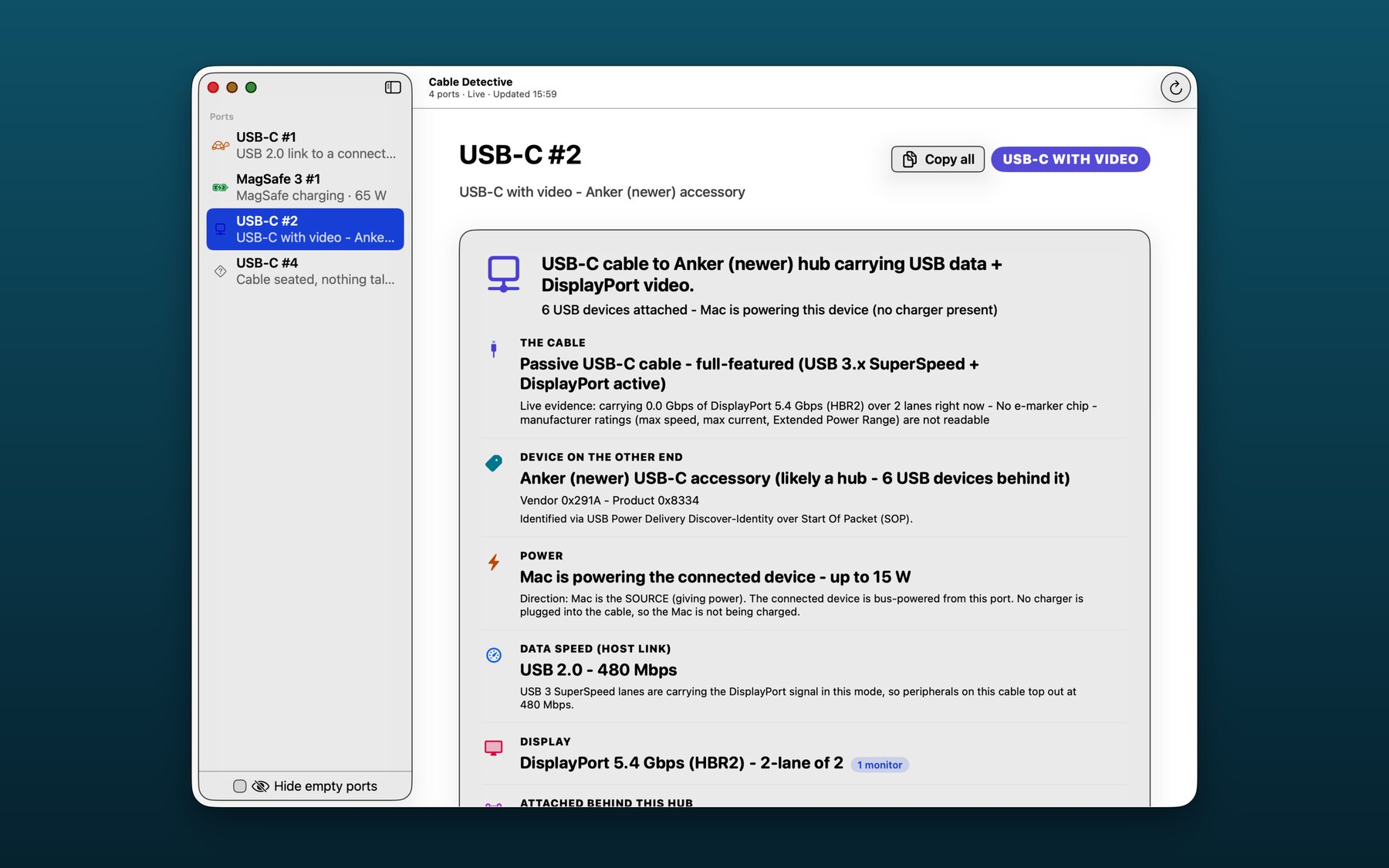
Cable Detective showing USB-C #2 with an Anker hub carrying USB data plus DisplayPort video at HBR2.

USB-C with hub + video - Anker hub, six USB devices behind it, DisplayPort 5.4 Gbps (HBR2) on 2 lanes, USB 2.0 lanes carrying the data.

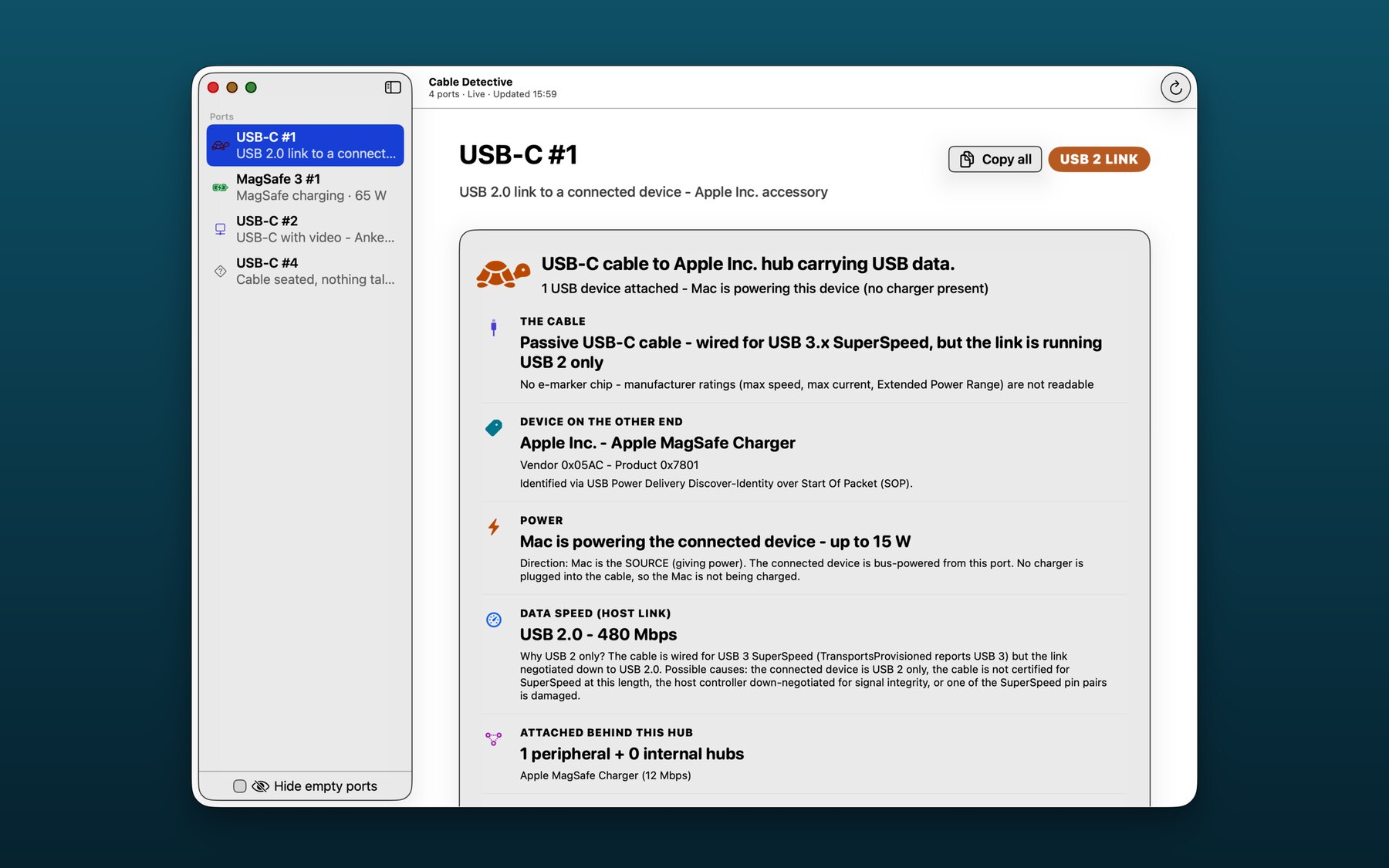
Cable Detective showing USB-C #1 with a USB 2.0 link to an Apple MagSafe Charger - the cable is wired for SuperSpeed but the link runs USB 2.

USB-C 2 link - The cable is wired for USB 3.x SuperSpeed but negotiated down to USB 2 only. The Mac is powering the device at 15 W. The detail page tells you which side gave up.

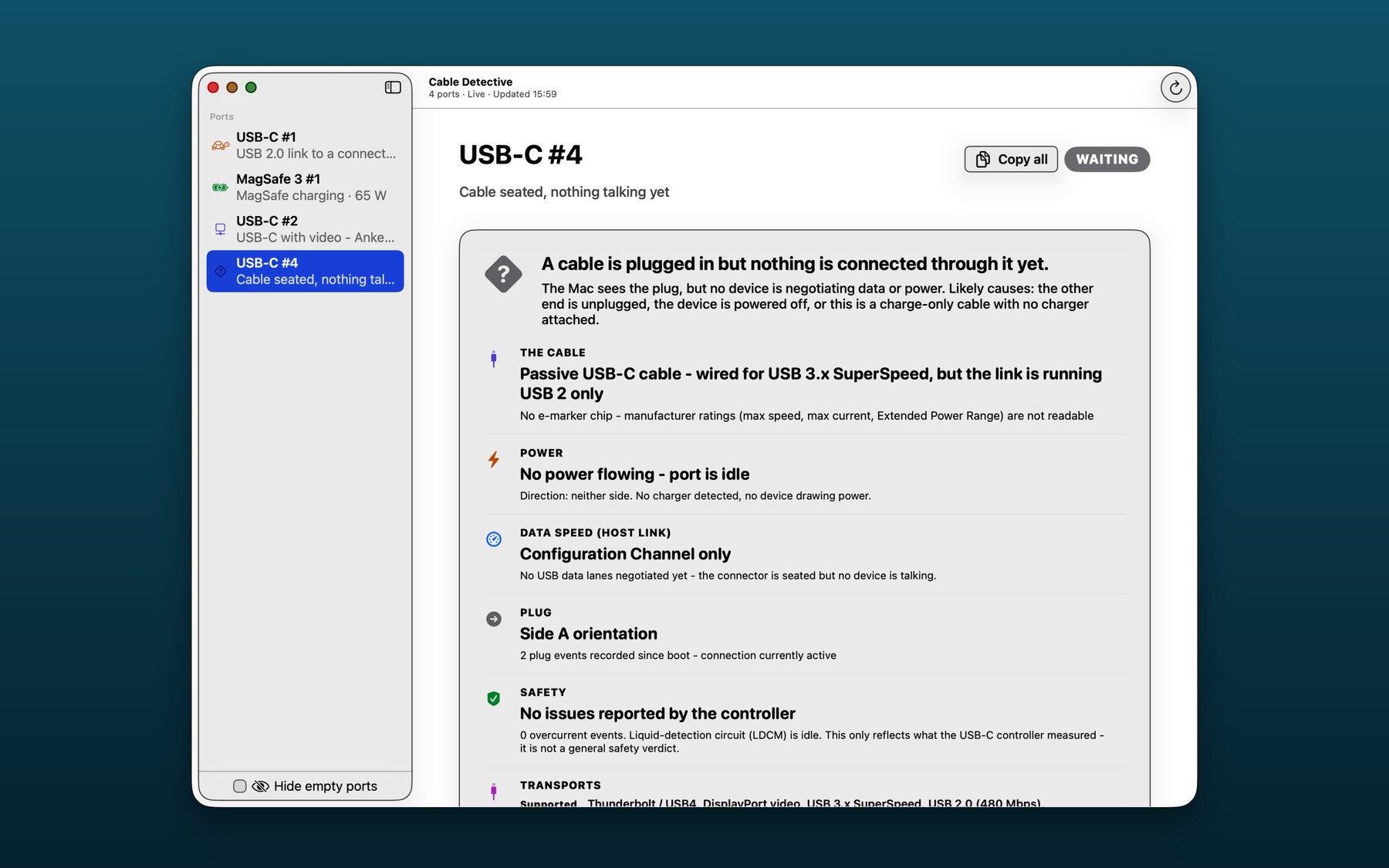
Cable Detective showing USB-C #4 with a cable seated but nothing connected - waiting state, no power flowing, configuration channel only.

Cable seated, nothing talking - The Mac sees the plug but no device is negotiating. Likely the other end is unplugged, the device is off, or it's a charge-only cable with no charger attached.

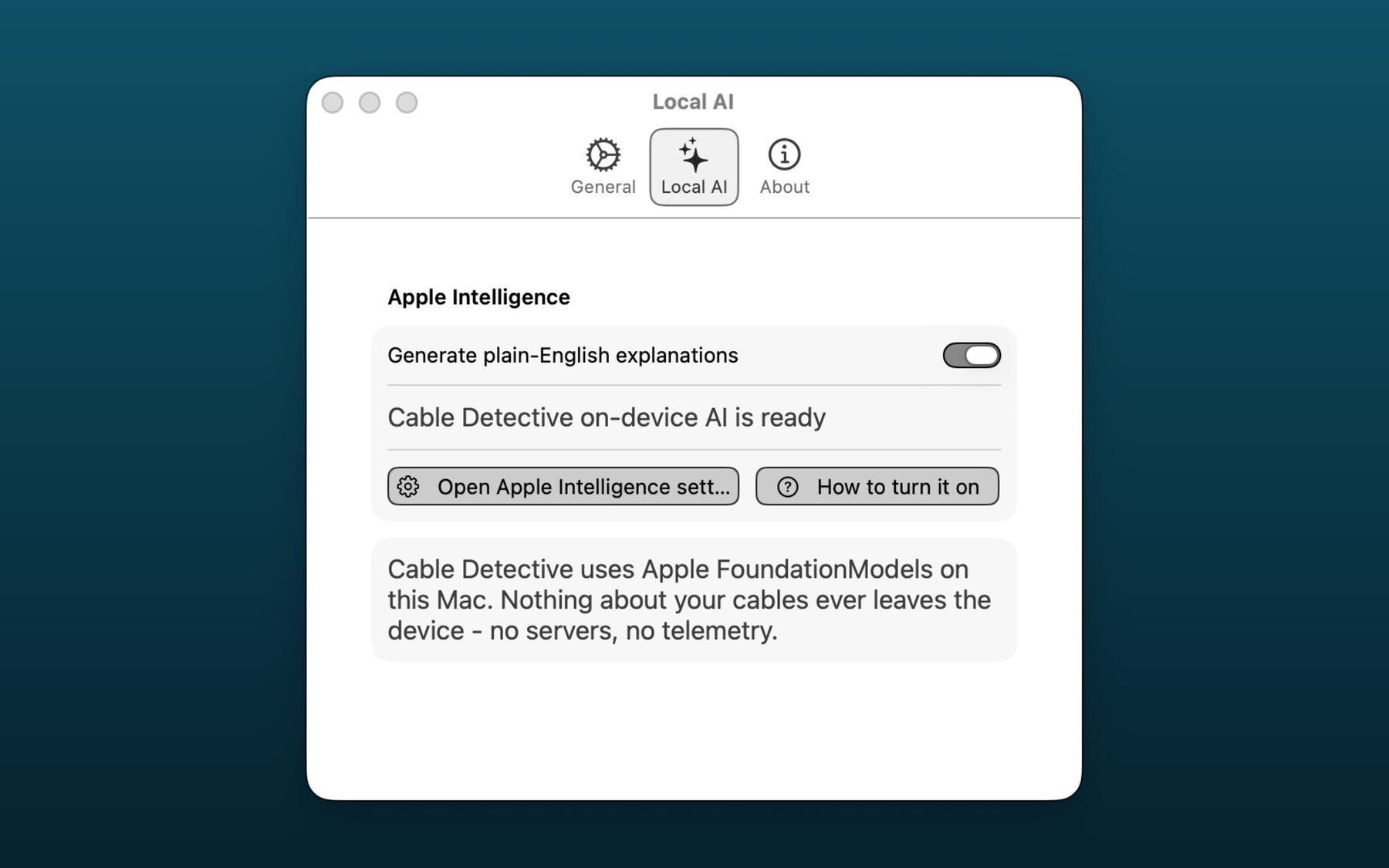
Cable Detective Settings - Local AI tab. The Apple Intelligence section has buttons that deep-link directly to the macOS Apple Intelligence settings pane and to Apple's official 'Turn on Apple Intelligence' guide.

Local AI - Apple Foundation Models, on-device only. Buttons deep-link straight to the macOS Apple Intelligence pane and the official Apple activation guide. Nothing leaves your Mac.

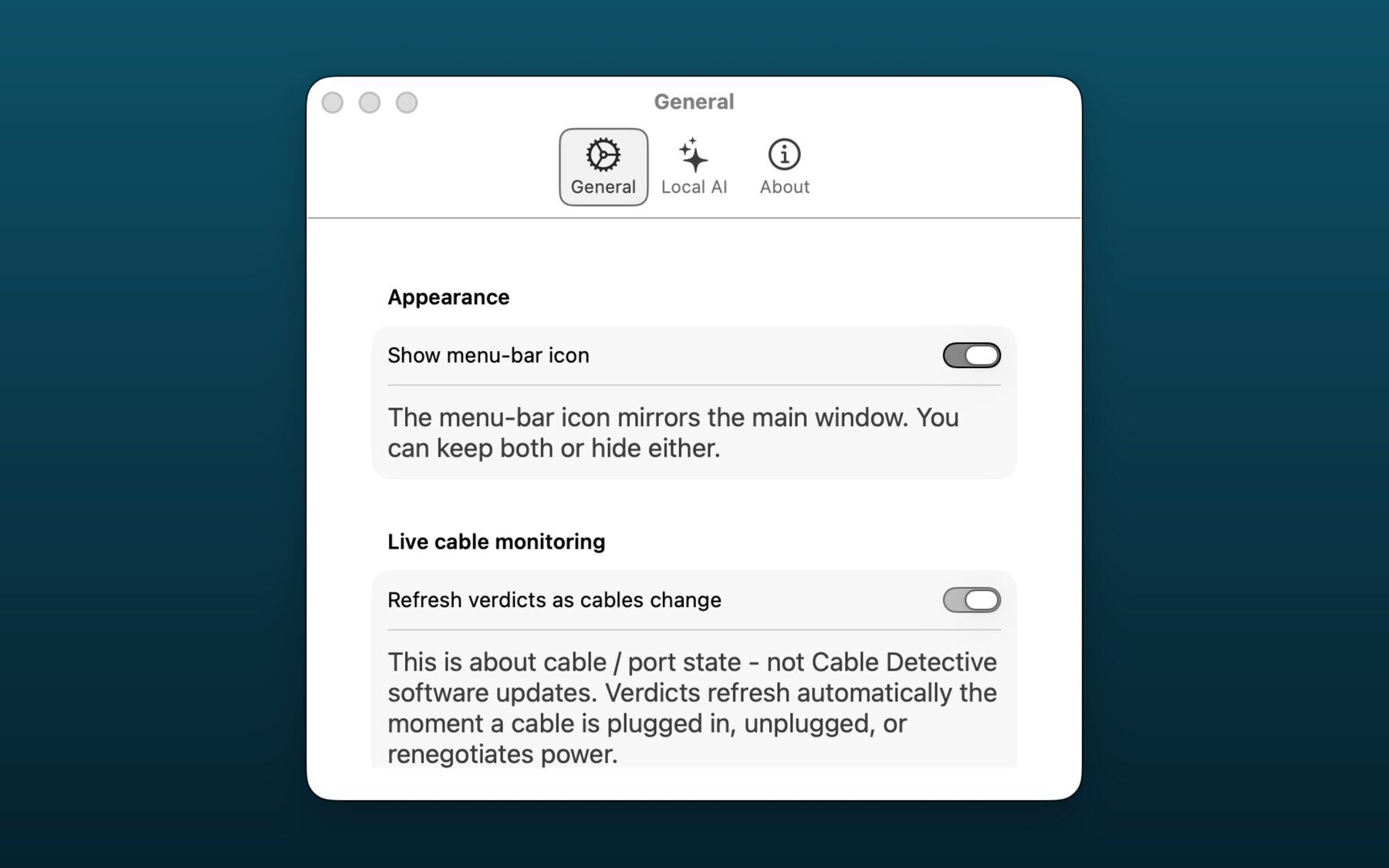
Cable Detective Settings - General tab. Live cable monitoring section explains that verdicts refresh automatically and the section is about cable state, not Cable Detective software updates.

Live cable monitoring - Verdicts refresh the moment a cable is plugged in, unplugged, or renegotiates power. No polling, no flicker, no software updates pinging.

10 cable problems this app actually solves.

Every one of these is a real pain point people post about. Cable Detective tells you which side - the cable, the charger, the device, or the port - is the cause. No guessing.

  1. "My MacBook is charging way slower than it should." The label says 96 W, the Mac says 30 W. Cable Detective shows the negotiated USB-PD contract, every PDO the charger advertised, and whether the cable's e-marker rating is the bottleneck (un-e-markered cables cap at 60 W).
  2. "I plugged in an external display and got nothing." Some USB-C cables carry data only and no DisplayPort lanes. Cable Detective shows whether DP-Alt Mode is active, how many lanes are running, at what link rate (RBR/HBR/HBR2/HBR3/UHBR), and how many display sinks the controller sees.
  3. "My USB-C SSD is writing at 40 MB/s instead of 1 GB/s." The cable says SuperSpeed on the box but the link is running USB 2. Cable Detective shows active vs supported transports for that exact port, so you know whether the cable, the enclosure, or the host downgraded the link.
  4. "Is this cable counterfeit?" Real USB-C accessories carry a PD e-marker chip with a USB-IF vendor ID. Cable Detective decodes the SOP / SOP' / SOP" identity, shows the vendor against the official USB-IF database, and tells you if the cable simply has no e-marker (very common, not necessarily fake, but caps power at 60 W).
  5. "My Thunderbolt dock isn't running at full speed." Thunderbolt 4 vs USB4 vs USB-C 3.x are easy to confuse. Cable Detective shows the actual Thunderbolt link speed for that port and whether the dock negotiated TB or fell back to USB-C.
  6. "Cable Detective said 'liquid detected' before macOS even popped a warning." The USB-C controller exposes a Liquid Detection (LDCM) signal long before the system-level dialog appears. We surface it directly so you can stop charging before damage spreads.
  7. "This cable works in port 1 but not port 4." Different USB-C ports on the same Mac can have different controller chips and capabilities. Cable Detective shows you the per-port active and supported transport list, the controller chip, the firmware revision, and the plug event count - so you can see when a port has been physically damaged.
  8. "My Anker hub disappeared from the system." When a hub is connected the Mac sees one USB topology root and many devices behind it. Cable Detective lists every device attached behind the hub, in physical port order, with vendor IDs and class info - so you know whether the hub itself is gone or just one downstream device.
  9. "I'm travelling and want to know if this random charger is really 100 W." Cable Detective shows the charger's full PDO menu (every voltage / amperage offer it advertises), the rated maximum, and the watts you are actually pulling right now. If a no-name charger only advertises 5 V / 3 A, you'll know before you trust it overnight.
  10. "I have a drawer full of identical-looking USB-C cables. Which one is which?" Plug each cable in for a few seconds. Cable Detective reads the e-marker chip (when present) and shows the vendor (decoded against the USB-IF database), product ID, declared speed class, current capability and EPR support. For cables with no e-marker chip - very common - it shows what the cable actually negotiates with your Mac, so you can tell a real SuperSpeed or Thunderbolt cable apart from a charge-only USB 2 cable by behaviour, not by squinting at moulded plug colours.

Zero network. Not a slogan.

Cable Detective has no network entitlement. The app has no servers, no account, no telemetry, no analytics SDK, no crash reporting. The optional AI explanations run on Apple's on-device Foundation Models on your Mac.

If we wanted to phone home, we would need to ship a new build with new entitlements. We don't.

When you tap “Did we get something not quite right?”, the app copies a redacted report to your clipboard and opens your browser. You decide there what to send. The app itself never speaks to a server.

Read the full Privacy Policy

Requirements

Mac
Apple Silicon (M-series). Intel Macs not supported.
macOS
26 (Tahoe) or later.
AI feature
Optional. Requires Apple Intelligence enabled in System Settings.
Permissions
USB device entitlement. No file access, no network, no camera, no microphone.

Pricing

Free

No subscription. No account.

  • Free on the Mac App Store, for starters.
  • No account. No cloud. No telemetry.
  • Family Sharing supported via Mac App Store.
  • Source: closed. Distribution: Mac App Store.

Download on the Mac App Store

Common questions

Why does my "USB-C" port only do USB 2.0?
Because the cable, the host port, or the device chose to. Cable Detective tells you which one. SuperSpeed needs a SuperSpeed-capable cable on a SuperSpeed-capable port — many bundled cables are USB 2.0 only.
It says my charger is delivering 86 W. The label says 96 W. Bug?
No. 86 W is the negotiated USB-PD contract right now (laptop's request × charger's offer × cable rating). The charger's capability is on the box; the negotiated contract is what's actually flowing.
Can it tell me if my cable is fake?
It can tell you what the cable's e-marker chip claims (or that it has none). It cannot test the conductor quality. A cable that lies in its e-marker is rare; a cable with no e-marker chip at all is common and limits negotiated wattage to 60 W.
Does it work on Intel Macs?
No. Apple Silicon only.
Does the AI explanation send anything to a server?
No. It uses Apple's on-device Foundation Models. The app has no network entitlement at all.
How much does it cost?
Free, for starters. Cable Detective is currently free on the Mac App Store. No subscription, no account, no recurring charge, no upsell, no in-app purchase. Just download it and use it. Pricing may change in a future version, but the version you download is yours.