

惯性聚合 高效追踪和阅读你感兴趣的博客、新闻、科技资讯
阅读原文 在惯性聚合中打开

推荐订阅源

GbyAI
GbyAI
T
Tenable Blog
Webroot Blog
Webroot Blog
L
Lohrmann on Cybersecurity
S
Securelist
S
Schneier on Security
NISL@THU
NISL@THU
Know Your Adversary
Know Your Adversary
C
Cybersecurity and Infrastructure Security Agency CISA
T
The Exploit Database - CXSecurity.com
L
LINUX DO - 热门话题
C
CXSECURITY Database RSS Feed - CXSecurity.com
O
OpenAI News
I
Intezer
Threat Intelligence Blog | Flashpoint
TaoSecurity Blog
TaoSecurity Blog
S
Secure Thoughts
Application and Cybersecurity Blog
P
Privacy International News Feed
H
Hacker News: Front Page
N
Netflix TechBlog - Medium
M
MIT News - Artificial intelligence
博客园 - Franky
PCI Perspectives
PCI Perspectives
OSCHINA 社区最新新闻
OSCHINA 社区最新新闻
Microsoft Azure Blog
MongoDB | Blog
MongoDB | Blog
L
LangChain Blog
P
Proofpoint News Feed
S
Security Affairs
WordPress大学
WordPress大学
The Last Watchdog
The Last Watchdog
S
SegmentFault 最新的问题
小众软件
小众软件
F
Full Disclosure
博客园 - 叶小钗
cs.AI updates on arXiv.org
T
The Blog of Author Tim Ferriss
Simon Willison's Weblog
P
Palo Alto Networks Blog
Security Latest
Security Latest
P
Proofpoint News Feed
月光博客
月光博客
T
Tailwind CSS Blog
Scott Helme
Scott Helme
Hacker News - Newest:
Hacker News - Newest: "LLM"
Google Online Security Blog
T
Threat Research - Cisco Blogs
Help Net Security
Help Net Security
Project Zero
Project Zero

Show HN

CSP Radar GitHub - awebai/aweb-team-coord-worktrees: An aweb team template for a minimum team with a permanent coordinator and worktrees with local developers. GitHub - fujibee/agmsg GitHub - lucastononro/notify: 100% local, free, offline attention skill for Claude Code: plays a sound and speaks a short status update when a long task finishes, blocks, or needs a decision. GitHub - sebastianwessel/skills: AI Skills tivatdoar / workout-to-work · GitLab GitHub - enumura1/py-sql-cleaner: Find, format, and safely extract embedded SQL from Python files. GitHub - intent-bench/intent-bench: Intent fulfillment benchmark for agentic AI engineering GitHub - steveking-gh/firmion: Firmion is DSL and engine for firmware image generation. GitHub - villagesql/villagesql-skills: Agent skills for VillageSQL - gemini-cli-extension; claude-code-plugin GitHub - 0gsd/enough: a personal language system for planning, writing, and translation. GitHub - Kaelio/ktx: ktx is an executable context layer for data and analytics agents 🐙 Allow Claude Code, Codex, and any AI agent to query data accurately through MCP with skills, memory and a semantic layer GitHub - ThatXliner/xtras: Xliner's Claude Code Skills GitHub - flightdeckhq/flightdeck: Observability and control plane for AI agents. GitHub - search-router/simple-search: Open-source reference app on top of the Search Router API: FastAPI + Jinja metasearch service with pluggable backends, deterministic mocks (no API key needed), RTL UI, Redis cache, and a demo ads cabinet. CSP Radar GitHub - Light-Heart-Labs/DreamServer: Turn your PC, Mac, or Linux box into an AI server. LLM inference, chat UI, voice, agents, workflows, RAG, and image generation. GitHub - Diplomat-ai/diplomat-agent-ts: What can your TypeScript AI agent do to the real world? Scan your code. See which tool calls have zero checks Code Block Selector - Visual Studio Marketplace Prometheus dependency graph — interactive showcase | Riftmap Show HN: I made a vi-like modal keyboard plugin for Figma GitHub - run-llama/liteparse: A fast, helpful, and open-source document parser GitHub - dalemyers/Roar: A macOS CLI tool for notifications GitHub - district-solutions/open-agent-tools-coder: Enables small-to-large self-hosted ai models to use local source code when running tool-calling agentic workloads. We actively data mine 20,900+ (2+ TB) popular github repos using large and small ai models to create reuseable: json, markdown and parquet files for local-first tool-calling models. GitHub - progapandist/stripeek: A local TUI proxy for real-time Stripe API debugging, built for navigating complex payloads fast. GitHub - sir1st/hermes-desktop: All-in-one cross-platform desktop app for Hermes Agent — bundles Python + hermes-agent + hermes-web-ui GitHub - astefanutti/shaderbang: Shebang for Shaders Show HN: Generate Claude Code Workflows using Spec Driven Development approach GitHub - nixys/nxs-universal-chart: The Helm chart you can use to install any of your applications into Kubernetes/OpenShift Show HN: AI agents for UK GDAD PCF roles and their skills The Two Pillars: Mixer Mode and Meta-Software in the Reorganization of Software Work After AI GitHub - JaiCode08/teleport-env What 1,000+ Harness Experiments Taught Me About Self-Improving Agents Show HN: Liiists, a Markdown-first, iOS and CLI list app SwiperTab – Get this Extension for 🦊 Firefox (en-US) GitHub - kouhxp/fftext: Summarize, explain, fact-check, or translate any text, URL, or file. No GPU. No cloud. One command GitHub - sweetpad-dev/sweetpad: Develop Swift/iOS projects using VSCode GitHub - dogmaticdev/IRON: IRON a.k.a. Intermediate Representation Object Notation is a Interpreter/Database that is used to create Programming Languages. GitHub - sjhalani7/vaen: Package your AI coding harness into a portable .agent file, and share it across repos, teams, & the community without ever having to copy-paste instructions, skills, MCP config, or secrets. Show HN: Gandalf the Grader Show HN: Citadeld – replay any CI failure locally from a single file GitHub - tdortman/cuSBF: High-Performance GPU Super Bloom Filter coral-ai/claude-code-token-xray at main · Coral-Bricks-AI/coral-ai GitHub - ulyssestenn/funes: Funes is a Git-based framework for LLM-managed knowledge work: an AI Librarian ingests raw sources, builds an interlinked Markdown knowledge base, and uses it to produce cited reports, analyses, and other outputs. GitHub - ThatXliner/gah: Git Add Hunk, built for agents to use GitHub - harmont-dev/harmont-cli: Command-line client for the Harmont CI platform GitHub - brooksmcmillin/mcp-authflow: OAuth 2.0 Authorization Server framework for MCP servers GitHub - javaid-codes/audit-supply-chain-agents GitHub - amorey/gochan: A small library of common channel architectures for Go, inspired by Rust GitHub - arifozgun/OpenGem: Free, Open-Source AI API Gateway with Gemini, OpenAI & Anthropic Compatibility in 1 file GitHub - Pranesh950/BioPetals: 🌸 Run BIOxAI models at home, BitTorrent-style. Fine-tuning and inference up to 10x faster than offloading GitHub - cnguyen14/bounty-doctor: Diagnose a GitHub bounty issue before you waste hours: detects honeypot scam repos, AI-bot attempt swarms, and stale contests. Show HN: CoreMCP – MCP Server for On-Prem DBs Show HN: KittyHTML – Render HTML/CSS as an inline image in your terminal GitHub - bingud/filemat: Web-based file manager Show HN: TruthLens – Free multi-signal deepfake image detector GitHub - apexlocal-jz/claude-usage-tray: Windows system-tray app showing your Claude Code rate-limit usage at a glance. Zero deps, ~300 lines of PowerShell. Cross-IDE (works regardless of VS Code, Cursor, plain terminal). Release v0.1.2.1 · kouhxp/yapsnap GitHub - noopolis/moltnet: Self-hostable chat network for AI agents. Pre-built bridges for Claude Code, Codex, and the Claws. Rooms, DMs, history. No Slack bots, no Matrix, no glue code. GitHub - tamerh/enju: Coordinating Humans, AI Agents, and Compute as Peers on a Shared Workflow Graph Show HN: Continuity-auth – Respect-weighted rate limits for the open web GitHub - luml-ai/luml: AI lifecycle platform where engineers and agents track experiments, train models, and ship to production. GitHub - mrdanielcasper/CoreTex: A UNIX-inspired, biomimetic, flat-file AI harness and knowledge engine. GitHub - clemg/pierre-github: Pierre's diffs.com and trees.software for Github GitHub - lyriks-io/unspaghettit: Behavior-driven AI development without prompt spaghetti. GitHub - sofumel/claude-handoff-revive: Resume Claude Code work after rate/usage/context limits without replaying the prior transcript. Auto-saves at 90%/95% usage. Plugin-installable, 10 languages. GitHub - dotexorg/saferpc: Typed, end-to-end encrypted RPC over any bidirectional channel. GitHub - BeeZeeAgent/beezee: Agent harness orchestration Legato Next.js Boilerplate for Internal Tools · CoreUI GitHub - clark-labs-inc/clark-hash: Clark Hash, 32x smaller searchable sketches for embeddings GitHub - ZeroPointRepo/youtube-mcp: The fastest YouTube transcript + YouTube search MCP for AI agents. Try for free. Typing Mastery — climb toward 100+ WPM, deliberately GitHub - Andebugulin/Awareen GitHub - fayzan123/claude-workflow-composer: Visual desktop app for composing multi-agent coding workflows. Drag agents, attach skills and MCPs, wire handoffs, export to .claude/ GitHub - StackOneHQ/stack-nudge We hardened an LLM agent. Each defense we added made it more exploitable. GitHub - alkait/WhatsKept: Agent-queryable WhatsApp history from an iOS backup — a single Go binary. GitHub - octelium/cordium: Open-source, general-purpose sandbox platform for devs and AI agents that provides identity-based secure access to infrastructure without credentials. GitHub - scosman/videowright: Build animated explainer videos with your coding agent GitHub - dipankar/dscode: The code editor you can take apart. GitHub - zoharbabin/web-researcher-mcp: MCP server (Go) for AI assistants: web search, content extraction, academic/patent/news research. Multi-provider routing, 4-tier scraping, search lenses. Works with Claude, Cursor, and any MCP client. GitHub - scanaislop/aislop: Catch the slop AI coding agents leave in your code: narrative comments, swallowed exceptions, as-any casts, dead code, oversized functions. 50+ rules across 7 languages (TypeScript, JavaScript, Python, Go, Rust, Ruby, PHP). Sub-second, deterministic, no LLM at runtime. MIT-licensed. GitHub - kouhxp/cheap-im: CPU-only voice agent approximating Thinking Machines' Interaction Models demo GitHub - unprovable/OrchidMantis: Orchid Mantis — standalone framework for Zero-Knowledge Proofs of eXploit (ZKPoX). GitHub - TangibleResearch/Halgorithem: A Algo designed to detect AI Hallucitions GitHub - CarpseDeam/Aura-IDE: An AI coding harness that shaped itself - Planner/Worker agents, repo awareness, surgical edits, validation, recovery, and safe diff approvals. GitHub - chojs23/concord: A feature-rich TUI client for Discord GitHub - aerf-spec/aerf: Agent Evidence Receipt Format (AERF) — an open specification for tamper-evident, independently verifiable records of AI agent actions. GitHub - Jwrede/tokentoll: Catch LLM cost changes in code review. Infracost for LLM spend. GitHub - samchon/ttsc: A `typescript-go` toolchain for compiler-powered plugins and type-safe execution + 500x faster lint integrated into compiler GitHub - Higangssh/homebutler: 🏠 Manage your homelab from chat. Single binary, zero dependencies. GitHub - olalie/tapmap: See where your computer connects and what stands out on a live world map. GitHub - Diplomat-ai/diplomat-agent: What can your AI agent do to the real world? Scan your code. See which tool calls have zero checks GitHub - Bajusz15/beacon: Open-source agent for secure remote access, monitoring, and deploys across home-lab and self-hosted machines like Raspberry Pi, N100, or any Linux server. Open web based TTY or tunnel Home Assistant and other local services securely without opening ports. BigTech AI News - Chrome 应用商店 GitHub - vinhnx/VTCode: VT Code is an open-source coding agent with LLM-native code understanding and robust shell safety. Supports multiple LLM providers with automatic failover and efficient context management. GitHub - Lumen-Labs/brainapi2: BrainAPI is a knowledge graph–powered AI memory layer that transforms unstructured data into structured knowledge, enabling intelligent search, recommendations, and contextual memory for AI agents and applications. GitHub - familiar-software/familiar: Let AI watch you work. Familiar lets your AI update its memory, skills, and knowledge by watching your screen. make sidebar/address bar rounded corner toggleable
Agent Security Stack — bondage + envchain-xtra + nono
nvk · 2026-06-03 · via Show HN

Reality check: this stack is still experimental. It is a practical local hardening pattern, not a finished security product. If you want the strongest isolation boundary for an agent, a dedicated VM is still better than a host-local CLI sandbox.
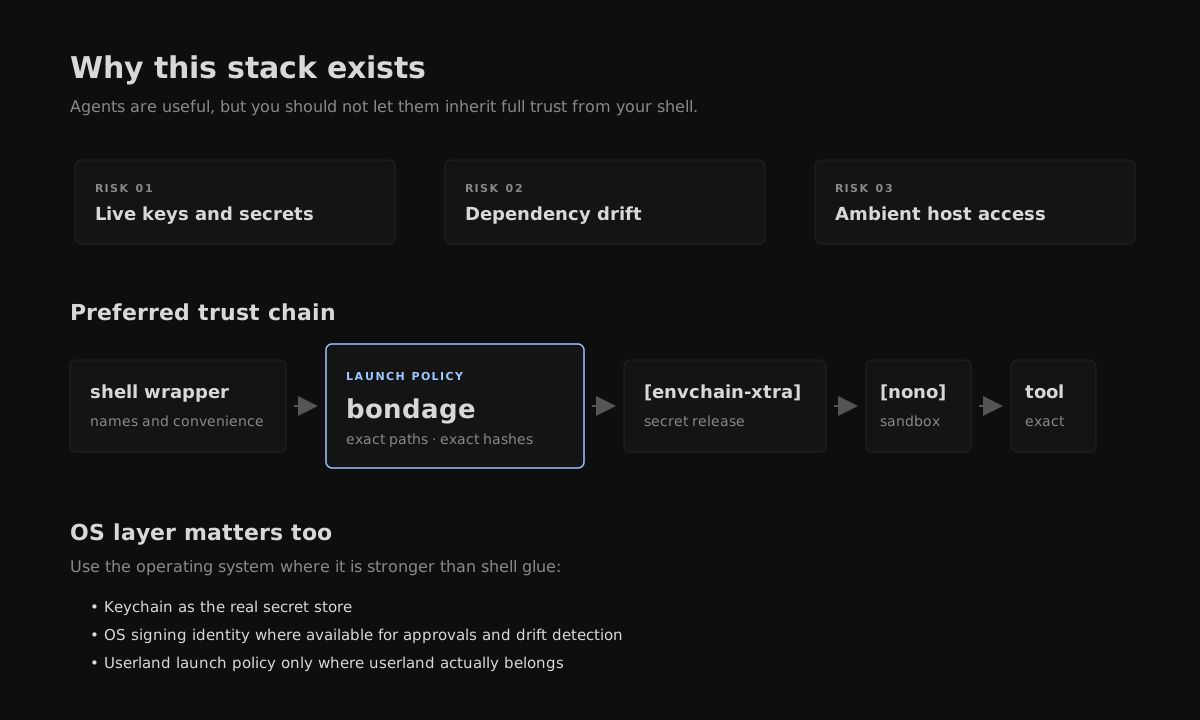
Diagram showing the agent security stack: shell wrapper to bondage to optional envchain-xtra to optional nono to exact pinned tool, with the core risks listed as live keys, dependency drift, and ambient environment access.
The point of the stack is not ceremony. It is to narrow trust around secrets, dependency drift, and host access.

1. Why this stack exists

By default, most agent setups inherit too much trust from the surrounding shell session. That means too many secrets, too much filesystem visibility, and too much confidence in whatever dependency tree happens to answer on PATH.

The actual reasons for hardening this are not abstract:

  • you do not want agents running loose with live API keys and other secrets
  • you cannot assume the dependency tree behind a familiar command is clean or stable
  • you do not want broad ambient access to shell state, config files, and local environment by default

The old pattern for hardening CLI agents was to stuff everything into shell wrappers: secret injection, Touch ID gates, sandbox flags, target resolution, and sometimes even binary verification. That can work, but it makes your shell script the real security boundary.

The cleaner model is to separate the jobs:

shell name → bondage → [envchain-xtra] → [nono] → exact pinned tool convenience launch policy secret release sandbox actual agent

That split matters because each layer addresses a different failure mode: bondage decides what exact artifact chain is allowed to launch, envchain-xtra decides when secrets are released, and nono decides what the launched process can actually touch.

It also deliberately leans on the OS where the OS is stronger than userland glue: macOS code-signing identity can be used as part of artifact approval, and Keychain remains the underlying secret store rather than re-implementing secret storage in the launcher.

If you want the implementation detail rather than the overview, start with agentbondage.org, then read the Getting Started and Trust Model docs.

2. Philosophy

This stack is opinionated. The philosophy is not “wrap everything in enough cleverness and call it secure.” It is to reduce ambient trust and make the risky decisions explicit.

  • Prefer explicit trust over ambient trust. Exact paths, exact hashes, explicit profiles, explicit secret release.
  • Use the OS for what the OS is good at. Keychain for secret storage, signing identity where available, kernel sandboxing for enforcement.
  • Keep layers narrow. Launch policy is not secret storage. Secret storage is not sandbox policy. Shell convenience is not a trust boundary.
  • Assume upgrades are security events. If a binary or package tree changed, re-approve it deliberately.
  • Make escape hatches obvious. If there is a no-sandbox path, it should be explicit and ugly, not a quiet profile drift.

In short: less magic, less ambient authority, more deliberate boundaries.

3. Layer responsibilities

LayerWhat it should doWhat it should not do
Shell wrapper Short names, prompt shaping, convenience aliases Decide which binary is trusted or which sandbox policy applies
bondage Verify exact targets, interpreters, package trees, and choose the launch policy Store secrets or enforce filesystem policy by itself
envchain-xtra Release secrets from Keychain-backed namespaces to one process tree Own the whole launch-policy story
nono Enforce filesystem, process, and network restrictions Resolve which launch artifact chain is trusted

4. Practical patterns

In practical terms: your secrets are already being shipped to frontier labs as tokens they can decode. Don't panic — you can hand this article to your coding agent and ask it to set the stack up for you.

The stack guide should explain the worldview, not carry every operational nuance inline. The sharp edges are better captured as repeatable patterns.

  • vendor-independence — keep instructions, plugins, tool access, and security layers portable across clients instead of baking the workflow into one vendor.
  • claude-to-codex-plugins — take a Claude-first plugin and make Codex first-class without forking the real workflow, using llm-wiki as the case study.
  • visual-inspection — use accessibility trees first, then a narrow localhost screenshot service when pixels actually matter.
  • sandbox-profiles — keep normal coding tight, make broader access explicit, and make true bypasses obvious.

These are the decisions that matter more than the exact command syntax: where the trust boundary lives, which capability gets isolated, and what counts as a real escape hatch.

5. Install

Quick bootstrap

If you want a working starter shape instead of hand-copying every profile, use agent-stack-bootstrap. It installs public templates and shell aliases, while keeping real local paths, fingerprints, hostnames, and tokens in private generated or ignored files.

git clone https://github.com/nvk/agent-stack-bootstrap.git
cd agent-stack-bootstrap
./install.sh
echo 'source "$HOME/.config/agent-stack/shell.zsh"' >> ~/.zshrc

The default install includes every optional public profile group. Pick narrower groups when you only need one path:

./install.sh --profiles spark
./install.sh --profiles ds4,pi-ds4
./install.sh --profiles none

The bootstrap stages bondage.conf.template; it does not install a live pinned ~/.config/bondage/bondage.conf. Render and pin that file locally after the target tools are installed.

The bootstrap also installs requirements.env and a version check helper. As of this guide update, the tested public ranges are nono >=0.61.0 <0.62.0, agent-bondage >=0.2.7 <0.3.0, envchain-xtra >=1.3.1 <2.0.0, node >=26.0.0 <27.0.0, codex >=0.136.0 <0.137.0, claude-code >=2.1.112 <2.2.0, and opencode >=1.14.40 <1.16.0.

Manual install

Start with the launcher and the sandbox:

brew tap nvk/tap
brew install nvk/tap/agent-bondage
brew install nono

The current public baseline is agent-bondage 0.2.7, envchain-xtra 1.3.1 when you use Keychain secret release, and nono 0.61.1. If you use registry-managed nono packs for agent profiles, keep the packs pinned too: always-further/codex@0.0.12, always-further/claude@0.0.16, and always-further/opencode@0.0.5.

If a profile needs Keychain-backed secret injection, add:

brew install nvk/tap/envchain-xtra

Important: `agent-bondage` is the formula name. It installs the bondage executable.

Useful references:

6. Recommended layout

Keep the pieces separate:

~/.config/bondage/bondage.conf
~/.bondage/tools/
~/.config/nono/profiles/
~/bin/

Good setups pin exact absolute artifacts, not PATH lookups or mutable global installs. For script-backed tools, that means pinning the entrypoint, the interpreter, and the package tree.

Minimal starter files

A non-doxing public starting point for the shared launcher config looks like this. Replace every absolute path and hash with values from your own machine.

# ~/.config/bondage/bondage.conf
[global]
envchain = /opt/homebrew/bin/envchain
envchain_fp = sha256:replace-me
nono = /opt/homebrew/bin/nono
nono_fp = sha256:replace-me
nono_profile_root = /Users/you/.config/nono/profiles
touchid = /opt/homebrew/bin/touchid-check
touchid_fp = sha256:replace-me
tool_root = /Users/you/.bondage/tools

[defaults "agent-nono"]
nono_allow_cwd = true
nono_allow_file = /dev/tty
nono_allow_file = /dev/null
nono_read_file = /dev/urandom

[defaults "github-env"]
env_command = GH_TOKEN=/opt/homebrew/bin/gh auth token
env_command = GITHUB_TOKEN=/opt/homebrew/bin/gh auth token

[defaults "codex-target"]
target_kind = native
target = /Users/you/.bondage/tools/codex/0.128.0/codex-aarch64-apple-darwin
target_fp = sha256:replace-me

[profile "codex"]
inherits = agent-nono,github-env,codex-target
use_envchain = false
use_nono = true
nono_profile = codex
touch_policy = none

Use [defaults "…"] blocks for repeated launch policy: common nono device grants, GitHub token injection, target paths, interpreter pins, and package-tree hashes. Each profile must opt in explicitly with inherits = …. Avoid one giant catch-all defaults block; keep defaults narrow enough that repin output tells you exactly what changed.

Then add one [profile "…"] block per client in bondage.conf and one matching JSON profile in ~/.config/nono/profiles/. The old fully-expanded profile format still works, but defaults make upgrades less brittle because a shared target pin can be repinned once instead of repeated across every tier.

A thin shell wrapper should look like this:

codex() {
  bondage exec codex ~/.config/bondage/bondage.conf -- "$@"
}

That wrapper is only naming sugar. The trust boundary is below it.

Keep home-shell startup boring

The login shell itself should not depend directly on a fragile repo symlink. Keep tiny stable bootstrap files in $HOME and let them source the real repo-backed config when it is readable.

# ~/.zshrc
if [ -r "$HOME/src-repo/.dotfiles/zsh/.zshrc" ]; then
  . "$HOME/src-repo/.dotfiles/zsh/.zshrc"
elif [ -r "$HOME/src-repo/.dotfiles/ai/shell.zsh" ]; then
  . "$HOME/src-repo/.dotfiles/ai/shell.zsh"
fi

That looks less clever than a direct symlink, but it fails much better. If the repo path is temporarily unreadable, you still have a stable entrypoint instead of silently falling back to a raw binary on PATH.

If you want concrete examples instead of the generic stack, jump to the tool-specific guides:

7. Operational hardening patterns

The architecture is only half the story. Local launcher stacks get brittle when upgrades, wrappers, and helper scripts are treated as harmless convenience instead of real operational policy.

  • Treat upgrades as security events. Re-pin the launcher after package-manager upgrades and verify the affected profiles before trusting the new toolchain.
  • Keep a named repair tier. A *-fix profile is different from *-unsafe and different again from *-rawdog. Repair access should be explicit and sandboxed where possible.
  • Test helper scripts. Denial helpers and restart suggestions need fixture tests for spaces, quotes, punctuation, and shell-heavy commands. A bad helper is worse than no helper.
  • Keep recovery and canonical state aligned. A temporary rescue path is fine. A permanent split between the rescue path and the real source of truth is not.

A practical post-upgrade loop is:

export BONDAGE_CONF="${BONDAGE_CONF:-$HOME/.config/bondage/bondage.conf}"

brew upgrade nono
brew cleanup nono

bondage --config "$BONDAGE_CONF" repin-globals
bondage --config "$BONDAGE_CONF" doctor
bondage --config "$BONDAGE_CONF" repin codex   # only if doctor suggests it

nono pull always-further/codex@0.0.12 --force
nono pull always-further/claude@0.0.16 --force
nono pull always-further/opencode@0.0.5 --force
nono pin always-further/codex
nono pin always-further/claude
nono pin always-further/opencode
nono list --installed
nono profile show "${NONO_PROFILE:-codex}" >/dev/null

bondage --config "$BONDAGE_CONF" verify codex
bondage --config "$BONDAGE_CONF" chain codex -- --help

If repin updates a defaults block, every profile that inherits that block gets the new pin. That is the point; the command output should make the shared update scope visible. Run brew cleanup nono before repinning globals if your config pins a versioned Homebrew Cellar path; otherwise the old keg can remain valid and keep the launcher pinned to the previous nono. Then open a fresh login shell and confirm your wrapper names still resolve to the expected shell functions.

Use non-doxing checks when you want to paste results into an issue, PR, or agent transcript:

export NONO_PROFILE="${NONO_PROFILE:-codex}"

for path in \
  "$HOME/.ssh" \
  "$HOME/.npmrc" \
  "$HOME/.aws" \
  "$HOME/Library/Keychains"
do
  nono why --profile "$NONO_PROFILE" --path "$path" --op read
done

nono why --profile "$NONO_PROFILE" --path "$HOME/.config/nono/profiles" --op write
nono why --profile "$NONO_PROFILE" --path "$HOME/.config/nono/profile-drafts" --op write

Expected shape: credential paths are denied, active profile writes are denied, and profile-drafts is writable only for profiles that intentionally support draft-and-promote profile edits.

8. Declared Trust Assumptions

This stack only makes sense if you are explicit about what is trusted, what is not, and what you are responsible for maintaining over time.

Trust anchors

  • the OS secret store, especially Keychain on macOS, remains the real place secrets live
  • OS-level signing identity and local fingerprints are valid approval signals for launch artifacts
  • nono and the underlying kernel sandbox are more trustworthy than an agent's own self-reported sandbox mode
  • your local bondage.conf is a policy file you control and review deliberately

What this stack assumes

  • You will pin exact launch artifacts, not just friendly command names.
  • You will re-approve binaries and package trees after upgrades instead of silently inheriting drift.
  • You will treat secret release as a policy decision per profile, not as a convenience default.
  • You will keep shell wrappers thin and avoid moving trust decisions back into shell glue.
  • You will prefer immutable or versioned tool trees over mutable global installs whenever possible.

What this stack does not assume

  • It does not assume a familiar command implies a safe dependency tree.
  • It does not assume npm, Homebrew, or any installer has already solved supply-chain trust for you.
  • It does not assume the agent's own internal sandbox is enough.
  • It does not assume that a prompt injection will stay polite once the model has tool access.

For JS-heavy agents, the real trust object is not the shell command name. It is the launch artifact set:

  • the exact entrypoint file
  • the exact interpreter
  • the exact package tree

9. What this does not solve

This is not a complete supply-chain solution, and it does not magically make agent dependencies trustworthy.

If you bless a compromised artifact tree, you only get a perfectly preserved compromise.

The stack is good at launch-time integrity and runtime containment. It is not magic at acquisition time. That means:

  • global npm installs are still a weak place to start from
  • mutable tool trees are worse than immutable versioned bundles
  • `rawdog` is a real escape hatch and should be treated as such
  • Touch ID gates are local approval signals, not remote attestation
  • a host-local sandbox is still weaker than a dedicated VM boundary

10. Verify before you trust it

Before wiring a tool into your shell, verify the profile explicitly:

bondage verify codex ~/.config/bondage/bondage.conf
bondage chain codex ~/.config/bondage/bondage.conf -- --help
bondage exec codex ~/.config/bondage/bondage.conf -- --help

The sequence matters:

  1. verify confirms the pinned artifacts match what you intended
  2. chain lets you inspect the exact launch chain without executing it
  3. exec proves the real path works

If you need one sentence for the model: keep shell convenience thin, put launch policy in bondage, let envchain-xtra release secrets, and let nono sandbox the result.