





Tabular model for profit targets.
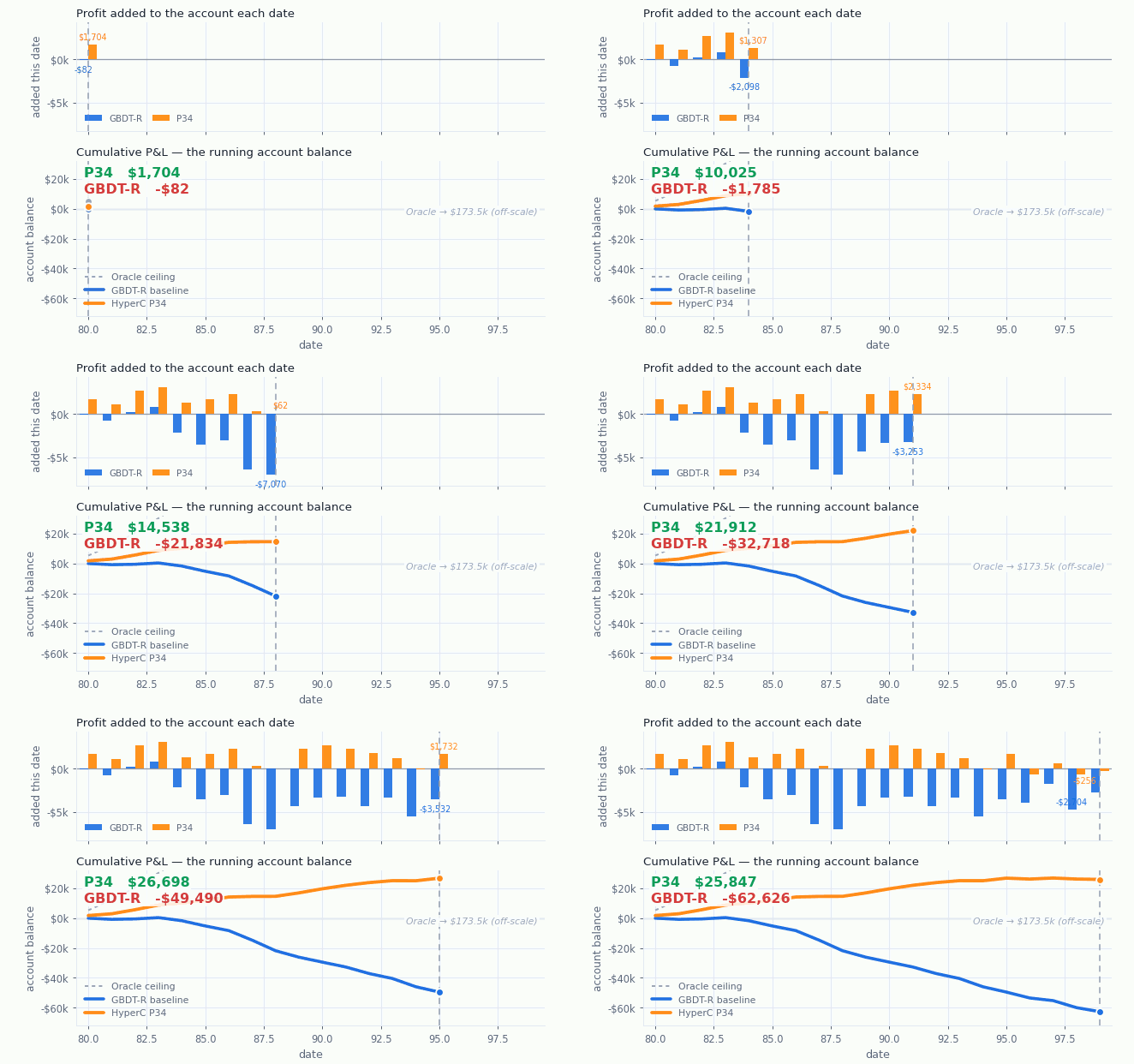
P34 is a Profit-as-Regression model that generates profitable portfolios out of available deals to trade.
It is intended as a replacement for naive tabular data fitting that tends to be too optimistic on real-world markets (above plot).
To create a portfolio out of available trade options, you just need to feed the features to predict:
from P34 import P34

model = P34(api_key)
selected_df = model.predict(
    X_menu=X_df,
    x_keys=x_keys,
    market_type="synthetic_inventory"
)
where X_menu is a dataframe with features and a separate line per qty (sizing of deal), and x_keys - a dataframe with a single key column identifying separate options so that qty will be unique within each key:
| qty | feature_1 | feature.. |  | key |        qty | profit
|-----|-----------|-----------|  |-----|       -----|--------
|  1  |    0.1    |    ...    |  | 123 |     ->  0  |  $0
|  2  |    1.6    |    ...    |  | 123 |     ->  0  |  $0
|  3  |    ...    |    ...    |  | 123 |     ->  0  |  $0
|  1  |    0.3    |    ...    |  | 456 |     ->  5  | $151.3
               (input)                           (predict)
                X_df                            selected_df
the model will predict best qty and profit per each key.
The model accepts previous history of observed trades as a “heavy” context:
from P34 import P34

model = P34(api_key)
selected = model.fit(
  X_historical_df,    # features, one deal per line
  y_historical_df,    # historical profit
  x_historical_keys,  # SKU, ASIN, etc.
  x_historical_dates, # integer dates
  x_historical_menus, # integer menu identifiers
  X_historical_available=None, # 1/0 for each qty line (availability)
  x_historical_choices=None,   # if exact historical choice is known
  market_type="synthetic_inventory"
        # pre-configured markets like "amazon" will be available
)
where X_historical_df is a (dataframe) list of all options that were available (all applications traffic, entire catalogs of inventory available historically, etc.),
y_historical_df - a single profit column dataframe with profit outcomes when available, and None if this option in X_historical_df was historically not traded,
x_historical_keys are key (SKU, ASIN, application_id etc.), and x_historical_dates - integer date columns,
x_historical_menus is a menu_id column that identifies which option belongs to which “menu” (a menu is a list of options that were present for the business to select from at decision time),
market_type is either one of the pre-configured markets, or “grounded” for advanced, fully-custom markets. TBD: advanced mode link.
The resulting table is a list of items to purchase. qty column - the sizing, and profit column - the indicative profit score that gives portfolio-wise prediction estimation. 0 when decided not to trade this option this time.
TBD
TBD
TBD
More computable markets include electricity, collectibles, virtual goods/skins, betting markets, used cars, industrial chemicals, construction materials, retail real estate, and others.
We recommend studying our synthetic benchmarks and requesting early API access to get familiar with the interface and to check if the performance meets your case.
The hard part of biased-data problems isn’t fitting the data — it’s the chain of engineering judgment calls made to compensate for the bias: feature treatment, regularization, conservatism assumptions. Different choices produce very different models, and the one that fits history best is usually the one that’s most over-optimistic on real markets.
P34 treats that space of engineering choices as the problem itself. We enumerate the choices as large, sparse unrolls and score each configuration by a survival criterion: across grounded simulations and real market history, did it avoid losses, stay comparable to the business’s prior performance, and stay close on portfolio-level profit predictions? The final-layer weights are trained against a lifted proxy loss so the model selects the configuration that survives across scenarios — not the one that fits the past best.
Entire historical “menu” must be provided; The model does not speculate on how the past and missed opportunities looked like.
P34 is slow and is designed to exploit inefficiencies of partially observed markets where market data mostly exists in latent space. It has no value in regulated, fully materialized (e.g. where historical order book exists) and high-frequency environments.
We are working hard to assess general limitations and safety issues. Currently, P34 is available upon approval and we’re working with select partners to come up with a safe and ethical usage rules.
The services are provided for technical research, engineering evaluation, and discussion purposes only. They do not constitute investment advice, financial advice, trading advice, a recommendation to buy or sell any asset, or an offer to provide investment-management services. HyperC does not guarantee profit, positive returns, loss avoidance, model accuracy, live-market performance, or suitability for any particular market, business, trading strategy, or investment decision. All benchmark results shown here are experimental and may not generalize to real-world deployment. Any use of P34 or related PARML methods in a live business or trading environment requires independent validation, risk controls, compliance review, and professional judgment.
Please contact us.

The HyperC team.
© 2026 HyperC (CriticalHop Inc)
+1 650 388 94 99
Santa Clara, CA
info@hyperc.com
Request Early Access | Support | Join us
此内容由惯性聚合(RSS阅读器)自动聚合整理,仅供阅读参考。 原文来自 — 版权归原作者所有。