


You’ve doubtless heard of hybrid cars, but what about a hybrid cement or glass plant? Likely not, since nearly all of them today run on fossil fuels. But that might change soon — one startup has developed a way to incorporate electric heat into existing facilities. And like a hybrid car, it lets companies save money while also using fewer fossil fuels.
“We hybridize industrial processes,” Carlos Ceballos, co-founder and CEO of NOC Energy, told TechCrunch. “Most companies are willing to electrify, but they don’t want to get rid of fossil fuels yet. In the energy transition, they want to have the opportunity to choose the lowest cost.”
NOC has developed a form of electric heating that can bolt onto existing fossil fuel-fired facilities. Heat from its system can be piped into a glass kiln or various parts of the cement production process. If the cost of electricity rises, the operator can switch it off NOC’s equipment and rely solely on fossil fuels.
Perhaps more important, the startup can deliver heat at temperatures reaching 1,200˚ C, and Ceballos said the company is working toward 1,500˚ C. Those temperatures have been hard to achieve with anything other than fossil fuels or hydrogen, the latter of which is currently too expensive in its non-polluting form. The field doesn’t have many entrants so far — Startup Battlefield alumnus Electrified Thermal Solutions stands out as one potential competitor.
NOC recently raised a $2.7 million seed round, the company exclusively told TechCrunch. The round was led by 360 Capital with participation from SOSV and Desai VC.
NOC’s first customers will likely choose the hybrid format, though they won’t have to if they don’t want to. NOC’s system can store heat for hours on end, allowing companies to use more electricity when the price is cheap — like when the wind is howling or the sun is beating down — and draw on the stored heat when the price spikes.
There are a few elements to NOC’s system that make both hybridization and electricity price arbitrage possible. The first is the induction heating element, which is similar in concept to induction stoves installed in kitchens around the world. Induction heaters use metal coils, usually made of copper, to produce magnetic fields when electricity courses through them. Those magnetic fields cause atoms in certain nearby metals, like steel, to vibrate quickly, generating heat.
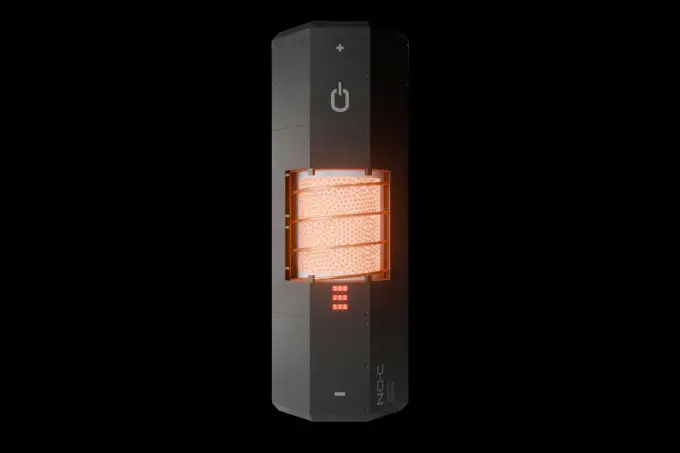
In NOC’s system, the induction coils go to work on steel spheres that are packed inside large ceramic containers that are 2.5 meters (around 8 feet) across. Wrapped around the containers are the heat-inducing copper coils and heat-conserving insulation. When heat is needed, electricity flows through the copper and warms the steel spheres. Air blown through the spheres extracts the heat and delivers it to where it’s needed, like a glass kiln or a section of a cement plant.
Now, NOC’s approach isn’t the only way to make heat that hot using electricity. Resistive heaters, similar to those found in toasters, can get the job done. But the higher the heat, the shorter their lifespan. At 1,000˚ C, specialized resistance heaters only last around 12 months, Ceballos said. At 1,200˚ C, that drops to three months, he added.
NOC’s heating elements — the copper coils — sidestep that problem entirely because they never come into contact with the heat they generate. That’s the beauty of induction heating — the coils are embedded in half a meter (about 20 inches) of insulation, staying at room temperature while casting their electromagnetic waves inward to the steel spheres.
The insulation is thick enough that NOC’s system can store heat for hours on end. The startup can size the system based on how long a customer wants to store the heat. For longer durations, NOC will stack more container modules on top of each other and pack them with more steel spheres.
The startup has run a refrigerator-size pilot-scale system for 15,000 hours so far, and has built two much larger demonstration systems, one for a glass manufacturer and another for a cement producer, both in France. Those systems should be switched on in May.
“Being hybrid allows them to derisk the future,” Ceballos said. “Given the geopolitical problems today, it’s very attractive.”
When you purchase through links in our articles, we may earn a small commission. This doesn’t affect our editorial independence.
Tim De Chant is a senior climate reporter at TechCrunch. He has written for a wide range of publications, including Wired magazine, the Chicago Tribune, Ars Technica, The Wire China, and NOVA Next, where he was founding editor.
De Chant is also a lecturer in MIT’s Graduate Program in Science Writing, and he was awarded a Knight Science Journalism Fellowship at MIT in 2018, during which time he studied climate technologies and explored new business models for journalism. He received his PhD in environmental science, policy, and management from the University of California, Berkeley, and his BA degree in environmental studies, English, and biology from St. Olaf College.
You can contact or verify outreach from Tim by emailing tim.dechant@techcrunch.com.
此内容由惯性聚合(RSS阅读器)自动聚合整理,仅供阅读参考。 原文来自 — 版权归原作者所有。