






If you’ve ever played a role-playing game (RPG), you know how fun it is to create your character in any way you choose and embark on epic adventures. Now, picture an AI-powered, text-based RPG where every interaction with a non-player character (NPC) is completely unscripted.
Latitude, the startup known for its open-ended text adventure games featuring “infinite storylines” generated by AI, recently unveiled its new platform that allows users to step into the role of game designers.
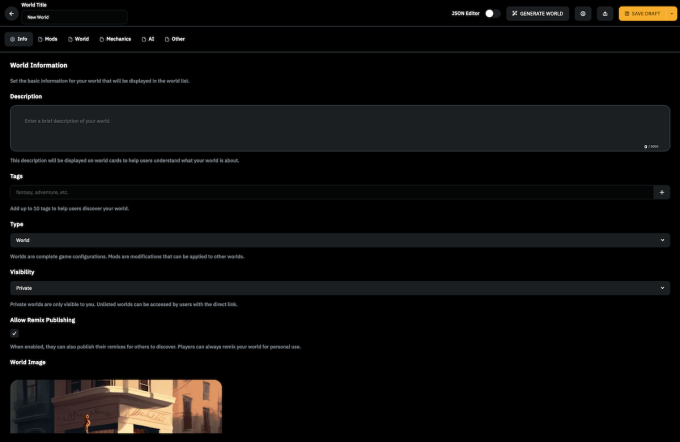
This AI-driven RPG platform, called Voyage, enables players to design their own gaming worlds with the help of AI. Players can describe their settings, including details such as regions, cities, landmarks, main quests, and villains. They can also establish game mechanics like abilities, leveling systems, and combat challenges.
For example, if you want to create a fishing village haunted by a sea monster, the AI will generate the necessary code to bring that idea to life. You can customize your world further before sharing it with others to play.
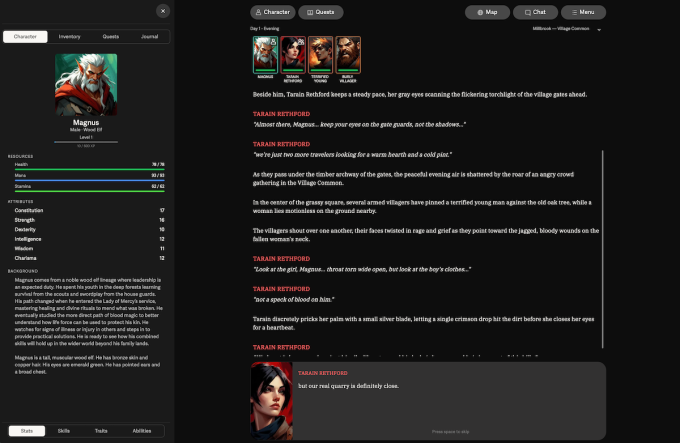
For players, Voyage’s platform offers a range of experiences across different genres, from cozy adventures to more hardcore quests. Because it’s text-based, players read along with the story (with audio narration available) and type how they want their character to act.
Unlike traditional RPGs, if a character is facing a goblin attack, instead of the typical options to run, fight, or hide, players can choose unique scenarios like becoming a goblin therapist, helping the creatures with their issues instead of resorting to violence.
When players enter their desired actions, the AI narrates the outcome, including how the NPCs respond. Because there’s no fixed script, interactions can veer in unexpected directions, often leading to surprising and sometimes weird conversations. For instance, during our testing, a troll who had tied up our character started to unload about his marriage troubles.
Character progression, meanwhile, depends on the character’s skills and a little luck, much like rolling dice in tabletop games. Each character can also unlock special abilities as they defeat bosses or finish quests, such as using “Counterspell” to stop an enemy from using magic. (Several abilities in Voyage draw inspiration from classic Dungeons & Dragons spells, which is fun!)
And, if players ever find themselves stuck, there’s a chatbot available to suggest actions or even skip to different parts of the story.
At the core of Voyage is Latitude’s World Engine, a system that took the company five years to develop. This engine leverages multiple AI systems that can narrate actions, manage gameplay, track characters and objects, and remember backstories and relationships, ensuring continuity throughout the game. So, instead of generic NPCs with repetitive lines, players encounter characters who remember previous interactions. For instance, if you betray a character’s trust, they may choose to avoid you or become a rival in future encounters.
“Characters aren’t just reactions to you, but have their own personality backstory, that react to you in ways that feel like real, and that’s really part of the magic of the engine,” Latitude CEO and co-founder Nick Walton told TechCrunch.
Latitude first made waves in AI-native gaming with the launch of AI Dungeon in 2019, which attracted millions of players.
“It exploded on the internet as one of the first times people interacted with generative AI,” Walton said. “It sort of established that initial promise of what would happen if we could have games and worlds that aren’t all predefined in advance, that aren’t all scripted… Voyage takes that core concept and blows it up 10x farther from a single AI model to a full-blown world that you have deterministic systems, challenges, progression, and persistence, and solves all the problems that I think AI Dungeon alone couldn’t fully get to.”
Voyage is currently in expanded beta testing, with an open beta scheduled for later this year. The platform has seen early testers interact with over 160,000 unique AI-generated characters, each with distinct personalities. The average player has made nearly 3,000 gameplay choices.

Alongside the launch announcement, Latitude announced a partnership with Google’s AI Futures Fund. The platform combines its proprietary models with third-party models like Google’s Gemini Flash for image generation and Gemma for text, audio, and video.
Additionally, former Roblox Chief Business Officer Craig Donato has joined as an investor and board member. Other notable investors include Album VC, Griffin Gaming Partners, Midjourney, and NFX.
Voyage is free to play but will soon offer subscription plans priced at $15, $30, and $50. These plans will provide advanced AI features and remove limitations on the number of actions players can take.
It’s also important to note that, while the platform is suitable for all ages, some experiences include mature content, which Walton says is similar to what you might find on Steam. He adds that Voyage implements safety measures and parental controls to help users filter out inappropriate material.
When you purchase through links in our articles, we may earn a small commission. This doesn’t affect our editorial independence.
此内容由惯性聚合(RSS阅读器)自动聚合整理,仅供阅读参考。 原文来自 — 版权归原作者所有。