












Meta
目录
一本书里面内容较多, 因此分成了多篇 Post, 可以从此处看到相关文章:
Metaprogramming 意指使用 JS 原生的一些方法实现一些高级的步骤
使用相同的值重新定义 symbol 将会得到两个完全不同的示例 Symbol('a') !== Symbol('a')
Symbol 创建的示例有自己的域 (Local or Global)
对于 Local Symbol, 只有得到 Symbol 的引用才能使用这个 Symbol
Object.getOwnPropertySymbols 来查看已经定义的 Symbol 但是依然无法访问和修改const clone = {...obj};
obj[symFoo] === clone[symFoo]; // true对于 Global Symbol 可以在任何位置引用到
/* Local */
const symFoo = Symbol('foo');
/* Global */
const symFoo = Symbol.for('foo'); /* 注意使用的方法不同 */
Symbol.keyFor(symFoo);// 'foo'就因为 Symbol 有这些神奇的功能, 所以可以考虑用来定义一个不可见的方法.
const _count = Symbol("count");
class Counter {
  constructor(count) {
    Object.defineProperty(this, _count, { enumerable: false, writable: true });
    this[_count] = count;
  }
  inc(by = 1) {
    return (this[_count] += by);
  }
  dec(by = 1) {
    return (this[_count] -= by);
  }
}

// Outside this class, there's no way to access the internal count property:
const counter = new Counter(1);
counter._count; // undefined
counter.count; // undefined
counter[Symbol('count')]; // undefined
counter[Symbol.for("count")]; // undefined
另外, 这边需要注意一下通过一些特定的 api (比如
Reflect.ownKeysandObject.getOwnPropertySymbols) 还是可以找到这个方法.
可以定义一个 Symbol, 使得在使用的时候进行判断其是否存在
export const toJson = (obj) => {
  /* 如果 obj 含有一个特定签名的方法则调用此方法, 否则调用默认方法 */
  return isFunction(obj[Symbol.for("toJson")])
    ? obj[Symbol.for("toJson")]()
    : JSON.stringify(obj);
};
const obj = {
  a: 1,
  b: 2,
};
const proxy = new Proxy(obj, {
  get: function (target, property) {
    return 3;
  },
});

obj.a // 1
proxy.a // 3
proxy.abcdef // 3 全部被代理并改写成 3
proxy // {a:1, b:2} 但是这个地方很神奇的, 依然显示 1 和 2
const traceLogHandler = {
get(target, key) {
/* target = credentials */
console.log( `${(new Date())} [TRACE] Calling: ${key}` );
return target[key];
},
};
const credentials = {
username: "@luijar",
password: "Som3thingR@ndom",
login: () => {
console.log("Logging in...");
},
};
const credentials$Proxy = new Proxy(credentials, traceLogHandler);
credentials$Proxy.login();const passwordObfuscatorHandler = {
get(target, key) {
/* 将密码替换成无意义的字符 */
if (key === "password" || key === "pwd") {
return "X".repeat(10);
}
return target[key];
},
has(target, key) {
/* 将这个属性从 Proxy 中移除 */
if (key === "password" || key === "pwd") {
return false;
}
return true;
},
};
credentials$Proxy.password; // 'XXXXXXXXXX'
/* has 方法移除了这个 key */
'password' in credentials$Proxy;如果希望有多个 Proxy嵌套那么就可以考虑使用compose方法:
const credentials$Proxy = new Proxy(
  new Proxy(credentials, passwordObfuscatorHandler),
  traceLogHandler
);
转换成
const weave = curry((handler, target) => new Proxy(target, handler));


const tracer = weave(traceLogHandler);  // 使用方法: tracer(target)
const obfuscator = weave(passwordObfuscatorHandler); // 使用方法: obfuscator(target)


const credentials$Proxy = compose(tracer, obfuscator)(credentials);
// 或者可以使用更方便,更简洁的 Pipeline Operator:
const credentials$Proxy = credentials |> obfuscator |> tracer;
Reflect is a built-in object that provides methods for interceptable JavaScript operations. The methods are the same as those of proxy handlers. Reflect is not a function object, so it’s not constructible.
const handler = (...props) => ({
  /* 在这个proxy里面设定set方法 */
  set(target, key) {
    /* 如果我set了一个特定的field */
    if (props.includes(key)) {
      debugger

      /* 调用默认的 set方法 */
      Reflect.set(...arguments);

      /* 使用被代理的obj的内置方法, target.data 当做参数传递进去 */
      const value = Reflect.apply(target.test, target, [target.data]);

      /* 给 target 的 value 设置计算后的值 */
      Reflect.set(target, "value", value);
      return true;
    }
  },
});

const block = {
  test: (v) => v + 1,
};

/* 可以看到这个地方首先创建了一个proxy */
const smartBlock = new Proxy(block, handler("data"));

smartBlock.data = 3; // 如此一来在每一次设置 data 参数的时候就会自动更新 value
smartBlock.value; // 4
smartBlock.data = 4;
smartBlock.value; // 5const handler = (...props) => ({
set(target, key) {
if (props.includes(key)) {
Reflect.set(...arguments);
const value = Reflect.apply(target.test, target, [target.data]);
Reflect.set(target, "value", value);
return true;
}
},
});
const block = {
test: (v) => v + 1,
};
/* 使用的时候有一些很小的区别, 这里不使用 new 进行构造 */
const smartBlock = Proxy.revocable(block, handler("data"));
smartBlock.data = 3; // 如此一来在每一次设置 data 参数的时候就会自动更新 value
smartBlock.value; // 4
smartBlock.revoke()
smartBlock.data = 4;
smartBlock.value; // 因为 Proxy 被 revoked, 这里不等于 5 了
class Counter {
  constructor(count) {
    this[_count] = count;
  }
  inc(by = 0) {
    return (this[_count] += by);
  }
  dec(by = 0) {
    return (this[_count] -= by);
  }
}

const decorator = {
  actions: {
    before: () => {},
    after: () => {},
  },
  methods: [],
};

/* 这个地方是 decrator 一个使用的例子. */
const validation = {
  actions: { before: checkLimit, after: identity },
  methods: ["inc", "dec"],
};
/* 首先这一设计一个简单的validate方法 */
const { isFinite, isInteger } = Number;
const checkLimit = (value = 1) =>
  isFinite(value) && isInteger(value) && value >= 0
    ? value
    : throw new RangeError("Expected a positive number");

/* Proxy 的 get 方法无法直接获得到 proxied method 的实际调用参数, 因此这个地方设计了一个 Higher-order function  */
const decorate = (decorator, obj) =>
  new Proxy(obj, {
    get(target, key) {
      if (!decorator.methods.includes(key)) {
        return Reflect.get(...arguments);
      }
      const methodRef = target[key];
      return (...capturedArgs) => {
        /* 在这里进行 before 调用 */
        const newArgs = decorator.actions?.before.call(target, ...capturedArgs);

        const result = methodRef.call(target, ...[newArgs]);

        /* 在这里进行 after 调用 */
        return decorator.actions?.after.call(target, result);
      };
    },
  });

/* 使用 decorate 这个 higher order function */
const counter$Proxy = decorate(validation, new Counter(3));
counter$Proxy.inc(); // 4
counter$Proxy.inc(3); // 7
counter$Proxy.inc(-3); // RangeError, 直接终止 inc 方法的执行
上面这一段 decorator 会产生以下这样的调用逻辑:
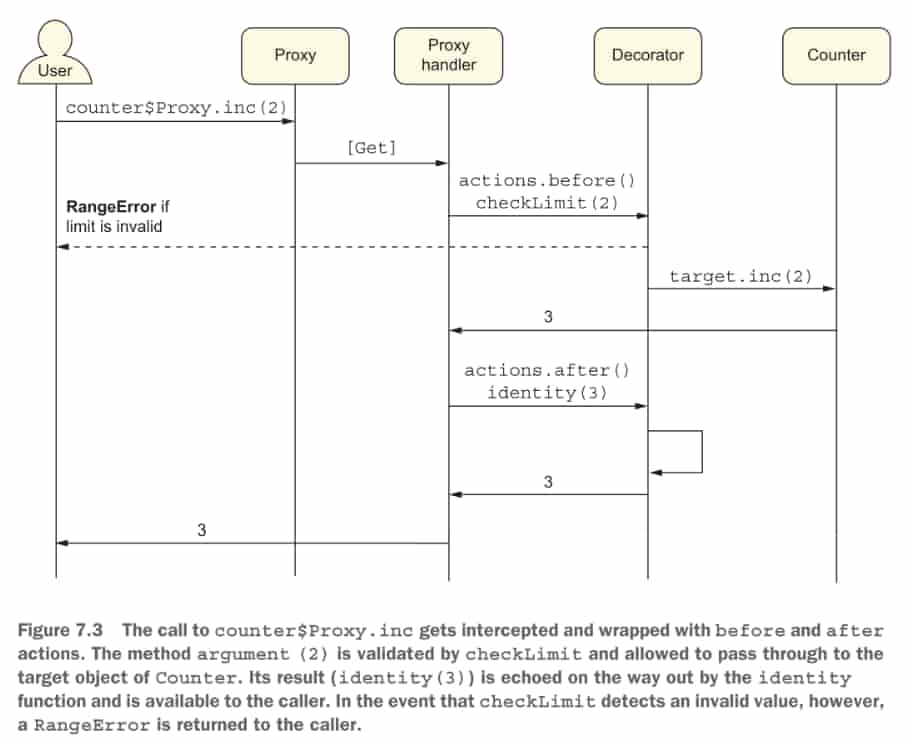
Proxy 虽然非常的有用,但是需要注意的是, 因为其调用逻辑很复杂, 可能造成其他开发者在这地方调试很久很久, 所以这类 metaProgramming 使用的时候要慎重.
此内容由惯性聚合(RSS阅读器)自动聚合整理,仅供阅读参考。 原文来自 — 版权归原作者所有。