







When [Denki Otaku] bought a ¥1,200 (roughly €6.5) XLR ground loop isolator off Japanese Amazon, he initially didn’t suspect that anything was off. Since they’re fairly simple devices, with basically a 1:1 transformer per channel in some kind of enclosure, the price wasn’t unreasonable.
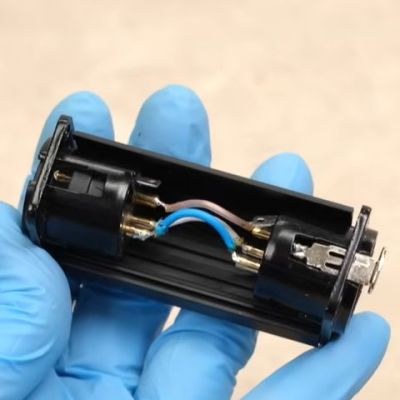
That’s before a teardown showed that this ‘ground loop isolator’ actually contains direct wiring between the XLR sockets, but that doesn’t mean that you cannot still make an educational video about the real devices.
First the basic theory is explained, before the fake ground loop isolator is subjected to an analysis, showing why you’d want to use the real deal. Of course, detecting a fake one is pretty easy, as a simple continuity test with a multimeter or similar will show that DC passes right through the fake isolator.
Next a real ground loop isolator was designed with a custom PCB and a high-pass filter added to the feature list. Here rather than a very basic filter with cheapo parts there was definitely some gold-plating going on, but it does show what you can do in addition to just adding a few simple transformers for ground isolation purposes.
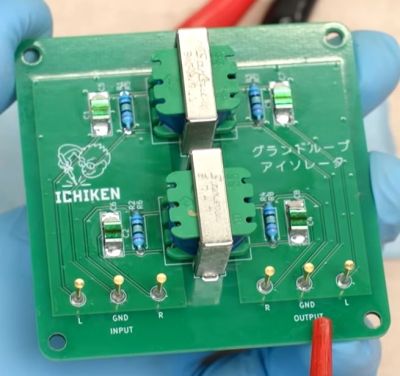 The finished ground loop isolator device is pretty large, and would definitely require a larger enclosure than the homeopathic device, but it makes for an easy test bed with convenient access during the subsequent analysis.
Here each of the two channels has its own transformer and filter, with an initial test just by ear making the injected 2 kHz noise signal appear to go completely away.
Next, an oscilloscope is used to visualize the functionality, with the non-isolated 440 Hz test signal first shown with and without the injected noise, showing the clear impact of the noise and subsequently the isolator.
Of course, high-frequency noises will still pass through the transformer via parasitic capacitance leakage between the windings, so it’s not a silver bullet. Here the analysis at the end of the video shows the noise-rejection characteristics of these isolators, and why adding a high-pass filter makes a lot of sense. Finally, the scam device’s XLR connectors were reused in an enclosure for this custom board, giving it some purpose after all.


