







There’s folk wisdom in just about every culture that teaches about renewable energy — things like “make hay while the sun shines”. But as an industrial culture, we want to make hay 24/7 and not be at the whims of some capricious weather god! Alas, renewable energy puts a crimp in that. Once again, energy supplies are slowly becoming tied to the sun and the wind.
Since “Make compute while the wind blows” doesn’t have a great ring to it, clearly our civilization needs to come up with some grid-scale storage. Over in Sardinia they’re testing an idea that sounds like hot air, but isn’t — because the working gas is CO2.
The principle is simple: when power is available, carbon dioxide is compressed, cooled, and liquefied into pressure vessels as happens at millions of industrial facilities worldwide every day. When power is required, the compressed CO2 can be run through a turbine to generate sweet, sweet electricity. Since venting tonnes of CO2 into the atmosphere is kind of the thing we’re trying to avoid with this whole rigmarole, the greenhouse gas slash working fluid is stored in a giant bag. It sits, waiting for the next charge cycle, like the world’s heaviest and saddest dirigible. In the test project in Sardinia — backed by Google, amongst others — the gas bag holds 2000 tonnes and can produce 20 megawatts of power for up-to 10 hours.
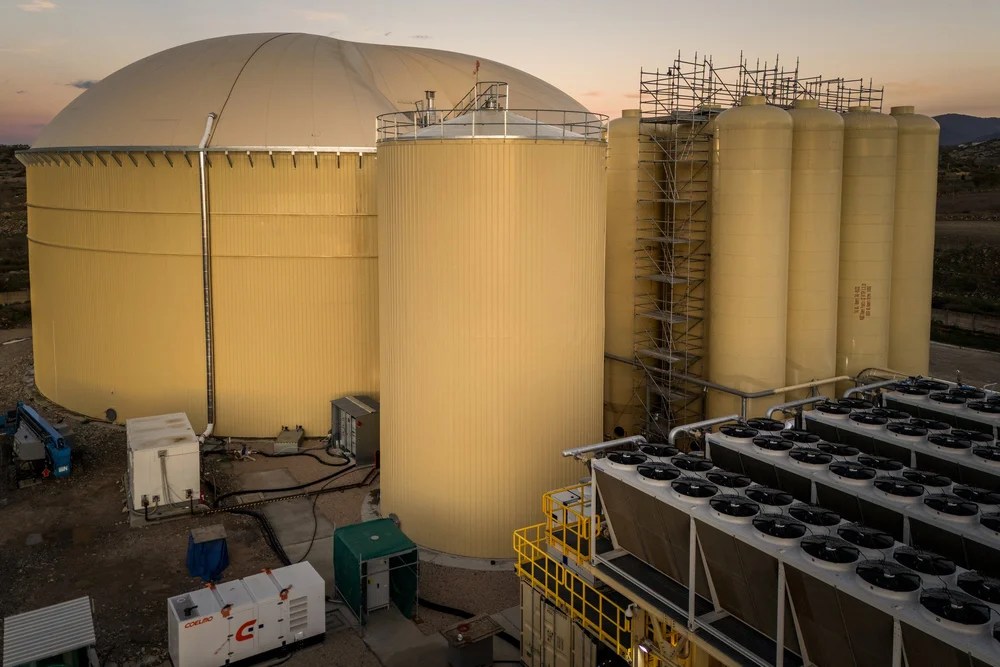
That’s not exactly astounding. It gets you through the night, but leaves you hanging if the next day is cloudy. But it’s scalable. The turbine is 20 megawatts, sure, but all you need is land to add extra energy capacity. The 200 MWh pilot plant is a five hectare facility, which is only about 12.3 acres, or roughly 1/10th the size of the Mall of America. It seems like increasing capacity would be fairly trivial; unlike, say, pumped hydro storage, no special topography is required. Ten hours of storage is also notably longer than the six to eight hours grid-scale battery farms usually aim for.
As of this writing, there’s only one of these plants in operation, but expect that to change rapidly. In 2026 the company behind the Sardinia project, Energy Dome, plans on putting in grid-scale storage based on its technology in India and Wisconsin, and that’s before Google gets into it. They’re hoping to roll this technology out at a number of data centers worldwide, though the exact details of the deal aren’t public.
We’ve talked about grid-scale energy storage before, using everything from liquid tin to electric car batteries and big piles of gravel. This methodology has a lot to recommend it over those others in comparison, and should worst come to worst, at least it won’t burn for days like certain batteries we could name. Releasing 2000 tonnes of CO2 might not be as benign as a failure from a liquid air battery, but storing liquid CO2 under pressure is a lot easier holding onto cryogenic air.
All images credited to Luigi Avantaggiato.


