

惯性聚合 高效追踪和阅读你感兴趣的博客、新闻、科技资讯
阅读原文 在惯性聚合中打开

推荐订阅源

Last Week in AI
Last Week in AI
GbyAI
GbyAI
Apple Machine Learning Research
奇客Solidot–传递最新科技情报
奇客Solidot–传递最新科技情报
N
Netflix TechBlog - Medium
量子位
aimingoo的专栏
aimingoo的专栏
D
Docker
F
Fortinet All Blogs
T
Tailwind CSS Blog
V
V2EX
D
DataBreaches.Net
Google DeepMind News
MyScale Blog
MyScale Blog
G
Google Developers Blog
罗磊的独立博客
MongoDB | Blog
MongoDB | Blog
Microsoft Security Blog
Microsoft Azure Blog
WordPress大学
WordPress大学
博客园 - 三生石上(FineUI控件)
小众软件
小众软件
A
About on SuperTechFans
IT之家
IT之家

Comments for Hackaday

Repairing A Pair Of Voodoo 2 GPUs For Some SLI Action AI The Truly Environmentally Friendly Way News Sites Are Blocking Internet Archive Over AI Scraping Fears How The 2020s Chip Crisis Led To A Buggy Saleae Analyzer In 2026 Evidence For Water Vapor Plumes On Europa Vanishes In Re-Analysis Mechanical Stability For Your Coils 3D Printed Hose Sprayer Sets Phasers To Suds The Merits Of Comment-Driven Development As Counterweight To TDD Building A Desktop Catalytic Cracker Process 4 Billion Pixels Per Second From 16 DIY Cameras For The Best V-Tubing Rig Ever An Unlikely Host For An 8080 Emulator Using Brand New NiMH Cells After Sitting 12 Years Unused Investigating The S3 Virge’s Reputation As A 3D Decelerator Card As It Turns Out, There’s More Than One Cassette Mechanism Being Made After All Using Windows 11 On An LGA 775 PC With AGP Videocard An Ethernet WiFi Router on a Pi Pico 2W This Week In Security: Messing With AI, 7Zip And Notepad++ Vulnerabilities, HTTP2 Bomb, And More Using Electrolysis For More Than Just Generating Hydrogen Vintage Turntable Gets Brain Transplant And Home Assistant Integration Connecting Your Car To Home Assistant Microsoft Claims 20 Second Qubits If You Want To Hack Me, Come In Through The Speaker Ways To Embed Magnets In 3D Prints And Not Ruin Printers An RGB Keyboard For Your Hackaday Communicator Badge Ask Hackaday: How Do You Feel About Electronic Shelf Labels? Make Your Ceiling Disappear With ADS-B And Short-Throw Projector Fixing A Nintendo Game Boy Clone That Runs Too Fast Web-Based Control For A CB Radio Distilling Stale Gasoline To Make It Usable Again DIY Ceramic Circuit Boards Surely Count As Solarpunk
Like A Wire Bender, But For Pop Tubes
Donald Papp · 2026-06-01 · via Comments for Hackaday

Skip to content

Are you familiar with pop tubes? Resembling the corrugated section of a bendy straw, they are at the core of PopTuber, an intriguing research project from the Actuated Experience Lab at the University of Chicago.
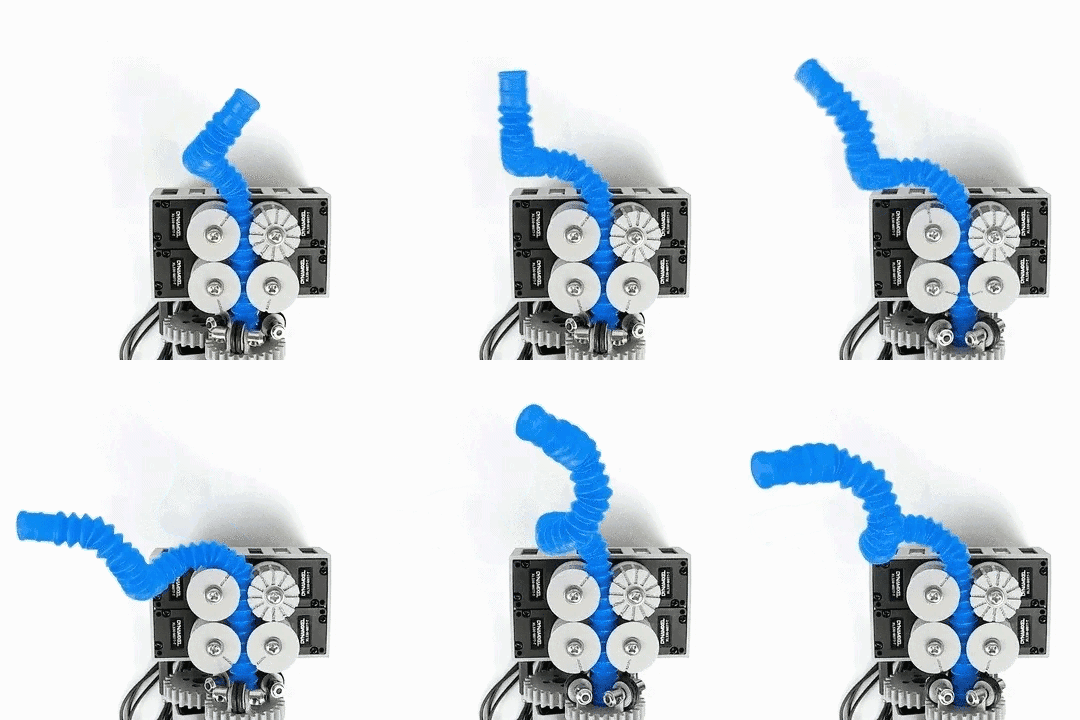
With five motors and specialized gears a pop tube can be formed into complex, arbitrary shapes, and just as easily reset.

PopTuber shows how five motors and some specialized gears are all it takes to bend pop tubes into complex and stable 3D shapes. One can design the shapes in software, feed a pop tube into the shaper, and watch the device do the work. Importantly, the device can just as easily reset and re-use the tube. Watch the video (embedded below the page break) to see it in action and get a feel for what it can do.

In concept, it’s a little like a wire-bending machine, although wire benders are bulkier in comparison, more complex to scale, and unbending a wire is a separate process with its own hardware.

This project explores possibilities for a machine that can crank out complex curves on demand, such as oddball user interfaces, physical prototyping, and even a strange sort of physical display. But the real forward-thinking and interesting question researchers asked is whether this idea could be a form of programmable matter. The project shows that five actuators in a relatively compact package are all that’s needed to shape (and reset) a pop tube of arbitrary length in a programmable way, and it can scale easily to different sizes.

Using pop tubes in this way reminds us of an origami-inspired method we covered for making a tube form stable, complex shapes. But it’s also different because origami- and kirigami-inspired methods bake the transformation into the material itself, whereas PopTuber can create arbitrary shapes on demand.