
惯性聚合 高效追踪和阅读你感兴趣的博客、新闻、科技资讯
阅读原文 在惯性聚合中打开

推荐订阅源

MongoDB | Blog
MongoDB | Blog
B
Blog RSS Feed
MyScale Blog
MyScale Blog
M
MIT News - Artificial intelligence
H
Hackread – Cybersecurity News, Data Breaches, AI and More
J
Java Code Geeks
U
Unit 42
Blog — PlanetScale
Blog — PlanetScale
L
LangChain Blog
C
Check Point Blog
WordPress大学
WordPress大学
Last Week in AI
Last Week in AI
人人都是产品经理
人人都是产品经理
T
Tailwind CSS Blog
Vercel News
Vercel News
腾讯CDC
GbyAI
GbyAI
有赞技术团队
有赞技术团队
S
SegmentFault 最新的问题
H
Help Net Security
博客园 - 三生石上(FineUI控件)
D
DataBreaches.Net
Microsoft Security Blog
小众软件
小众软件

Comments for Hackaday

Repairing A Pair Of Voodoo 2 GPUs For Some SLI Action AI The Truly Environmentally Friendly Way News Sites Are Blocking Internet Archive Over AI Scraping Fears How The 2020s Chip Crisis Led To A Buggy Saleae Analyzer In 2026 Evidence For Water Vapor Plumes On Europa Vanishes In Re-Analysis Mechanical Stability For Your Coils 3D Printed Hose Sprayer Sets Phasers To Suds The Merits Of Comment-Driven Development As Counterweight To TDD Building A Desktop Catalytic Cracker Process 4 Billion Pixels Per Second From 16 DIY Cameras For The Best V-Tubing Rig Ever An Unlikely Host For An 8080 Emulator Using Brand New NiMH Cells After Sitting 12 Years Unused Investigating The S3 Virge’s Reputation As A 3D Decelerator Card As It Turns Out, There’s More Than One Cassette Mechanism Being Made After All Using Windows 11 On An LGA 775 PC With AGP Videocard An Ethernet WiFi Router on a Pi Pico 2W This Week In Security: Messing With AI, 7Zip And Notepad++ Vulnerabilities, HTTP2 Bomb, And More Using Electrolysis For More Than Just Generating Hydrogen Vintage Turntable Gets Brain Transplant And Home Assistant Integration Connecting Your Car To Home Assistant Microsoft Claims 20 Second Qubits If You Want To Hack Me, Come In Through The Speaker Ways To Embed Magnets In 3D Prints And Not Ruin Printers An RGB Keyboard For Your Hackaday Communicator Badge Ask Hackaday: How Do You Feel About Electronic Shelf Labels? Make Your Ceiling Disappear With ADS-B And Short-Throw Projector Fixing A Nintendo Game Boy Clone That Runs Too Fast Web-Based Control For A CB Radio Distilling Stale Gasoline To Make It Usable Again DIY Ceramic Circuit Boards Surely Count As Solarpunk
Autopsy Of A Failed Vintage Carbon Resistor
Aknup · 2026-05-28 · via Comments for Hackaday

Skip to content

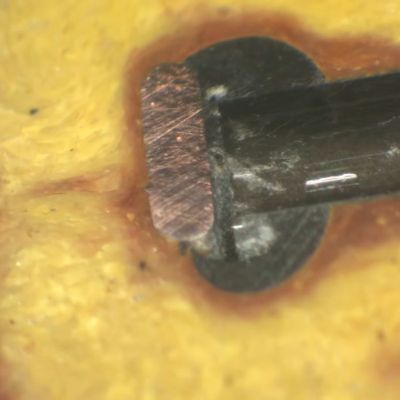
Detail of the lead connecting to the inner carbon-filled tube. (Credit: CuriousMarc)

Although resistors are hardly among the most exciting components, they are arguably one of the most important ones, as anyone who has done any amount of circuit design and debugging can attest to. So too with a single carbon resistor in a vintage Metrix oscilloscope that [CuriousMarc] recently repaired. After recapping the board there was still a major issue that got traced down to said resistor. After replacing it with a fresh resistor obviously this meant doing an autopsy to see why the old resistor had failed.

The 20 kOhm-rated resistor looked fine on the outside, with no obvious damage or discoloration, but it measured around 0.843 MOhm. To get to the insides [CuriousMarc] asked his friend [TubeTime] on how to proceed. The answer here was sandpaper and a lot of patience, and thus the experiment to see how much sanding it takes to get to the core of a fairly big resistor commenced.

Ultimately the insides were revealed, and they turned out to be rather interesting, with what looked like a glass tube filled with what would be the carbon-laden material between the two lead terminals. From poking around a bit at these insides it would appear that the failure mode was a degraded contact between these terminals and the carbon material. Considering that this resistor is many decades old and has gone through many thermal cycles and potentially various kinetic events some fractures are probably to be expected.

Perhaps most fascinating is the construction of this carbon resistor that looks to be a step above that of the average carbon resistor that [TubeTime] has taken apart over the years.