


惯性聚合 高效追踪和阅读你感兴趣的博客、新闻、科技资讯
阅读原文 在惯性聚合中打开

推荐订阅源

腾讯CDC
博客园 - Franky
MyScale Blog
MyScale Blog
L
LangChain Blog
Martin Fowler
Martin Fowler
Recent Announcements
Stack Overflow Blog
Stack Overflow Blog
OSCHINA 社区最新新闻
OSCHINA 社区最新新闻
奇客Solidot–传递最新科技情报
奇客Solidot–传递最新科技情报
博客园 - 司徒正美
量子位
A
About on SuperTechFans
C
Check Point Blog
大猫的无限游戏
大猫的无限游戏
Last Week in AI
Last Week in AI
小众软件
小众软件
Apple Machine Learning Research
I
InfoQ
V
Visual Studio Blog
Vercel News
Vercel News
B
Blog
爱范儿
爱范儿
aimingoo的专栏
aimingoo的专栏
U
Unit 42

Comments for Hackaday

AI The Truly Environmentally Friendly Way News Sites Are Blocking Internet Archive Over AI Scraping Fears How The 2020s Chip Crisis Led To A Buggy Saleae Analyzer In 2026 Evidence For Water Vapor Plumes On Europa Vanishes In Re-Analysis Mechanical Stability For Your Coils 3D Printed Hose Sprayer Sets Phasers To Suds The Merits Of Comment-Driven Development As Counterweight To TDD Building A Desktop Catalytic Cracker Process 4 Billion Pixels Per Second From 16 DIY Cameras For The Best V-Tubing Rig Ever An Unlikely Host For An 8080 Emulator Using Brand New NiMH Cells After Sitting 12 Years Unused Investigating The S3 Virge’s Reputation As A 3D Decelerator Card As It Turns Out, There’s More Than One Cassette Mechanism Being Made After All Using Windows 11 On An LGA 775 PC With AGP Videocard An Ethernet WiFi Router on a Pi Pico 2W This Week In Security: Messing With AI, 7Zip And Notepad++ Vulnerabilities, HTTP2 Bomb, And More Using Electrolysis For More Than Just Generating Hydrogen Vintage Turntable Gets Brain Transplant And Home Assistant Integration Connecting Your Car To Home Assistant Microsoft Claims 20 Second Qubits If You Want To Hack Me, Come In Through The Speaker Ways To Embed Magnets In 3D Prints And Not Ruin Printers An RGB Keyboard For Your Hackaday Communicator Badge Ask Hackaday: How Do You Feel About Electronic Shelf Labels? Make Your Ceiling Disappear With ADS-B And Short-Throw Projector Fixing A Nintendo Game Boy Clone That Runs Too Fast Web-Based Control For A CB Radio Distilling Stale Gasoline To Make It Usable Again DIY Ceramic Circuit Boards Surely Count As Solarpunk Texas Instruments Changes The NE5532 And Others Into Incompatible Versions
Alan Turing’s Remarkable, Nearly-Forgotten Voice Encrypti...
Donald Papp · 2026-06-26 · via Comments for Hackaday

Skip to content

[Popular Mechanics] has an interesting article about Alan Turing’s nearly-forgotten speech encryption device. Codenamed Delilah, it was in many ways an early form of digital encryption. It was secretly developed alongside his most famous wartime achievement of breaking the encryption used by the Nazis’ Enigma machine; itself a remarkable device we’ve covered in detail in the past.

Delilah was developed at a separate location, and Turing worked with a young electrical engineer by the name of Donald Bayley who not only helped Turing implement design concepts and theory as practical circuitry, but took copious notes of their work and discussions. His documents, which went up for auction a few years after his death in 2023, reveal a first-hand account of their work.
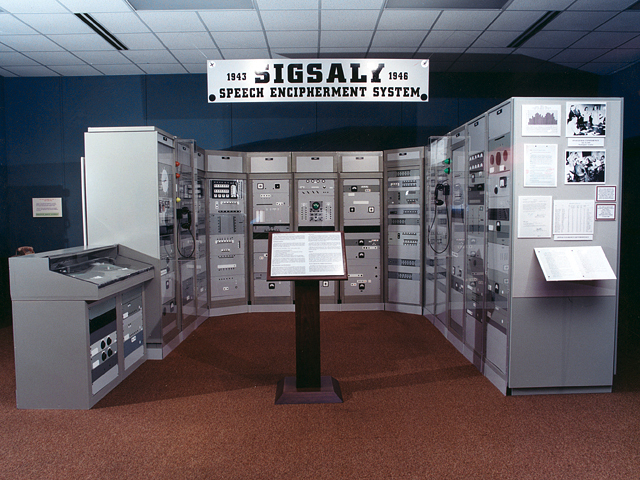
SIGSALY (the name is not an acronym, by the way) was a working voice encryption system whose main drawbacks were its massive size, weight, and power requirements. [image: Wikipedia]

Back then, a vocal encryption system did exist. Bell Labs had developed SIGSALY, a seriously top-secret system that provided encrypted voice communications at the highest levels. But one of SIGSALY’s biggest drawbacks was that it was absolutely monstrous.

Delilah did the same job, but was portable and battery-powered. Delilah was three small boxes weighing around 39 kg, and it’s hard to overstate just how remarkable of a feat of miniaturization this was. However, by the time Delilah was wrapped up, the war was over and the project wound down without ever being produced or deployed in any meaningful way.

Encrypted communications is standard stuff today, but back then there was simply no need for a vocal encryption system in peacetime. The reason we know what we do today is thanks mainly to the effort Bayley put into documenting things.

It again demonstrates that if the people involved don’t write things down while they know it, that knowledge can simply disappear. Sometimes people make the effort and the rest of us benefit, like with the Delilah project and also with the history of liquid rocket propellants — a dry-sounding topic that we assure you is anything but.