


惯性聚合 高效追踪和阅读你感兴趣的博客、新闻、科技资讯
阅读原文 在惯性聚合中打开

推荐订阅源

Latest news
Latest news
Cisco Talos Blog
Cisco Talos Blog
Simon Willison's Weblog
N
News and Events Feed by Topic
Recent Commits to openclaw:main
S
Security Affairs
PCI Perspectives
PCI Perspectives
I
Intezer
V2EX - 技术
V2EX - 技术
S
Securelist
O
OpenAI News
S
Secure Thoughts
aimingoo的专栏
aimingoo的专栏
V
Visual Studio Blog
P
Proofpoint News Feed
月光博客
月光博客
博客园 - 叶小钗
Hacker News: Ask HN
Hacker News: Ask HN
有赞技术团队
有赞技术团队
酷 壳 – CoolShell
酷 壳 – CoolShell
Stack Overflow Blog
Stack Overflow Blog
宝玉的分享
宝玉的分享
让小产品的独立变现更简单 - ezindie.com
Google DeepMind News
C
Cybersecurity and Infrastructure Security Agency CISA
H
Hackread – Cybersecurity News, Data Breaches, AI and More
cs.CL updates on arXiv.org
Schneier on Security
N
News | PayPal Newsroom
S
Schneier on Security
T
Threatpost
G
Google Developers Blog
P
Palo Alto Networks Blog
P
Privacy & Cybersecurity Law Blog
Microsoft Azure Blog
K
KPMG report finds enterprise disconnect between AI and its ROI | CIO
C
Cyber Attacks, Cyber Crime and Cyber Security
Exploit-DB.com RSS Feed
P
Privacy International News Feed
博客园 - 三生石上(FineUI控件)
Help Net Security
Help Net Security
Google Online Security Blog
C
CXSECURITY Database RSS Feed - CXSecurity.com
D
DataBreaches.Net
Cyberwarzone
Cyberwarzone
Cyber Security Advisories - MS-ISAC
Webroot Blog
Webroot Blog
K
Kaspersky official blog
Security Latest
Security Latest
www.infosecurity-magazine.com

Blog – Hackaday

Why Not Yserver? It’s Xserver, But Rust-y. OpenCAL: Computed Axial Lithographic 3D Printing For Everyone Is A CS Degree DOA Thanks To LLMs? IEEE Says TBD. Double The VRAM Of An RTX 3070 The Pacemaker Patch Robot Chess But Each Piece Is A Small Robot Bambuddy Says Bye To Bambu Lab Cloud Services Converting A Scanning Electron Microscope Into A TEM Is Surprisingly Easy Custom Watch Is On The Case Patterns Everywhere Behold A 60 Hz Refresh Rate E-ink Monitor GentleOS, A Simple OS For Your Old PC Deeply Optimized MSX Emulation On ESP32-S3 With VGA Output Homebrew Macropad Looks Good The Air Position Indicator For The B-29 Building A 1:150 Scale Toyota ProBox Micro Remote Control Car Adding Weight To A 3D Print With Plaster Of Paris, Cleanly Hackaday Podcast Ep 373: GPS, Danger In Space, And Robby The Robot A Peek Inside The Secret Lagercrantz Suitcase Radio This Week In Security: Microsoft On Microsoft, Register Your Domains, Linux On ARM, And FreeBSD Joins The File Cache Club Glue-in Hinge Design Tries Something Different The Hackaday Communicator Badge, Re-Imagined With New Firmware Amiga 1232 Storm CD Packs Every Upgrade Into One Wedge So Many Analog To Digital Converters Repairing A Pair Of Voodoo 2 GPUs For Some SLI Action AI The Truly Environmentally Friendly Way Evidence For Water Vapor Plumes On Europa Vanishes In Re-Analysis Mechanical Stability For Your Coils 3D Printed Hose Sprayer Sets Phasers To Suds The Merits Of Comment-Driven Development As Counterweight To TDD Building A Desktop Catalytic Cracker Process 4 Billion Pixels Per Second From 16 DIY Cameras For The Best V-Tubing Rig Ever 3D Printing A Miniature CoreXY Printer An Unlikely Host For An 8080 Emulator Using Brand New NiMH Cells After Sitting 12 Years Unused Investigating The S3 Virge’s Reputation As A 3D Decelerator Card Over-Engineering An FDM Spool Holder From Prusa Mk4S Remains As It Turns Out, There’s More Than One Cassette Mechanism Being Made After All Using Windows 11 On An LGA 775 PC With AGP Videocard Hackaday Podcast Episode 372: PopTubers, Shifty Semiconductors, And Shelving Shelf Labels An Ethernet WiFi Router on a Pi Pico 2W This Week In Security: Messing With AI, 7Zip And Notepad++ Vulnerabilities, HTTP2 Bomb, And More Using Electrolysis For More Than Just Generating Hydrogen Vintage Turntable Gets Brain Transplant And Home Assistant Integration Connecting Your Car To Home Assistant Microsoft Claims 20 Second Qubits If You Want To Hack Me, Come In Through The Speaker Ways To Embed Magnets In 3D Prints And Not Ruin Printers An RGB Keyboard For Your Hackaday Communicator Badge The World’s First GPIB Speech Synthesizer, And It’s For A GRiD Compass Ask Hackaday: How Do You Feel About Electronic Shelf Labels? Make Your Ceiling Disappear With ADS-B And Short-Throw Projector Fixing A Nintendo Game Boy Clone That Runs Too Fast Web-Based Control For A CB Radio Distilling Stale Gasoline To Make It Usable Again DIY Ceramic Circuit Boards Surely Count As Solarpunk Texas Instruments Changes The NE5532 And Others Into Incompatible Versions Deltarune’s Tenna Brought To Life Linux Fu: Fake Webcams, GUI Edition Hydraulic Drive For Your Lawn Tractor But Just What Is This ‘Artificial Intelligence’? Game Dodecahedron Runs AArch64 Assembly A Diffraction Grating Makes This Clock Readable Turning An Old 3D Printer Into A Vinyl Cutter For Cheap A High-Vacuum Controller For An Eventual Electron Microscope Does Your Terminal Speak Morse? This One Does From Scrappy Pallet Wood To Fancy Tea Tray The 2026 EMF Badge Arrives, With An Add-On. As Expected, It’s Familiar Linux Fu: Taming Strace STM32 Handheld Has OpenGL And All The Classics Jenny’s Daily Drivers: Microsoft Windows 11 Using A Mirror To 3D Scan Both Sides Of An Object At Once Cookies, Baked The 3D Printer Way Restoring Apple’s Terrible But Awesome IBook Laptop After The Dust Settles: Building Pebble Apps Bilingual E-paper News Feed Helps Brush Up Language Skills On The Wisdom Of Replacing A NiMH Module In A Prius Battery Pack Know Your Food: Cheesemaking Like A Wire Bender, But For Pop Tubes Revisiting Making Your Own Internet Router In 2026 Reverse Engineering A Rock Bottom NES Clone Classically-named Argus Robot Is Terminator Meets Tumbleweed Making a Zippy FDM Printer out of Wood Off-Grid OCR Server Powered By IPhone Hackaday Links: May 31, 2026 A Camera Viewfinder Makes A Great TV 4-bit Relay Logic Counter Begs To Have Its Buttons Pushed Loading Sega Genesis Games Off A Vinyl Record Ebike Display Uses Reflective LCD Modern Graphics Via DisplayLink For Your ISA-Era PC The Final Steps To A Sub-Minute Benchy Poking Around With JTAG On A Guitar Amp Keychain GameCube Controller Made Functional Breaking Enigma With An FPGA, Just Like At Bletchley Park The Uncooperative Mirror Will Not Help You Testing Various Ways To Waterproof FDM Printed Parts Cheap Yellow Display With Boosted PSRAM Turned Snazzy Emulator Station It’s Another Pi Handheld. But It’s A Really Good One Take The Reins Of This Unique Controller Be Your Own Oil Company With Desktop Fischer-Tropsch Process
Autopsy Of A Freshly Cooked 10Gbit SFP+ Network Adapter
Maya Posch · 2026-06-21 · via Blog – Hackaday

Skip to content

With the advent of affordable 2.5 Gbit, 5 Gbit, and 10 Gbit consumer networking gear, more and more people are taking advantage of these higher networking speeds, with [This Does Not Compute] having used 10 Gbit SFP+ modules over regular Cat-5e copper to connect to a NAS in the next room. Only problem was that after a while these SFP+ modules began to start dropping frames. On taking a closer look at these modules, he found that they were running pretty hot: 40°C while idle. A teardown of one of these modules showed severe discoloration due to heat.
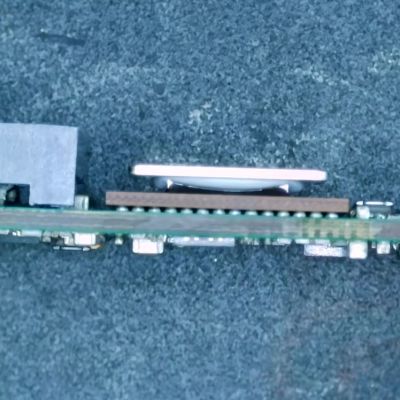
Side view of the SFP+ module's PCB. (Credit: This Does Not Compute, YouTube)
Side view of the SFP+ module’s PCB. (Credit: This Does Not Compute, YouTube)

Inside these 10Gbit modules is the Marvell-branded Alaska X 88X3310/40P PHY, which despite the ‘low-power’ claims have a metal heatsink glued onto the actual IC and thermally coupled to the module’s metal enclosure. The other side of the PCB was quite discolored, further indicating how hot these modules run in operation. Some digging revealed that this can go up to around 2.5 watts.

Perhaps the most fascinating part of this teardown is the discovery of an 8051-based MCU that’s responsible for telling the switch the module is put into that it is a 30-meter multi-mode fiber module, presumably for compatibility purposes. It’s definitely an interesting feature of these FS-branded SFP+ modules.

These old modules were replaced with Wiitek-branded modules that are supposed to use only up to around 1.5 watts in operation courtesy of a newer chipset, in the hope that these wouldn’t fry themselves. At idle these do however still run at 30 °C. As noted in the comments, it might be a good idea to have active airflow over high-speed networking gear like this, as they generally can get pretty hot and sometimes crispy.

The final solution for the video’s networking problem was to just run single-mode fiber to the room and use appropriate SFP+ modules for that, also because these run noticeably cooler. If you still have room in your cable ducts, that would seem to be the optimal solution.