


惯性聚合 高效追踪和阅读你感兴趣的博客、新闻、科技资讯
阅读原文 在惯性聚合中打开

推荐订阅源

博客园_首页
Google DeepMind News
J
Java Code Geeks
S
SegmentFault 最新的问题
Martin Fowler
Martin Fowler
罗磊的独立博客
T
The Blog of Author Tim Ferriss
N
Netflix TechBlog - Medium
大猫的无限游戏
大猫的无限游戏
Hugging Face - Blog
Hugging Face - Blog
Last Week in AI
Last Week in AI
奇客Solidot–传递最新科技情报
奇客Solidot–传递最新科技情报
H
Heimdal Security Blog
N
News and Events Feed by Topic
Threat Intelligence Blog | Flashpoint
P
Privacy International News Feed
T
Tailwind CSS Blog
AWS News Blog
AWS News Blog
雷峰网
雷峰网
PCI Perspectives
PCI Perspectives
CTFtime.org: upcoming CTF events
IT之家
IT之家
钛媒体:引领未来商业与生活新知
钛媒体:引领未来商业与生活新知
The Register - Security
N
News | PayPal Newsroom
C
CERT Recently Published Vulnerability Notes
Microsoft Security Blog
Attack and Defense Labs
T
Tenable Blog
博客园 - 【当耐特】
Vercel News
Vercel News
GbyAI
GbyAI
博客园 - 司徒正美
量子位
T
Threat Research - Cisco Blogs
The Cloudflare Blog
The Last Watchdog
The Last Watchdog
MyScale Blog
MyScale Blog
酷 壳 – CoolShell
酷 壳 – CoolShell
Hacker News - Newest:
Hacker News - Newest: "LLM"
TaoSecurity Blog
TaoSecurity Blog
T
Troy Hunt's Blog
Y
Y Combinator Blog
P
Proofpoint News Feed
L
LINUX DO - 最新话题
OSCHINA 社区最新新闻
OSCHINA 社区最新新闻
Jina AI
Jina AI
Recent Commits to openclaw:main
月光博客
月光博客
Apple Machine Learning Research

Blog – Hackaday

Why Not Yserver? It’s Xserver, But Rust-y. OpenCAL: Computed Axial Lithographic 3D Printing For Everyone Is A CS Degree DOA Thanks To LLMs? IEEE Says TBD. Double The VRAM Of An RTX 3070 The Pacemaker Patch Robot Chess But Each Piece Is A Small Robot Bambuddy Says Bye To Bambu Lab Cloud Services Converting A Scanning Electron Microscope Into A TEM Is Surprisingly Easy Custom Watch Is On The Case Patterns Everywhere Behold A 60 Hz Refresh Rate E-ink Monitor GentleOS, A Simple OS For Your Old PC Deeply Optimized MSX Emulation On ESP32-S3 With VGA Output Homebrew Macropad Looks Good The Air Position Indicator For The B-29 Building A 1:150 Scale Toyota ProBox Micro Remote Control Car Adding Weight To A 3D Print With Plaster Of Paris, Cleanly Hackaday Podcast Ep 373: GPS, Danger In Space, And Robby The Robot A Peek Inside The Secret Lagercrantz Suitcase Radio This Week In Security: Microsoft On Microsoft, Register Your Domains, Linux On ARM, And FreeBSD Joins The File Cache Club Glue-in Hinge Design Tries Something Different The Hackaday Communicator Badge, Re-Imagined With New Firmware Amiga 1232 Storm CD Packs Every Upgrade Into One Wedge So Many Analog To Digital Converters Repairing A Pair Of Voodoo 2 GPUs For Some SLI Action AI The Truly Environmentally Friendly Way Evidence For Water Vapor Plumes On Europa Vanishes In Re-Analysis Mechanical Stability For Your Coils 3D Printed Hose Sprayer Sets Phasers To Suds The Merits Of Comment-Driven Development As Counterweight To TDD Building A Desktop Catalytic Cracker Process 4 Billion Pixels Per Second From 16 DIY Cameras For The Best V-Tubing Rig Ever 3D Printing A Miniature CoreXY Printer An Unlikely Host For An 8080 Emulator Using Brand New NiMH Cells After Sitting 12 Years Unused Investigating The S3 Virge’s Reputation As A 3D Decelerator Card Over-Engineering An FDM Spool Holder From Prusa Mk4S Remains As It Turns Out, There’s More Than One Cassette Mechanism Being Made After All Using Windows 11 On An LGA 775 PC With AGP Videocard Hackaday Podcast Episode 372: PopTubers, Shifty Semiconductors, And Shelving Shelf Labels An Ethernet WiFi Router on a Pi Pico 2W This Week In Security: Messing With AI, 7Zip And Notepad++ Vulnerabilities, HTTP2 Bomb, And More Using Electrolysis For More Than Just Generating Hydrogen Vintage Turntable Gets Brain Transplant And Home Assistant Integration Connecting Your Car To Home Assistant Microsoft Claims 20 Second Qubits If You Want To Hack Me, Come In Through The Speaker Ways To Embed Magnets In 3D Prints And Not Ruin Printers An RGB Keyboard For Your Hackaday Communicator Badge The World’s First GPIB Speech Synthesizer, And It’s For A GRiD Compass Ask Hackaday: How Do You Feel About Electronic Shelf Labels? Make Your Ceiling Disappear With ADS-B And Short-Throw Projector Fixing A Nintendo Game Boy Clone That Runs Too Fast Web-Based Control For A CB Radio Distilling Stale Gasoline To Make It Usable Again DIY Ceramic Circuit Boards Surely Count As Solarpunk Texas Instruments Changes The NE5532 And Others Into Incompatible Versions Deltarune’s Tenna Brought To Life Linux Fu: Fake Webcams, GUI Edition Hydraulic Drive For Your Lawn Tractor But Just What Is This ‘Artificial Intelligence’? Game Dodecahedron Runs AArch64 Assembly A Diffraction Grating Makes This Clock Readable Turning An Old 3D Printer Into A Vinyl Cutter For Cheap A High-Vacuum Controller For An Eventual Electron Microscope Does Your Terminal Speak Morse? This One Does From Scrappy Pallet Wood To Fancy Tea Tray The 2026 EMF Badge Arrives, With An Add-On. As Expected, It’s Familiar Linux Fu: Taming Strace STM32 Handheld Has OpenGL And All The Classics Jenny’s Daily Drivers: Microsoft Windows 11 Using A Mirror To 3D Scan Both Sides Of An Object At Once Cookies, Baked The 3D Printer Way Restoring Apple’s Terrible But Awesome IBook Laptop After The Dust Settles: Building Pebble Apps Bilingual E-paper News Feed Helps Brush Up Language Skills On The Wisdom Of Replacing A NiMH Module In A Prius Battery Pack Know Your Food: Cheesemaking Like A Wire Bender, But For Pop Tubes Revisiting Making Your Own Internet Router In 2026 Reverse Engineering A Rock Bottom NES Clone Classically-named Argus Robot Is Terminator Meets Tumbleweed Making a Zippy FDM Printer out of Wood Off-Grid OCR Server Powered By IPhone Hackaday Links: May 31, 2026 A Camera Viewfinder Makes A Great TV 4-bit Relay Logic Counter Begs To Have Its Buttons Pushed Loading Sega Genesis Games Off A Vinyl Record Ebike Display Uses Reflective LCD Modern Graphics Via DisplayLink For Your ISA-Era PC The Final Steps To A Sub-Minute Benchy Poking Around With JTAG On A Guitar Amp Keychain GameCube Controller Made Functional Breaking Enigma With An FPGA, Just Like At Bletchley Park The Uncooperative Mirror Will Not Help You Testing Various Ways To Waterproof FDM Printed Parts Cheap Yellow Display With Boosted PSRAM Turned Snazzy Emulator Station It’s Another Pi Handheld. But It’s A Really Good One Take The Reins Of This Unique Controller Be Your Own Oil Company With Desktop Fischer-Tropsch Process
All The Different Lasers, And How Well They Mark 3D Prints
Donald Papp · 2026-06-25 · via Blog – Hackaday

Skip to content

[Stefan] of CNC Kitchen has an informative video describing his experiences with trying to cleanly laser-mark 3D printed plastics using different methods, and it also happens to be a fantastic tour of all the different laser options available to hobbyists and workshops these days.

Laser marking is a fast and effective way to put things like product names, serial numbers, and other information on plastics. [Stefan] wondered whether laser options would be capable of creating clean and professional marks on 3D-printed items, and approached things with his usual attention to detail.
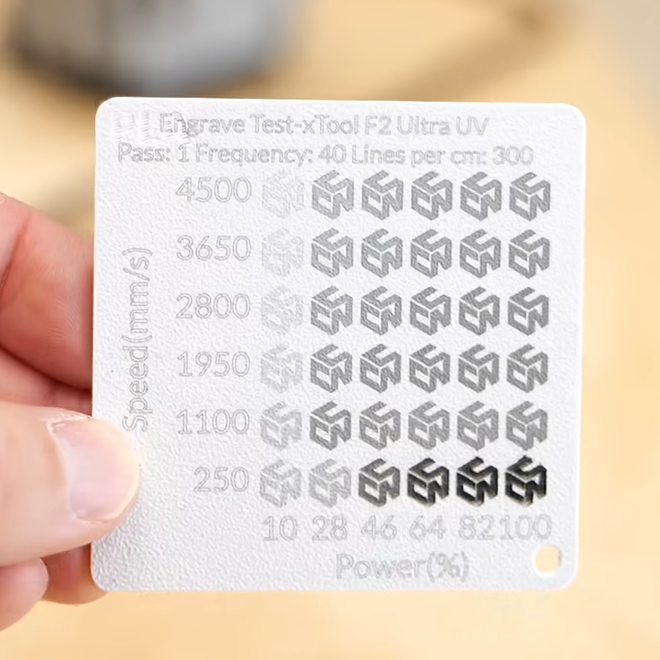
Great results can be had, but using the right tool and dialing in the right settings is critical to results.

How does a laser mark plastic? When the laser hits the material, its energy is dumped into it and can cause pigment bleaching, microfoaming, charring, melting, or ablation (vaporizing) of the surface. The goal is to have a combination of laser and material that delivers a crisp, high-contrast result.

There are several kinds of laser technologies easily available today, and of course a variety of filament types. [Stefan] printed a whole bunch of different PLA, PETG, ASA, TPU, and polycarbonate samples in different colors and tested them with different laser machines, including:

  • UV laser (355 nm wavelength)
  • Blue diode laser (450 nm wavelength)
  • MOPA fiber laser (1,064 nm wavelength)
  • CO2 laser (10,600 nm wavelength)

So is it possible? Yes, but it’s still a bit of a fussy process. There isn’t a one-size-fits-all solution for marking plastic, because results depend a lot on the the right combination of laser type, settings, and target material. That being said, [Stefan] was able to obtain some really great results.

Overall the UV laser was the most suited to marking 3D-printed plastics. [Stefan] says it produced the cleanest results on the widest range of materials with the least fiddling. The MOPA fiber laser also worked, but is clearly more of a metal-marking tool. We’ve seen them etch super-fine PCB traces and while great results are possible it isn’t quite in its element with plastics. Other lasers could get good results under just the right circumstances, but are overall best suited to cutting tasks rather than marking thermoplastics.

Check out the video below for the full details, including some really fantastic closeups.