



惯性聚合 高效追踪和阅读你感兴趣的博客、新闻、科技资讯
阅读原文 在惯性聚合中打开

推荐订阅源

让小产品的独立变现更简单 - ezindie.com
人人都是产品经理
人人都是产品经理
Cisco Talos Blog
Cisco Talos Blog
钛媒体:引领未来商业与生活新知
钛媒体:引领未来商业与生活新知
V
V2EX
博客园 - 三生石上(FineUI控件)
Martin Fowler
Martin Fowler
WordPress大学
WordPress大学
D
Docker
S
SegmentFault 最新的问题
博客园 - 聂微东
美团技术团队
Apple Machine Learning Research
月光博客
月光博客
奇客Solidot–传递最新科技情报
奇客Solidot–传递最新科技情报
Last Week in AI
Last Week in AI
M
MIT News - Artificial intelligence
F
Fortinet All Blogs
freeCodeCamp Programming Tutorials: Python, JavaScript, Git & More
The GitHub Blog
The GitHub Blog
GbyAI
GbyAI
L
LangChain Blog
Vercel News
Vercel News
博客园 - 叶小钗
MongoDB | Blog
MongoDB | Blog
Stack Overflow Blog
Stack Overflow Blog
H
Help Net Security
OSCHINA 社区最新新闻
OSCHINA 社区最新新闻
The Cloudflare Blog
Engineering at Meta
Engineering at Meta
T
Threat Research - Cisco Blogs
T
Threatpost
Scott Helme
Scott Helme
T
Tailwind CSS Blog
Latest news
Latest news
Stack Overflow Blog
Stack Overflow Blog
Blog — PlanetScale
Blog — PlanetScale
The Register - Security
罗磊的独立博客
P
Proofpoint News Feed
腾讯CDC
S
Schneier on Security
雷峰网
雷峰网
A
About on SuperTechFans
T
Tenable Blog
F
Full Disclosure
Cyberwarzone
Cyberwarzone
博客园_首页
有赞技术团队
有赞技术团队
K
Kaspersky official blog

Catchpoint Blog

SRE Report: AI optimism and the economics of effort SRE Report: Why fast is what users trust The SRE Report 2026: Defensible Ns SRE Report 2026: What surprised us, what didn't, and why the gaps matter most Why Synthetic Tracing Delivers Better Data, Not Just More Data A New Chapter: LogicMonitor + Catchpoint – A Personal Note from Mehdi Mezmo + Catchpoint deliver observability SREs can rely on The four pillars holding up your digital business, and what happens when they crumble When payments pause: lessons from a global payments outage Observability 2025 Decoded: What the DZone Report Means for SLO-Driven Ops The next evolution of WebPageTest has arrived, and it’s a game-changer The Monitoring Blind Spot That Could Cost You Black Friday Powering Mexico’s Digital Future: Expanded Internet Observability with Catchpoint The Next Chapter of WebPageTest: Your New Experience Starts Soon SRE Report Retrospectives — Have AIOps Predictions Held Up? When BGP becomes UX: The inside story of a SaaS routing decision gone wrong (or right) Session Replay explained: A guide to seeing digital experience through your user’s eyes Making the invisible visible: Are your cloud firewalls and DDoS protection really working? Why it’s time to move beyond APM: Monitoring from the user’s perspective When metrics mislead: Inside the 2025 Retail Web Performance Benchmark The vendor trap: why your next outage won’t be your fault—but will be your problem LLMs don’t stand still: How to monitor and trust the models powering your AI Semantic Caching: What We Measured, Why It Matters The Annual SRE Survey Is Open—We Want to Hear from You Observability isn’t about the tool. It’s about the truth Invisible dependencies, visible impact: Lessons from the Google Cloud outage Real-time detection of BGP blackholing and prefix hijacks Leading analyst firm reveals the real cost of internet disruptions The Power of Over 3000 Intelligent Observability Agents Monitoring in the Age of Complexity: 5 Assumptions CIOs Need to Rethink Why Intelligent Traffic Steering is Critical for Performance and Cost Optimization Retail digital performance event recap: Key insights from IBM & Catchpoint Zendesk outage: A case for proactive monitoring and faster incident response Silence during chaos: Why the X outage is a call to arms for proactive monitoring The $1 Million Lesson: Building a Culture of Quality Through SLAs When AI tools fail: How to map your AI dependencies for proactive visibility Why Super Bowl 2025 was a triumph for Internet Resilience Why use Playwright in Catchpoint for synthetic monitoring Introducing WebPageTest Expert Plan: Real-Time Insights, Synthetic + RUM together in One Platform The shift to digital: How businesses are reshaping their priorities for 2025 The SRE Report 2025's Call to Action Monitoring in the Age of the Internet: DEM, IPM, and APM—What You Need to Know SSL Monitoring, Trust, and McLOVIN Performing for the holidays: Look beyond uptime for season sales success Lessons from Microsoft’s office 365 Outage: The Importance of third-party monitoring Web Performance Experts Look into the Future of Web Performance The hidden challenges of Internet Resilience: Key insights from 2024 report When SSL Issues aren’t just about SSL: A deep dive into the TIBCO Mashery outage The curious case of Marriott and the untold impact of web performance on revenue Preparing for the unexpected: Lessons from the AJIO and Jio Outage It’s time to stop neglecting the elephant in the room: Performance Matters! The Need for Speed: Highlights from IBM and Catchpoint’s Global DNS Performance Study Learnings from ServiceNow’s Proactive Response to a Network Breakdown Webinar Recap: Taking Web Performance to the Next Level Use the Catchpoint Terraform Provider in your CI/CD workflows Is the Internet ready for L4S? Takeaways from the CrowdStrike outage: third-parties can pose risk July 19th global IT outage reminds us of digital complexity Agentic AI: Powerful But Fragile—What You Need to Know Demystifying API Monitoring and Testing with IPM Cloudflare outage: another wake-up call for resilience planning Cloudflare’s Resolver Outage: More Than Just DNS Cloud Monitoring's Blind Spot: The User Perspective Connected Devices: Unlocking the next frontier of Internet Performance Monitoring Consolidation and Modernization in Enterprise Observability Catchpoint named a leader in the 2024 Gartner® Magic Quadrant™ for Digital Experience Monitoring Catchpoint Peak Performance Summit 2025: Redefining Observability for the Outcome Economy Catchpoint Expands Observability Network to Barcelona: A Growing Internet Hub Catch frustration before it costs you: New tools for a better user experience Creating the IPM Category: Catchpoint’s Journey to Leadership and the LogicMonitor Era AWS Outage: How do you prepare for the failure of your own safety net? Achieving stability with agility in your CI/CD pipeline APM vs Observability: Observing beyond APM APM vs Observability: What comes next? APM vs observability: why your definitions are broken AppAssure: Ensuring the resilience of your Tier-1 applications just became easier APM vs Observability: Both-and, not either-or 2024: A banner year for Internet Resilience 5 Actions you can take to improve digital performance Fast and furious: The importance of performance in the digital age How SAP achieved world-class uptime through modern observability How AI Turns Monitoring From “What Now?” Into “What’s Next?” How IPM helped a top tech brand catch an OpenAI outage before it became a crisis Google’s Agent-to-Agent (A2A) Protocol is here—Now Let’s Make it Observable Here’s the proof: What the fastest sites on the web have in common Going for gold: Testing the resilience of Olympic websites From SEO to AEO: Why Web Performance Is the Key to AI Search Success From the source to the edge: the six agent types you can’t ignore Getting Started with Traceroute How to Monitor AI Agents in Commerce Systems From refresh to results: the metrics that shaped Election Day 2024 coverage Escalating risk, shrinking margins: The 2025 Internet Resilience Report Don’t get caught in the dark: Lessons from a Lumen & AWS micro-outage ECN explained: Navigate congestion for faster, smoother data delivery DNS misconfiguration can happen to anyone - the question is how fast can you detect it? Diagnosing Wi-Fi failures that traditional tools miss: a case study Did Delta's slow web performance signal trouble before CrowdStrike? Customer Survey 2024: Unveiling insights and impact Critical Requirements for Modern API Monitoring
Why Internet Performance Monitoring is the new health check for IT organizations
2025-02-20 · via Catchpoint Blog

Monitoring has been part of our lives for centuries. We watch ourselves, our environment, and our habits to gain insights and make better decisions. Even the much-dreaded annual health check we line up for each year is just another facet of this age-old process. The goal is simple: spot small red flags now, before they balloon into bigger health complications later. It’s the same principle that has guided us for generations—keeping tabs, so we can correct course before trouble takes hold.

The personal monitoring revolution

A person wearing a ringAI-generated content may be incorrect.


With modern technology, our ability to observe has grown. Smart rings and watches help us track everything from how restless our sleep was to the precise moment our heart starts racing after that extra espresso shot. Some devices, like the Apple Watch, even go so far as to perform an ECG—so you’ve basically got a mini heart lab strapped to your wrist.  

In many ways, these tools know more about us than we know ourselves: when we go to bed, how often we toss and turn, how many times we slouch too long on the couch, and exactly how many steps we take each day. They’re no longer just fancy gadgets; they’ve become personal health assistants, quietly tuning in to every part of our daily routine. The promise is simple yet powerful: by being constantly aware of our bodies’ signals, we can make smarter choices—like moving a bit more, breathing a bit deeper, and hopefully living a bit healthier.  

Of course, this habit of checking vital signs doesn’t end with our wrists or our fingertips. Organizations face a parallel challenge in keeping their digital systems healthy—because when a critical application crashes, the consequences can be catastrophic.  

Digital health: Why organizations need monitoring

A person sitting in front of a computerAI-generated content may be incorrect.


Today’s digital landscape is complex, and organizations face numerous challenges in maintaining optimal performance and user satisfaction. Monitoring is the lifeline here—the key to catching issues before they impact your customers.

For years, many businesses have leaned on Application Performance Monitoring (APM) to measure the health of their applications. APM tools log response times, error rates, and performance bottlenecks, all in the name of ensuring a smooth user experience. But while APM is useful, it can’t see all the forces affecting user experience. Sometimes, the real culprit might be network congestion or DNS delays, not the app itself. That’s where Internet Performance Monitoring (IPM) comes in.

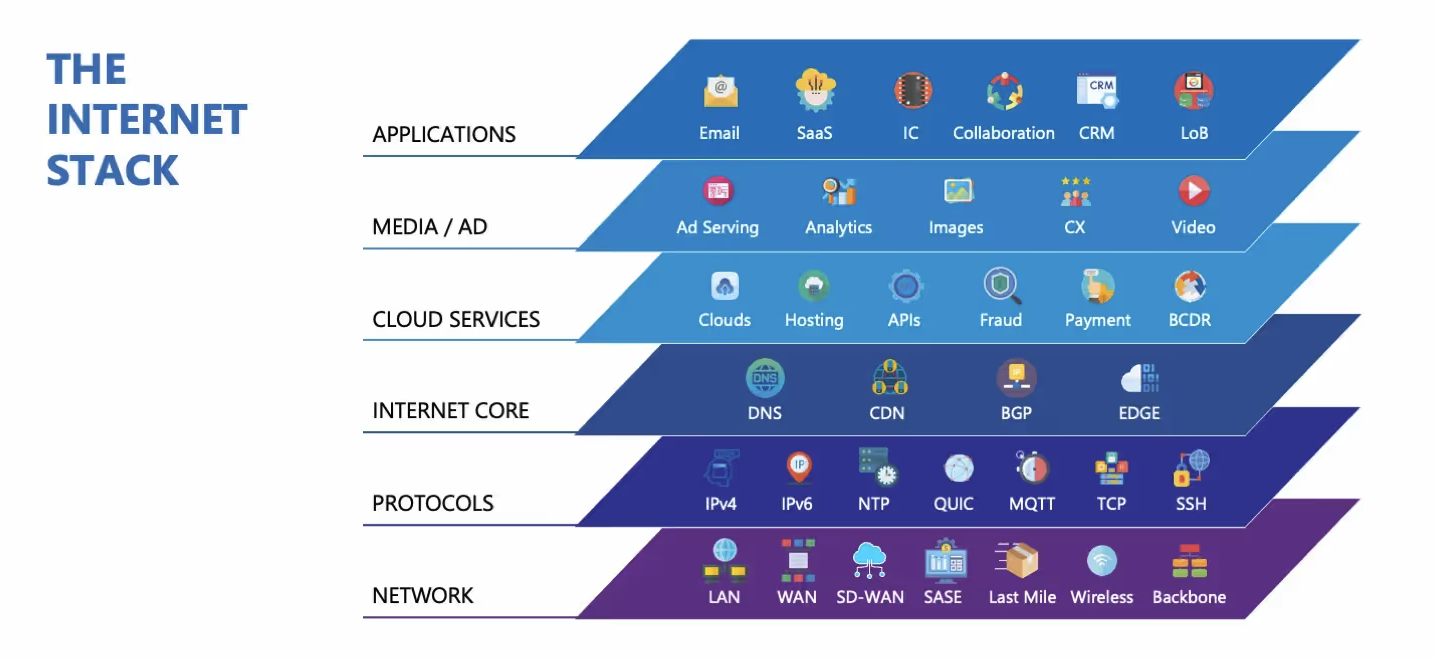
IPM provides a more comprehensive view of your entire digital experience, looking not just at the application itself but also at the underlying internet infrastructure—what we like to call the Internet Stack.  
A chart of different colored iconsAI-generated content may be incorrect.

The Internet Stack

By diving into network conditions, DNS performance, and more, IPM uncovers issues that traditional APM misses—much like using a health wearable to catch warning signs early.  

Let’s take a global eCommerce site that relies on online sales for its bottom line as an example. Its APM data shows smooth operations: no glaring code errors, no crashes. Yet users in a few regions keep timing out at checkout and abandoning their carts. Leveraging IPM, the company realizes the problem lies with slow DNS lookups and network lag in those specific areas. Armed with that intel, they optimize the network, add CDN servers, and tweak DNS settings. The result is faster page loads, happier customers, and—naturally—higher sales.

Where to go from here

By now it’s clear that IPM fills the gaps APM can’t reach, especially in a world where the Internet is fast becoming the new enterprise network. The stakes are higher than ever—when your Internet dependent applications and services fail, so do customer experiences and brand reputation.

So how do you pick the right IPM solution? Catchpoint has put together an Internet Performance Monitoring Buyer’s Guide to help CIOs and IT leaders navigate this evolving landscape. In it, we answer the tough questions every CIO asks when selecting an IPM solution:

  • How do I ensure my chosen platform can measure performance from the user perspective?
  • What are the components of the new Internet Stack every company needs to monitor?
  • How can AI-driven diagnostics help me identify issues quicker and reduce resolution times?

And that’s just the start, the guide also includes a handy Checklist for Evaluating IPM Platforms to make sure you're selecting the most suitable solution for your organization. Think of it as your personal health check—only this time, for the digital heartbeat of your entire organization.

Read the IPM Buyers Guide to Get the insights, tools, and checklist you need to future-proof your organization.

Monitoring has been part of our lives for centuries. We watch ourselves, our environment, and our habits to gain insights and make better decisions. Even the much-dreaded annual health check we line up for each year is just another facet of this age-old process. The goal is simple: spot small red flags now, before they balloon into bigger health complications later. It’s the same principle that has guided us for generations—keeping tabs, so we can correct course before trouble takes hold.

The personal monitoring revolution

A person wearing a ringAI-generated content may be incorrect.


With modern technology, our ability to observe has grown. Smart rings and watches help us track everything from how restless our sleep was to the precise moment our heart starts racing after that extra espresso shot. Some devices, like the Apple Watch, even go so far as to perform an ECG—so you’ve basically got a mini heart lab strapped to your wrist.  

In many ways, these tools know more about us than we know ourselves: when we go to bed, how often we toss and turn, how many times we slouch too long on the couch, and exactly how many steps we take each day. They’re no longer just fancy gadgets; they’ve become personal health assistants, quietly tuning in to every part of our daily routine. The promise is simple yet powerful: by being constantly aware of our bodies’ signals, we can make smarter choices—like moving a bit more, breathing a bit deeper, and hopefully living a bit healthier.  

Of course, this habit of checking vital signs doesn’t end with our wrists or our fingertips. Organizations face a parallel challenge in keeping their digital systems healthy—because when a critical application crashes, the consequences can be catastrophic.  

Digital health: Why organizations need monitoring

A person sitting in front of a computerAI-generated content may be incorrect.


Today’s digital landscape is complex, and organizations face numerous challenges in maintaining optimal performance and user satisfaction. Monitoring is the lifeline here—the key to catching issues before they impact your customers.

For years, many businesses have leaned on Application Performance Monitoring (APM) to measure the health of their applications. APM tools log response times, error rates, and performance bottlenecks, all in the name of ensuring a smooth user experience. But while APM is useful, it can’t see all the forces affecting user experience. Sometimes, the real culprit might be network congestion or DNS delays, not the app itself. That’s where Internet Performance Monitoring (IPM) comes in.

The Need for Internet Performance Monitoring (IPM)

IPM provides a more comprehensive view of your entire digital experience, looking not just at the application itself but also at the underlying internet infrastructure—what we like to call the Internet Stack.  

A chart of different colored iconsAI-generated content may be incorrect.

The Internet Stack

By diving into network conditions, DNS performance, and more, IPM uncovers issues that traditional APM misses—much like using a health wearable to catch warning signs early.  

Let’s take a global eCommerce site that relies on online sales for its bottom line as an example. Its APM data shows smooth operations: no glaring code errors, no crashes. Yet users in a few regions keep timing out at checkout and abandoning their carts. Leveraging IPM, the company realizes the problem lies with slow DNS lookups and network lag in those specific areas. Armed with that intel, they optimize the network, add CDN servers, and tweak DNS settings. The result is faster page loads, happier customers, and—naturally—higher sales.

Where to go from here

By now it’s clear that IPM fills the gaps APM can’t reach, especially in a world where the Internet is fast becoming the new enterprise network. The stakes are higher than ever—when your Internet dependent applications and services fail, so do customer experiences and brand reputation.

So how do you pick the right IPM solution? Catchpoint has put together an Internet Performance Monitoring Buyer’s Guide to help CIOs and IT leaders navigate this evolving landscape. In it, we answer the tough questions every CIO asks when selecting an IPM solution:

  • How do I ensure my chosen platform can measure performance from the user perspective?
  • What are the components of the new Internet Stack every company needs to monitor?
  • How can AI-driven diagnostics help me identify issues quicker and reduce resolution times?

And that’s just the start, the guide also includes a handy Checklist for Evaluating IPM Platforms to make sure you're selecting the most suitable solution for your organization. Think of it as your personal health check—only this time, for the digital heartbeat of your entire organization.

Read the IPM Buyers Guide to Get the insights, tools, and checklist you need to future-proof your organization.