
惯性聚合 高效追踪和阅读你感兴趣的博客、新闻、科技资讯
阅读原文 在惯性聚合中打开

推荐订阅源

博客园 - 三生石上(FineUI控件)
Hugging Face - Blog
Hugging Face - Blog
M
MIT News - Artificial intelligence
T
Tailwind CSS Blog
Webroot Blog
Webroot Blog
S
Secure Thoughts
N
News and Events Feed by Topic
月光博客
月光博客
TaoSecurity Blog
TaoSecurity Blog
Microsoft Azure Blog
B
Blog RSS Feed
N
News | PayPal Newsroom
Exploit-DB.com RSS Feed
小众软件
小众软件
Recent Commits to openclaw:main
P
Privacy & Cybersecurity Law Blog
GbyAI
GbyAI
K
Kaspersky official blog
WordPress大学
WordPress大学
P
Proofpoint News Feed
cs.CV updates on arXiv.org
博客园 - 叶小钗
W
WeLiveSecurity
Jina AI
Jina AI
The Cloudflare Blog
Project Zero
Project Zero
Simon Willison's Weblog
V
Vulnerabilities – Threatpost
L
LangChain Blog
Forbes - Security
Forbes - Security
PCI Perspectives
PCI Perspectives
Engineering at Meta
Engineering at Meta
Google DeepMind News
Recorded Future
Recorded Future
博客园 - 【当耐特】
H
Heimdal Security Blog
A
About on SuperTechFans
Cisco Talos Blog
Cisco Talos Blog
T
Threat Research - Cisco Blogs
云风的 BLOG
云风的 BLOG
Spread Privacy
Spread Privacy
L
LINUX DO - 最新话题
L
Lohrmann on Cybersecurity
Last Week in AI
Last Week in AI
Google DeepMind News
CTFtime.org: upcoming CTF events
I
Intezer
Martin Fowler
Martin Fowler
S
Securelist
Threat Intelligence Blog | Flashpoint

Catchpoint Blog

SRE Report: AI optimism and the economics of effort SRE Report: Why fast is what users trust SRE Report 2026: What surprised us, what didn't, and why the gaps matter most The SRE Report 2026: Defensible Ns Why Synthetic Tracing Delivers Better Data, Not Just More Data A New Chapter: LogicMonitor + Catchpoint – A Personal Note from Mehdi Mezmo + Catchpoint deliver observability SREs can rely on The four pillars holding up your digital business, and what happens when they crumble When payments pause: lessons from a global payments outage Observability 2025 Decoded: What the DZone Report Means for SLO-Driven Ops The next evolution of WebPageTest has arrived, and it’s a game-changer The Monitoring Blind Spot That Could Cost You Black Friday Powering Mexico’s Digital Future: Expanded Internet Observability with Catchpoint The Next Chapter of WebPageTest: Your New Experience Starts Soon SRE Report Retrospectives — Have AIOps Predictions Held Up? When BGP becomes UX: The inside story of a SaaS routing decision gone wrong (or right) Session Replay explained: A guide to seeing digital experience through your user’s eyes Making the invisible visible: Are your cloud firewalls and DDoS protection really working? Why it’s time to move beyond APM: Monitoring from the user’s perspective When metrics mislead: Inside the 2025 Retail Web Performance Benchmark The vendor trap: why your next outage won’t be your fault—but will be your problem LLMs don’t stand still: How to monitor and trust the models powering your AI Semantic Caching: What We Measured, Why It Matters The Annual SRE Survey Is Open—We Want to Hear from You Observability isn’t about the tool. It’s about the truth Invisible dependencies, visible impact: Lessons from the Google Cloud outage Real-time detection of BGP blackholing and prefix hijacks Leading analyst firm reveals the real cost of internet disruptions The Power of Over 3000 Intelligent Observability Agents Monitoring in the Age of Complexity: 5 Assumptions CIOs Need to Rethink Why Intelligent Traffic Steering is Critical for Performance and Cost Optimization Retail digital performance event recap: Key insights from IBM & Catchpoint Zendesk outage: A case for proactive monitoring and faster incident response Silence during chaos: Why the X outage is a call to arms for proactive monitoring The $1 Million Lesson: Building a Culture of Quality Through SLAs When AI tools fail: How to map your AI dependencies for proactive visibility Why Super Bowl 2025 was a triumph for Internet Resilience Why Internet Performance Monitoring is the new health check for IT organizations Why use Playwright in Catchpoint for synthetic monitoring Introducing WebPageTest Expert Plan: Real-Time Insights, Synthetic + RUM together in One Platform The shift to digital: How businesses are reshaping their priorities for 2025 The SRE Report 2025's Call to Action Monitoring in the Age of the Internet: DEM, IPM, and APM—What You Need to Know SSL Monitoring, Trust, and McLOVIN Performing for the holidays: Look beyond uptime for season sales success Lessons from Microsoft’s office 365 Outage: The Importance of third-party monitoring Web Performance Experts Look into the Future of Web Performance The hidden challenges of Internet Resilience: Key insights from 2024 report When SSL Issues aren’t just about SSL: A deep dive into the TIBCO Mashery outage The curious case of Marriott and the untold impact of web performance on revenue Preparing for the unexpected: Lessons from the AJIO and Jio Outage It’s time to stop neglecting the elephant in the room: Performance Matters! The Need for Speed: Highlights from IBM and Catchpoint’s Global DNS Performance Study Learnings from ServiceNow’s Proactive Response to a Network Breakdown Webinar Recap: Taking Web Performance to the Next Level Use the Catchpoint Terraform Provider in your CI/CD workflows Is the Internet ready for L4S? Takeaways from the CrowdStrike outage: third-parties can pose risk July 19th global IT outage reminds us of digital complexity 5 Actions you can take to improve digital performance 2024: A banner year for Internet Resilience APM vs Observability: Both-and, not either-or AppAssure: Ensuring the resilience of your Tier-1 applications just became easier APM vs observability: why your definitions are broken APM vs Observability: What comes next? APM vs Observability: Observing beyond APM Achieving stability with agility in your CI/CD pipeline AWS Outage: How do you prepare for the failure of your own safety net? Agentic AI: Powerful But Fragile—What You Need to Know Catch frustration before it costs you: New tools for a better user experience Catchpoint Expands Observability Network to Barcelona: A Growing Internet Hub Catchpoint Peak Performance Summit 2025: Redefining Observability for the Outcome Economy Catchpoint named a leader in the 2024 Gartner® Magic Quadrant™ for Digital Experience Monitoring Consolidation and Modernization in Enterprise Observability Connected Devices: Unlocking the next frontier of Internet Performance Monitoring Cloud Monitoring's Blind Spot: The User Perspective Cloudflare’s Resolver Outage: More Than Just DNS Cloudflare outage: another wake-up call for resilience planning Demystifying API Monitoring and Testing with IPM Creating the IPM Category: Catchpoint’s Journey to Leadership and the LogicMonitor Era Critical Requirements for Modern API Monitoring Customer Survey 2024: Unveiling insights and impact Did Delta's slow web performance signal trouble before CrowdStrike? Diagnosing Wi-Fi failures that traditional tools miss: a case study DNS misconfiguration can happen to anyone - the question is how fast can you detect it? ECN explained: Navigate congestion for faster, smoother data delivery Don’t get caught in the dark: Lessons from a Lumen & AWS micro-outage Escalating risk, shrinking margins: The 2025 Internet Resilience Report From refresh to results: the metrics that shaped Election Day 2024 coverage Fast and furious: The importance of performance in the digital age Getting Started with Traceroute From the source to the edge: the six agent types you can’t ignore From SEO to AEO: Why Web Performance Is the Key to AI Search Success Going for gold: Testing the resilience of Olympic websites Here’s the proof: What the fastest sites on the web have in common Google’s Agent-to-Agent (A2A) Protocol is here—Now Let’s Make it Observable How IPM helped a top tech brand catch an OpenAI outage before it became a crisis How AI Turns Monitoring From “What Now?” Into “What’s Next?” How to Monitor AI Agents in Commerce Systems
How SAP achieved world-class uptime through modern observability
2026-05-31 · via Catchpoint Blog

in this blog post

SAP Customer Experience (CX) has undergone a remarkable transformation over recent years, evolving from fragmented monitoring to a scalable, automated observability powerhouse. In a recent fireside chat, Martin Norato Auer, SAP CX’s VP of Observability, shed light on the strategies, practices, and measurable impacts behind SAP’s SLA, uptime, and responsiveness achievements.

SAP Commerce (formerly SAP Hybris) is an enterprise-grade e-commerce platform designed to unify and manage digital commerce across B2B, B2C, and B2B2C business models. It empowers businesses to deliver consistent, personalized, and seamless customer experiences across web, mobile, social, and physical channels.  

SAP Commerce is trusted by thousands of customers worldwide, with a particular concentration among large enterprises, including global leaders such as Alphabet, Shell, Cigna, British Petroleum, and Mercedes-Benz Group.  
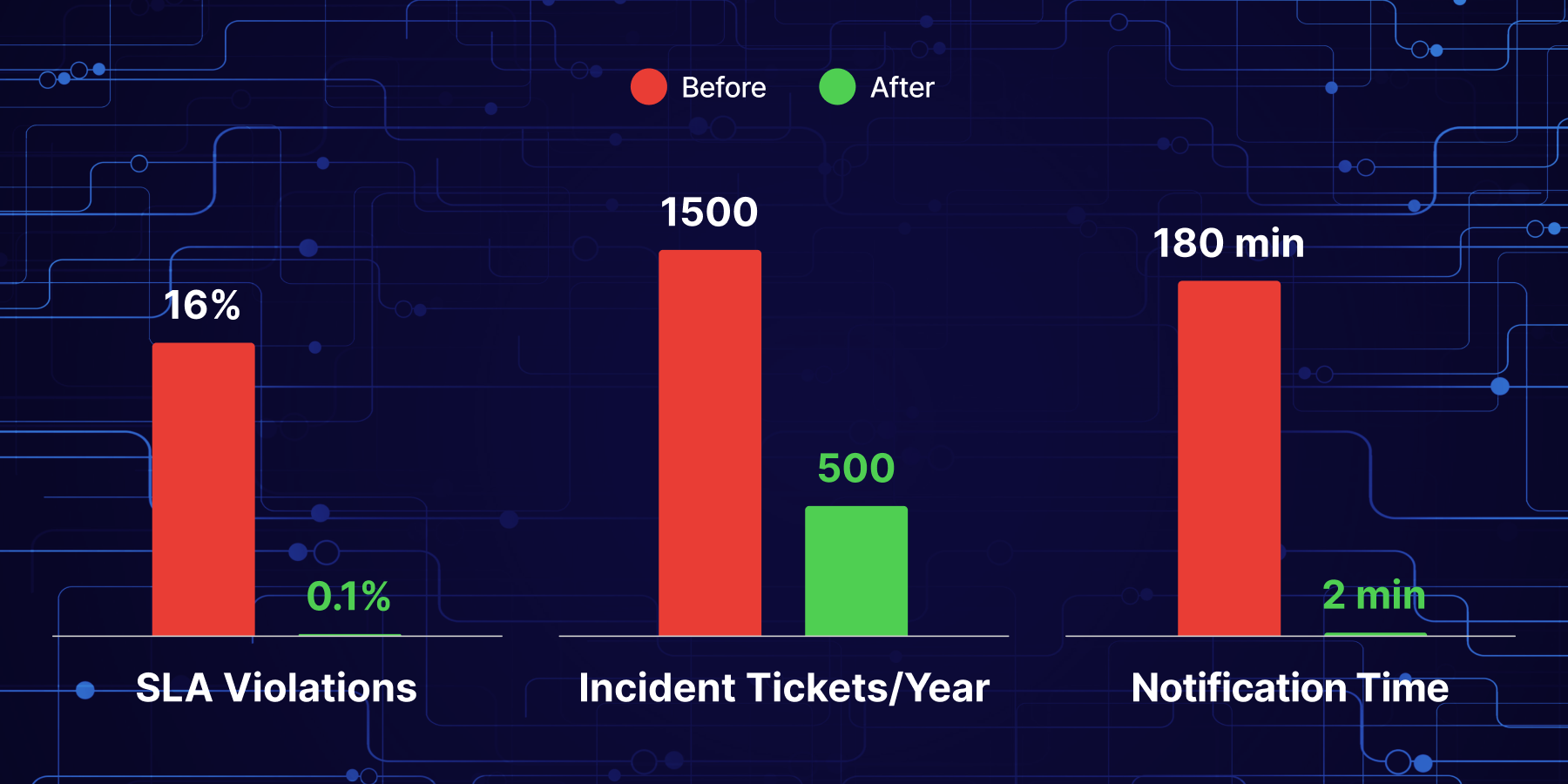
Raising the bar: SLA and uptime breakthroughs

  • SLA Violation Reduction: SAP CX cut SLA violations from 16% to just 0.1%, bringing them close to their long-term goal of zero downtime for customers.
  • Dramatic Ticket Reduction: The team slashed incident tickets from approximately 1,500 per year to 500, a two-thirds drop reflecting improved stability and proactive issue prevention.
  • Lightning-Fast Customer Notifications: Average time to inform customers about incidents plummeted from 180 minutes to just 2 minutes after incident detection.

For SAP Commerce customers, uptime and performance are critical because even brief disruptions or slowdowns can lead to lost revenue, diminished customer trust, and missed opportunities in highly competitive, always-on global markets.

Strategies for faster problem identification

  • Unified Observability Stack: SAP consolidated over ten fragmented monitoring tools into a cohesive platform—primarily Dynatrace for application performance and Catchpoint for Internet Performance Monitoring. This move drastically improved signal quality, reduced noise, and accelerated incident identification.
  • Automated Alert Relevance Filtering: Rather than simply multiplying alert volumes, SAP developed smart algorithms to distinguish truly relevant incidents, ensuring that human experts focus only on the most business-critical events.
  • Workflow Automation: By analyzing each stage of the incident notification chain, SAP introduced automation and APIs to eliminate manual handoffs wherever possible, while maintaining critical verification steps for high-stakes communications.
  • Proactive and Predictive Monitoring: The shift from reactive to predictive monitoring enabled SAP to spot potential issues and intervene before they impacted customers, leveraging dashboards that flag availability risk in advance.

Best practices that drove transformation

Large IT operations teams often face significant barriers when trying to implement transformative changes and adopt best practices. These challenges stem from a mix of organizational, cultural, and technical factors that compound as teams and systems grow in size and complexity. Here are some of the best practices SAP Commerce implemented:

  • Continuous Data Analysis: Every incident—missed or delayed—triggered a root cause analysis and process iteration, improving detection logic and reducing blind spots.
  • Process Transparency: Clear mapping of all steps needed for detection, triage, customer communication, and escalation allowed for targeted automation and efficiency gains.
  • Global Team Collaboration: A dispersed, cross-continental team structure enabled 24/7 coverage and quick mobilization for major events like Black Friday.
  • Leadership Engagement and Mobile Insights: SAP developed internal mobile apps to provide leadership with real-time, high-level incident summaries, enabling informed responses to customer inquiries within seconds.
  • AI for Summarization and Analysis: Generative AI tools summarized bridge call transcripts and communications, allowing both technical and non-technical users to grasp incident status instantly.

Transforming large, complex IT operations is challenging due to friction across people, processes, and platforms. Addressing these barriers requires strong, visible leadership, clear communication, aligning strategy to daily tasks, breaking down silos, modernizing legacy systems, investing in training, and adopting unified metrics. Only with an integrated, culture-sensitive approach can these organizations drive real, lasting change and successfully implement best practices

Lessons for the Enterprise

SAP Commerce has achieved global recognition as a leader in observability by transforming its operations into one of the most advanced, reliable, and responsive teams in the enterprise software industry. This evolution reflects a relentless drive to meet—and exceed—the high-availability, performance, and transparency demands of some of the world’s most complex businesses.

SAP’s journey highlights several key takeaways:

  • Tool consolidation is essential for reducing complexity and noise, enabling true end-to-end visibility.
  • Automation, not just monitoring, is key to shrinking response times and scale operations.
  • Customer-centric communication transforms incident management from technical firefighting into a trust-building opportunity.
  • Combining APM insights with IPM visibility enabled SAP Commerce to achieve comprehensive, end-to-end visibility—integrating deep application diagnostics (system logs, infrastructure metrics, code traces) with internet performance monitoring (Catchpoint IPM) —to quickly identify, prevent, and resolve incidents, thereby meeting their ambitious uptime and SLA goals while delivering an unparalleled customer experience.
  • Continuous improvement and data-driven iteration are the heartbeat of durable operational excellence.

By adopting these practices, SAP CX not only drove measurable, world-class improvements in SLA adherence, availability, and incident response, but also ensured SAP Commerce is trusted by organizations demanding the utmost in reliability, performance, and customer transparency.  

Watch the full fireside chat: Observability Lessons and Practices from a Fortune 500 Leader

Summary

SAP Customer Experience (CX) has undergone a remarkable transformation over recent years, evolving from fragmented monitoring to a scalable, automated observability powerhouse. In a recent fireside chat, Martin Norato Auer, SAP CX’s VP of Observability, shed light on the strategies, practices, and measurable impacts behind SAP’s SLA, uptime, and responsiveness achievements.

SAP Commerce (formerly SAP Hybris) is an enterprise-grade e-commerce platform designed to unify and manage digital commerce across B2B, B2C, and B2B2C business models. It empowers businesses to deliver consistent, personalized, and seamless customer experiences across web, mobile, social, and physical channels.  

SAP Commerce is trusted by thousands of customers worldwide, with a particular concentration among large enterprises, including global leaders such as Alphabet, Shell, Cigna, British Petroleum, and Mercedes-Benz Group.  

Raising the bar: SLA and uptime breakthroughs

  • SLA Violation Reduction: SAP CX cut SLA violations from 16% to just 0.1%, bringing them close to their long-term goal of zero downtime for customers.
  • Dramatic Ticket Reduction: The team slashed incident tickets from approximately 1,500 per year to 500, a two-thirds drop reflecting improved stability and proactive issue prevention.
  • Lightning-Fast Customer Notifications: Average time to inform customers about incidents plummeted from 180 minutes to just 2 minutes after incident detection.

For SAP Commerce customers, uptime and performance are critical because even brief disruptions or slowdowns can lead to lost revenue, diminished customer trust, and missed opportunities in highly competitive, always-on global markets.

Strategies for faster problem identification

  • Unified Observability Stack: SAP consolidated over ten fragmented monitoring tools into a cohesive platform—primarily Dynatrace for application performance and Catchpoint for Internet Performance Monitoring. This move drastically improved signal quality, reduced noise, and accelerated incident identification.
  • Automated Alert Relevance Filtering: Rather than simply multiplying alert volumes, SAP developed smart algorithms to distinguish truly relevant incidents, ensuring that human experts focus only on the most business-critical events.
  • Workflow Automation: By analyzing each stage of the incident notification chain, SAP introduced automation and APIs to eliminate manual handoffs wherever possible, while maintaining critical verification steps for high-stakes communications.
  • Proactive and Predictive Monitoring: The shift from reactive to predictive monitoring enabled SAP to spot potential issues and intervene before they impacted customers, leveraging dashboards that flag availability risk in advance.

Best practices that drove transformation

Large IT operations teams often face significant barriers when trying to implement transformative changes and adopt best practices. These challenges stem from a mix of organizational, cultural, and technical factors that compound as teams and systems grow in size and complexity. Here are some of the best practices SAP Commerce implemented:

  • Continuous Data Analysis: Every incident—missed or delayed—triggered a root cause analysis and process iteration, improving detection logic and reducing blind spots.
  • Process Transparency: Clear mapping of all steps needed for detection, triage, customer communication, and escalation allowed for targeted automation and efficiency gains.
  • Global Team Collaboration: A dispersed, cross-continental team structure enabled 24/7 coverage and quick mobilization for major events like Black Friday.
  • Leadership Engagement and Mobile Insights: SAP developed internal mobile apps to provide leadership with real-time, high-level incident summaries, enabling informed responses to customer inquiries within seconds.
  • AI for Summarization and Analysis: Generative AI tools summarized bridge call transcripts and communications, allowing both technical and non-technical users to grasp incident status instantly.

Transforming large, complex IT operations is challenging due to friction across people, processes, and platforms. Addressing these barriers requires strong, visible leadership, clear communication, aligning strategy to daily tasks, breaking down silos, modernizing legacy systems, investing in training, and adopting unified metrics. Only with an integrated, culture-sensitive approach can these organizations drive real, lasting change and successfully implement best practices

Lessons for the Enterprise

SAP Commerce has achieved global recognition as a leader in observability by transforming its operations into one of the most advanced, reliable, and responsive teams in the enterprise software industry. This evolution reflects a relentless drive to meet—and exceed—the high-availability, performance, and transparency demands of some of the world’s most complex businesses.

SAP’s journey highlights several key takeaways:

  • Tool consolidation is essential for reducing complexity and noise, enabling true end-to-end visibility.
  • Automation, not just monitoring, is key to shrinking response times and scale operations.
  • Customer-centric communication transforms incident management from technical firefighting into a trust-building opportunity.
  • Combining APM insights with IPM visibility enabled SAP Commerce to achieve comprehensive, end-to-end visibility—integrating deep application diagnostics (system logs, infrastructure metrics, code traces) with internet performance monitoring (Catchpoint IPM) —to quickly identify, prevent, and resolve incidents, thereby meeting their ambitious uptime and SLA goals while delivering an unparalleled customer experience.
  • Continuous improvement and data-driven iteration are the heartbeat of durable operational excellence.

By adopting these practices, SAP CX not only drove measurable, world-class improvements in SLA adherence, availability, and incident response, but also ensured SAP Commerce is trusted by organizations demanding the utmost in reliability, performance, and customer transparency.  

Watch the full fireside chat: Observability Lessons and Practices from a Fortune 500 Leader

This is some text inside of a div block.

You might also like

SRE Report: Why fast is what users trust

Why Synthetic Tracing Delivers Better Data, Not Just More Data

Creating the IPM Category: Catchpoint’s Journey to Leadership and the LogicMonitor Era