


Most operations teams trust their green dashboards. If the internal monitoring says everything is healthy, the app must be fine, right? But as the Internet keeps proving, what’s green inside the firewall can look red for customers outside of it. Sometimes, a single change in how web traffic moves can suddenly slow logins, disrupt websites, or hurt business results, even if everything looks fine inside.
This happened recently to a global SaaS platform specializing in IT service management and workflow automation. When they changed their IP routing strategy (essentially, how they send traffic to customers), nothing broke internally. SLAs looked clean. But customers suffered slowed logins, and the kind of unpredictable, frustrating performance that’s often caused by spiky SSL handshakes behind the scenes.
The cause? A quiet BGP routing decision that flipped how traffic moved across the US. This wasn’t just about performance. It was a lesson in how IT decisions shape what real people experience, every day. Let’s unpack what happened, why it matters for every business, and what teams need to learn to avoid hidden pain points.
Let’s look at what actually happened to real users. Browser-based performance tests revealed just how much the routing change affected login times and security handshakes across the country, sometimes multiplying delays tenfold.
Here’s what the data showed:
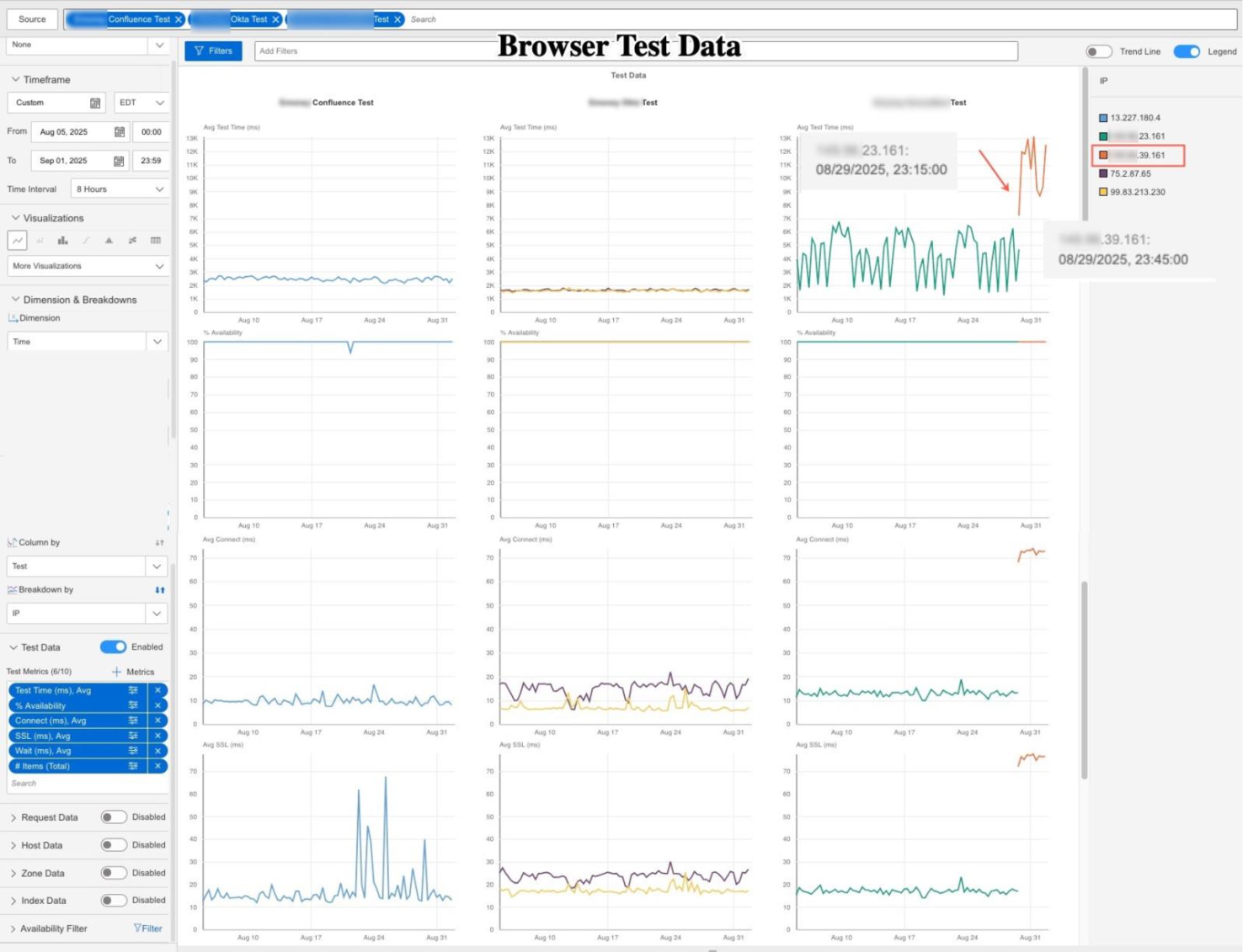
Until late August, most customers were using addresses in a specific range, the ‘/24 block’ (for the tech crowd: X.X.23.0/24) routed through a security service called Neustar. Neustar has connections across the country, which helped speed up traffic and protected users from online threats. For customers on the East Coast (like Philadelphia), this setup meant web requests reached the provider quickly, with lightning-fast response times (about 9 milliseconds) and almost no delays.
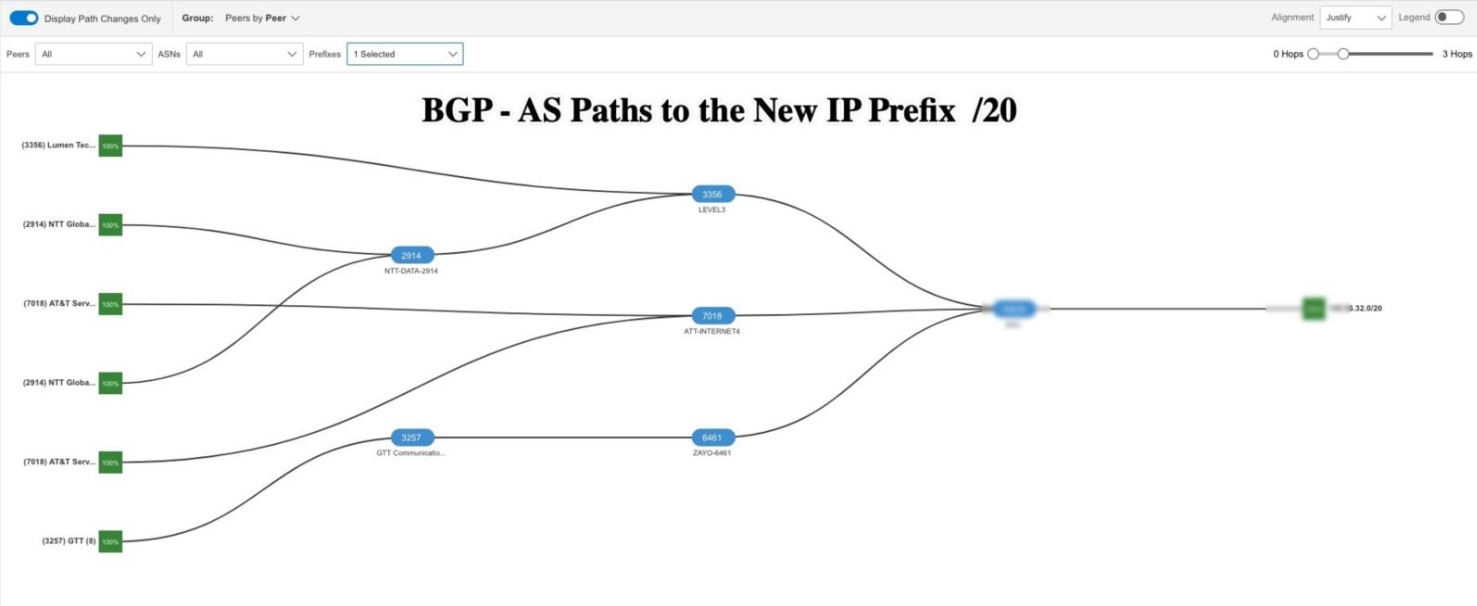
Then came the pivotal change. The SaaS provider moved customers from those addresses to a larger pool called the “/20 block.” On paper, this looked like a routine update. In practice, it was a big deal: it meant Neustar was no longer guiding the traffic. Instead, customers’ data was sent directly over the internet using providers like Lumen.
This was especially rough for East Coast users. Their requests now had to take a much longer journey, getting bounced across the country before arriving at the destination server in Phoenix. Users felt the pain immediately. Latency shot up by 10x, and basic tasks like logging in or establishing a secure connection suddenly took 5–10 times longer. For customers, everything just felt… slow.
This BGP flip essentially redistributed those who suffered and who benefited. Here’s how these changes played out in three real cities, backed by the browser-based measurements you saw above:
Philadelphia (East Coast):
Denver (Midwest):
Phoenix (West):
But it’s not just the numbers that changed. We ran traceroute tests to map out the journey customer traffic actually took before and after the routing shift. These show each handoff along the way—from city to city and network to network—offering a clear, visual proof of what caused the delays (or improvements).
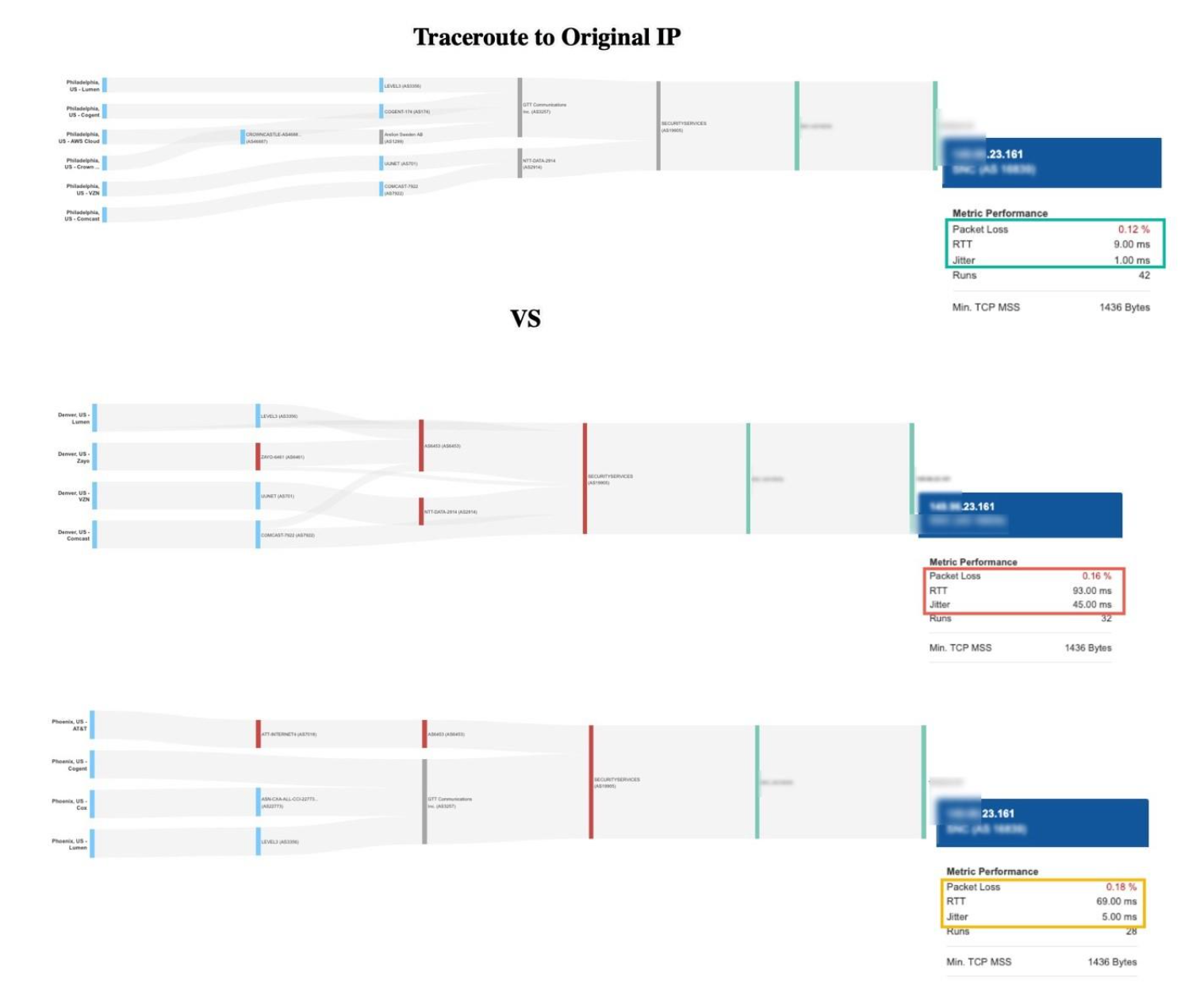
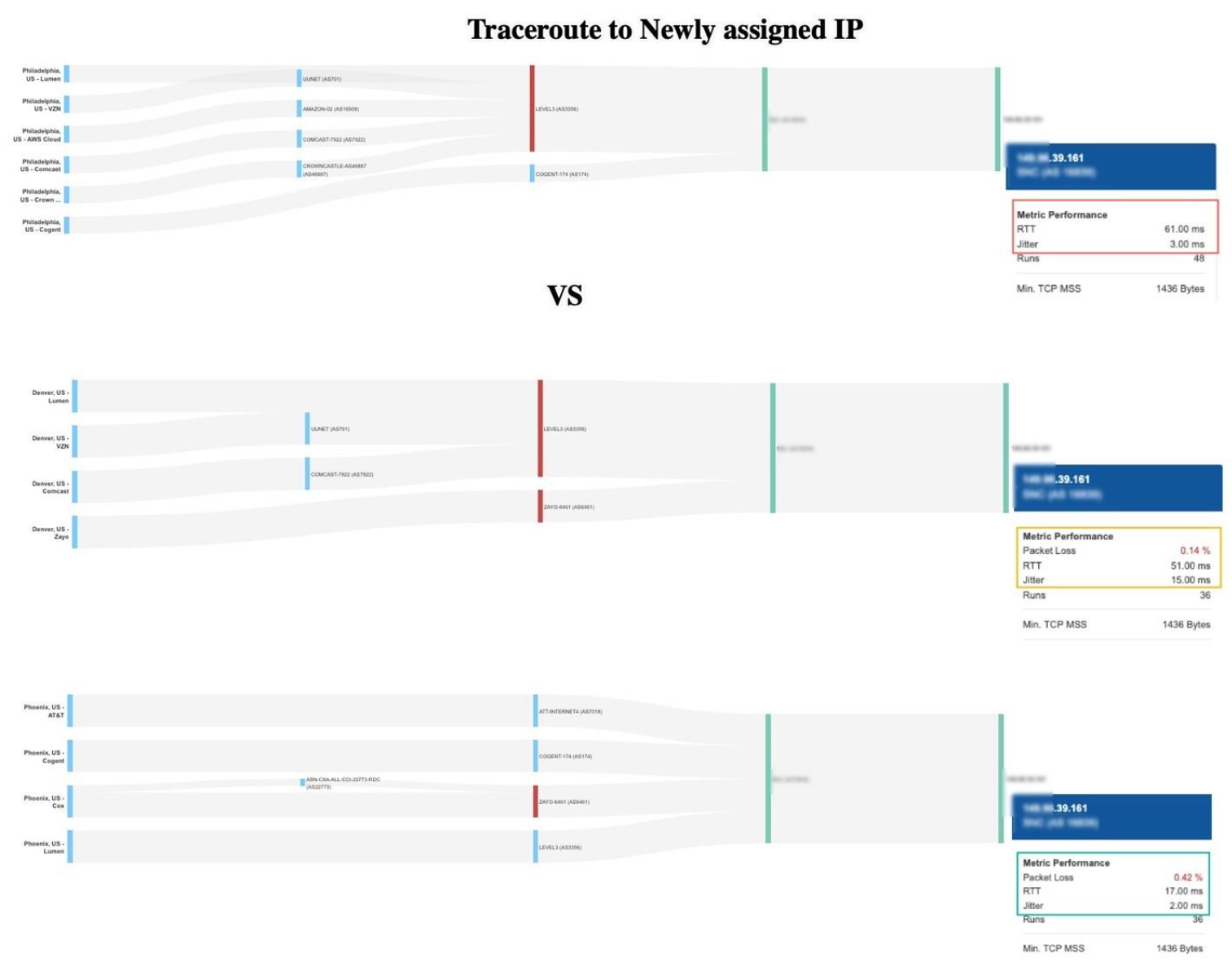
Traceroutes showing how the /24 anchored better for the East. The /20 anchored better for the West and Midwest. Neither strategy was consistent nationwide.
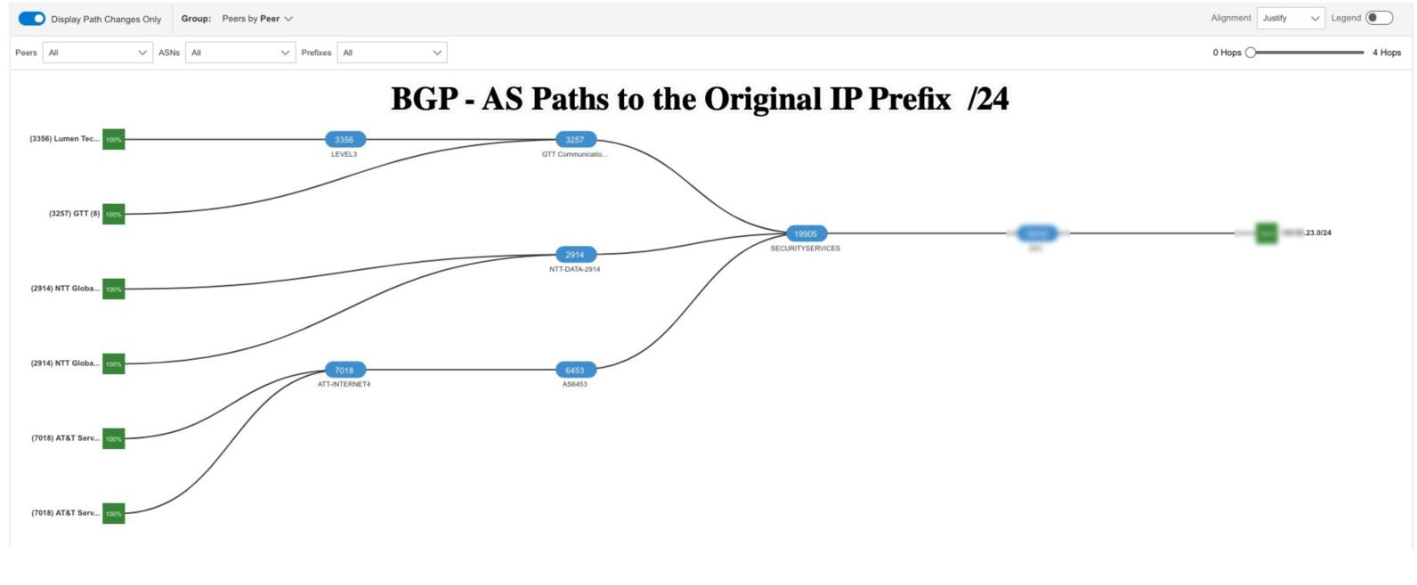
AS19905 is Vercara (formerly Neustar Security Services), widely used for DDoS mitigation and traffic scrubbing. For the SaaS platform, Neustar wasn’t just speeding up traffic, it acted as a key security and routing partner in the network. By running data through Neustar, the SaaS provider gave many customers a faster, more direct journey, with extra protections along the way. For East Coast users, this meant blazing-fast connections and a nearly flawless experience.
But this story isn’t just about latency, it’s about how the provider decided to split its network. After the routing change, some customers stayed on blocks that still pass through Neustar, getting their traffic scrubbed and distributed efficiently. Others were placed on new blocks that send data directly over major internet providers like Lumen, AT&T, NTT, GTT, or Zayo.
What’s the impact? Depending on which group you belong to, your web experience is completely different. Some users continue to benefit from both high security and fast delivery; others have a longer, less protected route, with more potential for delays.
Bottom line: Neustar’s “hidden role” meant a better, safer, and faster experience for part of the customer base. Removing it—and changing how blocks are routed—redrew the map of user pain and performance, by design.
Here’s what this story really shows about network changes, user experience, and why every organization should care
#1 Every BGP change can affect UX: A single prefix change can add 50+ ms to every transaction. That’s not visible on an internal dashboard but shows up immediately in user experience.
#2 Performance shifts aren’t random — they're routed: There’s rarely a universal win. Optimizing one geography often comes at another’s expense. Without broad external monitoring, you’ll never know whose experience got worse.
# 3 Security layers shape performance. The presence of Neustar as an intermediate ASN created one kind of experience; its absence created another. SaaS vendors juggle performance vs security vs cost. Sadly customers have to live with the consequences. Is there no other choice?
#4 You can’t rely on internal dashboards alone: The enterprise node in Philadelphia looked fine at layer 4. Only backbone tests and traceroutes revealed the real problem. Without external Internet visibility, ops teams would still be guessing.
From an enterprise perspective, this wasn’t about fixing an internal outage. It was about vendor accountability. With Catchpoint Internet Performance Monitoring (IPM) browser tests, traceroutes, and BGP visualizations, the ops team had undeniable evidence: the SaaS provider’s routing choice degraded East Coast performance. They could escalate with proof, not speculation.
This is why Internet-aware observability is non-negotiable:
The Internet is now your production stack. A SaaS provider’s decision to announce a /20 instead of a /24 isn’t just a routing artifact - it’s a user experience event. East Coast logins slowed because BGP policy shifted. West Coast users cheered while Philadelphia groaned. That’s the reality of Internet-scale delivery.
Green dashboards inside the enterprise won’t tell you this. Only IPM can. Because when BGP changes, so does your customer’s experience.
Want to see how proactive BGP monitoring works in action? Request your live demo today
A global SaaS provider changed its BGP routing, which dramatically shifted user experience across the US—East Coast users suffered higher latency, while the Midwest and West saw improvements. Internal dashboards missed these regional impacts, proving only external monitoring reveals the real customer story. The lesson: Every BGP decision matters for UX, and true visibility requires looking outside the firewall.
Most operations teams trust their green dashboards. If the internal monitoring says everything is healthy, the app must be fine, right? But as the Internet keeps proving, what’s green inside the firewall can look red for customers outside of it. Sometimes, a single change in how web traffic moves can suddenly slow logins, disrupt websites, or hurt business results, even if everything looks fine inside.
This happened recently to a global SaaS platform specializing in IT service management and workflow automation. When they changed their IP routing strategy (essentially, how they send traffic to customers), nothing broke internally. SLAs looked clean. But customers suffered slowed logins, and the kind of unpredictable, frustrating performance that’s often caused by spiky SSL handshakes behind the scenes.
The cause? A quiet BGP routing decision that flipped how traffic moved across the US. This wasn’t just about performance. It was a lesson in how IT decisions shape what real people experience, every day. Let’s unpack what happened, why it matters for every business, and what teams need to learn to avoid hidden pain points.
Let’s look at what actually happened to real users. Browser-based performance tests revealed just how much the routing change affected login times and security handshakes across the country, sometimes multiplying delays tenfold.
Here’s what the data showed:
Until late August, most customers were using addresses in a specific range, the ‘/24 block’ (for the tech crowd: X.X.23.0/24) routed through a security service called Neustar. Neustar has connections across the country, which helped speed up traffic and protected users from online threats. For customers on the East Coast (like Philadelphia), this setup meant web requests reached the provider quickly, with lightning-fast response times (about 9 milliseconds) and almost no delays.
Then came the pivotal change. The SaaS provider moved customers from those addresses to a larger pool called the “/20 block.” On paper, this looked like a routine update. In practice, it was a big deal: it meant Neustar was no longer guiding the traffic. Instead, customers’ data was sent directly over the internet using providers like Lumen.
This was especially rough for East Coast users. Their requests now had to take a much longer journey, getting bounced across the country before arriving at the destination server in Phoenix. Users felt the pain immediately. Latency shot up by 10x, and basic tasks like logging in or establishing a secure connection suddenly took 5–10 times longer. For customers, everything just felt… slow.
This BGP flip essentially redistributed those who suffered and who benefited. Here’s how these changes played out in three real cities, backed by the browser-based measurements you saw above:
Philadelphia (East Coast):
Denver (Midwest):
Phoenix (West):
But it’s not just the numbers that changed. We ran traceroute tests to map out the journey customer traffic actually took before and after the routing shift. These show each handoff along the way—from city to city and network to network—offering a clear, visual proof of what caused the delays (or improvements).
Traceroutes showing how the /24 anchored better for the East. The /20 anchored better for the West and Midwest. Neither strategy was consistent nationwide.
AS19905 is Vercara (formerly Neustar Security Services), widely used for DDoS mitigation and traffic scrubbing. For the SaaS platform, Neustar wasn’t just speeding up traffic, it acted as a key security and routing partner in the network. By running data through Neustar, the SaaS provider gave many customers a faster, more direct journey, with extra protections along the way. For East Coast users, this meant blazing-fast connections and a nearly flawless experience.
But this story isn’t just about latency, it’s about how the provider decided to split its network. After the routing change, some customers stayed on blocks that still pass through Neustar, getting their traffic scrubbed and distributed efficiently. Others were placed on new blocks that send data directly over major internet providers like Lumen, AT&T, NTT, GTT, or Zayo.
What’s the impact? Depending on which group you belong to, your web experience is completely different. Some users continue to benefit from both high security and fast delivery; others have a longer, less protected route, with more potential for delays.
Bottom line: Neustar’s “hidden role” meant a better, safer, and faster experience for part of the customer base. Removing it—and changing how blocks are routed—redrew the map of user pain and performance, by design.
Here’s what this story really shows about network changes, user experience, and why every organization should care
#1 Every BGP change can affect UX: A single prefix change can add 50+ ms to every transaction. That’s not visible on an internal dashboard but shows up immediately in user experience.
#2 Performance shifts aren’t random — they're routed: There’s rarely a universal win. Optimizing one geography often comes at another’s expense. Without broad external monitoring, you’ll never know whose experience got worse.
# 3 Security layers shape performance. The presence of Neustar as an intermediate ASN created one kind of experience; its absence created another. SaaS vendors juggle performance vs security vs cost. Sadly customers have to live with the consequences. Is there no other choice?
#4 You can’t rely on internal dashboards alone: The enterprise node in Philadelphia looked fine at layer 4. Only backbone tests and traceroutes revealed the real problem. Without external Internet visibility, ops teams would still be guessing.
From an enterprise perspective, this wasn’t about fixing an internal outage. It was about vendor accountability. With Catchpoint Internet Performance Monitoring (IPM) browser tests, traceroutes, and BGP visualizations, the ops team had undeniable evidence: the SaaS provider’s routing choice degraded East Coast performance. They could escalate with proof, not speculation.
This is why Internet-aware observability is non-negotiable:
The Internet is now your production stack. A SaaS provider’s decision to announce a /20 instead of a /24 isn’t just a routing artifact - it’s a user experience event. East Coast logins slowed because BGP policy shifted. West Coast users cheered while Philadelphia groaned. That’s the reality of Internet-scale delivery.
Green dashboards inside the enterprise won’t tell you this. Only IPM can. Because when BGP changes, so does your customer’s experience.
Want to see how proactive BGP monitoring works in action? Request your live demo today
This is some text inside of a div block.
此内容由惯性聚合(RSS阅读器)自动聚合整理,仅供阅读参考。 原文来自 — 版权归原作者所有。