
惯性聚合 高效追踪和阅读你感兴趣的博客、新闻、科技资讯
阅读原文 在惯性聚合中打开

推荐订阅源

Martin Fowler
Martin Fowler
CTFtime.org: upcoming CTF events
A
About on SuperTechFans
Apple Machine Learning Research
The Register - Security
Vercel News
Vercel News
H
Hackread – Cybersecurity News, Data Breaches, AI and More
人人都是产品经理
人人都是产品经理
MyScale Blog
MyScale Blog
云风的 BLOG
云风的 BLOG
博客园_首页
U
Unit 42
T
Tailwind CSS Blog
G
GRAHAM CLULEY
F
Full Disclosure
V
Vulnerabilities – Threatpost
T
Tenable Blog
月光博客
月光博客
P
Privacy & Cybersecurity Law Blog
P
Privacy International News Feed
K
Kaspersky official blog
Scott Helme
Scott Helme
cs.AI updates on arXiv.org
N
News and Events Feed by Topic
T
The Exploit Database - CXSecurity.com
N
News and Events Feed by Topic
有赞技术团队
有赞技术团队
Recent Commits to openclaw:main
L
LINUX DO - 最新话题
Recorded Future
Recorded Future
Application and Cybersecurity Blog
Help Net Security
Help Net Security
The GitHub Blog
The GitHub Blog
Cisco Talos Blog
Cisco Talos Blog
SecWiki News
SecWiki News
P
Proofpoint News Feed
Security Latest
Security Latest
cs.CL updates on arXiv.org
罗磊的独立博客
S
Security Affairs
M
MIT News - Artificial intelligence
L
LINUX DO - 热门话题
美团技术团队
Simon Willison's Weblog
T
Threat Research - Cisco Blogs
Stack Overflow Blog
Stack Overflow Blog
Forbes - Security
Forbes - Security
Hugging Face - Blog
Hugging Face - Blog
博客园 - Franky
V
Visual Studio Blog

Catchpoint Blog

SRE Report: AI optimism and the economics of effort SRE Report: Why fast is what users trust SRE Report 2026: What surprised us, what didn't, and why the gaps matter most The SRE Report 2026: Defensible Ns Why Synthetic Tracing Delivers Better Data, Not Just More Data A New Chapter: LogicMonitor + Catchpoint – A Personal Note from Mehdi Mezmo + Catchpoint deliver observability SREs can rely on The four pillars holding up your digital business, and what happens when they crumble When payments pause: lessons from a global payments outage Observability 2025 Decoded: What the DZone Report Means for SLO-Driven Ops The next evolution of WebPageTest has arrived, and it’s a game-changer The Monitoring Blind Spot That Could Cost You Black Friday Powering Mexico’s Digital Future: Expanded Internet Observability with Catchpoint The Next Chapter of WebPageTest: Your New Experience Starts Soon SRE Report Retrospectives — Have AIOps Predictions Held Up? When BGP becomes UX: The inside story of a SaaS routing decision gone wrong (or right) Session Replay explained: A guide to seeing digital experience through your user’s eyes Making the invisible visible: Are your cloud firewalls and DDoS protection really working? Why it’s time to move beyond APM: Monitoring from the user’s perspective When metrics mislead: Inside the 2025 Retail Web Performance Benchmark The vendor trap: why your next outage won’t be your fault—but will be your problem LLMs don’t stand still: How to monitor and trust the models powering your AI Semantic Caching: What We Measured, Why It Matters The Annual SRE Survey Is Open—We Want to Hear from You Observability isn’t about the tool. It’s about the truth Invisible dependencies, visible impact: Lessons from the Google Cloud outage Real-time detection of BGP blackholing and prefix hijacks Leading analyst firm reveals the real cost of internet disruptions The Power of Over 3000 Intelligent Observability Agents Monitoring in the Age of Complexity: 5 Assumptions CIOs Need to Rethink Why Intelligent Traffic Steering is Critical for Performance and Cost Optimization Retail digital performance event recap: Key insights from IBM & Catchpoint Zendesk outage: A case for proactive monitoring and faster incident response Silence during chaos: Why the X outage is a call to arms for proactive monitoring The $1 Million Lesson: Building a Culture of Quality Through SLAs When AI tools fail: How to map your AI dependencies for proactive visibility Why Super Bowl 2025 was a triumph for Internet Resilience Why Internet Performance Monitoring is the new health check for IT organizations Why use Playwright in Catchpoint for synthetic monitoring Introducing WebPageTest Expert Plan: Real-Time Insights, Synthetic + RUM together in One Platform The shift to digital: How businesses are reshaping their priorities for 2025 The SRE Report 2025's Call to Action Monitoring in the Age of the Internet: DEM, IPM, and APM—What You Need to Know SSL Monitoring, Trust, and McLOVIN Performing for the holidays: Look beyond uptime for season sales success Lessons from Microsoft’s office 365 Outage: The Importance of third-party monitoring Web Performance Experts Look into the Future of Web Performance The hidden challenges of Internet Resilience: Key insights from 2024 report When SSL Issues aren’t just about SSL: A deep dive into the TIBCO Mashery outage The curious case of Marriott and the untold impact of web performance on revenue Preparing for the unexpected: Lessons from the AJIO and Jio Outage It’s time to stop neglecting the elephant in the room: Performance Matters! The Need for Speed: Highlights from IBM and Catchpoint’s Global DNS Performance Study Learnings from ServiceNow’s Proactive Response to a Network Breakdown Webinar Recap: Taking Web Performance to the Next Level Use the Catchpoint Terraform Provider in your CI/CD workflows Is the Internet ready for L4S? Takeaways from the CrowdStrike outage: third-parties can pose risk July 19th global IT outage reminds us of digital complexity 5 Actions you can take to improve digital performance 2024: A banner year for Internet Resilience APM vs Observability: Both-and, not either-or AppAssure: Ensuring the resilience of your Tier-1 applications just became easier APM vs observability: why your definitions are broken APM vs Observability: What comes next? APM vs Observability: Observing beyond APM Achieving stability with agility in your CI/CD pipeline AWS Outage: How do you prepare for the failure of your own safety net? Agentic AI: Powerful But Fragile—What You Need to Know Catch frustration before it costs you: New tools for a better user experience Catchpoint Expands Observability Network to Barcelona: A Growing Internet Hub Catchpoint Peak Performance Summit 2025: Redefining Observability for the Outcome Economy Catchpoint named a leader in the 2024 Gartner® Magic Quadrant™ for Digital Experience Monitoring Consolidation and Modernization in Enterprise Observability Connected Devices: Unlocking the next frontier of Internet Performance Monitoring Cloud Monitoring's Blind Spot: The User Perspective Cloudflare’s Resolver Outage: More Than Just DNS Demystifying API Monitoring and Testing with IPM Creating the IPM Category: Catchpoint’s Journey to Leadership and the LogicMonitor Era Critical Requirements for Modern API Monitoring Customer Survey 2024: Unveiling insights and impact Did Delta's slow web performance signal trouble before CrowdStrike? Diagnosing Wi-Fi failures that traditional tools miss: a case study DNS misconfiguration can happen to anyone - the question is how fast can you detect it? ECN explained: Navigate congestion for faster, smoother data delivery Don’t get caught in the dark: Lessons from a Lumen & AWS micro-outage Escalating risk, shrinking margins: The 2025 Internet Resilience Report From refresh to results: the metrics that shaped Election Day 2024 coverage Fast and furious: The importance of performance in the digital age Getting Started with Traceroute From the source to the edge: the six agent types you can’t ignore From SEO to AEO: Why Web Performance Is the Key to AI Search Success Going for gold: Testing the resilience of Olympic websites Here’s the proof: What the fastest sites on the web have in common Google’s Agent-to-Agent (A2A) Protocol is here—Now Let’s Make it Observable How IPM helped a top tech brand catch an OpenAI outage before it became a crisis How AI Turns Monitoring From “What Now?” Into “What’s Next?” How SAP achieved world-class uptime through modern observability How to Monitor AI Agents in Commerce Systems
Cloudflare outage: another wake-up call for resilience planning
2026-05-31 · via Catchpoint Blog

in this blog post

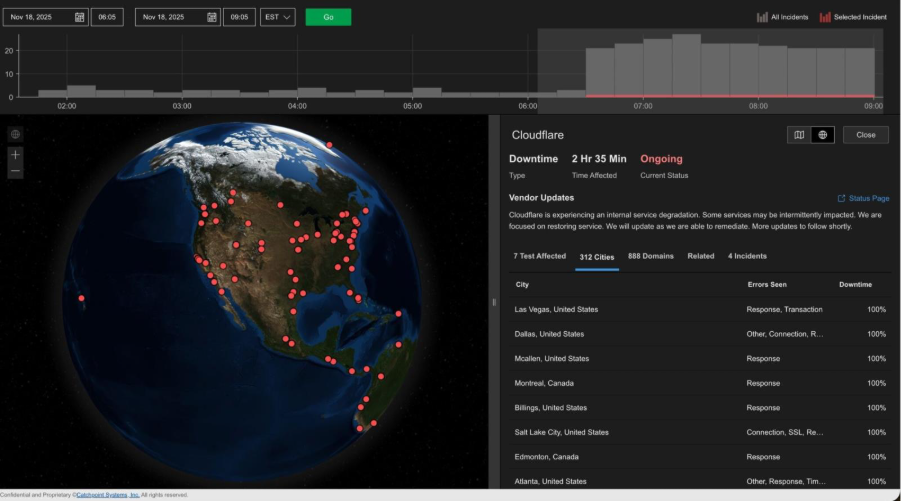
Another day, another massive Internet disruption, and this time it’s Cloudflare taking huge parts of the Internet offline.  
A screenshot of a computerAI-generated content may be incorrect.

Catchpoint Internet Sonar dashboard of Cloudflare’s ongoing outage in real time


This incident is not an anomaly. It is part of a recurring pattern that has become standard in digital infrastructure.

We have reached an inflection point in digital operations. Outages at major cloud and content delivery network (CDN) providers are now expected. The only real uncertainty is when it will happen next. More importantly, the most important question is: what are you doing about it?

The dangerous illusion of invincibility

Organizations continue to architect their entire digital presence around a belief that cloud providers or cloud services (like CDNs) will just work. Then they act surprised when that provider goes down and takes everything else with it.

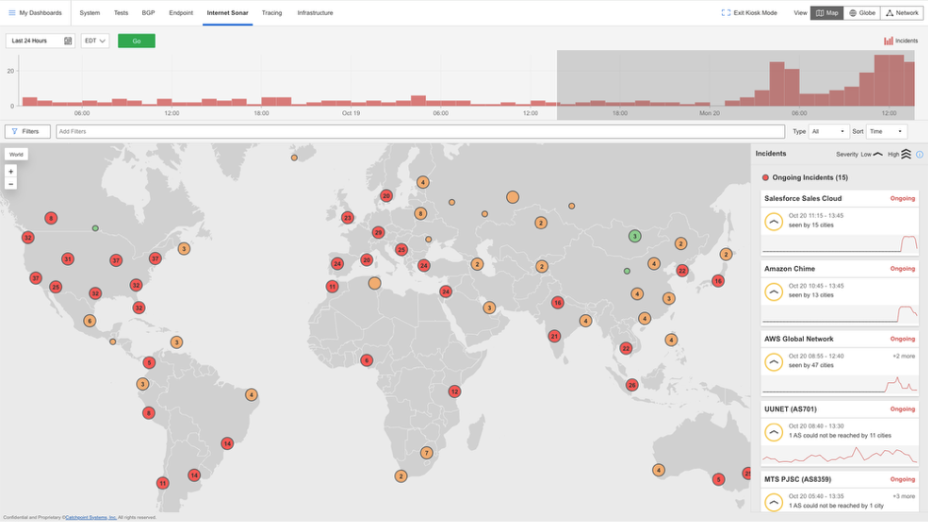
Take a look at the failures we have witnessed just recently. In July 2025, Cloudflare went down again. On October 20, it was AWS’s turn. Fortnite and Roblox players were suddenly locked out. Duolingo learners watched their streaks disappear. Snapchat’s 400 million daily users couldn’t send messages or view stories. Even Eight Sleep mattresses malfunctioned: some overheated or got stuck upright when their cloud connections failed.
A screenshot of a computer screenAI-generated content may be incorrect.

Catchpoint Internet Sonar dashboard of AWS’s October outage

Just nine days later, on October 29, 2025, Microsoft Azure’s Front Door CDN had a global outage that lasted more than eight hours. The result was widespread latency, timeouts, and errors across Microsoft 365, Outlook, Teams, Xbox Live, and many websites hosted on Azure – as well as corporate applications which had a component (an API, cloud service, or authentication service) hosted on Azure.  

A screenshot of a computerAI-generated content may be incorrect.

Catchpoint Internet Sonar dashboard showing Azure’s recent global outage

None of these outages are isolated events. They are evidence that cloud service failures should be expected problem in the infrastructure powering our connected world.  

Just because a server runs on a cloud does not mean there is some magic pixie dust that protects it from failing, misconfigurations, human error, failed updates, or their own dependencies.

The reality is that we live in a world where digital systems are critical for our daily lives, and those systems are complex, interconnected, distributed, and interdependent.  There is no cloud magic that protects systems just because they are hosted in the cloud.

The problem isn't just technical. It's a mindset.

Recently, I spoke with someone who said:

"I'm on Cloudflare. I don’t need anything else, I don’t need monitoring."

That sentiment expresses the heart of the issue. Why do we keep experiencing these massive internet disruptions? The answer is not just technical. The real problem is a mindset. There is a belief that using Cloudflare, AWS, Azure, or any major platform somehow makes companies immune to failure. When people rely on a "trusted" provider, they may feel justified in skipping resilience planning.

This way of thinking must go.

CDNs have been critical for performance acceleration since the late 1990s. They reduce latency, absorb traffic spikes (and DDoS attacks), and cache content closer to users. Somewhere along the line, though, we stopped thinking of them as tools and started believing they were flawless gatekeepers. When that happens, vulnerability creeps in.  

Even the best CDNs have outages. DNS delays, BGP leaks, TLS misconfigurations, and, in Cloudflare’s case, an oversized threat management file can all result in prolonged downtime. If you are locked into a single CDN without a fallback plan, there is nowhere left to redirect your traffic when disaster strikes.  

Multi-cloud contradiction

Here’s an ironic twist. Enterprises invest heavily in multi-cloud strategies. They spread compute, storage, and databases across AWS, Azure, and Google Cloud, investing in complex architecture and ongoing management. Yet, for the CDN layer that actually connects users to their apps, they usually choose one vendor.  

Think about it. No should run critical backend systems in just one availability zone. Why route all traffic through just one CDN? It’s like installing a world-class security system and then leaving the front door locked with a basic lock.

The impact is not simply about downtime. CDN outages frustrate users, erode brand credibility, and can negatively affect revenue and customer trust in seconds.  

When your CDN is also your eyes

The risk increases when companies depend on a single CDN not only for critical delivery but also for performance monitoring and incident visibility. It’s like having your accountant handle payroll, bookkeeping, and audit at the same time. While convenient, this approach means no independent oversight.  

When AWS’s massive outage struck, it didn’t just take down cloud services, apps, and enterprise platforms. It also knocked out many of the monitoring systems organizations depend on for real-time answers. Observability companies, including Datadog, New Relic, Checkly, Dynatrace, SpeedCurve, and Splunk Observability, lost visibility or functionality precisely when organizations needed them most.  

There is a very simple principle to follow: Your monitoring must be independent from the system being monitored. 

Redundancy and Resilience: Not just insurance, but strategy

Adopting a multi-vendor architecture is not just an emergency backup. It is a sensible strategy that drives real business value in performance, cost, and control.  

Here’s why:

  • Regional Performance Optimization: Different CDN providers excel in different regions. One may dominate in Europe. Another is best for Southeast Asia. Why limit yourself to a single provider’s strengths? Use the best performer for each geography.  
  • Vendor Leverage and Cost Optimization: Multiple providers mean you retain bargaining power. If your CDN’s price goes up or service falters, you have the flexibility to move workloads. Being able to shift traffic also encourages competitive pricing.  
  • Feature Flexibility: Providers specialize in varied areas—edge compute, video delivery, TLS offload, security features. A multi-CDN approach lets you choose the right platform for each job.  
  • Resilience Through Redundancy: Automated failover and smart routing help multi-CDN systems maintain service, even during major outages. If one provider goes down, traffic shifts instantly, often before users notice. Businesses using robust multi-CDN setups reach five nines (99.999%) reliability, or less than six minutes downtime per year, compared with eight or more hours with just one vendor.  

Intelligent traffic steering: When traffic is critical, implementing traffic steering brings not only resilience, but also the ability to make dynamic adjustments in real-time to optimize for user experience and cost optimization. A multi-vendor strategy is not foolproof. It can fail (will fail) unless you have the right visibility and the right processes to react as needed. At catchpoint, we are Cloudflare accounts, but we also have back up accounts. Having a second, backup CDN in a cloud is not that hard.

Even with a single vendor, some of the best IT teams today took advantage of proper planning and visibility to become aware of the problem immediately and switch traffic away from the failing service in seconds – while other teams continued to have failures for hours.
Building resilience: a practical framework

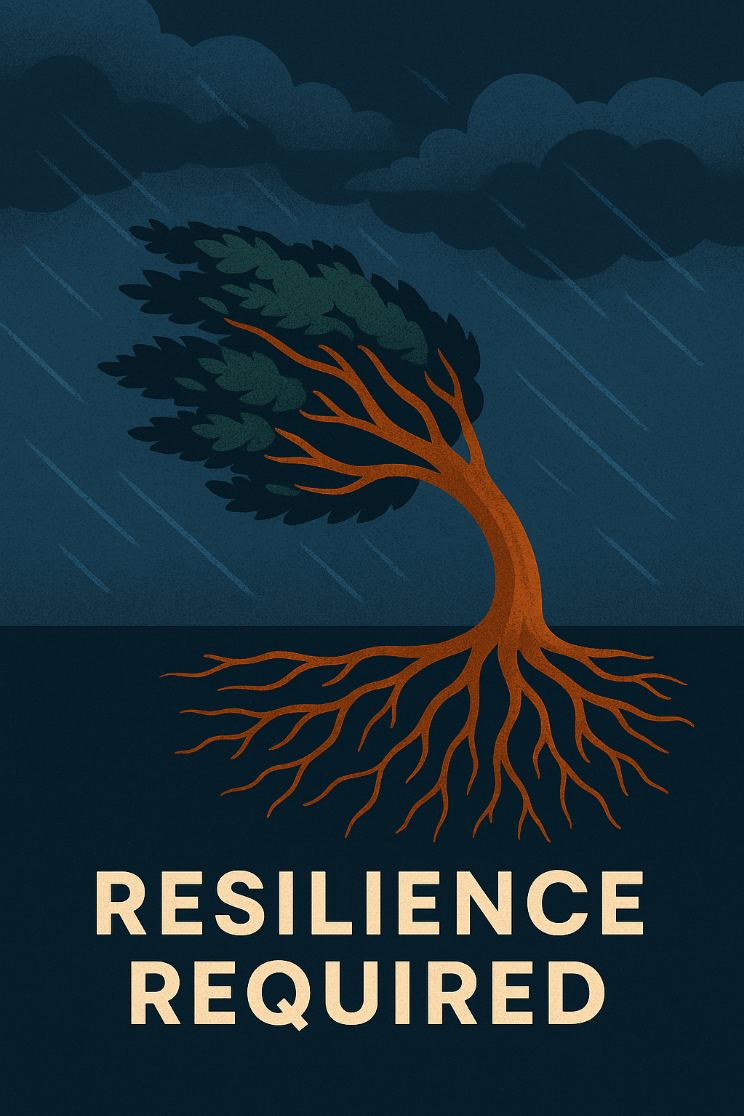
A tree with roots in waterAI-generated content may be incorrect.

Resilience does not arise by itself. It requires deliberate architectural choices and operational discipline. It needs to become a business priority that is taken seriously.

  • Establish a Chief Resilience Officer position. It’s time for companies to take this seriously and appoints a CRO that reports to the board. It needs to be an independent position with power to make the right investments and changes to minimize the risk to the business.
  • Become aware of your dependencies. And the dependencies of your dependencies. When Azure went down, Docusign went down too. This is a very serious thing for real estate businesses for example, and most likely a dependency they were not aware of.  
  • Plan for failure. Chaos engineering was invented in 2010 by Netflix when the cloud was a new thing. It was built on the idea of defining a steady state for a system, being aware of how a system could fail, designing how the system should respond to failure, and then running real-world controlled experiments to test for resilience.
  • Design Redundancy for every dependency: Eliminate single points of failure. Be prepared for any component of the system to fail. Distribution should be strategic, reflecting workload, geography, and risk.  
  • Create runbooks for every possible failure, It is important to document the process and desired actions when incidents happen based on their scope and severity.  
  • Test Failover Routinely: Simulate outages on a regular schedule. Confirm that both systems and staff respond well in emergencies. Practice makes sure no critical step is overlooked when customers depend on you.​
  • Establish Independent Visibility: Use monitoring tools that give you independent visibility into every dependency and can give you the ability to react quickly, minimizing impact to the business.. Don’t rely only on vendor dashboards. Independent validation is key.  
  • Understand Global and Local Performance: Users in different regions can have wildly different experiences. Service outages can be regional. Performance variations can become meaningful quickly. Monitor from diverse global vantage points to understand the real-world user experience – not only global uptime metrics.  

The path forward

Outages are unavoidable. You will experience a service outage soon. The question only question is when. But confusion, paralysis, and uncertainty do not have to be the result.  

This discussion is not about moving away from Cloudflare, AWS, Azure, or any major platform – even the best vendors suffer incidents, it’s the nature of technology. These providers offer immense capability and real business value. The real issue is building resilience, not relying on hope or luck.  

Redundancy is no longer optional. It is where resilience starts.

p.s. you may be interested in the 2025 Internet Resilience Report, it’s an insightful read (no registration required)

Summary

Cloudflare’s latest outage, like those on AWS and Azure before it, shows outages aren’t a surprise, but an expectation. Relying on a single CDN is a recipe for disaster. True resilience demands multi-CDN strategies, routine failover testing, independent performance monitoring, and a mindset shift away from convenience toward preparedness. Outages are normal; chaos is optional.

Another day, another massive Internet disruption, and this time it’s Cloudflare taking huge parts of the Internet offline.  

A screenshot of a computerAI-generated content may be incorrect.

Catchpoint Internet Sonar dashboard of Cloudflare’s ongoing outage in real time


This incident is not an anomaly. It is part of a recurring pattern that has become standard in digital infrastructure.

We have reached an inflection point in digital operations. Outages at major cloud and content delivery network (CDN) providers are now expected. The only real uncertainty is when it will happen next. More importantly, the most important question is: what are you doing about it?

The dangerous illusion of invincibility

Organizations continue to architect their entire digital presence around a belief that cloud providers or cloud services (like CDNs) will just work. Then they act surprised when that provider goes down and takes everything else with it.

Take a look at the failures we have witnessed just recently. In July 2025, Cloudflare went down again. On October 20, it was AWS’s turn. Fortnite and Roblox players were suddenly locked out. Duolingo learners watched their streaks disappear. Snapchat’s 400 million daily users couldn’t send messages or view stories. Even Eight Sleep mattresses malfunctioned: some overheated or got stuck upright when their cloud connections failed.

A screenshot of a computer screenAI-generated content may be incorrect.

Catchpoint Internet Sonar dashboard of AWS’s October outage

Just nine days later, on October 29, 2025, Microsoft Azure’s Front Door CDN had a global outage that lasted more than eight hours. The result was widespread latency, timeouts, and errors across Microsoft 365, Outlook, Teams, Xbox Live, and many websites hosted on Azure – as well as corporate applications which had a component (an API, cloud service, or authentication service) hosted on Azure.  

A screenshot of a computerAI-generated content may be incorrect.

Catchpoint Internet Sonar dashboard showing Azure’s recent global outage

None of these outages are isolated events. They are evidence that cloud service failures should be expected problem in the infrastructure powering our connected world.  

Just because a server runs on a cloud does not mean there is some magic pixie dust that protects it from failing, misconfigurations, human error, failed updates, or their own dependencies.

The reality is that we live in a world where digital systems are critical for our daily lives, and those systems are complex, interconnected, distributed, and interdependent.  There is no cloud magic that protects systems just because they are hosted in the cloud.

The problem isn't just technical. It's a mindset.

Recently, I spoke with someone who said:

"I'm on Cloudflare. I don’t need anything else, I don’t need monitoring."

That sentiment expresses the heart of the issue. Why do we keep experiencing these massive internet disruptions? The answer is not just technical. The real problem is a mindset. There is a belief that using Cloudflare, AWS, Azure, or any major platform somehow makes companies immune to failure. When people rely on a "trusted" provider, they may feel justified in skipping resilience planning.

This way of thinking must go.

CDNs have been critical for performance acceleration since the late 1990s. They reduce latency, absorb traffic spikes (and DDoS attacks), and cache content closer to users. Somewhere along the line, though, we stopped thinking of them as tools and started believing they were flawless gatekeepers. When that happens, vulnerability creeps in.  

Even the best CDNs have outages. DNS delays, BGP leaks, TLS misconfigurations, and, in Cloudflare’s case, an oversized threat management file can all result in prolonged downtime. If you are locked into a single CDN without a fallback plan, there is nowhere left to redirect your traffic when disaster strikes.  

Multi-cloud contradiction

Here’s an ironic twist. Enterprises invest heavily in multi-cloud strategies. They spread compute, storage, and databases across AWS, Azure, and Google Cloud, investing in complex architecture and ongoing management. Yet, for the CDN layer that actually connects users to their apps, they usually choose one vendor.  

Think about it. No should run critical backend systems in just one availability zone. Why route all traffic through just one CDN? It’s like installing a world-class security system and then leaving the front door locked with a basic lock.

The impact is not simply about downtime. CDN outages frustrate users, erode brand credibility, and can negatively affect revenue and customer trust in seconds.  

When your CDN is also your eyes

The risk increases when companies depend on a single CDN not only for critical delivery but also for performance monitoring and incident visibility. It’s like having your accountant handle payroll, bookkeeping, and audit at the same time. While convenient, this approach means no independent oversight.  

When AWS’s massive outage struck, it didn’t just take down cloud services, apps, and enterprise platforms. It also knocked out many of the monitoring systems organizations depend on for real-time answers. Observability companies, including Datadog, New Relic, Checkly, Dynatrace, SpeedCurve, and Splunk Observability, lost visibility or functionality precisely when organizations needed them most.  

There is a very simple principle to follow: Your monitoring must be independent from the system being monitored. 

Redundancy and Resilience: Not just insurance, but strategy

Adopting a multi-vendor architecture is not just an emergency backup. It is a sensible strategy that drives real business value in performance, cost, and control.  

Here’s why:

  • Regional Performance Optimization: Different CDN providers excel in different regions. One may dominate in Europe. Another is best for Southeast Asia. Why limit yourself to a single provider’s strengths? Use the best performer for each geography.  
  • Vendor Leverage and Cost Optimization: Multiple providers mean you retain bargaining power. If your CDN’s price goes up or service falters, you have the flexibility to move workloads. Being able to shift traffic also encourages competitive pricing.  
  • Feature Flexibility: Providers specialize in varied areas—edge compute, video delivery, TLS offload, security features. A multi-CDN approach lets you choose the right platform for each job.  
  • Resilience Through Redundancy: Automated failover and smart routing help multi-CDN systems maintain service, even during major outages. If one provider goes down, traffic shifts instantly, often before users notice. Businesses using robust multi-CDN setups reach five nines (99.999%) reliability, or less than six minutes downtime per year, compared with eight or more hours with just one vendor.  

Intelligent traffic steering: When traffic is critical, implementing traffic steering brings not only resilience, but also the ability to make dynamic adjustments in real-time to optimize for user experience and cost optimization. A multi-vendor strategy is not foolproof. It can fail (will fail) unless you have the right visibility and the right processes to react as needed. At catchpoint, we are Cloudflare accounts, but we also have back up accounts. Having a second, backup CDN in a cloud is not that hard.

Even with a single vendor, some of the best IT teams today took advantage of proper planning and visibility to become aware of the problem immediately and switch traffic away from the failing service in seconds – while other teams continued to have failures for hours.

Building resilience: a practical framework

A tree with roots in waterAI-generated content may be incorrect.

Resilience does not arise by itself. It requires deliberate architectural choices and operational discipline. It needs to become a business priority that is taken seriously.

  • Establish a Chief Resilience Officer position. It’s time for companies to take this seriously and appoints a CRO that reports to the board. It needs to be an independent position with power to make the right investments and changes to minimize the risk to the business.
  • Become aware of your dependencies. And the dependencies of your dependencies. When Azure went down, Docusign went down too. This is a very serious thing for real estate businesses for example, and most likely a dependency they were not aware of.  
  • Plan for failure. Chaos engineering was invented in 2010 by Netflix when the cloud was a new thing. It was built on the idea of defining a steady state for a system, being aware of how a system could fail, designing how the system should respond to failure, and then running real-world controlled experiments to test for resilience.
  • Design Redundancy for every dependency: Eliminate single points of failure. Be prepared for any component of the system to fail. Distribution should be strategic, reflecting workload, geography, and risk.  
  • Create runbooks for every possible failure, It is important to document the process and desired actions when incidents happen based on their scope and severity.  
  • Test Failover Routinely: Simulate outages on a regular schedule. Confirm that both systems and staff respond well in emergencies. Practice makes sure no critical step is overlooked when customers depend on you.​
  • Establish Independent Visibility: Use monitoring tools that give you independent visibility into every dependency and can give you the ability to react quickly, minimizing impact to the business.. Don’t rely only on vendor dashboards. Independent validation is key.  
  • Understand Global and Local Performance: Users in different regions can have wildly different experiences. Service outages can be regional. Performance variations can become meaningful quickly. Monitor from diverse global vantage points to understand the real-world user experience – not only global uptime metrics.  

The path forward

Outages are unavoidable. You will experience a service outage soon. The question only question is when. But confusion, paralysis, and uncertainty do not have to be the result.  

This discussion is not about moving away from Cloudflare, AWS, Azure, or any major platform – even the best vendors suffer incidents, it’s the nature of technology. These providers offer immense capability and real business value. The real issue is building resilience, not relying on hope or luck.  

Redundancy is no longer optional. It is where resilience starts.

p.s. you may be interested in the 2025 Internet Resilience Report, it’s an insightful read (no registration required)

This is some text inside of a div block.

You might also like

SRE Report: Why fast is what users trust

SRE Report 2026: What surprised us, what didn't, and why the gaps matter most

The SRE Report 2026: Defensible Ns