






Marketplace platforms no longer represent a single-category decision for enterprise buyers. The market is bifurcating into two operating models (or enterprise motions) that define how value is created, delivered, and measured: digital services (“bits”) and physical goods (“atoms”). To reflect this shift, we published two reports that align to a distinct buyer and consideration set:
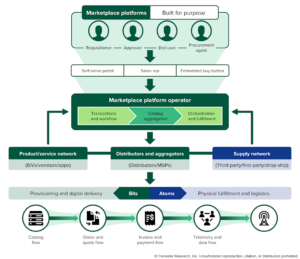
Technology companies and channel-centric businesses use marketplace platforms to scale growth through partners. The platforms create value by standardizing how offerings are packaged, sold, and managed across partners. These environments rely on digital provisioning, partner-led distribution, and recurring revenue tied to usage and services. Channel partners deliver implementation, integration, and ongoing management. Managed service providers build recurring revenue through continuous support and lifecycle engagement. Here, the focus is on capabilities that:
Retailers, distributors, and manufacturers use marketplace platforms to execute commerce across distributed supply networks. Platforms create value by orchestrating fulfillment, catalog, and financial operations at scale. They coordinate seller onboarding, catalog quality, fulfillment routing, payments, and returns across multiple parties. These environments introduce constraints in inventory ownership, logistics execution, and distributor relationships. Distributors often manage product flow, provide warehousing, and extend financing across the channel. These roles shape how enterprises evaluate marketplace platforms and the capabilities they require. Here, the focus is on capabilities that:
Many high-tech enterprises operate across both models. This complicates platform selection, and selecting the wrong model introduces friction across partners, operations, and revenue. If you’re evaluating marketplace platforms, don’t treat this as a single decision. Anchor your approach in how your business creates and delivers value, then align your platform strategy to that reality. This means technology leaders must:
If you need help, let’s talk. Forrester clients can schedule an inquiry or guidance session with me. I can help you:
Blog
The Next Millennial Domino Falls When reports emerged that SHEIN had acquired Everlane, the other shoe dropped. Like the recently departed Allbirds, Everlane was once the poster child for a new kind of Millennial consumerism. It promised radical transparency, clean design, ethical sourcing, and a rejection of disposable fashion culture. Along with a generation of […]
Blog
As B2B buyers rely on self-guided research, AI tools, and buying groups, many revenue leaders are questioning the future of revenue development reps (RDRs). The answer isn’t fewer RDRs — it’s a fundamentally reimagined role built around buying group insight, signal-based prioritization, and AI-enabled productivity.
此内容由惯性聚合(RSS阅读器)自动聚合整理,仅供阅读参考。 原文来自 — 版权归原作者所有。