


Google has emerged as US marketing agencies’ preferred AI partner, overtaking Adobe, Anthropic, Microsoft, and OpenAI for the first time since 2024. New Forrester and 4As research shows that agency leaders are no longer choosing the latest or best models; instead, they select the ecosystem that integrates data, creative, media, and commerce.
The 2026 Cannes Lions International Festival of Creativity reflects this shift. While AI vendors, adtech, and martech flood the Croisette with demos, activations, and partner perks, one provider is pulling ahead because it’s starting to solve for a difficult marketing need: marketing orchestration at scale.
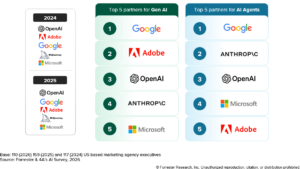
Agencies (and marketers) are no longer just buying AI models. They’re buying and building marketing operating systems, because the name of the game is no longer to optimize isolated marketing tasks but to orchestrate end-to-end marketing working systems that unify data, creative, activation, and measurement. Google is more preferred because it’s starting to connect a more complete marketing workflow.
Google’s advantage is breadth and integration. Its stack spans audience data (Google Analytics 360), measurement and optimization (Meridian), creative tooling (Asset Studio), AI models (Gemini, Imagen, Veo), and activation channels (Search, YouTube, Display). This allows agencies to collapse the distance between insight and execution.
This aligns with how agency holding companies and midsized agency networks build their own operating systems and technology stacks that manage end-to-end marketing capabilities for clients. From dentsu.Connect, Omnicom’s Omni, Publicis Groupe’s Marcel, and WPP Open to Converged, DEPT, and the Machine Agency, each relies on Google to complete or enhance its offering.
I feel like, in the future, I’ll be buying Google the same way I buy Adobe.
Agencies didn’t choose the smartest AI tool. They selected the AI ecosystem that helps collapse the distance between data, creative, media, and commerce. Google is the top partner because it made the shift from an ads platform using AI to an AI-enabled marketing operating system.
While the research places Google in the limelight, it also shines light on the category’s opportunity to unite marketing workflow for business growth. As the market shifts from tools that augment to ecosystems that orchestrate, competition is a critical force to maintain a customer-centric and brand-agnostic alternative. The AI tech market must be wary of backlash to rigid and closed-system practices. “Why should I believe any [tech company] agents won’t make biased, self-serving recommendations in their automated ad programs?” questions another agency executive. Looking at the remaining top five AI technology partners, marketers and agency executives should anticipate that:
In our upcoming report, “The State Of AI Inside US Marketing Agencies, 2026,” we detail the growth of generative and agentic AI (agents) within agencies, including objectives, use cases, benefits, barriers, partnerships, and remuneration. This reveals significant opportunities for how brands can leverage the emerging capabilities of marketing partners for their own growth.
If you’re a Forrester client interested in learning more about what the current state of play means for the future of the client-agency relationship, set up a guidance session with Jay Pattisall.
此内容由惯性聚合(RSS阅读器)自动聚合整理,仅供阅读参考。 原文来自 — 版权归原作者所有。