



惯性聚合 高效追踪和阅读你感兴趣的博客、新闻、科技资讯
阅读原文 在惯性聚合中打开

推荐订阅源

F
Fortinet All Blogs
让小产品的独立变现更简单 - ezindie.com
有赞技术团队
有赞技术团队
www.infosecurity-magazine.com
大猫的无限游戏
大猫的无限游戏
爱范儿
爱范儿
Threat Intelligence Blog | Flashpoint
T
Threatpost
V
Visual Studio Blog
Apple Machine Learning Research
博客园 - Franky
人人都是产品经理
人人都是产品经理
cs.AI updates on arXiv.org
The Cloudflare Blog
N
News and Events Feed by Topic
L
Lohrmann on Cybersecurity
cs.CL updates on arXiv.org
酷 壳 – CoolShell
酷 壳 – CoolShell
V
V2EX
AWS News Blog
AWS News Blog
S
SegmentFault 最新的问题
T
Tailwind CSS Blog
Hugging Face - Blog
Hugging Face - Blog
钛媒体:引领未来商业与生活新知
钛媒体:引领未来商业与生活新知
Spread Privacy
Spread Privacy
J
Java Code Geeks
博客园 - 聂微东
T
Tor Project blog
宝玉的分享
宝玉的分享
博客园 - 叶小钗
Webroot Blog
Webroot Blog
博客园 - 【当耐特】
freeCodeCamp Programming Tutorials: Python, JavaScript, Git & More
H
Heimdal Security Blog
Y
Y Combinator Blog
T
The Blog of Author Tim Ferriss
MongoDB | Blog
MongoDB | Blog
I
InfoQ
Security Latest
Security Latest
Martin Fowler
Martin Fowler
Hacker News: Ask HN
Hacker News: Ask HN
P
Privacy International News Feed
C
CERT Recently Published Vulnerability Notes
Latest news
Latest news
雷峰网
雷峰网
D
Darknet – Hacking Tools, Hacker News & Cyber Security
C
Cisco Blogs
H
Help Net Security
L
LINUX DO - 最新话题
L
LINUX DO - 热门话题

Featured Blogs - Forrester

Customer Zero Proves AI Works When Humans Change Customer Zero Programs Prove That AI Works When Humans Change Prime Day, June 2026: How Retailers Competed With Amazon Inclusive Design Is Automotive’s Overlooked Growth Opportunity B2B Social Media Influencers Have More Influence Than Ever Comcast Split Puts NBCUniversal In Play What Technology Leaders Should Not Miss At Technology & Innovation Forum Central Why Your AI Strategy Needs A DEXM Solution: Lessons From Nexthink Masters Of Experience The Next Era Of B2B Events: 8 Data-Backed Shifts Defining 2026 The Next Era Of B2B Events: Eight Data-Backed Shifts Defining 2026 Identiverse 2026 Recap: Identity Security for Agentic AI Dominates Announcing The Forrester Wave™ On Extended Detection And Response Platforms: Platformization, AI, And…AI Announcing The Forrester Wave™ On Extended Detection And Response Platforms: Platformization, AI, And … AI Use EO 14409 As A Canary For Enterprise PQC Migration And Procurement Use The New Executive Order As A Canary For Enterprise PQC Migration And Procurement EO 14409 Makes PQC Migration A Multi-Year Operational Program For Federal Security Leaders New Executive Order Makes PQC Migration A Multiyear Operational Program For Federal Security Leaders AI Is Moving Fast, But Trust Is Struggling To Keep Up: Why Security And Risk Leaders Can’t Miss Forrester’s AI Forum Answer Engines Will Select Your Content. Your Digital Experience Has To Do More. Meta Gambles With Its Trust In Prediction Markets The EU’s Digital Markets Act Meets The Mobile OS, Round 2 Don’t Just Hear About The IT Singularity — Work Through It At Our Austin Tech Forum Don’t Just Hear About The IT Singularity — Work Through It At Our NYC Tech Forum The Cost Of AI Productivity Is Less Creativity Dollars And Sense At FinOps X 2026: Is AI Value Management Bigger Than FinOps? Quantum Security Is No Longer Optional: A Practical Blueprint For Successful Implementation The AI Orchestration Layer In Banking Is The New Battleground The Canary in the CDP Mine: Databricks CustomerLake Is The Litmus Test For Agentic Marketing The Canary in the CDP Mine: Databricks CustomerLake Is The Litmus Test For Agentic Marketing AI Forces A Redesign Of How Marketing And Agencies Work The IT Singularity Is Here: Announcing Forrester’s 2026 Technology Events Nuvei Makes Its B2B Cross-border Payment Move: The Payoneer Acquisition Google Dethrones OpenAI As Agencies’ Preferred AI Partner When Algorithms And LLMs Become Sellers, Your Commerce Strategy Must Change Google Goes All-In: An AI-Operated System, Not AI-Assisted Products Cisco’s Platform Push: Big Vision, Real Questions Retail's Incremental Total Experience Shift: Select Brands See Significant Improvement It's Time To Elevate Journeys Into Decision Systems AI Agents Need Real-Time Context: Data Streaming Is How You Are Going To Get It Tackle Enterprise AI’s Hardest Question At Forrester’s AI Forums Building The Human Foundation For AI At CX Forum East What Separates Scalable AI-Driven Innovation From Promising Experiments Hyland CommunityLive 2026: A Call To Action for Enterprise Content Management Leaders Call For Entries: Forrester’s B2B Forum EMEA 2026 Awards AI Agents Are Your New Customer. But Can You Target and Grow Their Trust in Your Brand? Survey Insights: How Business Applications Are Purchased Governance: New Strategy, Old Hands On The Wheel … US Health Insurers Show Experience Improvements Announcing The 2026 Forrester Wave™ On Accounts Payable Invoice Automation Announcing The Forrester Wave™: Accounts Payable Invoice Automation Software, Q2 2026 US Banks’ Total Experience Is Improving, But Most Still Have Work To Do UK Social Media Ban Forces Platform Accountability Total Recall: A Cautionary Fable Of Anthropic And The US Government Consumers Aren’t Ready To Delegate Payments To AI Agents Fox Makes $22B Roku Acquisition Bet Secure The Future Of Internet Traffic As Agents Take Over Coupa’s Inspire 2026 Unveils A Strategy And Acquisition Spree To Build The Autonomous Spend Management “Network” A Fake PLG Strategy Is Exposed Through Your Digital Commerce Experiences Conway’s Law: Your Operating Model Matters More Than The AI Model Turn Application Portfolio Rationalization Into A Continuous Optimization Capability Healthcare And Life Sciences: Turning AI Momentum Into Lasting Value How To Build A Loyalty Team That Scales With Your Program Align B2B Marketing Teams To Thrive In A Buyer-Centric World OpenAI’s Proposed IPO Opens A Trifecta Of Opportunities For It, But Don’t Lock In Just Yet Retention-As-A-Service Is An Intriguing Idea — Here’s What It Actually Means Customer Success And Customer Experience: The Difference Is More Than Semantic How Fable 5 And Mythos 5 Change AI Security, Data Retention, And Vendor Risk Announcing Forrester’s Top Cybersecurity Threats For 2026 Your AI Bill Is A Context Problem Build The Human Foundations Before You Scale AI The State Of Agentic AI In 2026: Companies Are Chasing, Few Are Catching Move Over WAF. The Web Application Protection Platform Takes Over Microsoft Build 2026: Pushing The Frontier With A More Opinionated AI Playbook Anthropic’s Proposed IPO Will Change The Economics Of Enterprise AI AI Is Forging A New RevOps Identity AI Is Forging A New RevOps Identity Build Meaning Before Machines: Why Semantics, Ontologies, And Knowledge Graphs Matter For Agentic AI Red Hat Summit 2026: Can Red Hat Win Its Claim As The Hybrid AI Control Plane? Ad Creative Is A Technology Problem And Opportunity The State Of Portfolio And Product Marketing In 2026 Miro’s Big Bet: Can A Whiteboard Company Become The AI Decisioning Layer For The Enterprise? Agents Are In The Aisle: The 2026 NRF APAC Innovators To Watch Italy’s B2B Marketing Challenge Is Not Strategy — It’s Focus And Alignment If Buyers Change How They Search, Marketing Must Change How It Shows Up European B2B Marketing Has A Data Problem, Not A Vision Problem The AppGen And Low-Code Platforms Landscape, Q2 2026, Is Out! What Anthropic’s Two Recent Announcements Mean For Manufacturers Agentic AI In Insurance: Stop Chasing Autonomous Agents. Start Engineering Trust. The Consolidation Wars: M&A Is Rewriting Finance Automation Seven Ways To Turn CX Forum East Analyst Time Into Real Momentum Seven Ways To Turn CX Forum West Analyst Time Into Real Momentum Leading With Intention: What Women Leaders Told Us About AI And The Future Of Work Redesign B2B2C Digital Strategy For The AI Era Marketplace Platforms Aren’t One Market Anymore: Announcing Forrester’s Two Landscapes For 2026 The State Of Agentic Commerce In Mid-2026 If Your Employees Aren’t Ready For AI, Neither Is Your Business Announcing The Forrester Wave™: Governance, Risk, And Compliance Platforms, Q2 2026 Financial Well-Being Is Under Pressure — A Strategic Priority For Banks TeamViewer Connect: A Pragmatic Look At How IT Can Level Up DEX Freshworks Signals A More Practical Future For AI Service Management Zendesk Relate 2026 Showed Why Agentic Customer Service Starts With Knowledge
The Dawn Of The Accidental Developer
Chris Gardner · 2026-06-26 · via Featured Blogs - Forrester

Recently, a colleague of mine was working on a mathematical model in Excel. He asked Copilot to solve a complex problem. The answer the spreadsheet produced wasn’t quite right. He asked Copilot what it did to figure out the answer. It started spitting out Python code. 

My colleague was not a developer. He had never written a line of code in their life. He had no interest in becoming a developer. However, at that moment, he had become one. 

AI An Abstraction Layer 

When it comes to software development, I’ve referred to AI as an “abstraction layer”. My data scientist friends hate when I say that, but the reality is that we’ve been following a natural trend in programming abstraction since the dawn of Babbage’s Difference engine: 
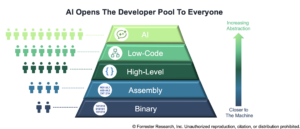
  • We started with binary. A handful of people could effectively program in ones and zeroes. 
  • Next, we moved to assembly language. This opened the doors to more complex programs and more potential programmers. 
  • Soon after, we created higher level languages. This included C, C++, Fortran, Cobol, etc. These lead to vastly more complex programs and made professional programming a viable career. 
  • Eventually, we created simplified languages like Visual Basic and low-code. This made it easier to create visual representations of programs and logic. It also opened the doors to citizen developers. 
  • Now, we have AI. Anyone can prompt to create software – including that pizza place up the street. 

At each level, the abstraction layer got further and further between the programmer and the underlying binary. At the same time, the gamut of who could become a “programmer” got larger. We’re now at a point where the abstraction layer is so great that programmers no longer consistently identify themselves as programmers. 

Put another way, we no longer have “professional” and “citizen” developer – we just have developers. And some of them are accidental developers – they don’t even know they’re writing code. 

The Fundamental Flaw With Tools Creating Tools 

My colleague’s interaction with AI is not a unique one. I’ve seen this with others as well, and we’ve posited the “tools creating tools” space for some time when it comes to AI. 

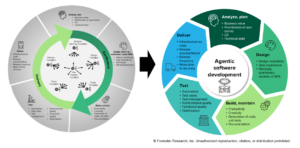
However, we’ve glossed over a significant challenge: In the more than a century we’ve been perfecting software engineering, programmers have focused on writing secure, reliable, and redundant code at scale. All of the steps of the traditional software development lifecycle (SDLC): analyze/plan, design, build/maintain, test, and deliver were formalized under the assumption that humans manage each stage. 

In my conversations with accidental developers, however, they’ve handed off the wheel of these stages to AI – if they know there are stages at all. When I ask them if they’ve reviewed the code generated, they rarely do. If they do, they often don’t understand it. Some have the wherewithal to ask AI to test the code generated, but that’s an explicit ask and often done with the same AI that wrote the code (a situation that would be frowned upon with human developers). Delivery has its own challenge: “it ran on my laptop” takes on entirely new meaning when AI has installed packages and a container runtime on your machine you didn’t install yourself and now need to replicate in the cloud. And proper analyzing/planning and designing beforehand? Forget about it. 

This hasn’t been helped by the fact that we’ve seen a shift in coding agents grow in capabilities to do multiple parts of the SDLC. We’ve gone from multiple agents from different vendors communicating intent across multiple phases of the SDLC, to single agents doing everything. Separation of duties, this is not. 
 

We Need To Address Developer Safeguards Tactically And Strategically 

It would be silly to presume we can close Pandora’s Box at this point. Now that the agentic software development genie is out of the bottle, we can’t (and shouldn’t) tell people, “Don’t write code”. Two reasons: 1) Fundamentally, programming should be open to all and 2) As made clear in this blog, some people don’t even know they’re writing code to begin with. This is especially true as tools creating tools cascades to multiple levels of hammers making other hammers. 

In short, we need to solve this tactically and strategically: 

  • You can’t hallucinate security, reliability, and redundancy. This means, tactically, we need to educate and train users. They need to know that just as AI can hallucinate answers you have to double-check, it can create code that you also have to double-check. Users must learn to prompt to test software created – even if they’re unsure software was created in the first place. They must learn the disciplines of properly analyzing/planning and designing before they even start prompting. They must be taught the difference in deploying a prototype locally versus deploying an enterprise-grade system in the cloud. Even in smaller situations, like when Excel creates Python, users must be trained to test code created and verify results.
  • In the future, the models themselves will become the responsible safeguards. More strategically, just as safeguards are being built into AI models to protect against personal (e.g., conversations about suicide) and societal (e.g., questions about warfare) threats, equivalent safeguards must be created for software development. Going forward, models must be trained so that every time code is generated by AI – whether the user knows about it or not – it’s tested for security, reliability, and redundancy. This should be done preferably by different agents. Delivery plans must be created for multiple environments varying in scale, and users must be informed about the blast radius of their actions.

Spec-driven development practices will help this, but there are fundamental requirements that must be built into the models themselves. The onus is on users and model creators to work together and build software securely with AI, whether they call themselves developers or not.

Forrester has a full team of analysts covering the revolution of agentic software development and the dawn of the accidental developer – I am the team’s Reesearch Director. Schedule a guidance session with us if you’re a client to discuss the ramifications of this, or leverage our Forrester AI for instant insight. 

Categories

Blog

Announcing The Forrester Wave™ On Extended Detection And Response Platforms: Platformization, AI, And … AI

Last week, Forrester released The Forrester Wave™: Extended Detection And Response Platforms, Q2 2026. This is the third iteration of the extended detection and response (XDR) Wave, with prior versions published in 2021 and 2024. This Wave differs significantly from the past, especially because of: The number of vendors. This year, only seven vendors were […]

Blog

The Cost Of AI Productivity Is Less Creativity

AI is now standard across marketing agencies — but its impact remains constrained. Forrester’s “The State Of AI Inside US Marketing Agencies, 2026” finds that CMOs must shift their AI ambitions toward creativity, differentiation, and growth to unlock real value.