




B2B event teams remain under pressure. Budgets are constrained, competition for attendees has intensified, and audience expectations continue to rise. While around half of organizations say their events are performing well, just 38% of CMOs agree — exposing misalignment at an executive level.
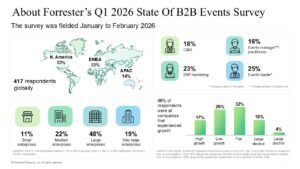
To help leaders navigate this environment, Forrester’s Q1 2026 State Of B2B Events Survey gathered insights from over 400 event decision-makers globally to uncover key trends. The findings point to a market being reshaped by data, integration, and AI.
The percentage of organizations seeing budgets increase more than 10% has doubled year on year, but two-thirds still face flat or declining budgets. In response, leaders are making deliberate trade-offs. Nearly 70% are reducing the number of events they run while protecting the attendee experience. As one leader put it, “We’ll do fewer events, but if we’re in, we’re in, and I want to deliver the right experience.”
Small, repeatable formats continue to lead the way. A majority of teams plan more intimate networking events and sub-200-attendee in-person events, while just 18% plan more large-hosted events. These formats enable better targeting, use less resources, and deliver more intimate experiences.
After several years of post-pandemic decline, virtual events are rebounding, with the number of organizations planning more of this format doubling year on year. Budget pressures and geopolitical uncertainty have played a role, but there is also growing recognition that virtual events deliver efficient, scalable reach and content generation.
Attendees now expect to participate at events, not just consume content. Presentation-heavy formats are being replaced by experiences that offer higher levels of interaction and peer exchange. As one leader noted, “If you go to an in-person event and feel like you’re watching TV, then what’s the point?” Reflecting this realization, two-thirds of organizations plan more workshops, roundtables, and structured networking at their events.
Well-executed events serve multiple objectives. They build brand, deepen relationships, and drive demand, but for over half of all organizations, net-new lead generation is the primary objective. While this revenue focus is understandable, it risks undervaluing the broader value that an event delivers. It also drives overly simplistic measurement and post-event follow-up that fail to reflect how B2B buying actually happens.
Three priorities dominate for more than 90% of organizations: audience acquisition, maximizing the value of event data, and showing impact. Data sits at the center of all three, informing targeting, enabling personalized followup, and underpinning measurement. Leading organizations are going further, investing in deeper integrations and utilizing AI to interrogate and activate data more effectively.
Two-thirds of organizations have now integrated their primary event platform with the wider sales and marketing tech stack, a 44% year-on-year increase. This matters, because organizations with deep integrations are more likely to activate their event data, do a better job measuring event impact, and are also adopting AI at a faster rate. They are significantly more satisfied with event performance, with 62% of those with a deep integration saying they are satisfied (versus 37% for those who haven’t integrated).
AI usage in events is increasing rapidly, with adoption doubling across key use cases, but the focus remains on efficiency and productivity, rather than anything transformational. Currently, less than a quarter of organizations use AI to deliver personalized attendee experiences, largely due to challenges with data quality and accessibility, with 63% citing this as a barrier.
Leading organizations operate differently. They’re building audience-centric, integrated event portfolios that prioritize attendee interaction; they’ve deeply integrated their event technology into their wider ecosystem, enabling them to exploit data more effectively; and they do a better job aligning event performance with business goals.
Forrester clients can listen to an on-demand webinar, in which we explore the survey findings in more detail, or can request a guidance session to better understand what the trends mean for their teams and organization.
此内容由惯性聚合(RSS阅读器)自动聚合整理,仅供阅读参考。 原文来自 — 版权归原作者所有。