






The question on everyone's mind - are we launching Supabase Functions? Well, it's complicated.
Today we're announcing part of Functions - Supabase Hooks - in Alpha, for all new projects.
We're also releasing support for Postgres Functions and Triggers in our Dashboard, and some timelines for the rest of Supabase Functions. Let's cover the features we're launching today before the item that everyone is waiting for: Supabase Functions.
PostgreSQL Functions#
(Not to be confused with Supabase Functions!)
Postgres has built-in support for SQL functions. Today we're making it even easier for developers to build PostgreSQL Functions by releasing a native Functions editor. Soon we'll release some handy templates!
You can call PostgreSQL Functions with supabase-js using your project API [Docs]:
_10
const { data, error } = await supabase.rpc('best_star_wars_series', {
_10
name: 'The Prequels',
_10
})
PostgreSQL Triggers#
Triggers are another amazing feature of Postgres, which allows you to execute any SQL code after inserting, updating, or deleting data.
While triggers are a staple of Database Administrators, they can be a bit complex and hard to use. We plan to change that with a simple interface for building and managing PostgreSQL triggers.
They say building a startup is like jumping off a cliff and assembling the plane on the way down. At Supabase it's more like assembling a 747 since, although we're still in Beta, thousands of companies depend on us to power their apps and websites.
For the past few months we've been designing Supabase Functions based on our customer feedback.
BYO Functions, zero lock-in#
A recurring request from our customers is the ability to trigger their existing Functions. This is especially true for our Enterprise customers, but also Jamstack developers who develop API Functions directly within their stack (like Next.js API routes, or Redwood Serverless Functions).
Timeline#
To meet these goals, we're releasing Supabase Functions in stages:
- Stage 1: Give developers the ability to trigger external HTTP functions - today, using Database Webhooks.
- Stage 2: Give developers the ability to trigger their own Serverless functions on AWS and GCP - Q4 2021.
- Stage 3: Release our own Serverless Functions (Supabase Functions) - Q4 for Early Preview customers.
(Note: Database Webhooks were previously called "Function Hooks")
Today we're releasing Functions Hooks in ALPHA. The ALPHA tag means that it is NOT stable, but it's available for testing and feedback. The API will change, so do not use it for anything critical. You have been warned.
Hooks? Triggers? Firestore has the concept of Function Triggers, which are very cool. Supabase Hooks are the same concept, just with a different name. Postgres already has the concept of Triggers, and we thought this would be less confusing1.
Hook Events#
Database Webhooks allow you to "listen" to any change in your tables to trigger an asynchronous Function. You can hook into a few different events:INSERT, UPDATE, and DELETE. All events are fired after a database row is changed. Keen eyes will be able to spot the similarity to Postgres triggers, and that's because Database Webhooks are just a convenience wrapper around triggers.
Hook Targets#
Supabase will support several different targets.
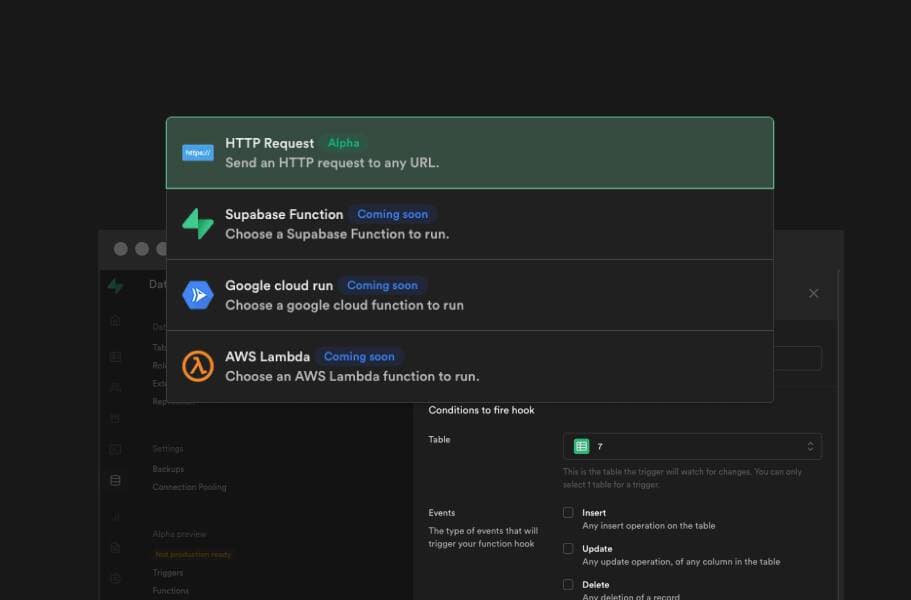
- HTTP/Webhooks: Send HTTP requests directly from your Postgres Database.
- AWS Lambda/Google Cloud Run: Provide Supabase with a restricted IAM role to trigger Serverless functions natively.
- Supabase Functions: We'll develop an end-to-end experience.
Hook Payload#
If the target is a Serverless function or an HTTP POST request, the payload is automatically generated from the underlying table data. The format matches Supabase Realtime, except in this case you don't a client to "listen" to the changes. This provides yet another mechanism for responding to database changes.
_21
type InsertPayload = {
_21
type: 'INSERT'
_21
table: string
_21
schema: string
_21
record: TableRecord<T>
_21
old_record: null
_21
}
_21
type UpdatePayload = {
_21
type: 'UPDATE'
_21
table: string
_21
schema: string
_21
record: TableRecord<T>
_21
old_record: TableRecord<T>
_21
}
_21
type DeletePayload = {
_21
type: 'DELETE'
_21
table: string
_21
schema: string
_21
record: null
_21
old_record: TableRecord<T>
_21
}
As with most of the Supabase platform, we leverage PostgreSQL's native functionality to implement Database Webhooks (previously called "Function Hooks").
To build hooks, we've released a new PostgreSQL Extension, pg_net, an asynchronous networking extension with an emphasis on scalability/throughput. In its initial (unstable) release we expose:
- asynchronous HTTP
GETrequests. - asynchronous HTTP
POSTrequests with a JSON payload.
The extension is (currently) capable of >300 requests per second and is the networking layer underpinning Database Webhooks. For a complete view of capabilities, check out the docs.
Usage#
pg_net allows you to make asynchronous HTTP requests directly within your SQL queries.
_11
-- Make a request
_11
select
_11
net.http_post(
_11
url:='https://httpbin.org/post',
_11
body:='{"hello": "world"}'::jsonb
_11
);
_11
_11
-- Immediately returns a response ID
_11
http_post
_11
---------
_11
1
After making a request, the extension will return an ID. You can use this ID to collect a response.
_14
-- Collect the response from a request
_14
select
_14
*
_14
from
_14
net.http_collect_response(1);
_14
_14
-- Results (1 row)
_14
status | message | response
_14
--------+---------+----------
_14
SUCCESS ok (
_14
status_code := 200,
_14
headers := '{"date": ...}',
_14
body := '{"args": ...}'
_14
)::net.http_response_result
You can cast the response to JSON within PostgreSQL:
_10
-- Collect the response json payload from a request
_10
select
_10
(response).body::json
_10
from
_10
net.http_collect_response(request_id:=1);
Result:
_20
{
_20
"args": {},
_20
"data": "{\"hello\": \"world\"}",
_20
"files": {},
_20
"form": {},
_20
"headers": {
_20
"Accept": "*/*",
_20
"Content-Length": "18",
_20
"Content-Type": "application/json",
_20
"Host": "httpbin.org",
_20
"User-Agent": "pg_net/0.1",
_20
"X-Amzn-Trace-Id": "Root=1-61031a5c-7e1afeae69bffa8614d8e48e"
_20
},
_20
"json": {
_20
"hello": "world"
_20
},
_20
"origin": "135.63.38.488",
_20
"url": "https://httpbin.org/post"
_20
}
_20
(1 row)
Implementation#
To build asynchronous behavior, we use a PostgreSQL background worker with a queue. This, coupled with the libcurl multi interface, enables us to do multiple simultaneous requests in the same background worker process.
Shout out to Paul Ramsey, who gave us the implementation idea in pgsql-http. While we originally hoped to add background workers to his extension, the implementation became too cumbersome and we decided to start with a clean slate. The advantage of being async can be seen by making some requests with both extensions:
_21
\timing on
_21
_21
-- using pgsql-http to fetch from "supabase.io" 10 times
_21
select
_21
*
_21
from
_21
http_get('https://supabase.com')
_21
cross join
_21
generate_series(1, 10) _;
_21
_21
-- Returns in 3.5 seconds
_21
Time: 3501.935 ms
_21
_21
-- using pg_net to fetch from "supabase.io" 10 times
_21
select
_21
net.http_get('https://supabase.com')
_21
from
_21
generate_series (1,10) _;
_21
_21
-- Returns in 1.5 milliseconds
_21
Time: 1.562 ms
Of course, the sync version waits until each request is completed to return the result, taking around 3.5 seconds for 10 requests; while the async version returns almost immediately in 1.5 milliseconds. This is really important for Supabase hooks, which run requests for every event fired from a SQL trigger - potentially thousands of requests per second.
Future/Roadmap#
This is only the beginning! First we'll thoroughly test it and make a stable release, then we expect to add support for
- the remaining HTTP methods (
PUT/PATCH) - synchronous HTTP
- additional protocols e.g. SMTP, FTP
- more throughput (using epoll)
Database Webhooks is enabled today on all new projects. Find it under Database > Alpha Preview > Database Webhooks.
-
Postgres also has the concept of Hooks, but they're more of an internal concept. ↩