



惯性聚合 高效追踪和阅读你感兴趣的博客、新闻、科技资讯
阅读原文 在惯性聚合中打开

推荐订阅源

T
Tor Project blog
Threat Intelligence Blog | Flashpoint
T
Threatpost
T
Troy Hunt's Blog
O
OpenAI News
S
Securelist
cs.CV updates on arXiv.org
P
Proofpoint News Feed
S
Secure Thoughts
Martin Fowler
Martin Fowler
H
Hacker News: Front Page
博客园_首页
Security Latest
Security Latest
Cyberwarzone
Cyberwarzone
阮一峰的网络日志
阮一峰的网络日志
L
LINUX DO - 热门话题
V2EX - 技术
V2EX - 技术
W
WeLiveSecurity
雷峰网
雷峰网
博客园 - Franky
C
Cyber Attacks, Cyber Crime and Cyber Security
Jina AI
Jina AI
S
Security @ Cisco Blogs
Apple Machine Learning Research
S
Security Affairs
Scott Helme
Scott Helme
T
The Exploit Database - CXSecurity.com
博客园 - 三生石上(FineUI控件)
P
Privacy & Cybersecurity Law Blog
罗磊的独立博客
G
Google Developers Blog
L
Lohrmann on Cybersecurity
量子位
The GitHub Blog
The GitHub Blog
V
Vulnerabilities – Threatpost
大猫的无限游戏
大猫的无限游戏
T
Threat Research - Cisco Blogs
K
Kaspersky official blog
奇客Solidot–传递最新科技情报
奇客Solidot–传递最新科技情报
Webroot Blog
Webroot Blog
F
Fortinet All Blogs
CTFtime.org: upcoming CTF events
小众软件
小众软件
cs.CL updates on arXiv.org
GbyAI
GbyAI
PCI Perspectives
PCI Perspectives
N
News | PayPal Newsroom
OSCHINA 社区最新新闻
OSCHINA 社区最新新闻
Spread Privacy
Spread Privacy
有赞技术团队
有赞技术团队

Supabase Blog

AI Agents Know About Supabase. They Don't Always Use It Right. Custom OIDC Providers for Supabase Auth 100,000 GitHub stars Supabase docs over SSH Navigating Regional Network Blocks Supabase Joins the Stripe Projects Developer Preview Log Drains: Now available on Pro Supabase Storage: major performance, security, and reliability updates Supabase incident on February 12, 2026 Hydra joins Supabase X / Twitter OAuth 2.0 is now available for Supabase Auth BKND joins Supabase Supabase is now an official Claude connector Supabase PrivateLink is now available Introducing: Postgres Best Practices When to use Read Replicas vs. bigger compute Introducing TRAE SOLO integration with Supabase Supabase Security Retro: 2025 Sync Stripe Data to Your Supabase Database in One Click Building ChatGPT Apps with Supabase Edge Functions and mcp-use Own Your Observability: Supabase Metrics API Introducing iceberg-js: A JavaScript Client for Apache Iceberg Introducing Supabase for Platforms Adding Async Streaming to Postgres Foreign Data Wrappers Build "Sign in with Your App" using Supabase Auth Introducing Seven New Email Templates for Supabase Auth The new Supabase power for Kiro Introducing Supabase ETL Introducing Analytics Buckets Introducing Vector Buckets Snap, Inc. Launches Snap Cloud, Powered by Supabase Triplit joins Supabase Supabase Series E 1000 Y Combinator Founders Choose Supabase gm 👋 web3, welcome aboard to Sign in with Web3 (Solana, Ethereum) Announcing the Supabase Remote MCP Server Enterprise speed, enterprise standards with Bolt Cloud + Supabase PostgREST 13 Lovable Cloud + Supabase: The Default Platform for AI Builders Processing large jobs with Edge Functions, Cron, and Queues Defense in Depth for MCP Servers OrioleDB Patent: now freely available to the Postgres community Supabase Launch Week 15 Hackathon Winner Announcement The Vibe Coder's Guide to Supabase Environments Testing for Vibe Coders: From Zero to Production Confidence The Vibe Coding Master Checklist Vibe Coding: Best Practices for Prompting Supabase Auth: Build vs. Buy Top 10 Launches of Launch Week 15 Supabase Launch Week 15 Hackathon Storage: 10x Larger Uploads, 3x Cheaper Cached Egress, and 2x Egress Quota Persistent Storage and 97% Faster Cold Starts for Edge Functions Algolia Connector for Supabase New Observability Features in Supabase Improved Security Controls and A New Home for Security Introducing Branching 2.0 Stripe-To-Postgres Sync Engine as standalone Library Create a Supabase backend using Figma Make Introducing JWT Signing Keys Supabase UI: Platform Kit Build a Personalized AI Assistant with Postgres Announcing Multigres: Vitess for Postgres Building on open table formats Open Data Standards: Postgres, OTel, and Iceberg Simplifying back-end complexity with Supabase Data APIs PostgreSQL Event Triggers without superuser access Top 10 Launches of Launch Week 14 Supabase MCP Server Data API Routes to Nearest Read Replica Declarative Schemas for Simpler Database Management Realtime: Broadcast from Database Keeping Tabs on What's New in Supabase Studio Edge Functions: Deploy from the Dashboard + Deno 2.1 Automatic Embeddings in Postgres Introducing the Supabase UI Library Supabase Auth: Bring Your Own Clerk Postgres Language Server: Initial Release Migrating from Fauna to Supabase Migrating from the MongoDB Data API to Supabase Dedicated Poolers Postgres as a Graph Database: (Ab)using pgRouting AI Hackathon at Y Combinator Calendars in Postgres using Foreign Data Wrappers Supabase Launch Week 13 Hackathon Winners How to Hack the Base! Running Durable Workflows in Postgres using DBOS database.build v2: Bring-your-own-LLM Restore to a New Project Hack the Base! with Supabase Top 10 Launches of Launch Week 13 Supabase Queues High Performance Disk Supabase Cron Supabase CLI v2: Config as Code Supabase Edge Functions: Introducing Background Tasks, Ephemeral Storage, and WebSockets Supabase AI Assistant v2 OrioleDB Public Alpha Executing Dynamic JavaScript Code on Supabase with Edge Functions ClickHouse Partnership, improved Postgres Replication, and Disk Management Live Share: Connect to in-browser PGlite with any Postgres client
Supabase Analytics Buckets with Iceberg Support
Oliver Rice, Fabrizio Fenoglio · 2025-07-15 · via Supabase Blog

Supabase Analytics Buckets with Iceberg Support

Today we're launching Supabase Analytics Buckets in private alpha. These are a new kind of storage bucket optimized for analytics, with built-in support for the Apache Iceberg table format.

Analytics buckets are integrated into Supabase Studio, power table-level views instead of raw files, and can be queried using the new Supabase Iceberg Wrapper, also launching in alpha.

Apache Iceberg is a high-performance, open table format for large-scale analytics on object storage. It brings the performance and features of a database to the flexibility of flat files.

We chose Iceberg for its bottomless data model (append-only, immutable history), built-in snapshotting and versioning (time travel), and support for schema evolution. Iceberg is also an open standard widely supported across the ecosystem. Supabase is committed to open standards and portability, and Iceberg aligns with that goal by enabling users to move data in and out without being locked into proprietary formats.

Once your project has been accepted into the alpha release program, Analytics buckets can be created via Studio and the API. To create an analytics bucket, visit Storage > New bucket in Studio.

Analytics buckets are a separate bucket type from standard Supabase Storage buckets. You can't mix file types between the two.

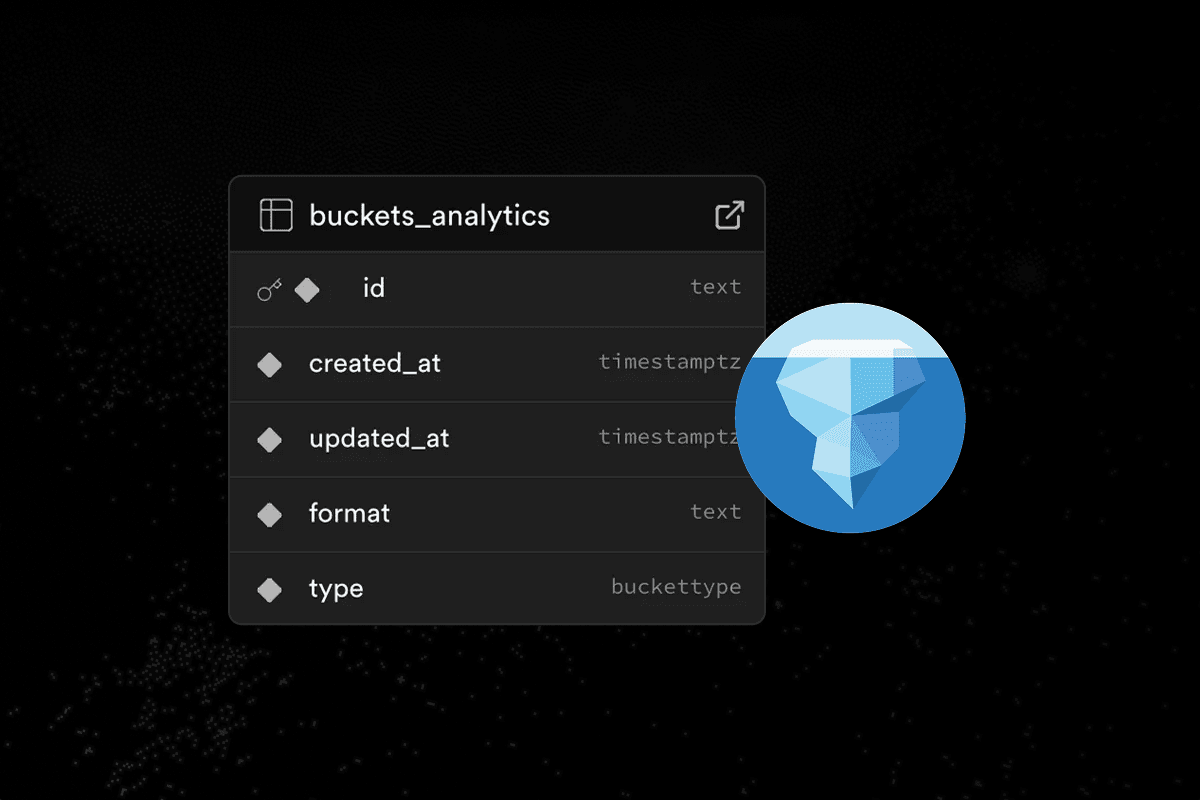
They're stored in a new system table: storage.buckets_iceberg. These buckets are not included in the storage.buckets table and objects inside them are not shown in storage.objects. However, the listBuckets() endpoint returns a merged list of standard and analytics buckets for consistency with Studio and API consumers.

After creating the bucket, we're met with connection details. Copy the WAREHOUSE, VAULT_TOKEN, and CATALOG_URI values and and create an Iceberg namespace and table using your preferred method. The example below uses pyiceberg to create a namespace market with table prices:


_38

import datetime

_38

import pyarrow as pa

_38

from pyiceberg.catalog.rest import RestCatalog

_38

from pyiceberg.exceptions import NamespaceAlreadyExistsError, TableAlreadyExistsError

_38

_38

# Define catalog connection details (replace variables)

_38

WAREHOUSE= ...

_38

VAULT_TOKEN = ...

_38

CATALOG_URI= ...

_38

_38

# Connect to Supabase Data Catalog

_38

catalog = RestCatalog(

_38

name="catalog",

_38

warehouse=WAREHOUSE,

_38

uri=CATALOG_URI,

_38

token=VAULT_TOKEN,

_38

)

_38

_38

# Schema and Table Names

_38

namespace_name = "market"

_38

table_name = "prices"

_38

_38

# Create default namespace

_38

catalog.create_namespace(namespace_name)

_38

_38

df = pa.table({

_38

"tenant_id": pa.array([], type=pa.string()),

_38

"store_id": pa.array([], type=pa.string()),

_38

"item_id": pa.array([], type=pa.string()),

_38

"price": pa.array([], type=pa.float64()),

_38

"timestamp": pa.array([], type=pa.int64()),

_38

})

_38

_38

# Create an Iceberg table

_38

table = catalog.create_table(

_38

(namespace_name, table_name),

_38

schema=df.schema,

_38

)


Back in Studio, we can see the newly created our newly created Namespace with 0/1 connected tables

Click connect and select a Target Schema to map the Iceberg tables into. It is recommended to create a standalone schema for your tables. Do not use the public schema because that would expose your table over the project's REST API.

Viewing an analytics bucket in Supabase Studio redirects you to the Table Editor. Instead of exposing raw Parquet files, the system shows a table explorer, powered by the Supabase Iceberg Wrapper.

The wrapper exposes Iceberg tables through a SQL interface, so you can inspect and query your data using Studio, or any SQL IDE. This makes analytical data feel like a native part of your Supabase project.

In this case the corresponding SQL query to access the data would be


_10

select

_10

*

_10

from market_analytics.prices;


Writing is a work in progress. We're actively building Supabase ETL, which will allow you to write directly from Postgres into Iceberg-backed buckets. We'll also add write capability to the Supabase Iceberg Wrapper as soon as write support lands in the upstream iceberg-rust client library. This will complete the workflow of write → store → query, all inside Supabase.

Once live, that enables bottomless Postgres storage through shifting records into Analytics Buckets, all using open formats. As a bonus, Iceberg gets us time travel for free.

Analytics Buckets are launching in private alpha with the following constraints:

  • Two analytics buckets per project
  • Up to five namespaces per bucket
  • Ten tables per namespace
  • Pricing will be announced in a few weeks
  • You cannot store standard objects in analytics buckets

This launch marks the first step toward full analytical capabilities in Supabase. Over the next few months, we'll introduce SQL catalog support so you can explore Iceberg table metadata directly from the database. Studio will also gain deeper integration for schema inspection, column-level filtering, and time travel queries. Our goal is to make Supabase a full-featured HTAP backend, where you can write, store, and query analytical data seamlessly.

Join the waitlist here to get early access and start working with bottomless, time-travel-capable analytics data inside Supabase.