
惯性聚合 高效追踪和阅读你感兴趣的博客、新闻、科技资讯
阅读原文 在惯性聚合中打开

推荐订阅源

Security Archives - TechRepublic
Project Zero
Project Zero
K
Kaspersky official blog
G
Google Developers Blog
T
Threat Research - Cisco Blogs
T
The Blog of Author Tim Ferriss
Cyberwarzone
Cyberwarzone
Y
Y Combinator Blog
Recorded Future
Recorded Future
Blog — PlanetScale
Blog — PlanetScale
Threat Intelligence Blog | Flashpoint
Cisco Talos Blog
Cisco Talos Blog
Latest news
Latest news
Microsoft Security Blog
H
Help Net Security
S
Schneier on Security
P
Palo Alto Networks Blog
H
Hacker News: Front Page
N
News and Events Feed by Topic
N
Netflix TechBlog - Medium
博客园 - Franky
OSCHINA 社区最新新闻
OSCHINA 社区最新新闻
SecWiki News
SecWiki News
Cloudbric
Cloudbric
TaoSecurity Blog
TaoSecurity Blog
CTFtime.org: upcoming CTF events
The Hacker News
The Hacker News
C
Check Point Blog
L
LangChain Blog
腾讯CDC
小众软件
小众软件
T
Tenable Blog
Google DeepMind News
GbyAI
GbyAI
L
LINUX DO - 最新话题
A
About on SuperTechFans
Google Online Security Blog
C
Cisco Blogs
Recent Announcements
Hacker News: Ask HN
Hacker News: Ask HN
freeCodeCamp Programming Tutorials: Python, JavaScript, Git & More
Vercel News
Vercel News
雷峰网
雷峰网
美团技术团队
D
DataBreaches.Net
Martin Fowler
Martin Fowler
Help Net Security
Help Net Security
钛媒体:引领未来商业与生活新知
钛媒体:引领未来商业与生活新知
F
Full Disclosure
博客园_首页

Supabase Blog

AI Agents Know About Supabase. They Don't Always Use It Right. Custom OIDC Providers for Supabase Auth 100,000 GitHub stars Supabase docs over SSH Navigating Regional Network Blocks Supabase Joins the Stripe Projects Developer Preview Log Drains: Now available on Pro Supabase Storage: major performance, security, and reliability updates Supabase incident on February 12, 2026 Hydra joins Supabase X / Twitter OAuth 2.0 is now available for Supabase Auth BKND joins Supabase Supabase is now an official Claude connector Supabase PrivateLink is now available Introducing: Postgres Best Practices When to use Read Replicas vs. bigger compute Introducing TRAE SOLO integration with Supabase Supabase Security Retro: 2025 Sync Stripe Data to Your Supabase Database in One Click Building ChatGPT Apps with Supabase Edge Functions and mcp-use Own Your Observability: Supabase Metrics API Introducing iceberg-js: A JavaScript Client for Apache Iceberg Introducing Supabase for Platforms Adding Async Streaming to Postgres Foreign Data Wrappers Build "Sign in with Your App" using Supabase Auth Introducing Seven New Email Templates for Supabase Auth The new Supabase power for Kiro Introducing Supabase ETL Introducing Analytics Buckets Introducing Vector Buckets Snap, Inc. Launches Snap Cloud, Powered by Supabase Triplit joins Supabase Supabase Series E 1000 Y Combinator Founders Choose Supabase gm 👋 web3, welcome aboard to Sign in with Web3 (Solana, Ethereum) Announcing the Supabase Remote MCP Server Enterprise speed, enterprise standards with Bolt Cloud + Supabase PostgREST 13 Lovable Cloud + Supabase: The Default Platform for AI Builders Processing large jobs with Edge Functions, Cron, and Queues Defense in Depth for MCP Servers OrioleDB Patent: now freely available to the Postgres community Supabase Launch Week 15 Hackathon Winner Announcement The Vibe Coder's Guide to Supabase Environments Testing for Vibe Coders: From Zero to Production Confidence The Vibe Coding Master Checklist Vibe Coding: Best Practices for Prompting Supabase Auth: Build vs. Buy Top 10 Launches of Launch Week 15 Supabase Launch Week 15 Hackathon Storage: 10x Larger Uploads, 3x Cheaper Cached Egress, and 2x Egress Quota Persistent Storage and 97% Faster Cold Starts for Edge Functions Algolia Connector for Supabase New Observability Features in Supabase Improved Security Controls and A New Home for Security Introducing Branching 2.0 Stripe-To-Postgres Sync Engine as standalone Library Supabase Analytics Buckets with Iceberg Support Create a Supabase backend using Figma Make Introducing JWT Signing Keys Supabase UI: Platform Kit Build a Personalized AI Assistant with Postgres Announcing Multigres: Vitess for Postgres Building on open table formats Open Data Standards: Postgres, OTel, and Iceberg Simplifying back-end complexity with Supabase Data APIs Top 10 Launches of Launch Week 14 Supabase MCP Server Data API Routes to Nearest Read Replica Declarative Schemas for Simpler Database Management Realtime: Broadcast from Database Keeping Tabs on What's New in Supabase Studio Edge Functions: Deploy from the Dashboard + Deno 2.1 Automatic Embeddings in Postgres Introducing the Supabase UI Library Supabase Auth: Bring Your Own Clerk Postgres Language Server: Initial Release Migrating from Fauna to Supabase Migrating from the MongoDB Data API to Supabase Dedicated Poolers Postgres as a Graph Database: (Ab)using pgRouting AI Hackathon at Y Combinator Calendars in Postgres using Foreign Data Wrappers Supabase Launch Week 13 Hackathon Winners How to Hack the Base! Running Durable Workflows in Postgres using DBOS database.build v2: Bring-your-own-LLM Restore to a New Project Hack the Base! with Supabase Top 10 Launches of Launch Week 13 Supabase Queues High Performance Disk Supabase Cron Supabase CLI v2: Config as Code Supabase Edge Functions: Introducing Background Tasks, Ephemeral Storage, and WebSockets Supabase AI Assistant v2 OrioleDB Public Alpha Executing Dynamic JavaScript Code on Supabase with Edge Functions ClickHouse Partnership, improved Postgres Replication, and Disk Management Live Share: Connect to in-browser PGlite with any Postgres client
PostgreSQL Event Triggers without superuser access
Steve Chavez · 2025-05-08 · via Supabase Blog

PostgreSQL Event Triggers without superuser access

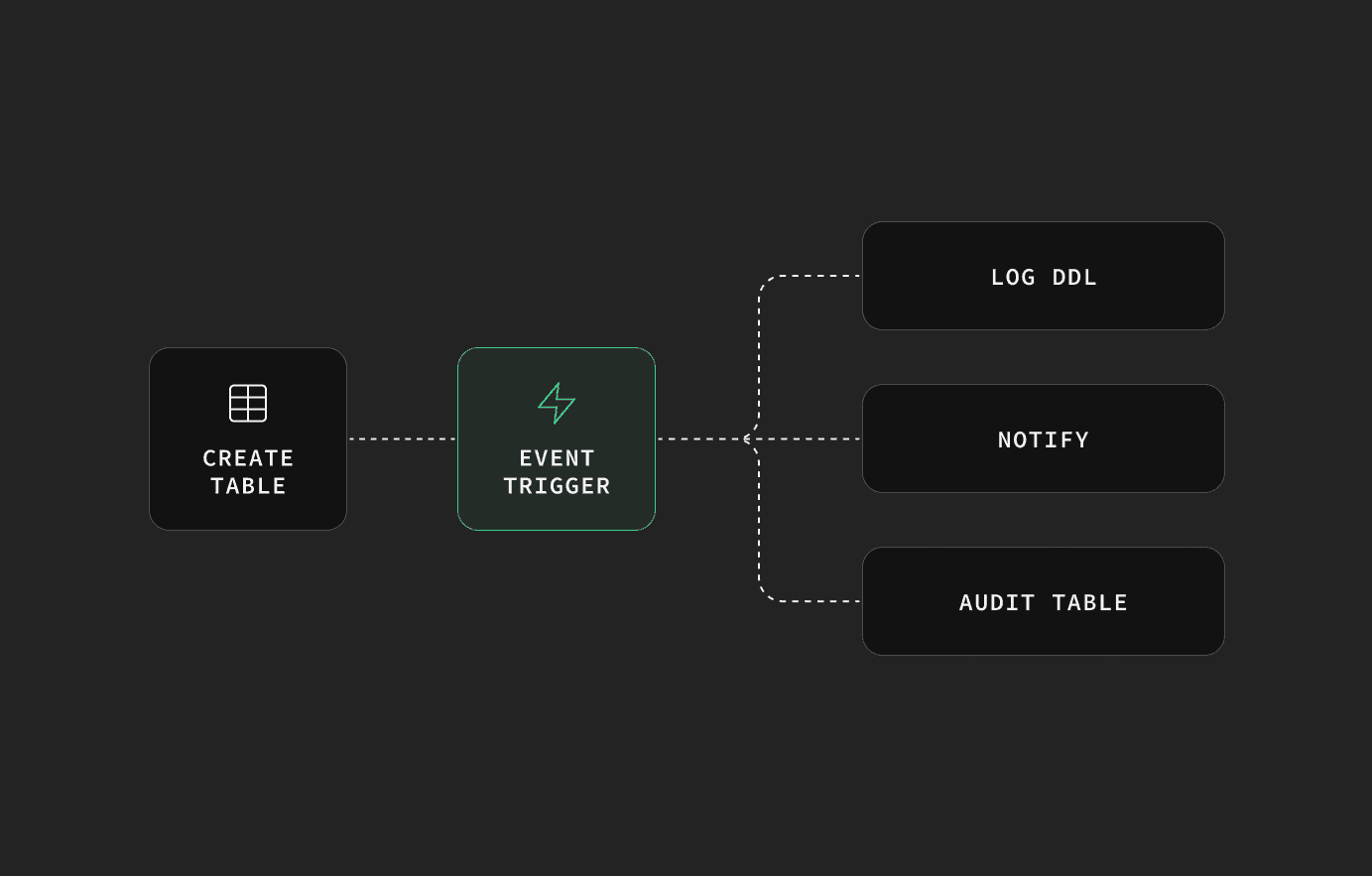
Event Triggers in Postgres are powerful, but only a superuser can create them. In cloud environments, granting superuser access isn't an option.

But thanks to Postgres' extensibility, we can allow regular users to create Event Triggers, in a safe way.

In this blog post, we’ll explain how we do this in the supautils extension, using a combination of the Utility Hook and the Function Manager Hook.

The core of supautils is the “privileged role”, which is a role that serves as proxy to superuser. It provides a safe subset of superuser capabilities and it’s accessible to regular users.

When the privileged role does a create event trigger, we intercept the statement with a Utility Hook (ProcessUtility_hook). Here we elevate the role to a superuser, continuing the usual flow and allowing the creation on Postgres core. As a last step, we downgrade to the privileged role and make it the event trigger owner 1.

Creating an event trigger like this is not safe though, as it would allow privilege escalation.

Here, a problem arises. Once an Event Trigger is created:

  • It targets every role.
  • It runs using the target role privileges 2.

This means that a malicious user can create an Event Trigger like:


_11

create or replace function become_super()

_11

returns event_trigger

_11

language plpgsql as

_11

$$

_11

begin

_11

alter role malicious SUPERUSER;

_11

end;

_11

$$;

_11

_11

create event trigger bad_event_trigger on ddl_command_end

_11

execute procedure become_super();


And once a superuser trips on the event trigger, it will fire with its privileges. Making the malicious user a superuser.

A solution would be skipping user Event Triggers for superusers.

The Function Manager hook (fmgr_hook) allows us to intercept and modify functions’ execution.

We can intercept the Event Trigger function and replace it with a “noop”. Postgres doesn’t provide a noop function, but we can use the existing version() function for the same purpose.

Besides superusers, we also want to skip user event triggers for “reserved roles” 3. These are used for managed services (like pgbouncer).

This now allows users to safely create Event Triggers, without superuser access:


_26

-- use the privileged role, which is configured to be "postgres"

_26

set role postgres;

_26

select current_setting('is_superuser'); -- prove it's not a superuser

_26

current_setting

_26

-----------------

_26

off

_26

(1 row)

_26

_26

-- now create the event trigger

_26

create function show_current_user()

_26

returns event_trigger as $$

_26

begin

_26

raise notice 'the event trigger is executed for %', current_user;

_26

end;

_26

$$ language plpgsql;

_26

_26

create event trigger myevtrig on ddl_command_end

_26

execute procedure show_current_user();

_26

_26

-- check it succeeds

_26

create table foo();

_26

NOTICE: the event trigger is executed for postgres

_26

_26

set role myrole;

_26

create table bar();

_26

NOTICE: the event trigger is executed for myrole


Future in Postgres core#

We would also like to allow regular user event triggers in Postgres core. To this end, we’ve submitted some patches which are already generating fruitful discussion.

Note that user Event Triggers in Postgres core will likely be more restricted than the supautils version.

User Event Triggers are now available for new projects on the Supabase platform.

You can also git clone the supautils repo and make install it in your own deployment.

Finally, we want to give a special shout out to the Zero Sync team, who pushed us to release this feature.


  1. This is so the event trigger can be altered or dropped by end users. ↩

  2. This is not true if you mark the event trigger function as security definer, then it will run with the privileges of the function owner. But this is not a usual practice on event triggers, as they usually want to preserve the context of the current user. ↩

  3. These are configurable. You can read more about reserved roles here. ↩