


惯性聚合 高效追踪和阅读你感兴趣的博客、新闻、科技资讯
阅读原文 在惯性聚合中打开

推荐订阅源

让小产品的独立变现更简单 - ezindie.com
人人都是产品经理
人人都是产品经理
OSCHINA 社区最新新闻
OSCHINA 社区最新新闻
T
The Exploit Database - CXSecurity.com
N
News and Events Feed by Topic
Latest news
Latest news
cs.CL updates on arXiv.org
C
CXSECURITY Database RSS Feed - CXSecurity.com
IT之家
IT之家
V
V2EX
WordPress大学
WordPress大学
Apple Machine Learning Research
Cisco Talos Blog
Cisco Talos Blog
K
Kaspersky official blog
钛媒体:引领未来商业与生活新知
钛媒体:引领未来商业与生活新知
freeCodeCamp Programming Tutorials: Python, JavaScript, Git & More
S
SegmentFault 最新的问题
小众软件
小众软件
A
Arctic Wolf
酷 壳 – CoolShell
酷 壳 – CoolShell
腾讯CDC
宝玉的分享
宝玉的分享
Last Week in AI
Last Week in AI
G
GRAHAM CLULEY
罗磊的独立博客
T
Tor Project blog
C
Cisco Blogs
美团技术团队
博客园 - Franky
月光博客
月光博客
博客园 - 三生石上(FineUI控件)
T
Threat Research - Cisco Blogs
Cyberwarzone
Cyberwarzone
Threat Intelligence Blog | Flashpoint
有赞技术团队
有赞技术团队
奇客Solidot–传递最新科技情报
奇客Solidot–传递最新科技情报
Security Latest
Security Latest
博客园 - 司徒正美
Hugging Face - Blog
Hugging Face - Blog
Spread Privacy
Spread Privacy
J
Java Code Geeks
C
CERT Recently Published Vulnerability Notes
大猫的无限游戏
大猫的无限游戏
S
Securelist
The Cloudflare Blog
博客园 - 叶小钗
D
Darknet – Hacking Tools, Hacker News & Cyber Security
阮一峰的网络日志
阮一峰的网络日志
雷峰网
雷峰网
Project Zero
Project Zero

Supabase Blog

AI Agents Know About Supabase. They Don't Always Use It Right. Custom OIDC Providers for Supabase Auth 100,000 GitHub stars Supabase docs over SSH Navigating Regional Network Blocks Supabase Joins the Stripe Projects Developer Preview Log Drains: Now available on Pro Supabase Storage: major performance, security, and reliability updates Supabase incident on February 12, 2026 Hydra joins Supabase X / Twitter OAuth 2.0 is now available for Supabase Auth BKND joins Supabase Supabase is now an official Claude connector Supabase PrivateLink is now available Introducing: Postgres Best Practices When to use Read Replicas vs. bigger compute Introducing TRAE SOLO integration with Supabase Supabase Security Retro: 2025 Sync Stripe Data to Your Supabase Database in One Click Building ChatGPT Apps with Supabase Edge Functions and mcp-use Own Your Observability: Supabase Metrics API Introducing iceberg-js: A JavaScript Client for Apache Iceberg Introducing Supabase for Platforms Adding Async Streaming to Postgres Foreign Data Wrappers Build "Sign in with Your App" using Supabase Auth Introducing Seven New Email Templates for Supabase Auth The new Supabase power for Kiro Introducing Supabase ETL Introducing Analytics Buckets Introducing Vector Buckets Snap, Inc. Launches Snap Cloud, Powered by Supabase Triplit joins Supabase Supabase Series E 1000 Y Combinator Founders Choose Supabase gm 👋 web3, welcome aboard to Sign in with Web3 (Solana, Ethereum) Announcing the Supabase Remote MCP Server Enterprise speed, enterprise standards with Bolt Cloud + Supabase PostgREST 13 Lovable Cloud + Supabase: The Default Platform for AI Builders Processing large jobs with Edge Functions, Cron, and Queues Defense in Depth for MCP Servers OrioleDB Patent: now freely available to the Postgres community Supabase Launch Week 15 Hackathon Winner Announcement The Vibe Coder's Guide to Supabase Environments Testing for Vibe Coders: From Zero to Production Confidence The Vibe Coding Master Checklist Vibe Coding: Best Practices for Prompting Supabase Auth: Build vs. Buy Top 10 Launches of Launch Week 15 Supabase Launch Week 15 Hackathon Storage: 10x Larger Uploads, 3x Cheaper Cached Egress, and 2x Egress Quota Persistent Storage and 97% Faster Cold Starts for Edge Functions Algolia Connector for Supabase New Observability Features in Supabase Improved Security Controls and A New Home for Security Introducing Branching 2.0 Stripe-To-Postgres Sync Engine as standalone Library Supabase Analytics Buckets with Iceberg Support Create a Supabase backend using Figma Make Introducing JWT Signing Keys Supabase UI: Platform Kit Build a Personalized AI Assistant with Postgres Announcing Multigres: Vitess for Postgres Building on open table formats Open Data Standards: Postgres, OTel, and Iceberg Simplifying back-end complexity with Supabase Data APIs PostgreSQL Event Triggers without superuser access Top 10 Launches of Launch Week 14 Supabase MCP Server Data API Routes to Nearest Read Replica Declarative Schemas for Simpler Database Management Realtime: Broadcast from Database Keeping Tabs on What's New in Supabase Studio Edge Functions: Deploy from the Dashboard + Deno 2.1 Automatic Embeddings in Postgres Introducing the Supabase UI Library Supabase Auth: Bring Your Own Clerk Postgres Language Server: Initial Release Migrating from Fauna to Supabase Migrating from the MongoDB Data API to Supabase Dedicated Poolers Postgres as a Graph Database: (Ab)using pgRouting AI Hackathon at Y Combinator Calendars in Postgres using Foreign Data Wrappers Supabase Launch Week 13 Hackathon Winners How to Hack the Base! Running Durable Workflows in Postgres using DBOS database.build v2: Bring-your-own-LLM Restore to a New Project Hack the Base! with Supabase Top 10 Launches of Launch Week 13 Supabase Queues High Performance Disk Supabase Cron Supabase CLI v2: Config as Code Supabase Edge Functions: Introducing Background Tasks, Ephemeral Storage, and WebSockets Supabase AI Assistant v2 OrioleDB Public Alpha Executing Dynamic JavaScript Code on Supabase with Edge Functions ClickHouse Partnership, improved Postgres Replication, and Disk Management
Partial data dumps using Postgres Row Level Security
Paul Copplestone · 2022-06-28 · via Supabase Blog

Partial data dumps using Postgres Row Level Security

When working with databases, it's common to create a seed.sql file which contains a subset of production data for testing.

During early development, it's fine to dump the entire database and restore it on your development machine. However, once you have production users this becomes a security issue - do you really want to dump your users' data onto your local machines?

There are many ways to solve this, but recently I stumbled upon a neat way to do it using PostgreSQL's Row Level Security (RLS).

The concept is simple:

  1. Create a database user with restricted access.
  2. Define some RLS rules for that user, limiting what data they can access.
  3. Run pg_dump as that user.

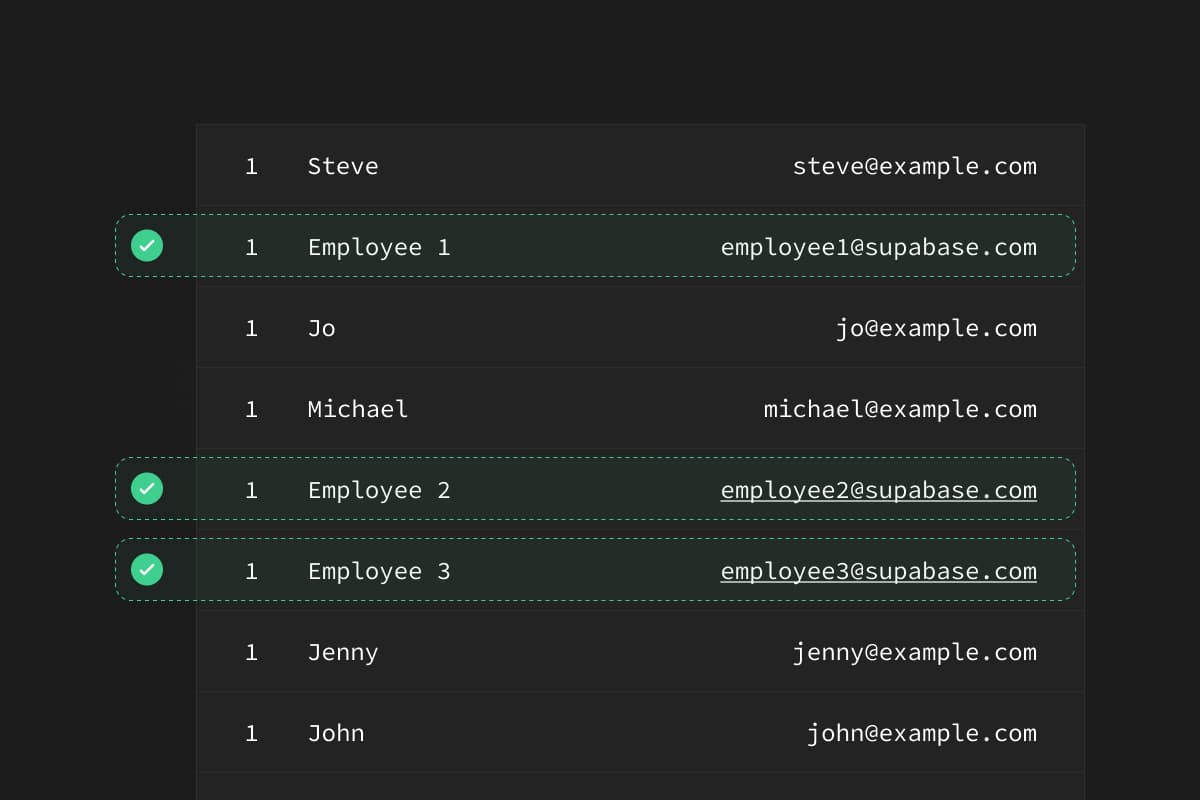
For this scenario, let's imagine that you have a table called profiles in your database:


_10

create table profiles (

_10

id serial primary key,

_10

name text,

_10

email text

_10

);


idnameemail
1Employee 1employee1@supabase.com
2Employee 2employee2@supabase.com
3Employee 3employee3@supabase.com
4Jennyjenny@example.com
5Joejoe@example.com

In this case, if we ran a pg_dump we will save Jenny and Joe's personal data. We don't want that, so let's create a Postgres user called exporter, who can only dump the data we want.

Step 1: Prepare a user#

Create a user to connect to the database. We'll call them exporter and grant them access to the public schema:


_10

-- Create a new user with login privileges

_10

create user exporter

_10

with password 'exporter_secure_password';

_10

_10

-- Allow this user to select the rows we need

_10

grant usage on schema public to exporter;

_10

grant select on profiles to exporter;


Step 2: Create data access rules#

Let's turn on RLS for this table and limit the data which exporter can access:


_11

-- Turn on Row Level Security

_11

alter table profiles

_11

enable row level security;

_11

_11

-- Only dump data for internal team members 1, 2, 3

_11

create policy "Data dump rule" on profiles

_11

for select

_11

to exporter

_11

using (

_11

id in (1, 2, 3)

_11

);


Step 3: Export the data#

Now we can use pg_dump to get only the data that we need.

Run the dump with the exporter user that we created above and use the --enable-row-security flag to ensure that the dump succeeds.


_11

# Dump all the data into a "seed.sql" file

_11

# which we can use to restore our local databases.

_11

pg_dump \

_11

-h db.host.supabase.co \

_11

-U exporter \

_11

-d postgres \

_11

-n public \

_11

--data-only \

_11

--enable-row-security \

_11

--table=profiles \

_11

> seed.sql


_10

-h db.host.supabase.co \


And that's it. You can follow this same pattern for any tables that you want to dump.

RLS is a bit like appending a “where” clause to a select, so you can create all sorts of data access patterns. Let's see a few more which are useful for extracting seed data.

Using email rules#

Instead of using hardcoded numbers in our RLS policies, we could use email extensions to determine the users who we want to export:


_10

-- Only dump data for supabase employees

_10

create policy "Data dump rule" on profiles

_10

for select

_10

to exporter

_10

using (

_10

substring(email from '@(.*)$') = 'supabase.com'

_10

);


Only recent data#

If we have a table with a lot of data, like an analytics table, we might only care about the last 2 months of data.


_18

-- A fake analytics table where we store actions a user takes

_18

create table analytics (

_18

id serial primary key,

_18

ts timestamptz default now(),

_18

profile_id references profiles,

_18

event text

_18

);

_18

alter table profiles

_18

enable row level security;

_18

_18

-- Here is an "age" rule so that we only dump the most recent analytics

_18

create policy "Data dump rule" on logs

_18

for select

_18

to exporter

_18

using (

_18

profile_id in (1, 2, 3) and

_18

ts > now() - interval '2 MONTHS' -- here's the magic

_18

);


Using flags#

If you don't mind having some additional columns in you database, you can add flags to each row to determine whether it's safe to export.


_14

create table profiles (

_14

id serial primary key,

_14

name text,

_14

email text,

_14

is_exportable boolean -- make this "TRUE" if you want to allow access

_14

);

_14

alter table profiles

_14

enable row level security;

_14

_14

-- Only dump data for internal team members 1, 2, 3

_14

create policy "Data dump rule" on profiles

_14

for select

_14

to exporter

_14

using ( is_exportable = true );


Using seed data isn't the only way to run development environments. It's also possible to run fully-masked copies of your database using tools like Snaplet.

We're also bullish on copy-on-write strategies which allow users to "fork" a database at a point in time, a strategy used by Database Lab Engine. DLE uses the ZFS file system to achieve this, but it's within reach of the Postgres core once alternative storage strategies become easier to implement.

If you want to try out the steps we described in this article, fire up a full PostgreSQL database: database.new

More Postgres resources#