


PostgreSQL manages permissions through roles. To create these roles, a database user needs the CREATEROLE privilege,
which not only allows role creation but also modification of any role (except superusers).
At Supabase, we use dedicated roles for each of our customers' backend services. For instance, our Storage API
uses the supabase_storage_admin role for connecting to the database. Giving the CREATEROLE privilege to our customers would allow them to
drop this role and take their own Storage API down.
And yet, we want to give our customers the ability to manage roles the same as they do it in on-premises databases,
with the usual CREATE ROLE, ALTER ROLE, and DROP ROLE statements.
So, how do we grant them the CREATEROLE privilege and, at the same time, protect our own roles? In this blog post,
we explain how we managed to do this by using PostgreSQL Hooks in our SupaUtils extension.
PostgreSQL has a list of predefined roles — all prefixed with "pg_" — that cannot be dropped or altered. Attempting to do so will throw an error mentioning that the role is "reserved".
_10
alter role pg_monitor createdb;
_10
ERROR: role name "pg_monitor" is reserved
_10
DETAIL: Cannot alter reserved roles.
This mechanism is an internal implementation detail. Unfortunately Postgres doesn't allow us to define our own reserved roles.
RDS reserved roles#
Amazon RDS has a similar defense mechanism, all of its predefined roles — prefixed with "rds" — cannot be modified.
_10
alter role rdsadmin rename to another;
_10
ERROR: The "rdsadmin" role cannot be renamed.
_10
DETAIL: The "rdsadmin" role cannot be renamed because either the source
_10
or the target name refer to an Amazon RDS reserved role name.
_10
LOCATION: handle_rename, rdsutils.c:1534
Again, the error mentions that the role is "reserved".
Also note the rdsutils.c mention. That's not a stock Postgres source file. This means that the logic comes
from an RDS extension. We can confirm this is the case by showing the preloaded libraries.
_10
show shared_preload_libraries;
_10
_10
shared_preload_libraries
_10
-----------------------------
_10
rdsutils,pg_stat_statements
rdsutils can be seen there. Naturally this lead us into thinking we can achieve the same logic with an extension
of our own, and thus the SupaUtils idea was born.
Extending PostgreSQL with Hooks#
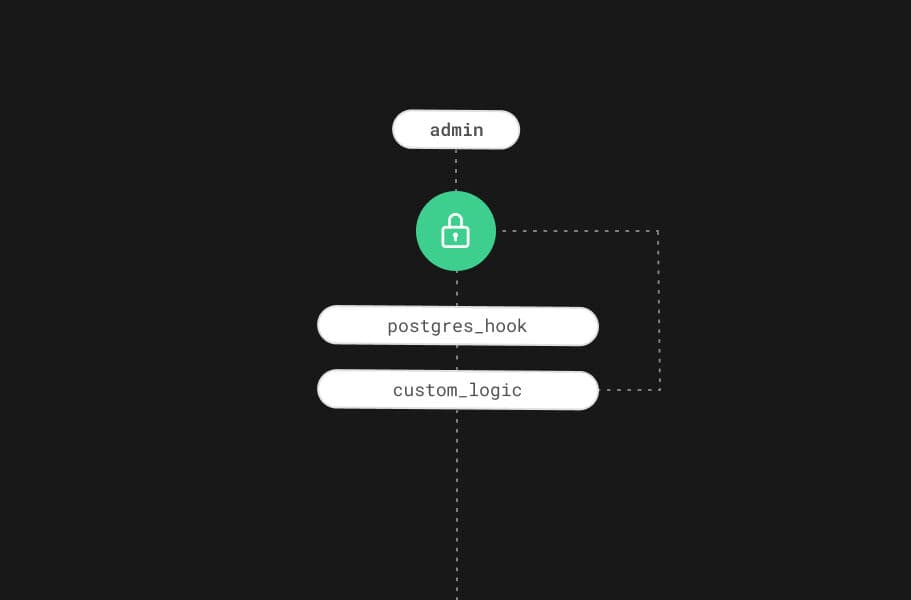
PostgreSQL hooks allow us to extend internal functionality. Hooks can modify behavior at different places, including when running SQL statements.
For example, if we wanted to enforce our own password restrictions whenever a user changes passwords, we could
use the check_password_hook to verify the password. We would write out our own Custom Logic, and raise an error
if the password fails the password requirements.
For SupaUtils, we're particularly interested in the ProcessUtility_hook, which allows us to hook into utility statements: every statement except select, insert, delete or update. They include alter role and drop role, which are the statements we want to hook on.
Hooks are global function pointers#
To use hooks, we can override functions pointers that are global. On the Postgres codebase, the ProcessUtility_hook is basically used1 like this:
_16
// src/backend/tcop/utility.c
_16
_16
// ProcessUtility_hook is NULL by default
_16
ProcessUtility_hook_type ProcessUtility_hook = NULL;
_16
_16
// This function is used for processing all the utility statements
_16
void
_16
ProcessUtility(PARAMS_OMITTED_FOR_BREVITY)
_16
{
_16
// call the ProcessUtility_hook if it's not NULL
_16
if (ProcessUtility_hook)
_16
(*ProcessUtility_hook)(PARAMS_OMITTED_FOR_BREVITY);
_16
// otherwise call the standard function used to process utility statements
_16
else
_16
standard_ProcessUtility(PARAMS_OMITTED_FOR_BREVITY);
_16
}
As you can see, ProcessUtility_hook is NULL by default, so our extension should set it for the hook to run. Also, the standard_ProcessUtility function is the one that actually does the job of creating or modifying the roles (among other things) so our hook should also call it.
Loading and running the hook#
Each extension set in shared_preload_libraries will get its _PG_init function called. This function will allow us to set our hook onto ProcessUtility_hook.
Since hooks are global function pointers, it might be the case that another extension modifies the hook pointer (on its own _PG_init) before us and sets its own hook. So we need to ensure we also run this previously-set hook, before or after our own hook runs.
It's typically2 done like this:
_26
// variable to store the previous hook
_26
static ProcessUtility_hook_type prev_hook = NULL;
_26
_26
// initialize our extension
_26
void
_26
_PG_init(void)
_26
{
_26
// ProcessUtility_hook has the global function pointer.
_26
// Store its value in case another extension already set its own hook.
_26
prev_hook = ProcessUtility_hook;
_26
// Now override the ProcessUtility_hook with our hook
_26
ProcessUtility_hook = our_hook;
_26
}
_26
_26
static void
_26
our_hook(PARAMS_OMITTED_FOR_BREVITY)
_26
{
_26
// our hook logic goes here
_26
_26
// If there was a previous hook, run it after our hook
_26
if (prev_hook)
_26
prev_hook(PARAMS_OMITTED_FOR_BREVITY);
_26
// If there's no previous hook, call the standard function
_26
else
_26
standard_ProcessUtility(PARAMS_OMITTED_FOR_BREVITY);
_26
}
We can use the concepts above to build our extension.
First we'll need a Makefile in order to compile the extension code and include it into our PostgreSQL installation.
_13
# Makefile
_13
_13
# Our shared library
_13
MODULE_big = supautils
_13
_13
# Our object files to build for the library
_13
OBJS = src/supautils.o
_13
_13
# Tell pg_config to pass us the PostgreSQL extensions makefile(PGXS)
_13
# and include it into our own Makefile through the standard "include" directive.
_13
PG_CONFIG = pg_config
_13
PGXS := $(shell $(PG_CONFIG) --pgxs)
_13
include $(PGXS)
For the source file, we'll start with variable definitions and functions declarations.
_30
// src/supautils.c
_30
_30
// include common declarations
_30
#include "postgres.h"
_30
_30
// required macro for extension libraries to work
_30
PG_MODULE_MAGIC;
_30
_30
// variable for the previous hook
_30
static ProcessUtility_hook_type prev_hook = NULL;
_30
_30
// variable for our reserved roles configuration parameter
_30
static char *reserved_roles = NULL;
_30
_30
// function declaration for extension initialization
_30
void _PG_init(void);
_30
_30
// function declaration for our hook
_30
static void supautils_hook(
_30
PlannedStmt *pstmt,
_30
const char *queryString,
_30
ProcessUtilityContext context,
_30
ParamListInfo params,
_30
QueryEnvironment *queryEnv,
_30
DestReceiver *dest,
_30
QueryCompletion *completionTag
_30
);
_30
_30
// function declaration for our pure function that will return a reserved role
_30
static char* look_for_reserved_role(Node *utility_stmt, List *reserved_role_list);
Up next we'll define each one of these function declarations.
Let's now _PG_init our extension. Besides setting the hook here, we want to define our reserved roles as a configuration parameter, that way they can be modified by editing the postgresql.conf file. For this, we can use the DefineCustomStringVariable function, which inserts the parameter into Postgres "Grand Unified Configuration"(GUC) system.
_22
void
_22
_PG_init(void)
_22
{
_22
// Store the previous hook
_22
prev_hook = ProcessUtility_hook;
_22
// Set our hook
_22
ProcessUtility_hook = supautils_hook;
_22
_22
// Define our "supautils.reserved_roles" parameter
_22
// some arguments are unused so they are left as NULL
_22
DefineCustomStringVariable("supautils.reserved_roles",
_22
"Comma-separated list of roles that cannot be altered or dropped",
_22
NULL,
_22
// It will be assigned to the reserved_roles variable
_22
&reserved_roles,
_22
NULL,
_22
// We should be able to reload this parameter without restarting the server,
_22
// e.g. with "select pg_reload_conf()".
_22
PGC_SIGHUP,
_22
0,
_22
NULL, NULL, NULL);
_22
}
Now that our hook is set, we'll define what it will do. As specified in the ProcessUtility_hook_type, the hook's first parameter is a PlannedStmt, this represents the planned statement — the output from the Postgres planner. This is a step before the statement is executed.
We'll look for the presence of a reserved role in the planned statement. If there's one present, we'll report an error and abort the statement execution step.
_55
static void
_55
supautils_hook(
_55
// The planned statement
_55
PlannedStmt *pstmt,
_55
// These parameters are here for completion, we'll not use any of them
_55
const char *queryString,
_55
ProcessUtilityContext context,
_55
ParamListInfo params,
_55
QueryEnvironment *queryEnv,
_55
DestReceiver *dest,
_55
QueryCompletion *completionTag
_55
)
_55
{
_55
// Get the utility statement from the planned statement
_55
Node *utility_stmt = pstmt->utilityStmt;
_55
_55
// Only do the logic if supautils.reserved_roles is not NULL
_55
if(reserved_roles){
_55
// The found reserved role, assume none was found by default
_55
char *reserved_role = NULL;
_55
// Temp var for storing the list of reserved roles
_55
List *reserved_role_list;
_55
_55
// split the comma-separated string into a List by using a
_55
// helper function from varlena.h
_55
if (!SplitIdentifierString(pstrdup(reserved_roles), ',', &reserved_role_list))
_55
// abort and report an error if the splitting fails
_55
ereport(ERROR,
_55
(errcode(ERRCODE_INVALID_PARAMETER_VALUE),
_55
errmsg("parameter \"%s\" must be a comma-separated list of "
_55
"identifiers", reserved_roles)));
_55
_55
// look for the reserved role in an internal function
_55
reserved_role = look_for_reserved_role(utility_stmt, reserved_role_list);
_55
_55
// we're done with the list so free it from memory
_55
list_free(reserved_role_list);
_55
_55
// abort and report an error if a reserved role was found
_55
if(reserved_role)
_55
ereport(ERROR,
_55
(errcode(ERRCODE_INSUFFICIENT_PRIVILEGE),
_55
errmsg("\"%s\" is a reserved role, it cannot be modified", reserved_role)));
_55
}
_55
_55
// Run the previous hook if defined or call the standard function
_55
if (prev_hook)
_55
prev_hook(pstmt, queryString,
_55
context, params, queryEnv,
_55
dest, completionTag);
_55
else
_55
standard_ProcessUtility(pstmt, queryString,
_55
context, params, queryEnv,
_55
dest, completionTag);
_55
}
Lastly, we'll define how we look for the reserved role.
At this stage, we already have the utility statement and the reserved role list. All that's left to do is to define if the utility statement is an ALTER ROLE or DROP ROLE statement, and whether if the role it affects is a reserved one.
_70
static char*
_70
look_for_reserved_role(Node *utility_stmt, List *reserved_role_list)
_70
{
_70
// Check the utility statement type
_70
switch (utility_stmt->type)
_70
{
_70
// Matches statements like:
_70
// ALTER ROLE role NOLOGIN
_70
case T_AlterRoleStmt:
_70
{
_70
// cast the utility statement to an alter role statement
_70
AlterRoleStmt *stmt = (AlterRoleStmt *) utility_stmt;
_70
_70
//RoleSpec has the role name plus some attributes
_70
RoleSpec *role = stmt->role;
_70
_70
// postgres defines its own list utilities in pg_list.h
_70
// ListCell is an element of the list that we'll use for iteration
_70
ListCell *role_cell;
_70
_70
// pg_list.h includes the foreach macro for iterating over lists
_70
foreach(role_cell, reserved_role_list)
_70
{
_70
// get the list element
_70
char *reserved_role = (char *) lfirst(role_cell);
_70
_70
// compare the statement role with the reserved role
_70
// get_rolespec_name will get the RoleSpec role name,
_70
// even in cases where the role is the special case of
_70
// "current_user" or "session_user"
_70
if (strcmp(get_rolespec_name(role), reserved_role) == 0)
_70
return reserved_role;
_70
}
_70
_70
break;
_70
}
_70
_70
// Matches statements like:
_70
// DROP ROLE role
_70
case T_DropRoleStmt:
_70
{
_70
// cast the utility statement to a drop role statement
_70
DropRoleStmt *stmt = (DropRoleStmt *) utility_stmt;
_70
ListCell *item;
_70
_70
// the logic is the same as before, iterate over the reserved role list
_70
// and find a match
_70
foreach(item, stmt->roles)
_70
{
_70
RoleSpec *role = lfirst(item);
_70
ListCell *role_cell;
_70
_70
foreach(role_cell, reserved_role_list)
_70
{
_70
char *reserved_role = (char *) lfirst(role_cell);
_70
_70
if (strcmp(get_rolespec_name(role), reserved_role) == 0)
_70
return reserved_role;
_70
}
_70
}
_70
_70
break;
_70
}
_70
_70
default:
_70
break;
_70
}
_70
// Didn't find any reserved role on the statement, so return NULL
_70
return NULL;
_70
}
Now that the code is finished, we can test the extension. Since we already have a Makefile, the extension can be installed by doing make && make install. Then, in postgresql.conf:
_10
# set the extension as preloaded, this will require a restart
_10
shared_preload_libraries="supautils"
_10
_10
# the reserved roles
_10
supautils.reserved_roles="supabase_storage_admin, supabase_auth_admin"
We'll now try to alter or drop the reserved roles:
_10
alter role supabase_storage_admin nologin password 'fake';
_10
ERROR: "supabase_storage_admin" is a reserved role, it cannot be modified
_10
_10
drop role supabase_auth_admin;
_10
ERROR: "supabase_auth_admin" is a reserved role, it cannot be modified
_10
_10
-- Success!!
As you can see, PostgreSQL Hooks allow us to intercept SQL statements. There are many types of hooks, you can see unofficial documentation for these at AmatanHead/psql-hooks.
The full SupaUtils code is in our GitHub repository.
By the way, if you like working on PostgreSQL tooling and extensions: we are hiring PostgreSQL experts!
More Postgres resources#
- Implementing "seen by" functionality with Postgres
- Partial data dumps using Postgres Row Level Security
- Postgres Views
- Postgres Auditing in 150 lines of SQL
- Cracking PostgreSQL Interview Questions
- What are PostgreSQL Templates?
- Realtime Postgres RLS on Supabase
-
You can see the
ProcessUtility_hookdeclaration here and its usage here. ↩ -
This is also done on pg_stat_statements and sepgsql. ↩