


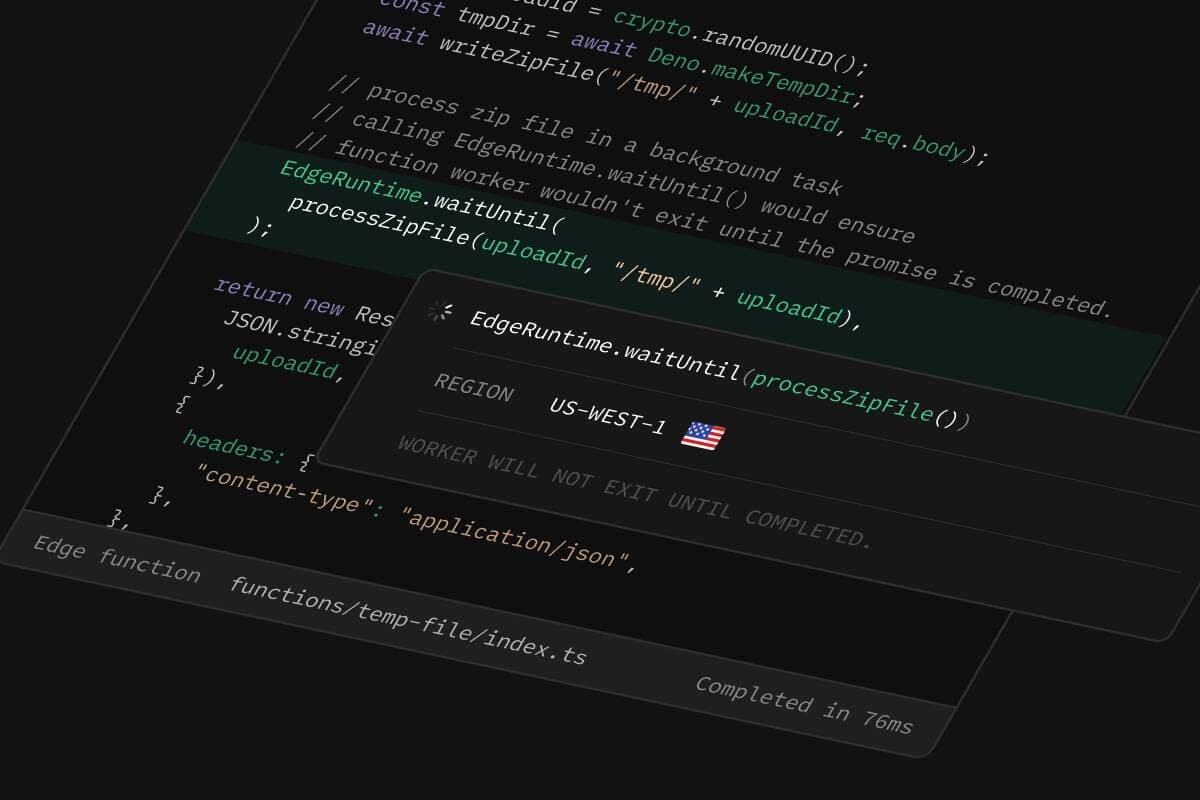
We are excited to announce three long-awaited features: Background Tasks, Ephemeral File Storage, and WebSockets.
Starting today, you can use these features in any project. Let's explore what exciting things you can build with them.
Sometimes you need a backend logic to do more than respond to a request. For example, you might want to process a batch of files and upload the results to Supabase Storage. Or read multiple entries from a database table and generate embeddings for each entry.
With the introduction of background tasks, executing these long-running workloads with Edge Functions is super easy.
We've introduced a new method called EdgeRuntime.waitUntil , which accepts a promise. This ensures that the function isn't terminated until the promise is resolved.
Free projects can run background tasks for a maximum of 150 seconds (2m 30s). If you are on a paid plan, this limit increases to 400 seconds (6m 40s). We plan to introduce more flexible limits in the coming months.
You can subscribe to notifications when the function is about to be shut down by listening to beforeunload event. Read the guide for more details on how to use background tasks.
Edge Function invocations now have access to ephemeral storage. This is useful for background tasks, as it allows you to read and write files in the /tmp directory to store intermediate results.
Check the guide on how to access ephemeral storage.
Example: Extracting a zip file and uploading its content to Supabase Storage#
Let's look at a real-world example using Background Tasks and Ephemeral Storage.
Imagine you're building a Photo Album app. You want your users to upload photos as a zip file. You would extract them in an Edge Function and upload them to storage.
One of the most straightforward ways to implement is using streams:
_35
import { ZipReaderStream } from 'https://deno.land/x/zipjs/index.js'
_35
import { createClient } from 'jsr:@supabase/supabase-js@2'
_35
_35
const supabase = createClient(
_35
Deno.env.get('SUPABASE_URL'),
_35
Deno.env.get('SUPABASE_SERVICE_ROLE_KEY')
_35
)
_35
_35
Deno.serve(async (req) => {
_35
const uploadId = crypto.randomUUID()
_35
_35
const { error } = await supabase.storage.createBucket(uploadId, {
_35
public: false,
_35
})
_35
_35
for await (const entry of await req.body.pipeThrough(new ZipReaderStream())) {
_35
// write file to Supabase Storage
_35
const { error } = await supabase.storage
_35
.from(uploadId)
_35
.upload(entry.filename, entry.readable, {})
_35
_35
console.log('uploaded', entry.filename)
_35
}
_35
_35
return new Response(
_35
JSON.stringify({
_35
uploadId,
_35
}),
_35
{
_35
headers: {
_35
'content-type': 'application/json',
_35
},
_35
}
_35
)
_35
})
If you test out the streaming version, it will run into memory limit errors when you try to upload zip files over 100MB. This is because the streaming version has to keep every file in a zip archive in memory.
We can modify it instead to write the zip file to a temporary file. Then, use a background task to extract and upload it to Supabase Storage. This way, we only read parts of the zip file to the memory.
_73
import { BlobWriter, ZipReader, ZipReaderStream } from 'https://deno.land/x/zipjs/index.js'
_73
_73
import { createClient } from 'jsr:@supabase/supabase-js@2'
_73
_73
const supabase = createClient(
_73
Deno.env.get('SUPABASE_URL'),
_73
Deno.env.get('SUPABASE_SERVICE_ROLE_KEY')
_73
)
_73
_73
let numFilesUploaded = 0
_73
_73
async function processZipFile(uploadId, filepath) {
_73
const file = await Deno.open(filepath, { read: true })
_73
const zipReader = new ZipReader(file.readable)
_73
const entries = await zipReader.getEntries()
_73
_73
await supabase.storage.createBucket(uploadId, {
_73
public: false,
_73
})
_73
_73
await Promise.all(
_73
entries.map(async (entry) => {
_73
// read file entry
_73
const blobWriter = new BlobWriter()
_73
const blob = await entry.getData(blobWriter)
_73
_73
if (entry.directory) {
_73
return
_73
}
_73
_73
// write file to Supabase Storage
_73
await supabase.storage.from(uploadId).upload(entry.filename, blob, {})
_73
_73
numFilesUploaded += 1
_73
console.log('uploaded', entry.filename)
_73
})
_73
)
_73
_73
await zipReader.close()
_73
}
_73
_73
// you can add a `beforeunload` event listener to be notified
_73
// when Function Worker is about to terminate.
_73
// use this to do any logging, save states.
_73
globalThis.addEventListener('beforeunload', (ev) => {
_73
console.log('function about to terminate: ', ev.detail.reason)
_73
console.log('number of files uploaded: ', numFilesUploaded)
_73
})
_73
_73
async function writeZipFile(filepath, stream) {
_73
await Deno.writeFile(filepath, stream)
_73
}
_73
_73
Deno.serve(async (req) => {
_73
const uploadId = crypto.randomUUID()
_73
await writeZipFile('/tmp/' + uploadId, req.body)
_73
_73
// process zip file in a background task
_73
// calling EdgeRuntime.waitUntil() would ensure
_73
// function worker wouldn't exit until the promise is completed.
_73
EdgeRuntime.waitUntil(processZipFile(uploadId, '/tmp/' + uploadId))
_73
_73
return new Response(
_73
JSON.stringify({
_73
uploadId,
_73
}),
_73
{
_73
headers: {
_73
'content-type': 'application/json',
_73
},
_73
}
_73
)
_73
})
Edge Functions now support establishing both inbound (server) and outbound (client) WebSocket connections. This enables a variety of new use cases.
Example: Building an authenticated relay to OpenAI Realtime API#
OpenAI recently introduced a Realtime API, which uses WebSockets. This is tricky to implement purely client-side because you'd need to expose your OpenAI key publicly. OpenAI recommends building a server to authenticate requests.
With our new support for WebSockets, you can easily do this in Edge Functions without standing up any infrastructure. Additionally, you can use Supabase Auth to authenticate users and protect your OpenAI usage from being abused.
_80
import { createClient } from 'jsr:@supabase/supabase-js@2'
_80
_80
const supabase = createClient(
_80
Deno.env.get('SUPABASE_URL'),
_80
Deno.env.get('SUPABASE_SERVICE_ROLE_KEY')
_80
)
_80
const OPENAI_API_KEY = Deno.env.get('OPENAI_API_KEY')
_80
_80
Deno.serve(async (req) => {
_80
const upgrade = req.headers.get('upgrade') || ''
_80
_80
if (upgrade.toLowerCase() != 'websocket') {
_80
return new Response("request isn't trying to upgrade to websocket.")
_80
}
_80
_80
// WebSocket browser clients does not support sending custom headers.
_80
// We have to use the URL query params to provide user's JWT.
_80
// Please be aware query params may be logged in some logging systems.
_80
const url = new URL(req.url)
_80
const jwt = url.searchParams.get('jwt')
_80
if (!jwt) {
_80
console.error('Auth token not provided')
_80
return new Response('Auth token not provided', { status: 403 })
_80
}
_80
const { error, data } = await supabase.auth.getUser(jwt)
_80
if (error) {
_80
console.error(error)
_80
return new Response('Invalid token provided', { status: 403 })
_80
}
_80
if (!data.user) {
_80
console.error('user is not authenticated')
_80
return new Response('User is not authenticated', { status: 403 })
_80
}
_80
_80
const { socket, response } = Deno.upgradeWebSocket(req)
_80
_80
socket.onopen = () => {
_80
// initiate an outbound WebSocket connection to OpenAI
_80
const url = 'wss://api.openai.com/v1/realtime?model=gpt-4o-realtime-preview-2024-10-01'
_80
_80
// openai-insecure-api-key isn't a problem since this code runs in an Edge Function
_80
const openaiWS = new WebSocket(url, [
_80
'realtime',
_80
`openai-insecure-api-key.${OPENAI_API_KEY}`,
_80
'openai-beta.realtime-v1',
_80
])
_80
_80
openaiWS.onopen = () => {
_80
console.log('Connected to OpenAI server.')
_80
_80
socket.onmessage = (e) => {
_80
console.log('socket message:', e.data)
_80
// only send the message if openAI ws is open
_80
if (openaiWS.readyState === 1) {
_80
openaiWS.send(e.data)
_80
} else {
_80
socket.send(
_80
JSON.stringify({
_80
type: 'error',
_80
msg: 'openAI connection not ready',
_80
})
_80
)
_80
}
_80
}
_80
}
_80
_80
openaiWS.onmessage = (e) => {
_80
console.log(e.data)
_80
socket.send(e.data)
_80
}
_80
_80
openaiWS.onerror = (e) => console.log('OpenAI error: ', e.message)
_80
openaiWS.onclose = (e) => console.log('OpenAI session closed')
_80
}
_80
_80
socket.onerror = (e) => console.log('socket errored:', e.message)
_80
socket.onclose = () => console.log('socket closed')
_80
_80
return response // 101 (Switching Protocols)
_80
})
In the past few months, we have made many performance, stability, and DX improvements to Edge Functions. While these improvements often aren't visible to the end-users, they are the foundation of the new features we are announcing today.
We have a very exciting roadmap planned for 2025. One of the main priorities is to provide customizable compute limits (memory, CPU, and execution duration). We will soon announce an update on it.
Stay tuned for the upcoming launches this week. You will see how all these upcoming pieces fit like Lego bricks to make your developer life easy.