


惯性聚合 高效追踪和阅读你感兴趣的博客、新闻、科技资讯
阅读原文 在惯性聚合中打开

推荐订阅源

MongoDB | Blog
MongoDB | Blog
博客园 - 聂微东
Attack and Defense Labs
WordPress大学
WordPress大学
D
Darknet – Hacking Tools, Hacker News & Cyber Security
Spread Privacy
Spread Privacy
AI
AI
宝玉的分享
宝玉的分享
K
KPMG report finds enterprise disconnect between AI and its ROI | CIO
C
Cyber Attacks, Cyber Crime and Cyber Security
爱范儿
爱范儿
Help Net Security
Help Net Security
V
Visual Studio Blog
大猫的无限游戏
大猫的无限游戏
Forbes - Security
Forbes - Security
P
Privacy & Cybersecurity Law Blog
Project Zero
Project Zero
IT之家
IT之家
Hugging Face - Blog
Hugging Face - Blog
博客园 - 三生石上(FineUI控件)
S
SegmentFault 最新的问题
有赞技术团队
有赞技术团队
T
Troy Hunt's Blog
美团技术团队
T
Threatpost
K
Kaspersky official blog
V
V2EX
Scott Helme
Scott Helme
Vercel News
Vercel News
T
The Blog of Author Tim Ferriss
T
Tailwind CSS Blog
V
Vulnerabilities – Threatpost
Last Week in AI
Last Week in AI
PCI Perspectives
PCI Perspectives
Google Online Security Blog
Apple Machine Learning Research
Engineering at Meta
Engineering at Meta
Exploit-DB.com RSS Feed
I
InfoQ
cs.CL updates on arXiv.org
酷 壳 – CoolShell
酷 壳 – CoolShell
GbyAI
GbyAI
L
LINUX DO - 最新话题
T
The Exploit Database - CXSecurity.com
L
LangChain Blog
S
Security @ Cisco Blogs
The Last Watchdog
The Last Watchdog
H
Hacker News: Front Page
让小产品的独立变现更简单 - ezindie.com
TaoSecurity Blog
TaoSecurity Blog

Supabase Blog

AI Agents Know About Supabase. They Don't Always Use It Right. Custom OIDC Providers for Supabase Auth 100,000 GitHub stars Supabase docs over SSH Navigating Regional Network Blocks Supabase Joins the Stripe Projects Developer Preview Log Drains: Now available on Pro Supabase Storage: major performance, security, and reliability updates Supabase incident on February 12, 2026 Hydra joins Supabase X / Twitter OAuth 2.0 is now available for Supabase Auth BKND joins Supabase Supabase is now an official Claude connector Supabase PrivateLink is now available Introducing: Postgres Best Practices When to use Read Replicas vs. bigger compute Introducing TRAE SOLO integration with Supabase Supabase Security Retro: 2025 Sync Stripe Data to Your Supabase Database in One Click Building ChatGPT Apps with Supabase Edge Functions and mcp-use Own Your Observability: Supabase Metrics API Introducing iceberg-js: A JavaScript Client for Apache Iceberg Introducing Supabase for Platforms Adding Async Streaming to Postgres Foreign Data Wrappers Build "Sign in with Your App" using Supabase Auth Introducing Seven New Email Templates for Supabase Auth The new Supabase power for Kiro Introducing Supabase ETL Introducing Analytics Buckets Introducing Vector Buckets Snap, Inc. Launches Snap Cloud, Powered by Supabase Triplit joins Supabase Supabase Series E 1000 Y Combinator Founders Choose Supabase gm 👋 web3, welcome aboard to Sign in with Web3 (Solana, Ethereum) Announcing the Supabase Remote MCP Server Enterprise speed, enterprise standards with Bolt Cloud + Supabase PostgREST 13 Lovable Cloud + Supabase: The Default Platform for AI Builders Processing large jobs with Edge Functions, Cron, and Queues Defense in Depth for MCP Servers OrioleDB Patent: now freely available to the Postgres community Supabase Launch Week 15 Hackathon Winner Announcement The Vibe Coder's Guide to Supabase Environments Testing for Vibe Coders: From Zero to Production Confidence The Vibe Coding Master Checklist Vibe Coding: Best Practices for Prompting Supabase Auth: Build vs. Buy Top 10 Launches of Launch Week 15 Supabase Launch Week 15 Hackathon Storage: 10x Larger Uploads, 3x Cheaper Cached Egress, and 2x Egress Quota Persistent Storage and 97% Faster Cold Starts for Edge Functions Algolia Connector for Supabase New Observability Features in Supabase Improved Security Controls and A New Home for Security Introducing Branching 2.0 Stripe-To-Postgres Sync Engine as standalone Library Supabase Analytics Buckets with Iceberg Support Create a Supabase backend using Figma Make Introducing JWT Signing Keys Supabase UI: Platform Kit Build a Personalized AI Assistant with Postgres Announcing Multigres: Vitess for Postgres Building on open table formats Open Data Standards: Postgres, OTel, and Iceberg Simplifying back-end complexity with Supabase Data APIs PostgreSQL Event Triggers without superuser access Top 10 Launches of Launch Week 14 Supabase MCP Server Data API Routes to Nearest Read Replica Declarative Schemas for Simpler Database Management Realtime: Broadcast from Database Keeping Tabs on What's New in Supabase Studio Edge Functions: Deploy from the Dashboard + Deno 2.1 Automatic Embeddings in Postgres Introducing the Supabase UI Library Supabase Auth: Bring Your Own Clerk Postgres Language Server: Initial Release Migrating from Fauna to Supabase Migrating from the MongoDB Data API to Supabase Dedicated Poolers Postgres as a Graph Database: (Ab)using pgRouting AI Hackathon at Y Combinator Calendars in Postgres using Foreign Data Wrappers Supabase Launch Week 13 Hackathon Winners How to Hack the Base! Running Durable Workflows in Postgres using DBOS database.build v2: Bring-your-own-LLM Restore to a New Project Hack the Base! with Supabase Top 10 Launches of Launch Week 13 Supabase Queues High Performance Disk Supabase Cron Supabase CLI v2: Config as Code Supabase Edge Functions: Introducing Background Tasks, Ephemeral Storage, and WebSockets Supabase AI Assistant v2 OrioleDB Public Alpha Executing Dynamic JavaScript Code on Supabase with Edge Functions ClickHouse Partnership, improved Postgres Replication, and Disk Management
Brace yourself, IPv6 is coming
Paul Copplestone · 2024-01-12 · via Supabase Blog

Brace yourself, IPv6 is coming

On February 1st 2024, AWS will start charging for IPv4 addresses. This will cost $0.005 per hour - around $4 month.

A more accurate title for this post would be “Brace yourself, IPv4 is leaving”, because I can't imagine many companies will pay to keep using the IPv4 address. While $4 is relatively small for an individual, my hypothesis is that AWS is a foundational layer to many infrastructure companies, like Supabase - we offer a full EC2 instance for every Postgres database, so this would add millions to our AWS bill.

Infrastructure companies on AWS have a few choices:

  1. Pass on the cost to the customer.
  2. Provide a workaround (for example, a proxy).
  3. Only offer IPv6 and hope the world will catch up.

Let's explore the difficulties of 3.

As a quick primer, an IPv4 looks like this: 93.184.216.34. It is the “address” of a server, similar to a phone number - it tells your computer where to find something on the internet. The problem is there are only ~4.3 billion IPv4 addresses, and we're running out.

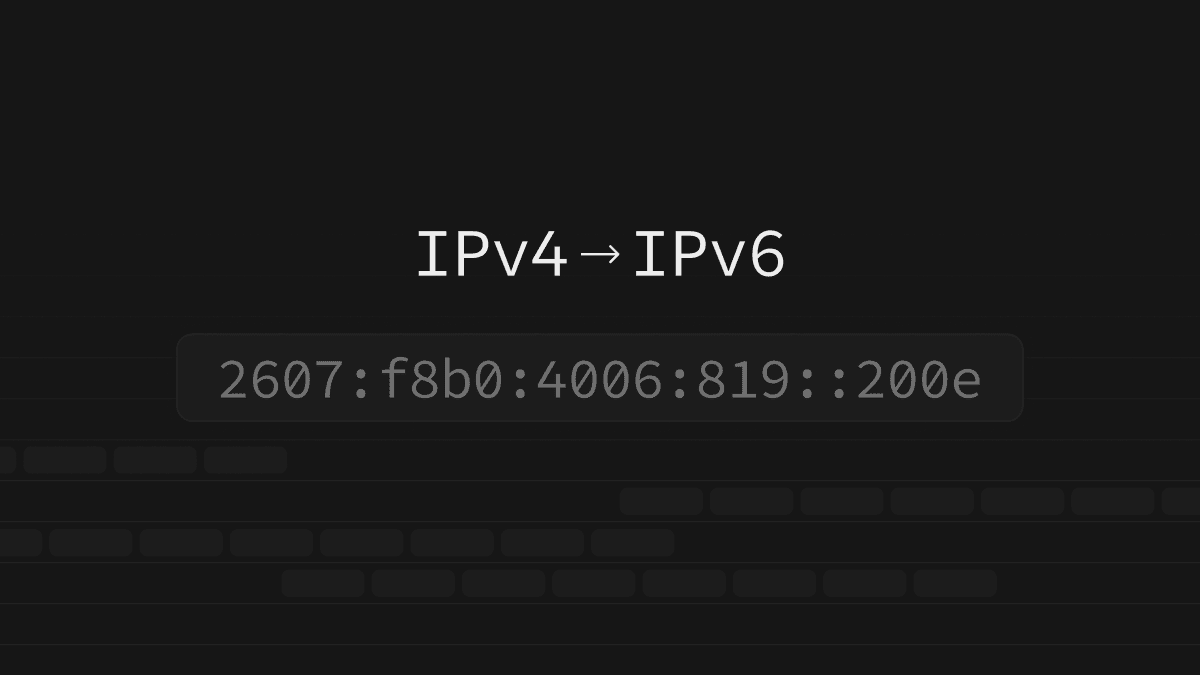
An IPv6 looks like this: 2607:f8b0:4006:819::200e. It functions the same as an IPv4, except that there are 340 undecillion of them - that's more than the grains of sand on the planet (by many orders of magnitude). We won't run out any time soon.

IPv6 is clearly a good thing, so what's the challenge? It mostly comes down to:

  1. ISP support
  2. Tooling support

The biggest challenge to global adoptions is ISP support. Does your Internet Service Provider support IPv6? Probably not.

When you type a website's domain name, it's translated into an IP address. Traditionally, these addresses have been IPv4:

example.com93.184.216.34

These domain names will eventually be translated into IPv6:

example.com2607:f8b0:4006:819::200e

After your ISP receives this address, it is responsible for routing all traffic to the correct destination. Unfortunately many ISPs simply aren't ready for this - they require newer switches, newer software, and interoperability with IPv4. All of this costs money, and for the past 10 years this investment hasn't been worthwhile.

Here are some of the ways that you will be affected when domains/servers start resolving to IPv6 instead of IPv4, if your ISP doesn't support IPv6:

  • Do you have a web server set up in AWS? You won't be able to SSH into it.
  • Are you connected to a Supabase database from your local machine using the direct connection? You need to use the connection pooler which will resolve as IPv4 instead (we will pay for IPv4 addresses on these).
  • Are you connecting to any AWS server from Vercel? That will start failing soon if you don't set up an IPv4 address for that server.

A lot of developer tools simply aren't set up for IPv6 yet. We can use Supabase as an example - our data team needed to make the following changes to support IPv6 with their toolchain:

  • Add IPv6 support to the VPC network.
  • Add IPv6 support to our Airflow VM.
  • Add IPv6 support to Docker and Compose.

These seem small, so to really convey what a PITA this can be, here were the steps for Docker:

1/ Update /etc/docker/daemon.json:


_10

"ipv6": true,

_10

"fixed-cidr-v6": "fd00:ffff::/80",

_10

"ip6tables": true,

_10

"experimental": true


2/ Restart the Docker service:


_10

systemctl restart docker


3/ Create a temporary IPv6 net and test it:


_10

docker network create --ipv6 --subnet fd00:ffff::/80 ip6net

_10

docker run --rm -it --network ip6net busybox ping6 google.com -c3


4/ Check IPv6 iptables config (FORWARD)

5/ Add IPv6 network config to the compose config file docker-compose.yaml


_10

# enable IPv6 to default network

_10

networks:

_10

default:

_10

enable_ipv6: true

_10

ipam:

_10

config:

_10

- subnet: fd00:c16a:601e::/80

_10

gateway: fd00:c16a:601e::1


6/ Check if it is working from a container


_10

docker exec -it "airflow_airflow-worker_1" bash

_10

curl -6 https://ifconfig.co/ip


That's … a lot more complicated than it should be for a tool as ubiquitous as Docker.

I suspect that the next few months there is going to be a lot of talk about IPv6.

The fallout from AWS's changes will likely start slow. AWS will simply start charging their customers rather than revoking the IPv4 address. Once that happens, infrastructure companies will notice their bills increasing and start removing IPv4, or providing proxies. Providers might even require some downtime to implement kernel-level changes to support IPv6.

If you want to ensure your company continues to run smoothly, start making as many changes as possible now before the start of February.

If you are a Supabase customer, we have 3 simple solutions:

  1. Switch your “direct” database connection to our new Supavisor database proxy. You can find these details in the project connect page.
  2. We will bring out a paid add-on for IPv4. This will be $4/m - we will simply pass on the AWS cost to you. Update: The add-on is now available on all paid plans.
  3. We'll support you. We know that this period will be difficult for many. If you encounter any issues, simply reach out to us via supabase.help and we will make sure your databases continue to run smoothly.