

GitHub Blog Editor and Strategist










When we shared this year’s Octoverse data with Guido van Rossum, the creator of Python, his first reaction was genuine surprise.
While TypeScript overtook Python to become the most used language on GitHub as of August 2025 (marking the biggest language shift in more than a decade), Python still grew 49% year over year in 2025, and remains the default language of AI, science, and education for developers across the world.
“I was very surprised by that number,” Guido told us, noting how this result is different from other popularity trackers like the TIOBE Index.
To learn more, we sat down with Guido for a candid conversation about Python’s roots, its ever-expanding reach, and the choices—both big and small—that have helped turn a one-time “hobby project” into the foundation for the next generation of developers and technologies.
Watch the full interview above. 👆
For Guido, Python began as a tool to solve the very real (and very painful) gap between C’s complexity and the limitations of shell scripting.
I wanted something that was much safer than C, and that took care of memory allocation, and of all the out of bounds indexing stuff, but was still an actual programming language. That was my starting point.
Guido van Rossum, creator of Python
He was working on a novel operating system, and the only available language was C.
“In C, even the simplest utility that reads two lines from input becomes an exercise in managing buffer overflows and memory allocation,” he says.
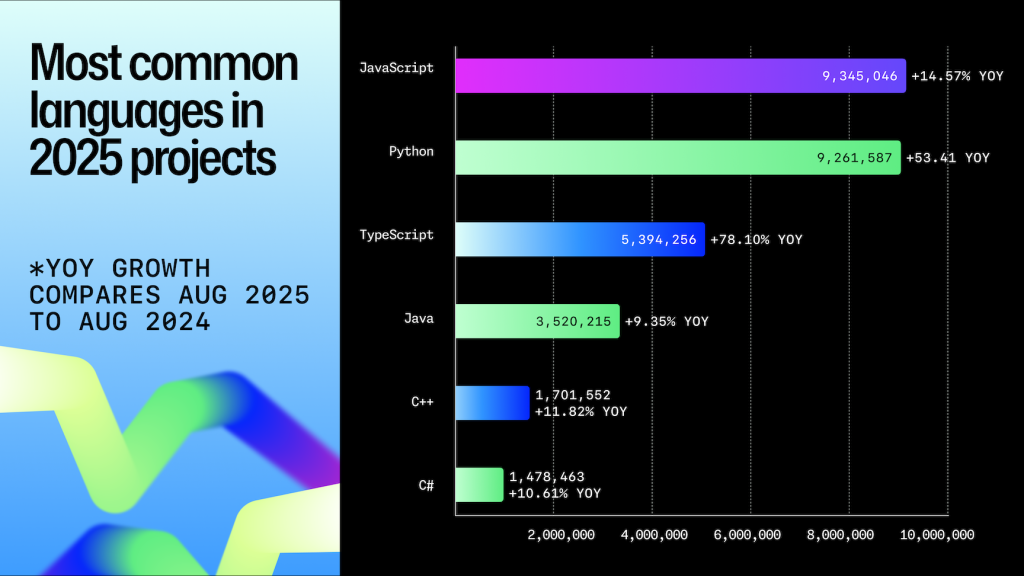
Shell scripts weren’t expressive enough, and C was too brittle. Building utilities for a new operating system showed just how much friction existed in the developer workflow at the time.
Guido wanted to create language that served as a practical tool between the pain of C and the limits of shell scripting. And that led to Python, which he designed to take care of the tough parts, and let programmers focus on what matters.
Python’s core DNA—clarity, friendliness, and minimal friction—was baked in from the beginning, too. It’s strangely fitting that a language that started as such a practical project now sits at the center of open source, AI, data science, and enterprise AI.
Unlike other programming languages named for ancient philosophers or stitched-together acronyms, Python’s namesake comes from Monty Python’s Flying Circus.
“I wanted to express a little irreverence,” Guido says. “A slight note of discord in the staid world of computer languages.”
The name “Python” wasn’t a joke—it was a design choice, and a hint that programming doesn’t have to feel solemn or elitist.
That sense of fun and accessibility has become as valuable to Python’s brand as its syntax. Ask practically anyone who’s learned to code with Python, and they’ll talk about its readability, its welcoming error messages, and the breadth of community resources that flatten that first steep climb.
If you wrote something in Python last week and, six months from now, you’re reading that code, it’s still clear. Python’s clarity and user friendliness compared to Perl was definitely one of the reasons why Python took over Perl in the early aughts.
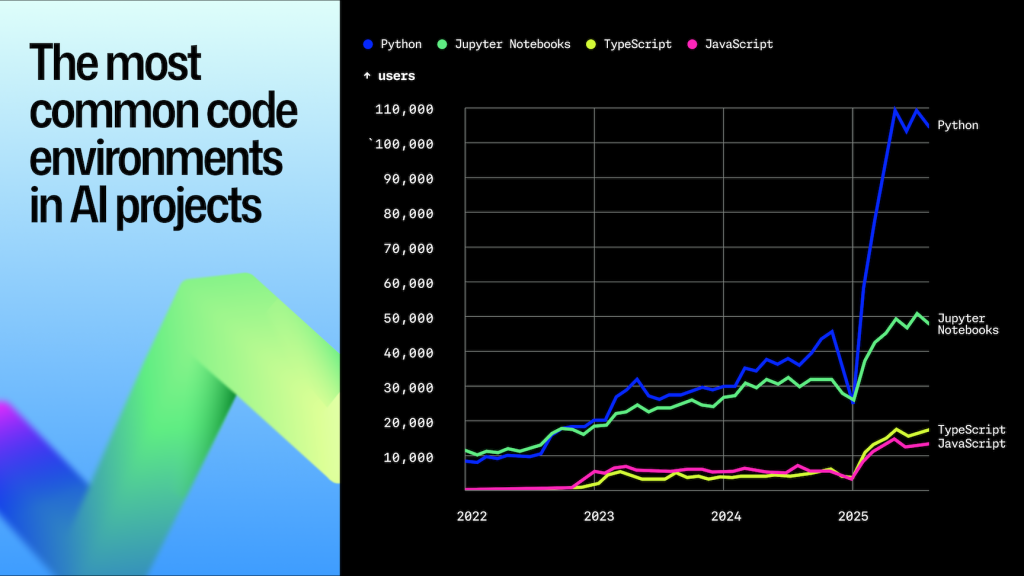
Python’s influence in AI isn’t accidental. It’s a signal of the broader ecosystem compounding on itself. Today, some of the world’s fastest-growing AI infrastructure is built in Python, such as PyTorch and Hugging Face Transformers.
So, why Python? Guido credits the ecosystem around Python as the primary cause: after all, once a particular language has some use and seems to be a good solution, it sparks an avalanche of new software in that language, so it can take advantage of what already exists.
Moreover, he points to key Python projects:
The people now writing things for AI are familiar with Python because they started out in machine learning.
Python isn’t just the language of AI. It enabled AI to become what it is today.
That’s due, in part, to the language’s ability to evolve without sacrificing approachability. From optional static typing to a treasure trove of open source packages, Python adapts to the needs of cutting-edge fields without leaving beginners behind.
With AI generating more Python than ever, the natural question is: does Python need stricter typing?
Guido’s answer was immediate: “I don’t think we need to panic and start doing a bunch of things that might make things easier for AI.”
He believes Python’s optional typing system—while imperfect—is “plenty.”
AI should adapt to us, not the other way around.
He also offered a key insight: The biggest issue isn’t Python typing, but the training data.
“Most tutorials don’t teach static typing,” he says. “AI models don’t see enough annotated Python.
But LLMs can improve. “If I ask an AI to add a type annotation,” he says, “it usually researches it and gets it right.”
This reveals a philosophy that permeates the language: Python is for developers first and foremost. AI should always meet developers where they are.
We asked why Python remains one of the most popular first programming languages.
His explanation is simple and powerful: “There aren’t that many things you can do wrong that produce core dumps or incorrect magical results.”
Python tells you what went wrong, and where. And Guido sees the downstream effect constantly: “A very common theme in fan mail is: Python made my career. Without it, I wouldn’t have gotten into software at all.”
That’s not sentimentality. It’s user research. Python is approachable because it’s designed for developers who are learning, tinkering, and exploring.
It’s also deeply global.
This year’s Octoverse report showed that India alone added 5M+ developers in 2025, in a year where we saw more than one developer a second join GitHub. A number of these new developers come from non-traditional education paths.
Guido saw this coming: “A lot of Python users and contributors do not have a computer science education … because their day jobs require skills that go beyond spreadsheets.”
The clear syntax provides a natural entry point for first-time coders and tinkerers. As we’ve seen on GitHub, the language has been a launchpad not just for CS graduates, but for scientists in Brazil, aspiring AI developers in India, and anyone looking for the shortest path from idea to implementation.
Python famously uses indentation for grouping. Most developers love this. But some really don’t.
Guido still receives personal emails complaining.
“Everyone else thinks that’s Python’s best feature,” he says. “But there is a small group of people who are unhappy with the use of indentation or whitespaces.”
It’s charming, relatable, and deeply on brand.
Maintaining Python’s momentum hasn’t meant standing still. Guido and the core dev team are laser-focused on backward compatibility, carefully weighing every new feature against decades of existing code.
For every new feature, we have to very carefully consider: is this breaking existing code?
Sometimes, the best ideas grow from constraints.
For instance, Python’s soft keywords, context-sensitive new features that preserve old code, are a recent architectural decision that let the team introduce new syntax without breaking old programs. It’s a subtle but powerful engineering choice that keeps enterprises on solid ground while still allowing the language to evolve.
This caution, often misinterpreted as reluctance, is exactly why Python has remained stable across three decades.
For maintainers, the lessons are clear: learn widely, solve for yourself, invite input, and iterate. Python’s journey proves that what starts as a line of code to solve your own problem can become a bridge to millions of developers around the world.
Python’s future remains bright because its values align with how developers actually learn and build:
As AI continues to influence software development—and Octoverse shows that 80% of new developers on GitHub use GitHub Copilot in their first week—Python’s clarity matters more than ever.
And as the next generation begins coding with AI, Python will be there to help turn ideas into implementations.
GitHub Blog Editor and Strategist

Build what’s next on GitHub, the place for anyone from anywhere to build anything.

Catch up on the GitHub podcast, a show dedicated to the topics, trends, stories and culture in and around the open source developer community on GitHub.
此内容由惯性聚合(RSS阅读器)自动聚合整理,仅供阅读参考。 原文来自 — 版权归原作者所有。

