惯性聚合 高效追踪和阅读你感兴趣的博客、新闻、科技资讯
阅读原文 在惯性聚合中打开

推荐订阅源

J
Java Code Geeks
月光博客
月光博客
aimingoo的专栏
aimingoo的专栏
Google DeepMind News
Recent Announcements
MyScale Blog
MyScale Blog
钛媒体:引领未来商业与生活新知
钛媒体:引领未来商业与生活新知
S
SegmentFault 最新的问题
Hugging Face - Blog
Hugging Face - Blog
Martin Fowler
Martin Fowler
WordPress大学
WordPress大学
F
Fortinet All Blogs
小众软件
小众软件
D
Docker
U
Unit 42
博客园 - 聂微东
freeCodeCamp Programming Tutorials: Python, JavaScript, Git & More
爱范儿
爱范儿
OSCHINA 社区最新新闻
OSCHINA 社区最新新闻
IT之家
IT之家
云风的 BLOG
云风的 BLOG
博客园 - 司徒正美
有赞技术团队
有赞技术团队
腾讯CDC

The latest developer news & insights - The GitHub Blog

GitHub availability report: August 2026 The August 17 outage, and the work ahead Your guide to GitHub Universe 2026 is here: The schedule just launched! GitHub availability report: July 2026 GitHub availability report: June 2026 GitHub joins coalition advocating for fixes to California AI Transparency Act to protect open source GitHub availability report: May 2026 GitHub Universe is back: All together now, in the agentic era GitHub Copilot app: The agent-native desktop experience Still a developer. Just outside. Our latest GitHub Shop collection is here. Take your local GitHub sessions anywhere GitHub availability report: April 2026 GitHub Copilot individual plans: Introducing flex allotments in Pro and Pro+, and a new Max plan Why age assurance laws matter for developers How researchers are using GitHub Innovation Graph data to reveal the “digital complexity” of nations An update on GitHub availability GitHub Copilot is moving to usage-based billing Changes to GitHub Copilot Individual plans Bringing more transparency to GitHub’s status page
Q1 2026 Innovation Graph update: Open source collaboratio...
Kevin Xu · 2026-07-08 · via The latest developer news & insights - The GitHub Blog

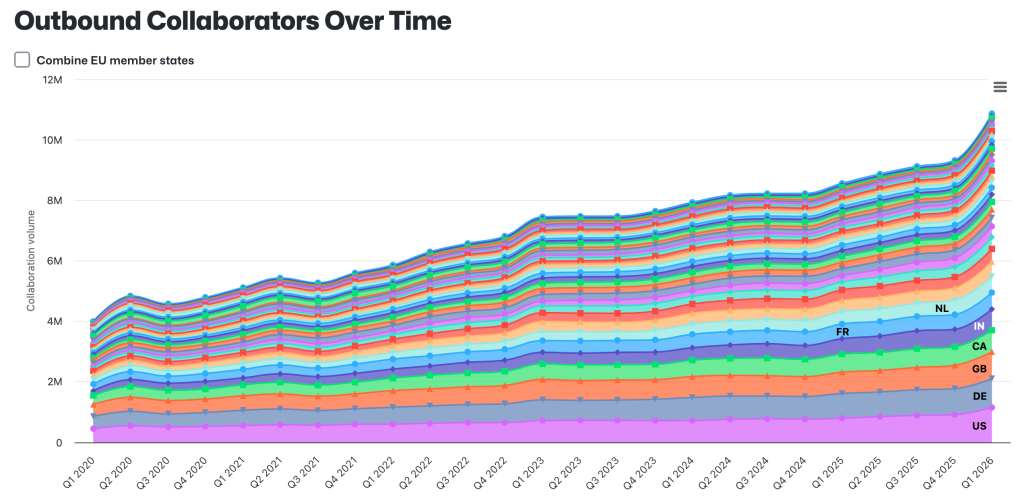
Q1 2026 was a banner quarter for open source collaboration, as shown by the GitHub Innovation Graph’s economy collaborators metric, part of the latest data release. Outbound collaboration, defined as the sum of git pushes and pull requests sent from developers in one economy to public repositories in another economy, grew by 16% quarter-over-quarter from Q4 2025 to Q1 2026.

Stacked area chart of quarterly outbound collaboration among the top 30 economies, showing a steady increase from Q1 2020 to Q1 2026.

That’s the second highest quarter-over-quarter growth rate we’ve seen since 2020. The highest was in Q2 2020, with a 21% growth rate, when many of us suddenly and collectively decided to use our computers more.

In third place was Q1 2023, with a 9% growth rate. This was the first quarter after a research lab blogged about a new website they made, and they enticed users to sign up and file bug reports by offering a chance to win up to $500 in API credits. Evidently, sweepstakes are unreasonably effective motivators.

Metrics by economy

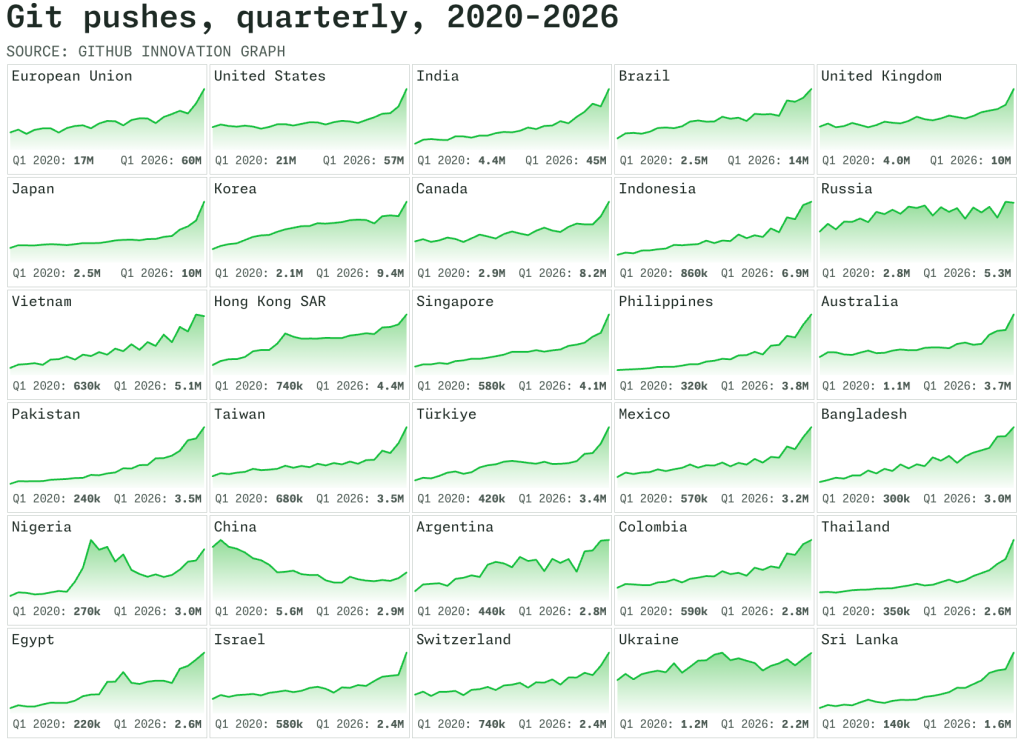
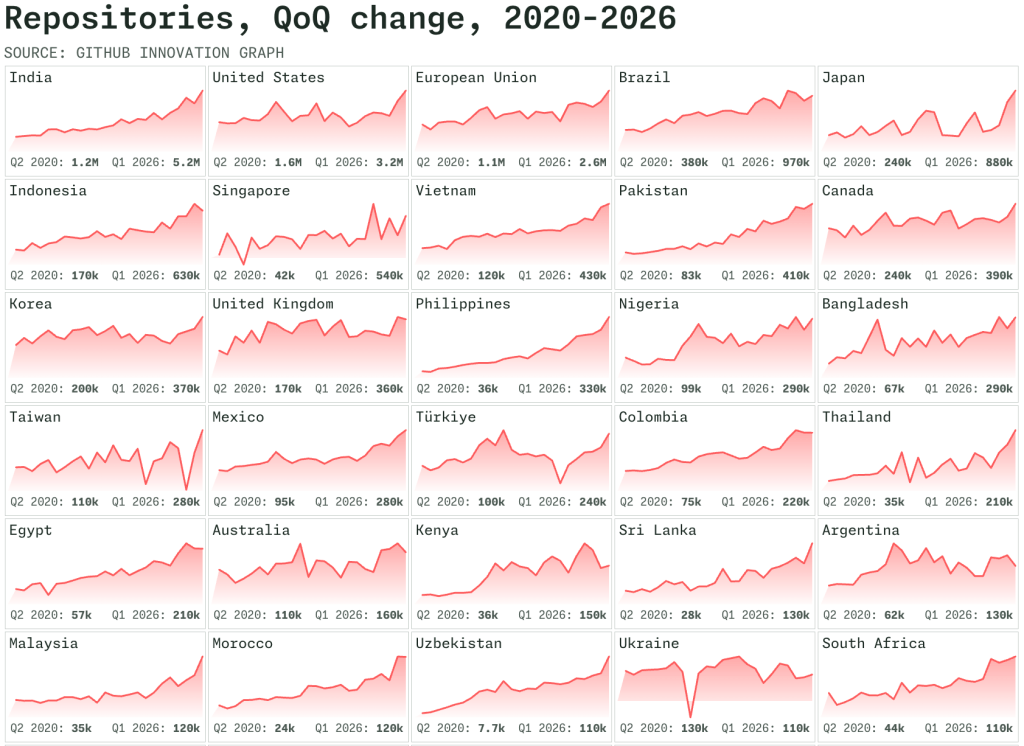
While it’s clear that collaboration is growing globally, plotting these and other metrics separately by economy highlights the different trajectories of the world’s developer communities:

A grid of line charts showing the top 30 economies by quarterly outbound collaboration from 2020-2026. Most of the charts show increasing collaboration volume, with the European Union ranked first.
A grid of line charts showing the top 30 economies by quarterly git pushes from 2020-2026. Most of the charts show increasing counts of git pushes, with the European Union ranked first.
A grid of line charts showing the top 30 economies by quarter-over-quarter change in repository count from 2020-2026. Most of the charts show increasing quarter-over-quarter growth of repositories, with India ranked first.

Now, it’s your turn to analyze the underlying datasets yourself for interesting pursuits, such as improving how economic growth is measured or estimating the impact of a research lab’s new website. While we have no sweepstakes to offer (for now), we think there are fascinating data stories strewn throughout these CSVs just waiting to be told.

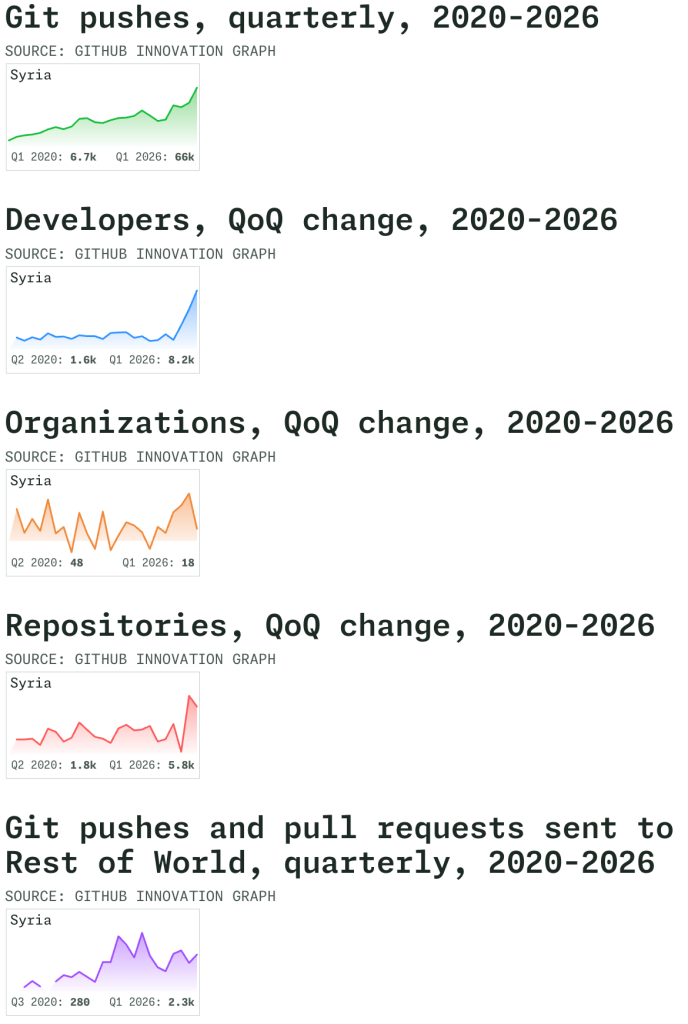
One example might be the impressive recent growth in Syria starting in Q4 2025, which coincides with changes we made to enable broader access to GitHub functionality following the relaxation of sanctions and export controls on the country:

Line charts of git pushes, developers, organizations, repositories, and outbound collaboration for Syria for Q1 2020 through Q1 2026. Most charts show increasing activity, with particularly pronounced recent growth in the number of developers in Syria.

We’re grateful to the developers who advocated for these changes and the communities that continue to help spread the word, such as GitSyria. Thanks to their efforts, we’re happy to share that we’ve been able to provide the GitHub Student Developer Pack to over 8,000 verified Syrian students in just the last six months.

Helping maintainers manage collaboration

While greater collaboration leads to many benefits, we recognize that the rapid increase in contribution volume has strained several communities. Ashley Wolf, our Director of Open Source Programs, wrote about the Eternal September of Open Source in February 2026, describing how maintainers are managing new contribution dynamics and what we’re doing to try to help. Features we’ve shipped include:

  • Pull request limits: You can set a maximum number of open pull requests that users without write access may have open in your repository at one time, giving you a more proactive way to manage contribution volume.
  • Repo-level pull request and issue controls: Gives maintainers the option to limit pull request and issue creation to collaborators or disable pull requests and issues entirely.
  • Pinned comments on issues: You can now pin a comment to the top of an issue from the comment menu.
  • Banners to reduce comment noise: Experience fewer unnecessary notifications with a banner that encourages people to react or subscribe instead of leaving noise like “+1” or “same here.”
  • Pull request performance improvements: Pull request diffs have been optimized for greater responsiveness and large pull requests in the new files changed experience respond up to 67% faster.
  • Faster issue navigation: Easier bug triage thanks to significantly improved speeds when browsing and navigating issues as a maintainer.
  • Temporary interaction limits: You can temporarily enforce a period of limited activity for certain users on a public repository.

Do you have feedback on the directions we’re exploring? Share it in the community discussion.

Share what is working for your projects, where the gaps are, and what would meaningfully improve your experience maintaining open source.

Written by

Kevin Xu

Staff Software Engineer, CELA

Related posts

Explore more from GitHub

Docs

Docs

Everything you need to master GitHub, all in one place.

Go to Docs

GitHub

GitHub

Build what’s next on GitHub, the place for anyone from anywhere to build anything.

Start building

Customer stories

Customer stories

Meet the companies and engineering teams that build with GitHub.

Learn more

GitHub Universe 2026

GitHub Universe 2026

Join us October 28-29 in San Francisco or online for GitHub Universe, our flagship developer event uniting people, agents, and the world’s code.

Register now