The wait is over: we finally have data to back up the benefits of developer experience (DevEx).
We’ve always known that providing a good DevEx is a smart business move, as it enables developers to solve complex tasks, collaborate with peers, and unleash their creativity. We hear this from customers all the time.
But despite the benefits, DevEx conversations usually end when execs ask for hard data on what their business will gain by improving it. While we have anecdotal evidence, we haven’t had the data to satisfy this question—until now. New research we just published uses statistical analysis to pinpoint how key DevEx factors—flow state, cognitive load, and feedback loops—impact individual, team, and organizational outcomes by improving productivity and innovation.
To conduct this research, we partnered with DX, which helps teams measure developer experience, to leverage their insights and expertise. Using work design theory, we created a set of research hypotheses, developed questions, and surveyed more than 20 industry-diverse companies. We ran rigorous statistical analyses to see which measures were validated and significant. We also documented our survey questions so others could reuse our work and provided step-by-step guidance on advocating for DevEx and measuring the results.
The result is the following body of evidence-based outcomes and advice—detailed in the summary below and a new report—that business leaders everywhere can use to make the case for investing in DevEx.
Dr. Eirini Kalliamvakou
Staff researcher at GitHub, co-author of the study
Boosting flow state
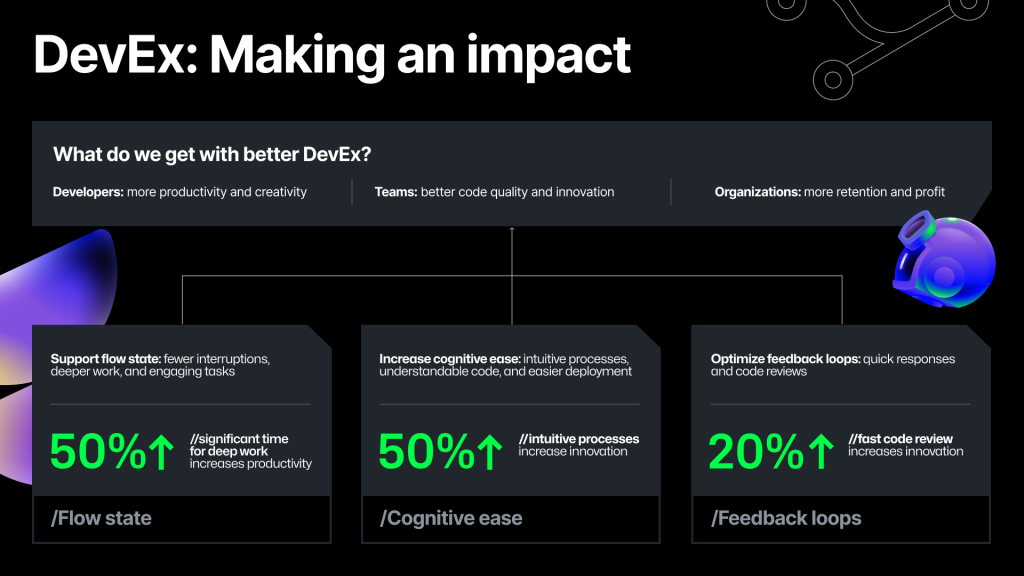
The research is clear: developers who carve out significant time for deep work enjoy a 50% productivity boost. Minimizing distractions, which can be everything from Slack messages to meetings to peers asking for help is paramount for high-value work. Granted, it’s not always easy to reserve blocks of time, especially in distributed teams across multiple time zones. However, providing your developers an atmosphere where they can maximize their flow state can pay high dividends.
“To optimize building code, you need the right environment,” says Dr. Eirini Kalliamvakou, staff researcher at GitHub and co-author of the study. “Implementing practices that enable your developers to enter and stay in the flow is a winning move.”
Adobe is an example of a company that recognizes the value of providing an effective working environment for developers. CJ Dotson, senior PM of developer productivity at Adobe, notes that “when technology is what you sell, investments in DevEx are not optional. Adobe’s investment in DevEx leads to higher developer satisfaction and better business outcomes.”
Additionally, developers who find their work engaging feel 30% more productive, according to the DevEx study. This stat should help your organization rethink the distribution of tasks. Do you have the same developers working on less desirable projects that could lead to burnout? Are your teams regularly engaging in tasks they find boring or divorced from the company’s mission? If you want to optimize their work, ensure that your teams are excited about the projects on their plate, at least most of the time.
“Providing deep work and exciting, engaging projects are some of the biggest things companies can do to improve productivity,” says Dr. Nicole Forsgren, partner researcher at Microsoft and co-author of the study.
Reducing cognitive load
It’s a familiar pattern: developers who report a high degree of understanding of their code feel 42% more productive than those with low or no understanding. Low understanding can come from various factors, including poor or outdated documentation, lack of onboarding, or the sheer pace of innovation with AI.
“Every developer has experienced the frustration of not understanding their code or its surrounding context well,” Forsgren says. “Because so much of our code is interconnected and developed by multiple people, understandability is part of why having a good DevEx is so important.”
Kalliamvakou also notes that this is where good tooling comes in: “Certain technologies like GitHub Copilot can help developers better understand their code and future-proof their productivity.”
Additionally, it should be no surprise that intuitive, easy processes can boost innovation, while cumbersome processes can sink time and create frustration. Our research shows that developers who have intuitive processes feel they are 50% more innovative.
“And it’s not always about the technology,” Forsgren adds. “If you can find ways to remove friction and blockers for developers, you’ll unlock so many things.”
Dermot Russell, director of engineering at Etsy, agrees: “Etsy’s enablement initiatives have improved developers’ day-to-day experience while also enabling rapid software delivery as our organization has grown.”
Improving feedback loops
In the world of development, efficient feedback loops are critical. According to the research, developers who report fast code turnaround times feel 20% more innovative than developers who don’t. “Getting fast feedback allows you to move along quickly while maintaining your curiosity and drive,” Kalliamvakou says. “It allows developers to stay in the flow and create the next great thing.”
Focusing on improving feedback loops can benefit the organization’s overall effectiveness and developer satisfaction. For example, UKG’s VP of developer acceleration, Thomas Newton, says, “it’s a virtuous cycle: by reducing friction and waste from developers’ daily work, developers are able to ship high-quality software faster, while also improving happiness and engagement.”
There’s another benefit to quick feedback loops: teams that provide faster responses to developers’ questions report 50% less technical debt. In other words, good documentation pays off. Documenting common developer questions and putting tooling in place that enables them to easily find the responses they need, allows developers to increase their agility.
At the end of the day, nimble developers beget nimble teams and organizations.
“So often, if you’re a developer, you have to wait for feedback,” Forsgren adds. “You get interrupted. You’re constantly stalled. You have to figure out a cumbersome process. But if, instead, you can collaborate quickly, have no interruptions, use intuitive technologies, and stay in the flow—that’s when you can problem-solve, be creative, and get work done, which will benefit the team and entire organization.”
The path forward
Software creation is critical for innovation. Across all industries, companies need to build and maintain high-quality software to meet their goals. As such, investing in DevEx is a must.
“If you’re a business leader who’s focused on being profitable and innovative, enabling a good DevEx is one of the key levers at your disposal,” Kalliamvakou says. “The research we published finally gives us the solid data and evidence we need to make the case to the larger community.”
Read the full research paper, DevEx in action: A study of its tangible impacts.
Want to learn how GitHub can help your organization do more with AI?
At GitHub Galaxy 2024, we’ll explore cutting-edge research and best practices in the rapidly evolving world of AI—empowering your business to maximize productivity and innovate at scale.
Register now >
Written by
Dr. Eirini Kalliamvakou is a Research Advisor at GitHub, and leads research that deciphers developers' motivations, needs, behavior, and how tools support them. Her insights shape product thinking, strategic storytelling, and leadership decisions across the company. Eirini holds a PhD in Computer Science from the University of Victoria, and speaks about developer productivity, happiness, and the impact of AI on individuals, teams, and organizations.
GitHub is the world's best developer experience and the only AI-powered platform with security incorporated into every step, so you can innovate with confidence.












