



惯性聚合 高效追踪和阅读你感兴趣的博客、新闻、科技资讯
阅读原文 在惯性聚合中打开

推荐订阅源

Martin Fowler
Martin Fowler
Engineering at Meta
Engineering at Meta
钛媒体:引领未来商业与生活新知
钛媒体:引领未来商业与生活新知
阮一峰的网络日志
阮一峰的网络日志
奇客Solidot–传递最新科技情报
奇客Solidot–传递最新科技情报
量子位
Jina AI
Jina AI
Microsoft Azure Blog
博客园_首页
L
LangChain Blog
A
About on SuperTechFans
人人都是产品经理
人人都是产品经理
freeCodeCamp Programming Tutorials: Python, JavaScript, Git & More
美团技术团队
博客园 - 三生石上(FineUI控件)
N
Netflix TechBlog - Medium
D
DataBreaches.Net
P
Proofpoint News Feed
小众软件
小众软件
Vercel News
Vercel News
T
The Blog of Author Tim Ferriss
WordPress大学
WordPress大学
雷峰网
雷峰网
G
Google Developers Blog

Monocle

Air-con has become the latest front in a culture war – but more hot air is the last thing our overheating cities need All aboard as the Emirates’ first train service takes to the rails The seven standout shows at Paris Fashion Week Men’s spring/summer 2027 Where to eat and beat the heat in Paris: three new restaurants favoured by the fashion crowd What can be gleaned from Washington’s Reflecting Pool on the week of the US’s 250th birthday? Inside Monocle's July/August 2026 issue What makes Copenhagen a great city? Its ability to learn from its mistakes Stadium designer Alex Thomas’s top-10 sports venues in the world The case for keeping the economy – and the office – cool Cities are like theatres, we the actors. What part do you want to play? Cities are like theatres, we the actors. What part do you want to play? Onion – The Mansion: The latest outpost of a fashion retailer born of a musician’s side hustle Summer playlist: Celebrate the summer with these 40 scorching songs Meet the practice behind the Obama Presidential Center’s brand identity For all its problematic elements, the Fifa World Cup remains the greatest show on Earth Despite its enormous scale, Tokyo remains a city where good manners thrive Heatwave be damned! Paris Fashion Week Men’s brings leather and layers to the runways The Amble EV is gearing up to reinvent the way we drive Our summer issue is out now and measures the immeasurable – what makes a city worth living in? The art of the amble: Exploring the social rituals of evening walks across Spain, Italy and Greece Greetings from the past: A look back at postcards serving as snapshots of history It takes a village: Three new co-living developments that are bringing generations together The People’s charter for living well in cities: 13 rules for oafs, oiks and rapscallions How a city splashed out on staying cool: Zürich’s best fountains How The Lobb Club became Bangkok’s coolest tennis hangout Why does everyone want to be a member of Madrid’s Real Club de Campo Villa? A shore cure for urban fatigue: How Sydney, New York and Kobe are rethinking their waterfronts How Dubai, New York, Paris and Shenzhen are building their flying-taxi networks Saddle up at Polo Palladio for a taste of Jaipur’s social scene Tyler Brûlé introduces Monocle's 2026 Quality of Life survey on CNN
Berlin swimmers take the plunge amid efforts to reclaim b...
Yegor Mostovshikov · 2026-06-23 · via Monocle

Campaign group Flussbad Berlin is going against the tide with its campaign to open the Spree to public bathing. Will it sink or swim?

Almost four decades after reunification, Berlin’s primary struggle remains reconciling its legacy as a divided city with the realities of being a modern metropolis. The German press has long labelled the city a “failed state” and it might be right – but Berliners haven’t lost hope. In fact, one group believes that reclaiming the city’s river for swimming could help to quell the tide of local tension. 

Jan and Tim Edler, brothers and founders of art and architecture studio Realities:United, first campaigned to lift the city’s ban on bathing in the Spree in 1998. Swimming in the inner-city section of the waterway was banned in 1925 because of industrial pollution. Following the Cold War and subsequent division of the city, much of the river ran through East Berlin, where the GDR treated swimming West Berliners as illegal border-crossers. 

“The river has become detached from the city and we need to rebuild that bond,” says Jan. They eventually established Flussbad Berlin, an NGO advocating to transform a 835-metre stretch of the Spree into a natural-water swimming area. It now boasts more than 500 members, who cite the city’s lack of cooling spaces as a reason for joining.
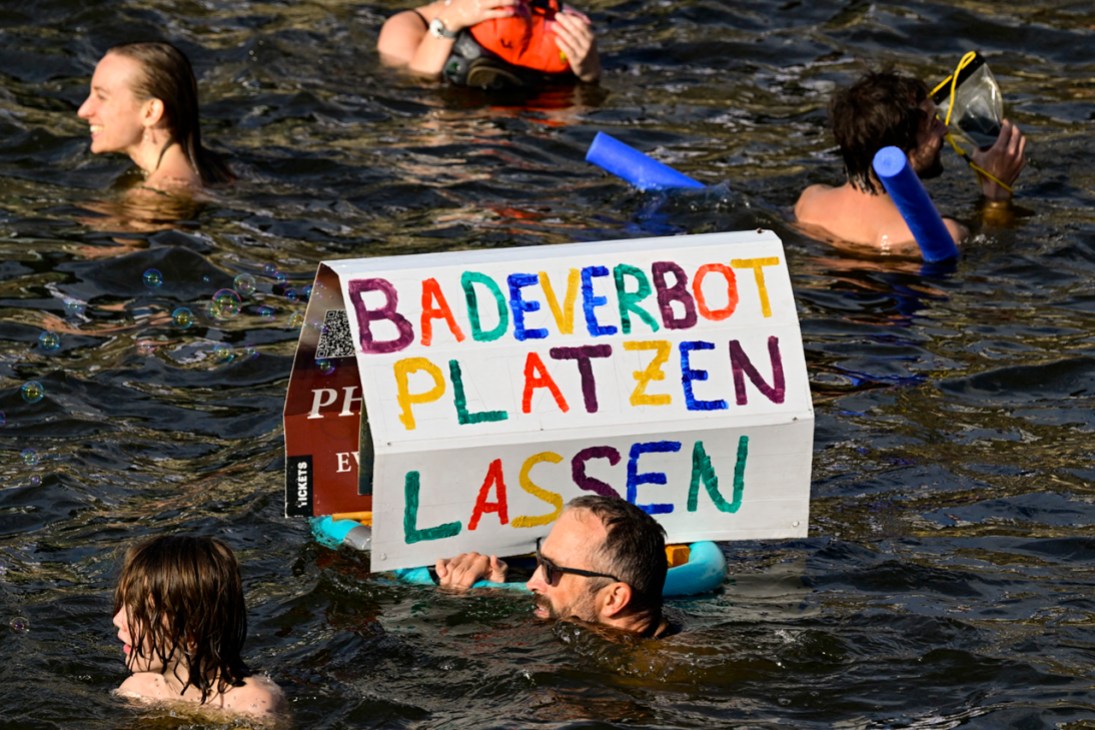
A participant swims with a placard with the lettering 'Break the bathing ban' while taking a dip in the Spree river during a second swimming demonstration for the abolition of the general swimming ban in the inner-city Spree river in central Berlin on August 12, 2025. They demonstrate for the possibility to swim in the inner-city Spree river again; it was banned around 100 years ago. (Photo by John MACDOUGALL / AFP) (Photo by JOHN MACDOUGALL/AFP via Getty Images)
Going on a Spree: A protestor with a ‘Break the bathing ban’ sign (Image: Photo by John MacDougall/AFP via Getty Images)

But this lack of swimming access reflects broader frustrations regarding access to civic infrastructure across the German capital. In recent years, Berlin has struggled with regulations and bureaucracy, a housing crisis and failing public transport. Urban development is also slow: the city’s new S15 railway line opened this month after significant delays and restorations to the Pergamon Museum have now entered their 14th year.

Protests have been driven by a desire to enrich the city’s quality of life and protect its public spaces. In 2014, Berliners forced a referendum that blocked any construction on the 300-hectare Tempelhofer Field, one of the largest inner-city open spaces in the world. In 2018, after two years of fierce local protests, Google dropped its plans to build a campus in the bohemian Kreuzberg district. And, in 2024, Tesla put its Gigafactory expansion in the Grünheide forest on hold. This year, Berliners are even opposing bids to host the Olympics in 2036, 2040 or 2044.

“It’s embarrassing,” says Jan. “Berlin has lost its ambition and it’s up to Berliners to act.” Volunteers at Flussbad Berlin developed a water-monitoring app and found that sanitation improvements have improved river safety, meaning that the Spree is now clean enough for swimming about 80 per cent of the time between May and October. The barrier to access, according to Jan, is political will: officials might allow bathing in the Spree during a potential Olympics but not at other times.

In protest of the swimming ban, the club’s members will dive into the Spree on the 20th of each month this year until the Berlin House of Representatives election in September. “Being in a river is a special feeling,” he says, “one that opens you up to ideas about caring for your city. Berliners are famous for being grumpy but in the water, it’s all smiles.”

Yegor Mostovshikov is a Berlin-based writer. For more opinion, analysis and insight, subscribe to Monocle today.