







It has been exactly 10 years since British voters chose to leave the EU. The result of that referendum swiftly destroyed the prime minister who called it, David Cameron; while the impossibilities of Brexit were also, to varying extents, the undoing of his four Conservative successors. In 2024, the same electorate awarded a thumping landslide to the Labour party of Keir Starmer, widely interpreted as a plea for stable, sensible, even tedious governance.
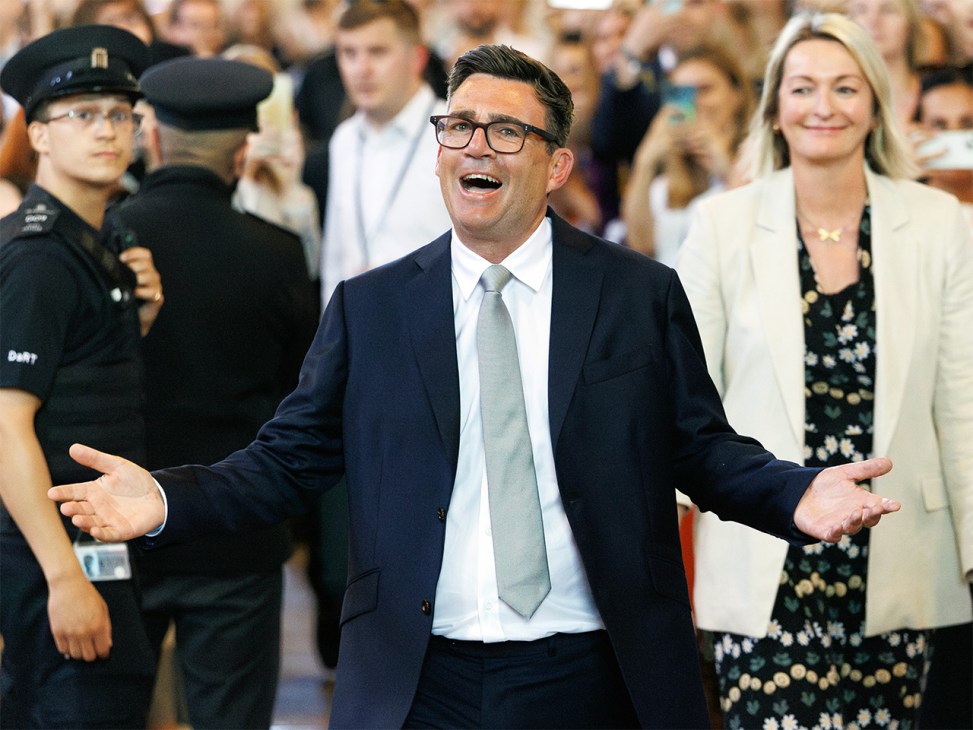
Scarcely two years later, the British public has now decided, according to consistent polling, that they don’t want Starmer either. On Monday 22 June, Starmer announced that he would resign, joining a rapidly elongating line of people who couldn’t inhabit 10 Downing Street long enough to justify redecorating. In his wake, the next PM hopeful will almost certainly be Andy Burnham, who returned to the House of Commons last week after a nine-year stint as mayor of Greater Manchester.
To illustrate the disarray caused to British politics by Brexit, one simply needs to look at the six prime ministers before Cameron: the survey takes you all the way to 1974. That was the second premiership of Harold Wilson, a pipe-chewing Yorkshireman from Huddersfield who, by happy symmetry with Burnham’s imminent accession, was the UK’s most recent authentically northern prime minister. (In the British context, “northern” means specifically northern English, and therefore excludes Scottish-born Tony Blair and Gordon Brown, and Margaret Thatcher, who was from Lincolnshire, which is just too far south to be considered properly Northern.)
It’s impossible to explain the appeal of Andy Burnham without explaining something of England’s north-south divide. Take a motorway heading upwards on the map from London and you will encounter signs reading simply and forbiddingly “The North”, understood to mean: “Here be if not monsters exactly, then whippets, flat caps and surliness.” In the opposite direction, “The South” has an invisible asterix attached to an understood footnote warning of braying toffs called Hugo and Arabella, milk that comes from things other than cows and glib insincerity. Southerners race horses; northerners pigeons. Two great British rock’n’roll rivalries – The Beatles vs The Rolling Stones, Oasis vs Blur – were projections of the north-south divide, the latter especially, pitching Oasis’s blokey Mancunian earnestness against Blur’s London art-school posturing. Oasis’s “Some Might Say” featured prominently in Burnham’s recent by-election campaign.
Burnham has a history of trowelling on the northern schtick (a southerner would pay someone else to trowel their schtick on for them). During a previous campaign for the Labour leadership – he has fallen short twice before – Burnham was asked to name his favourite biscuit. He replied “I don’t have a sweet tooth and don’t eat biscuits. But give me a beer and chips and gravy any day,” a line which would have been groaned out of the Coronation Street writers’ room.
Burnham was born in Liverpool in 1970 (in the context of that city’s municipal divide, he is a Blue, which is to say he supports Everton Football Club, not Liverpool). Though his boosters will pitch him as a rugged, authentic outsider, Burnham is the very model of a career politician: parliamentary researcher, special adviser, Member of Parliament and holder of several ministerial and/or cabinet posts during the 2007 to 2010 premiership of Gordon Brown. After Labour lost power in 2010, Burnham assumed various shadow portfolios (Education, Health, the Home Office) before leaving parliament to run for the newly created role of mayor of Greater Manchester. He won it by a street, and was re-elected twice. The contrast with Starmer’s tanking approval rating grew unignorable, then irresistible.
As mayor, Burnham is generally regarded to have done well on public transport and the local economy, and on unabashedly amplifying the regional identity (the Burnhamite creed of complementary economic and social progress has become known as “Manchesterism”). He is an affable and able communicator, one of those rare politicians who has the knack of looking like he’s enjoying the work, and like he does not regard constituents as a baffling, querulous nuisance.
Burnham has offered few clear lines on what kind of prime minister he hopes to be. He has spoken of a belief that Britain has been on the wrong path for 40 years, which seems a curious dismissal of the long period of Labour government (1997 to 2010) of which he was part. On foreign affairs, which consumed so much of Starmer’s attention, little is clear – though it would be surprising if much changed about the UK’s approach to Ukraine, the Middle East and China, or in its dogged insistence that it enjoys a “special relationship” with the US.
Burnham is, for the moment at least, merely the latest desperate response to what has become the default setting of the British electorate: “Whatever it is, I’m against it.”
此内容由惯性聚合(RSS阅读器)自动聚合整理,仅供阅读参考。 原文来自 — 版权归原作者所有。