


The Greater Manchester mayor’s by-election victory puts him on a collision course with the prime minister. Should he take the Labour crown, he’ll have three years to prepare for the bigger battle with Reform.
By-elections, in the British context, are constituency elections that occur outside general elections. They are most often occasioned by the death, retirement or resignation in disgrace of the sitting MP and are usually of interest only to the voters of the district in question – unless the reasons for the resignation in disgrace have been noteworthily picturesque.
Yesterday’s by-election in Makerfield, Greater Manchester, was an exception. Makerfield’s voters were likely choosing the UK’s next prime minister. The constituency’s previous MP, Labour’s Josh Simons, stepped aside in May to allow long-serving Greater Manchester mayor Andy Burnham to seek the seat in the House of Commons necessary for the launch of a bid for the top job.
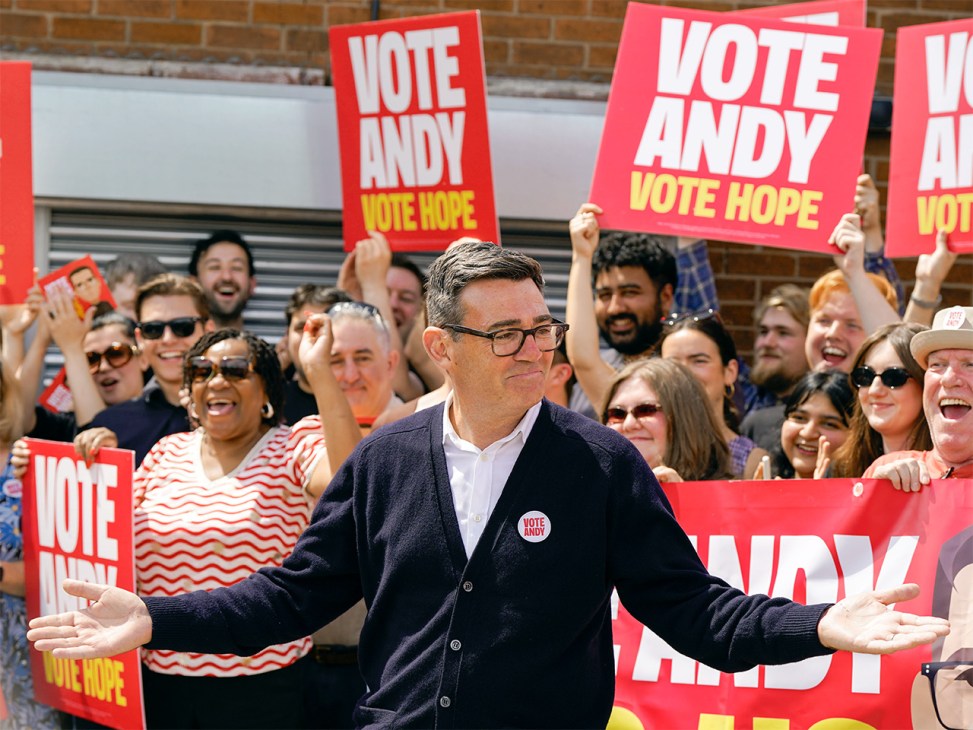
That first hurdle has now been cleared and with room to spare – Burnham convincingly saw off his nearest opponent, Robert Kenyon of far-right populists Reform UK. Burnham was helped by the fact that Kenyon was deeply unimpressive, even by the lackadaisical standards of the party that he represented, and that Makerfield’s seething oddball vote was split between Reform UK and its even more feral analogues, Restore Britain. Burnham has been a popular and effective mayor, hence the hopes at large within Labour that he might be able to do for the country what he has done for one of its cities.
There will now probably be – and in pretty short order – a challenge to the prime minister, Keir Starmer, for the leadership of the Labour Party. Starmer has vowed to defend his position but he will likely lose it to Burnham, who will take charge of a party with a huge majority in the House of Commons. As such, Burnham will be duly asked by King Charles III to form a government and will become the UK’s seventh prime minister in just over a decade. Another general election is not due until August 2029; Burnham would have three years to prepare.
These will be three important years. Defeat in Makerfield notwithstanding, Reform UK leads in national polls. Though surveys suggest that some 64 per cent of British voters disapprove of Reform UK’s leader, Nigel Farage, he remains on track to follow Burnham into 10 Downing Street. Burnham might be the last bulwark against the UK emulating the US’s ongoing experiment in turning its governance over to a cabal of clowns, cranks, quacks and grifters.
If any analysis of the Makerfield result is, by definition, a first draft of Starmer’s political obituary, it should at least be noted that his career, which seems to be ending in proverbial failure, can boast one considerable and commendable success. When he became leader of the Labour Party in 2020, it had been out of power for a decade, losing four consecutive general elections – the previous two under Jeremy Corbyn, a backbench barnacle around whom a peculiar cult of personality had coalesced (Corbyn, still an MP, was expelled from the party in 2024 and has resumed doing what he has always most enjoyed, striking vainglorious poses in the service of lost causes and bickering with his fellow left-wingers). Turning Labour back into a plausible party of opposition, then a party of government, in just four years was no meagre accomplishment.
If Makerfield is the beginning of the end for Starmer, he is entitled to feel somewhat aggrieved. Measured on the issues about which British voters profess to be most vexed, he is delivering. Net migration has been reduced, ditto the unsanctioned crossing of the English Channel in small boats. National Health Service waiting lists, though objectively horrendous (there are more than six million people in the queue), are down from their peak and much the same could be said of inflation. Energy prices are up but Starmer wasn’t the one who started a war in the Persian Gulf – and he was the one who ultimately decided that the UK would not, as it usually does, play Sancho Panza whenever the US’s Don Quixote lowers its lance at a Middle Eastern windmill.
But this is not how politics works, less so than ever in a modern media environment that is ill designed to flatter an earnest, awkward, methodical lawyer in his mid-sixties. Labour will probably turn to Burnham because he is liked, or at least less disliked than anybody else available.
此内容由惯性聚合(RSS阅读器)自动聚合整理,仅供阅读参考。 原文来自 — 版权归原作者所有。