








In the town of Avilés, northern Spain, a collection of eight large-scale voile fabrics printed with blue cyanotypes hangs in a former fish market. Fittingly for the marine setting, one of the fabrics shows the silhouette of a pile of prawns. The artist behind the installation, Agnes Essonti, says the image draws from her ancestry in Cameroon – named by 15th-century Portuguese conquistadors after camarões (prawns) for the region’s abundance of shellfish.
Barcelona-based Essonti is among the 40-plus artists exhibiting in Spain’s new Bienal Climática, an exhibition on view until 20 September that seeks to connect contemporary art with ecological and industrial issues. Ingredients such as cocoa, sugar cane and okra also feature in Essonti’s project, which she says relates to how food is “affected by the eco-social crisis that we’re going through”.
The new climate biennial was thought up by Atelier ITD, a Madrid-based foundation that develops collaborative projects around issues including the environment, employment and demographic change. Atelier ITD secured €1m in funding from the Spanish government to produce the new event, which it sees as part of Avilés’s wider regeneration, and hopes to reach some 90,000 visitors across its three-month span.
The art of reinvention: Avilés (Image: Nico Rodríguez)
“Art has a role to play in times like these,” says artistic director Amanda Masha Caminals, who curated existing work and artworks in progress to fit the exhibition’s themes, which include weather phenomena, industrialisation and the emotional aspects of ecological transition. Artists have also been chosen to participate in residencies that will produce new works for the biennial. The showcase unfolds across 13 venues spread out across Avilés and nearby areas – many of which are current or former industrial sites. Future iterations of the biennial are planned for other Spanish cities.
Home to approximately 75,000 inhabitants, Avilés is the third-largest municipality in the principality of Asturias. The 1950s and 1960s saw a boom of industries such as steel, zinc, aluminium and glass. It drew workers from across Spain but also turned Avilés into one of Europe’s most polluted cities. “Industry sacrificed the city’s identity,” says Mayor Mariví Monteserin Rodríguez. “It devastated the environment, degraded the air and river, and hid the city’s heritage under a layer of dirt.”
Several local artists engage with this legacy while incorporating Asturian folklore and agricultural traditions. At Factoría Cultural (a former clothing factory), Avilés-born Alba Matilla’s video-projection triptych was inspired by a local legend about a mystical fog that engulfed helpless wanderers. She has reimagined the fog as industrial smoke billowing from factories. At Palacio de Camposagrado, an installation by Sara García features dresses decorated with tear-shaped bread, while a video shows bread offerings being ceremonially placed in nature to highlight how this staple has been polluted by chemically assisted mass production.
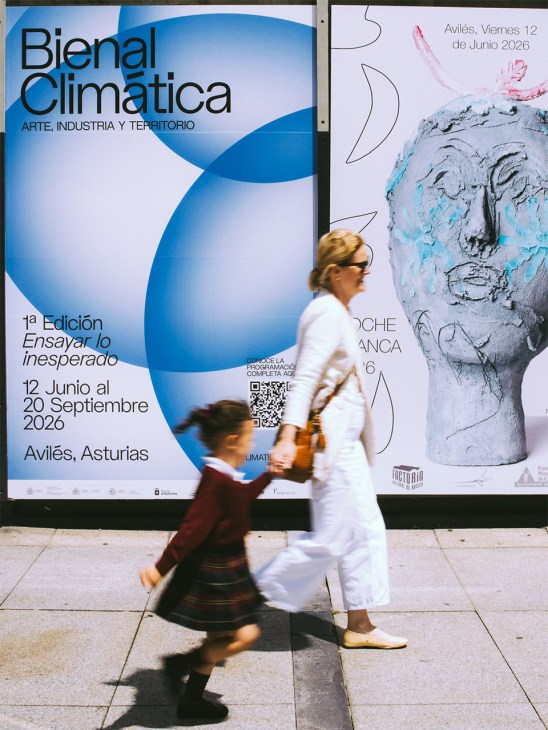
Over the past couple of years, Avilés has been part of an initiative to decarbonise industrial manufacturing across several midsize European cities. For the biennial, it was important to make sense of the transition through art while acknowledging how much industrial manufacturing has shaped the city. “Industry is a source of pollution”, says Masha Caminals, “but it is also part of the identity and sustenance of many people in this region.”
To connect with the city’s industrial identity, the biennial set up one of its displays in steel company Arcelormittal’s training centre. Asunción Molinos Gordo’s textile wall piece, made of 52 species of sheepswool, questions the notions of purity that underpin modern agriculture, economy and society. Works by Elena Lavellés and Olmo Cuña consider the transition towards green hydrogen, while Gabriela Bettini’s painting focuses on an open-cast copper mine on the border between Chile and Bolivia that has deteriorated the land’s topography. The same venue also hosts artists from outside Spain, including Singapore’s Priyageetha Dia, who explores rubber plantations in Southeast Asia, and Jordan-born Lawrence Abu Hamdan, who looks at Israeli wind farming projects in Golan Heights, Syria.
A similar event, Klima Biennale Wien, launched in Vienna in 2024. Such initiatives diverge from the conventional biennial model, which is now notorious for its heavy carbon footprint. The model was “built for a different era”, privileging spectacular displays and international movement without considering their impacts, says the director of the Austrian event, Sithara Pathirana. Changing the system also entails more than exhibiting environment-related art: “If the content is about ecological transformation, the container has to change too,” says Pathirana. “Otherwise it’s just greenwashing with better wall texts.”
Bienal Climática, however, doesn’t claim to pressure anyone into closed conclusions. “It’s not a lobby,” explains Masha Caminals. “It’s a meeting place between agents who probably wouldn’t cross paths otherwise.” By engaging on a local level and celebrating contemporary artists’ capacity for envisioning alternative futures, the initiative is out to show how culture can contribute to a city’s ecological changes. “Art won’t give us magical solutions,” the artistic director continues. “It can’t erase conflicts – but it can give us the tools to inhabit them together.”
bienalclimatica.org
此内容由惯性聚合(RSS阅读器)自动聚合整理,仅供阅读参考。 原文来自 — 版权归原作者所有。