







As summery music goes, Káryyn has the kind of glacier-cool falsetto that could help to bring down the temperature. In her pop songs, R&B and glitchy beats meet soaring vocals, experimental electronics and 3D sonics, like an ice sculpture splintering into shards only to fuse back together with the listener at the centre.
Káryyn’s refreshing style has won over heavyweights of the avant-garde. Her 2019 debut album, The Quanta Series, explored her American-Armenian-Syrian heritage and she has just released her second, Physics Universal Love Language (PULL). Its songs are inspired by Buddhism, neuroplasticity, works by folklorist Alan Lomax and Princess Peach from the Super Mario Brothers video-game franchise. And that’s just the tip of the iceberg: a thread of female empowerment runs through her work. It’s complex, Káryyn explains while sitting in a London café, having just arrived from Los Angeles and often breaking into song to illustrate her point. “Brevity is a book that I need to read,” she says.
PULL took nearly two decades to finish. It has a stellar cast of collaborators, including producers James Ford, Hudson Mohawke and mix engineer Marta Salogni. They helped to fine-tune the album’s layered sound, though Káryyn is also the album’s executive producer. “It sounds the way it sounds because of me,” she says. It’s an intense, immersive listen. “I want everyone to be able to feel this.”
You started writing this album a long time ago. Was revisiting the songs like reopening an old diary?
I worked on this album for 16 years but it’s not [made up of] old songs. I collaborate with my past, present and future self every year. Why did it take so long? It just is what it is. What even is an album cycle, when songs that came out 10 years ago are going ‘boom’ [on Tiktok]. I believe that everything has its perfect timing.
Your music is very visceral. How do you visualise it?
Every sound I hear has a texture or a colour. I’m now understanding that I have something called synaesthesia. I always feel this way. When someone has an emotion, I see the emotion. All I’m doing is painting with words, so every part of this production helps to serve what [the voice] is saying and feeling.
There’s a lot of emotional intensity on this album. How far were you willing to go?
I am not afraid of being cringey. What I’ve made is for people who want to feel their emotions. That has to be the purpose of my life – not about being fabulous or being seen. I play a show and people tell me that they felt their feelings, that they could sit with what they couldn’t before. That’s it.
Were you tempted to experiment with AI for this record?
Definitely not. This album is about being human.
The styling in your album artwork is striking. What did you envisage?
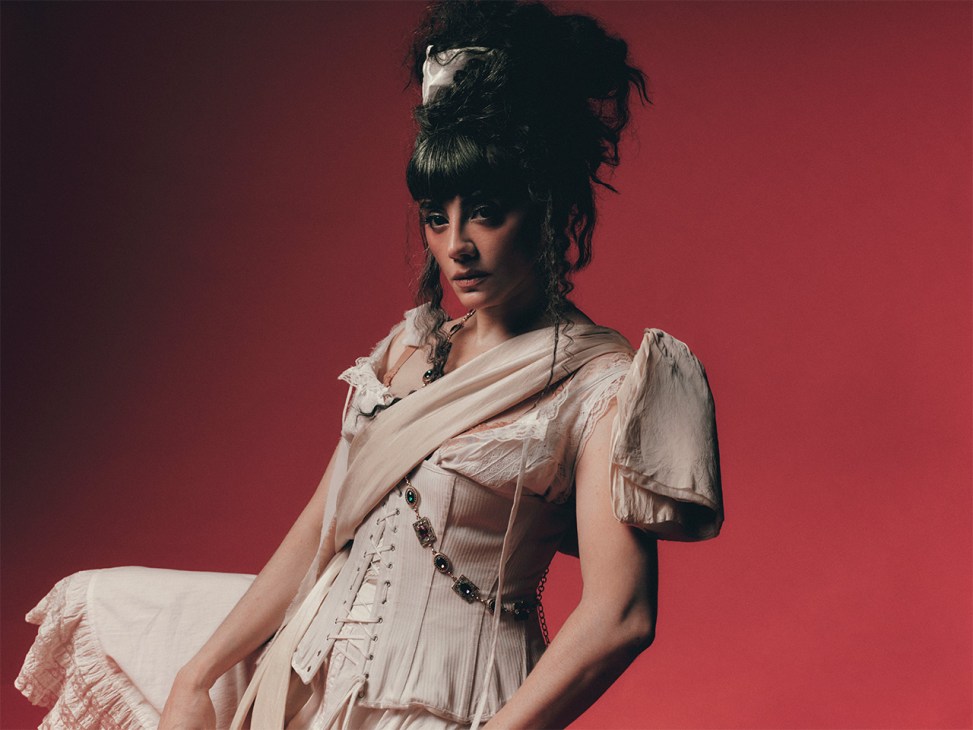
Fashion tells a story on this album. I’m thinking a lot about the suffragette era and the 1800s, women selling their bodies and corsets. [The album is] about empowerment and becoming a grounded woman who owns her sexuality. She’s in control of it and she can reveal it. I wanted the revolutionary jacket because of the human revolution that I’ve gone through, from child to woman.
What else will you be wearing during the warmer months?
Erdem is a longtime obsession – that painterly romanticism with real structure underneath. Right now, I’m living in vintage silhouettes from the 1880s to 1910s and anything cut with a Japanese menswear sensibility. I lean toward a sculptural, deep-coloured wardrobe with a bit of armour to it. In the heat, my go-to is Parisian eyewear brand Izipizi, which is cheap and charming.
What kind of artist are you at home?
I am in my room reading. When I was younger, I was running around at all the shows. [These days] I’m in my room with my TVs. I’ve got a camera feeding [a] TV. I’ve got Blade Runner on [on another]. I like the hum of the DVD player. I’ve got my Nintendo 64 if I get bored. I love analogue stuff because it’s tactile. For me, it’s always been about this idea of the past, present, future of technology. It’s all interconnected.
What about your summer plans?
I’m splitting my time between London, Berlin and Yerevan, where I’ll be playing on 26 June. It’ll be a kind of homecoming, given my Armenian roots, so there’ll be family, mountains and a lot of long tables in the late light.
And for summer listening, which records will you have on repeat?
Journey in Satchidananda, Alice Coltrane
Summer needs something devotional and weightless. This [album is] warm air made audible.
Keyboard Fantasies, Beverly Glenn-Copeland
It feels like driving with the windows down at dusk.
World of Echo, Arthur Russell
A cello, a voice and a lot of space. Intimate and a little oceanic, perfect for the hour between day and night.
And something from home: Nancy Ajram, always.
此内容由惯性聚合(RSS阅读器)自动聚合整理,仅供阅读参考。 原文来自 — 版权归原作者所有。