




惯性聚合 高效追踪和阅读你感兴趣的博客、新闻、科技资讯
阅读原文 在惯性聚合中打开

推荐订阅源

Exploit-DB.com RSS Feed
A
About on SuperTechFans
IT之家
IT之家
让小产品的独立变现更简单 - ezindie.com
Blog — PlanetScale
Blog — PlanetScale
aimingoo的专栏
aimingoo的专栏
云风的 BLOG
云风的 BLOG
The GitHub Blog
The GitHub Blog
Vercel News
Vercel News
G
Google Developers Blog
J
Java Code Geeks
宝玉的分享
宝玉的分享
T
Tailwind CSS Blog
Cloudbric
Cloudbric
L
LINUX DO - 最新话题
MyScale Blog
MyScale Blog
H
Heimdal Security Blog
PCI Perspectives
PCI Perspectives
Attack and Defense Labs
S
Security @ Cisco Blogs
Latest news
Latest news
I
Intezer
L
Lohrmann on Cybersecurity
C
CXSECURITY Database RSS Feed - CXSecurity.com
月光博客
月光博客
T
Threatpost
博客园 - 【当耐特】
S
Schneier on Security
P
Privacy International News Feed
G
GRAHAM CLULEY
T
Tenable Blog
AWS News Blog
AWS News Blog
Threat Intelligence Blog | Flashpoint
雷峰网
雷峰网
博客园 - Franky
Engineering at Meta
Engineering at Meta
美团技术团队
S
Secure Thoughts
T
Troy Hunt's Blog
Microsoft Security Blog
SecWiki News
SecWiki News
V
Visual Studio Blog
人人都是产品经理
人人都是产品经理
Application and Cybersecurity Blog
Cisco Talos Blog
Cisco Talos Blog
奇客Solidot–传递最新科技情报
奇客Solidot–传递最新科技情报
Martin Fowler
Martin Fowler
Webroot Blog
Webroot Blog
Google DeepMind News
H
Hackread – Cybersecurity News, Data Breaches, AI and More

Monocle

Air-con has become the latest front in a culture war – but more hot air is the last thing our overheating cities need All aboard as the Emirates’ first train service takes to the rails The seven standout shows at Paris Fashion Week Men’s spring/summer 2027 Where to eat and beat the heat in Paris: three new restaurants favoured by the fashion crowd What can be gleaned from Washington’s Reflecting Pool on the week of the US’s 250th birthday? Inside Monocle's July/August 2026 issue What makes Copenhagen a great city? Its ability to learn from its mistakes Stadium designer Alex Thomas’s top-10 sports venues in the world The case for keeping the economy – and the office – cool Cities are like theatres, we the actors. What part do you want to play? Cities are like theatres, we the actors. What part do you want to play? Onion – The Mansion: The latest outpost of a fashion retailer born of a musician’s side hustle Summer playlist: Celebrate the summer with these 40 scorching songs Meet the practice behind the Obama Presidential Center’s brand identity For all its problematic elements, the Fifa World Cup remains the greatest show on Earth Despite its enormous scale, Tokyo remains a city where good manners thrive Heatwave be damned! Paris Fashion Week Men’s brings leather and layers to the runways The Amble EV is gearing up to reinvent the way we drive Our summer issue is out now and measures the immeasurable – what makes a city worth living in? The art of the amble: Exploring the social rituals of evening walks across Spain, Italy and Greece Greetings from the past: A look back at postcards serving as snapshots of history It takes a village: Three new co-living developments that are bringing generations together The People’s charter for living well in cities: 13 rules for oafs, oiks and rapscallions How a city splashed out on staying cool: Zürich’s best fountains How The Lobb Club became Bangkok’s coolest tennis hangout Why does everyone want to be a member of Madrid’s Real Club de Campo Villa? How Dubai, New York, Paris and Shenzhen are building their flying-taxi networks Saddle up at Polo Palladio for a taste of Jaipur’s social scene Tyler Brûlé introduces Monocle's 2026 Quality of Life survey on CNN Monocle’s Quality of Life Survey 2026: The 20 most liveable cities in the world At 25, Vienna’s MuseumsQuartier remains a model for putting art and design at the centre of city life The 10 best spring/summer 2027 collections at Milan Fashion Week Men’s Can Flame Tree Season create Dubai's own cherry-blossom moment? Who is Andy Burnham? The man hoping to be the UK’s seventh prime minister in 10 years Berlin swimmers take the plunge amid efforts to reclaim bathing in the Spree Manifesta makes a case for site-specific biennials as it arrives to Ruhr for its 16th edition The Monocle Quality of Life Survey’s top cities throughout the past decade Six beautiful travel books from Monocle to guarantee a well-spent summer Storied US news programme ‘60 Minutes’ might be old but it doesn’t need to change How London’s Workshop Café & Academy is bringing a touch of luxury to the daily grind How London’s Workshop Café & Academy is bringing a touch of luxury to the daily grind Seven little luxuries that make life worth the luggage allowance Spain’s newest art initiative Bienal Climática bridges Avilés’s industrial past with its ecological future Spain’s newest art initiative Bienal Climática bridges Avilés’s industrial past with its ecological future ‘Everything has its perfect timing’: Káryyn on summer songs and the album that took 16 years to make Why are we asking AI all our silly questions when our partners have all the answers? How one intrepid iPhone kept a cabin entertained from Madrid to Montevideo Running brands are going the extra mile as South Koreans take to the great outdoors Andy Burnham seems on course for Downing Street – but Keir Starmer hasn’t been a total failure Art Basel brings fun back to the fair with the element of surprise ‘Silence is part of our products’ performance’: Amundsen Sports’ CEO on building an outdoor-clothing brand using natural fabrics Peacocks on safari and other observations from this year’s Pitti Immagine Uomo Is AI-created art worthy of display? A new Los Angeles museum thinks so Colombia’s presidential election is a choice between extremes. The country needs to return to the centre Hermès goes big, bright and bold at its new London flagship The UK’s under-16 social-media ban won’t make Big Tech safer The US’s 250th anniversary celebrations come out swinging with a show of pumped-up machismo at the White House AI won’t replace jobs humans are good at. Now people just need to prove their worth SpaceX IPO, diamond smuggling and the inconvenient truth about Mars The 2026 Women’s Prize winners talk rejection, process and finding stories worth telling There’s a place for your backpack on the train – it’s not your back Want to know why São Paulo is so vibrant and ambitious? Here are 10 observations The biggest contest of the 2026 World Cup is off the pitch Japan must prioritise pragmatism with China over provocation Few artists made a bigger splash than David Hockney, who has died at 88 Why US cities are poised to be fantastic World Cup hosts Copenhagen’s 3 Days of Design proves that big things can come in small packages Tacky? Yes. Patriotic? Often. But the World Cup needs its anthems A sticky World Cup tradition: Tracking down Panini football stickers Dane in the life: Takeaways from Copenhagen’s 3 Days of Design AI isn’t reinventing the wheel but it should heed the lessons of human innovation Seven Amsterdam bookshops worth writing home about Amid rising regional tensions and soaring travel costs, Gulf residents are choosing staycations The Mercadona doctrine and how to make yourself at home part-time Montevideo might be small but it knows how to appreciate good architecture London’s Quentin Blake Centre for Illustration opens in a bid to draw new audiences to the art form A shore thing: Konfekt’s summer issue is an ode to sun, sand and sea ‘What we are dealing with is a moral trauma’: How NGO Superhumans is helping to rehabilitate battle-scarred Ukrainians A shore thing: Konfekt’s summer issue is an ode to sun, sand and sea Mark Carney is the gaffer to get behind as World Cup co-host Canada readies for kick-off Couture is ‘a dance with the materials’: Iris van Herpen on keeping the art of fashion alive See the best of the Swedish capital with Monocle’s guide to Stockholm From the Pope to Bad Bunny, ‘Madrileños’ have plenty to put their faith in this weekend At the Black Sea Security Forum in Odesa, Ukraine looks increasingly like the leader of the free world Forget Milan, Paris and London: Helsinki is where talent scouts head to look for the best fashion designers Looking to the sky reveals much about what’s happening on the ground Is Lisbon’s art market on the up? Arco Lisboa, the city’s growing contemporary art fair, has put on a promising display Off the wall: How Frank Bowling painted his way to prominence Dress codes for dummies: Can AI save Chad and Britney from their worst wardrobe impulses? What is so special about ‘Le Petit Prince’? Electric bikes are handy but why must they be used as garbage bins on wheels? The best new books, films, museums and albums in June How Iranians have been coping with the US-Israel conflict through limited internet access Ibiza is hoping to capitalise on Dubai’s affluent tourist exodus – but it would do well to remember its roots Songtsam: Modern Chinese hospitality Editor’s letter: Andrew Tuck on the booming business of coffee What’s hot in the world of coffee? We spill the beans on the global market Not your average joe: 25 of the world’s best coffee shops, run by next-generation owners Breaking new ground: 25 exceptional brands that are leading the coffee industry Travel across L’Empordà, Spain – a coastline of storied hotels, seafront tables and surrealist heritage
A shore cure for urban fatigue: How Sydney, New York and Kobe are rethinking their waterfronts
Aarti Betigeri · 2026-06-25 · via Monocle

Waterfronts often serve as connection points in urban environments. When designed well, such spaces function as ecological buffers, economic engines and public spaces where communities can gather. But arriving at such a point requires vision, investment and ambition to reimagine precisely what a shoreline can be. Here, we examine three cities that have done exactly this: Sydney, reinvented through industrial infrastructure; New York, restored through environmental intervention; and Kobe, reshaped through civic and landscape design.


1.
Sydney Fish Market
Sydney, Australia

It’s 06.30 and the operations centre at the new Sydney Fish Market is in full swing. At one terminal, a worker is washing mud crabs in a deep sink; at another, fish are being checked for freshness. An aquatic bounty sits on slabs of ice: tuna, snapper, barramundi, tiger prawns. Workers push the market’s signature blue crates through the wide lanes, deftly avoiding some tourists – even at this early hour, there is a tour group coming through, learning about how the market functions. It’s all part of a grand architectural plan. Unveiled in January, this is the largest fish market in the southern hemisphere.

“We have turned an introverted industry inside out,” says Fred Holt, partner and Australian director at architecture firm 3XN. The international outfit, headquartered in Denmark, designed the building in partnership with Australia’s BVN Architecture and landscape firm Aspect Studios. The trio has produced a design that serves the public and industry, with a blurred activity programme headlined by a market hall that accommodates fishmongers, speciality shops, cafés and restaurants.
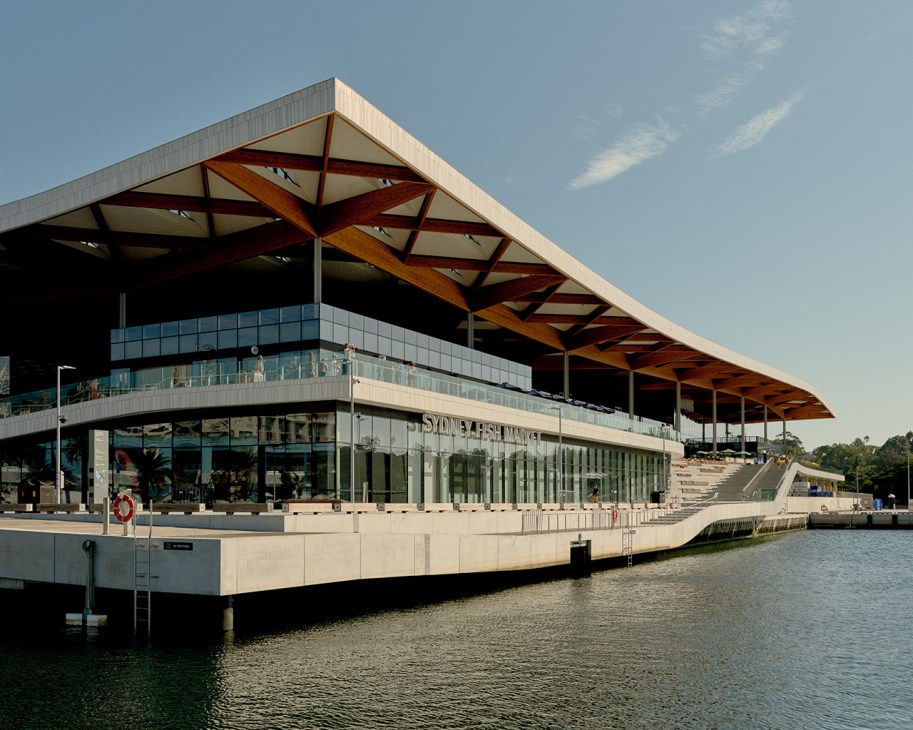
Sydney fish market
(Images: Nick Bannehr)

In a similar vein, the behind-the-scenes operations of the market have been foregrounded: the cold storage rooms are set on ground level and visible to anyone driving or walking past. Visitors can also see the auction hall, though circulation flows have been smartly designed to separate the daily operations of the working fish market from the public. “We’re putting the back-of-house operations on display,” says Holt. “We’re making the theatrics and intense choreography of seafood trading part of the public experience.”

As if to prove the point, Holt welcomes Monocle to the auction hall early on a summer day, whose cloudless blue sky promises scorching heat. It’s surprisingly quiet: about 40 bidders sit at desks in the hall, which is lined with glass windows and cascading rows of seating that make it reminiscent of a university lecture theatre. Coffees in hand, they stare intently at computer screens at their terminals. The auction uses a Dutch system, involving a clock that ticks down until a winning bid is made. Occasionally the contenders groan loudly when they’re outbid, otherwise the only sounds are gentle murmurs.

Far from simply being innovative in terms of inviting the public into an industrial market, work has also been done to link the site to the city. The building is set on Blackwattle Bay in the inner-city suburb of Glebe, along a 15km foreshore walk that starts near the Sydney Opera House. Part of the brief was to connect the building with this walk through a waterfront promenade. “The building is shaped to respond to this request,” says Holt. “The ground level has sweeping stairs to draw people up but also provide a place for Sydneysiders to just enjoy the view.”

It’s a view that the city’s inhabitants are well acquainted with: the building is a replacement for the former fish market, which, since opening on an adjacent site in 1966, had been a fixture of Sydney’s economic, cultural and tourist map. The new structure builds on this storied legacy but while adding a layer of architectural significance – it has already been described as the city’s most outstanding harbourside structure since the Opera House. Appropriately, the fish market’s roof, which looks like a wave coated in fish scales, is well on its way to icon status too. The design was informed by practical requirements: it needed to be low-lying to avoid obstructing the nearby Moreton Bay fig trees.

An undulating form proved the best solution, allowing natural light and ventilation to flow through the space, while collecting rainwater for later reuse. It’s a savvy design that means the building gives back to its tenants. “The Sydney Fish Market is actually owned by the industry for people who actually support it,” says Gus Dannoun, the operations manager at the market, who has worked here for more than 40 years. “One half of the business is owned by the licensed commercial fishermen through a trust, and the other half is owned by the tenants and merchants who operate from this site. It’s a truly industry-owned operation.”

It’s a situation that Holt is perfectly happy to acknowledge, adding that his work has built on it. “The fish market is two things,” he tells Monocle, as he wraps up his tour of the building. “It’s an operating fish market but it’s also a Sydney institution.” By 09.00 the public spaces have filled up – there are people walking dogs, buying flowers and coffees, gathering around an oyster shucker to watch him work, and, of course, buying plenty of fish. “It’s Sydney’s living room,” adds Holt.

View Monocle’s complete city guide to Sydney.


2.
East Side Coastal Resiliency
New York, USA

When the $1.45bn (€1.25bn) East Side Coastal Resiliency project is completed in 2027, the waterfront along lower Manhattan’s East River will look significantly different to the one that was destroyed by Hurricane Sandy in 2012. The ambitious 15-year project, named the Big U, is being built to a master plan by Bjarke Ingels Group and One Architecture and Urbanism. It is defined by a 16km stretch of park and public realm, featuring flood protections (such as a tidal gate chamber, floodwalls and elevated parkland) designed to safeguard New Yorkers from future storms and tidal floods, while also providing abundant public amenities.
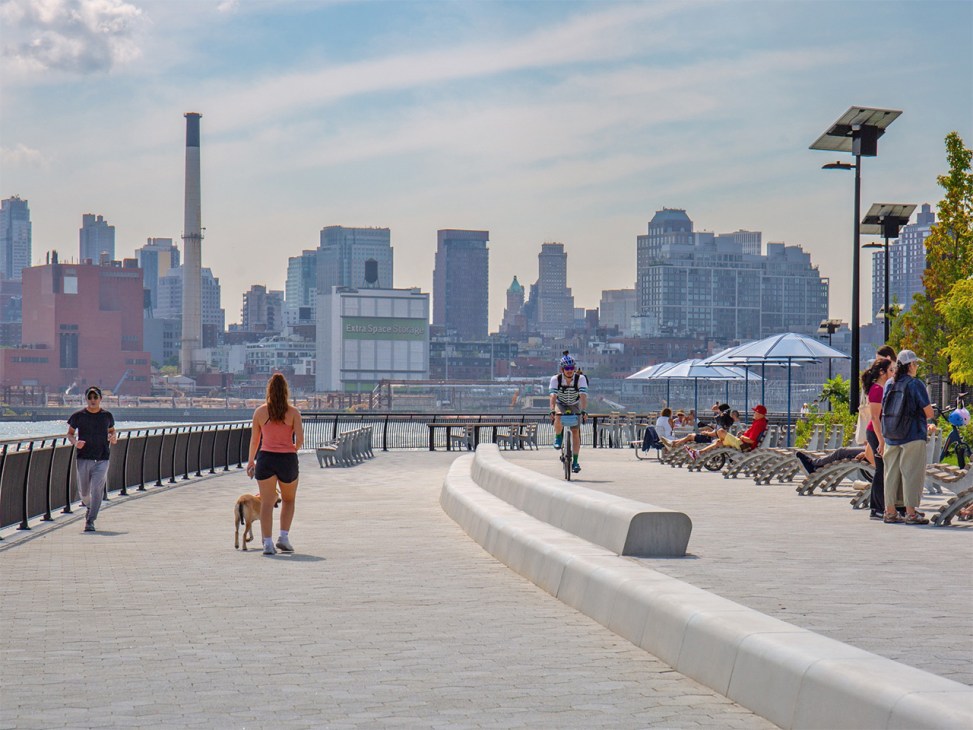
New York on a sunny afternoon
East River Park’s waterfront (Images: Matthew Lapiska/East Side Coastal Resiliency)

“It’s an archipelago of parks forming an elevated, undulating new landscape – a ‘parkipelago’ if you will,” says Ingels. “Each island of green is devoted to a use and character decided by the community. Rather than separating the city from the waterfront, we’ve designed a public realm that invites people in.”

Its crown jewel is the 4km-long East River Park, which is being transformed into the Lower East Side’s most vibrant civic space. Those who visit the site this summer will hear the hum of construction at the park’s northern end. But they will also be able to visit the most recently opened section (pictured) south of the Williamsburg Bridge.
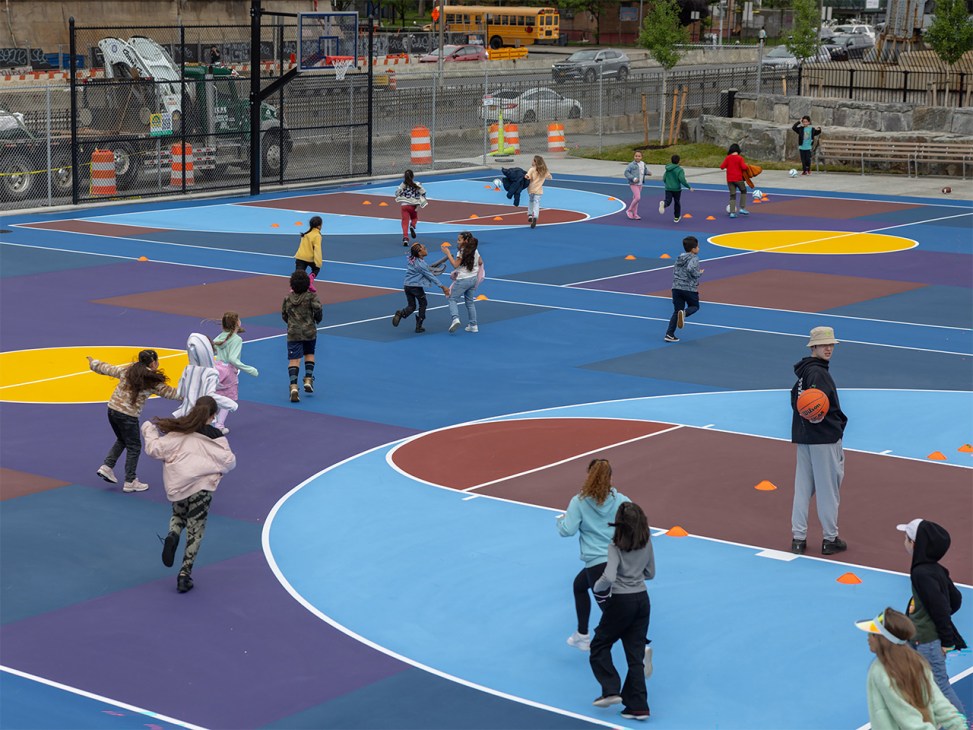
Sports courts in East Side Coastal Resiliency, New York
Sports courts are part of the mix

Elevated above the floodplain, it features lush planting, sports courts and spots for the community to gather in, fields, lawns, nature and water play areas, an amphitheatre and an extended esplanade for walking, running and cycling. “It protects, connects and inspires,” says Ingels. “Proof that the future of our cities can be both safe from floods and full of life.”

View Monocle’s complete city guide to New York.


3.
Tottei Green Hill
Kobe, Japan

Fifty years ago, the Japanese port of Kobe had multiple inner-city piers lined with cargo ships. Times have changed: an earthquake in 1995 caused extensive damage to the waterfront and today’s larger container vessels now dock offshore. Architect Tomohiro Hata was tasked with transforming the tip of the centrally located No 2 Pier into a space for Kobe’s citizens. “Our first thought was an outdoor theatre where people could gather,” says Hata. Inspired by the Teatro Antico di Taormina, a third-century BC amphitheatre in Sicily, Hata set about creating a venue that made sense in a modern Japanese metropolis.
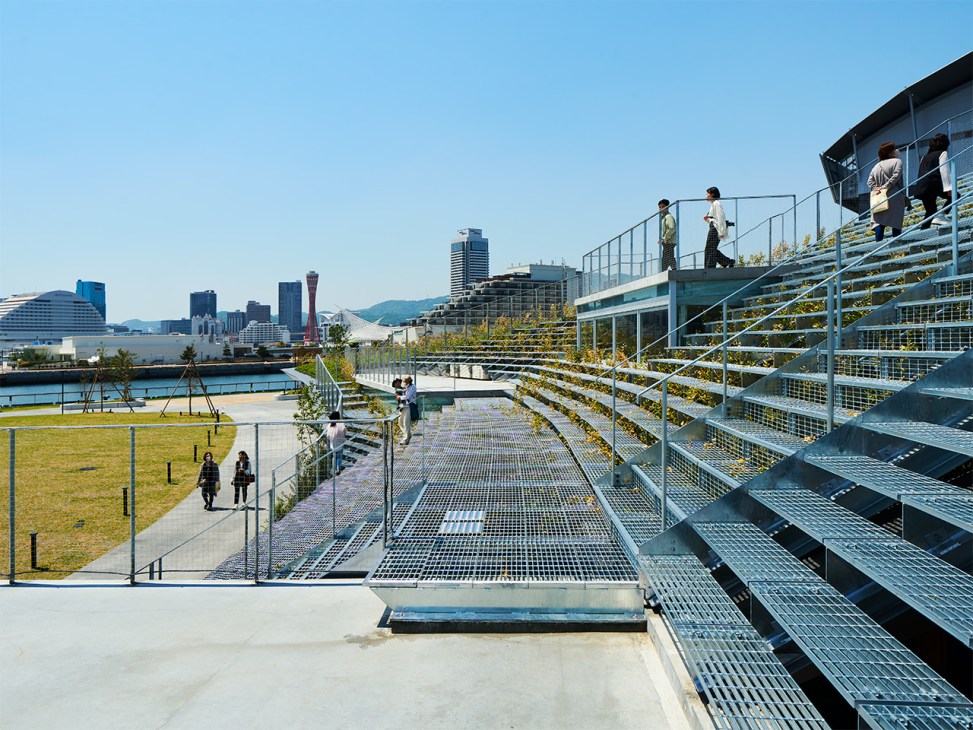
Tottei Green Hill, Kobe Japan
Stepped metal platforms make up the Tottei Green Hill theatre in Kobe

The city of 1.5 million is sandwiched between the Seto Inland Sea and Rokko mountains. “When you walk through Kobe, the dense concentration of high-rise buildings makes it difficult to understand the connection between the sea and the mountains,” says Hata. Once you reach the waterfront, however, the region’s dramatic topography reveals itself. The brief called for a large public space so Hata designed a grassy plaza before raising one corner by 11 metres, creating a hill that opens up to those panoramic views.

Hata’s idea to combine an outdoor theatre and a manmade hill demanded complex engineering. “To realise the hill, we used moisture-retaining lightweight soil and planted two varieties of bamboo grass of differing heights, capable of withstanding harsh seaside conditions.” The design allowed for rapid drainage of seawater even when exposed to large waves. For the theatre part, stepped platforms made from metal grates float above the planted slopes, allowing sunlight to reach the vegetation below while providing spaces for people to sit. The empty space within the hollow hill can be used for events in all weathers.

It’s an impressive reinvention of a piece of unwanted urban infrastructure – and Kobe has embraced it. Hata thinks that the idea could work elsewhere too. “People are drawn to waterfronts,” he says, “It suggests a universal quality that extends beyond the context of Kobe.”