
惯性聚合 高效追踪和阅读你感兴趣的博客、新闻、科技资讯
阅读原文 在惯性聚合中打开

推荐订阅源

J
Java Code Geeks
S
SegmentFault 最新的问题
V
Visual Studio Blog
人人都是产品经理
人人都是产品经理
阮一峰的网络日志
阮一峰的网络日志
腾讯CDC
Stack Overflow Blog
Stack Overflow Blog
博客园 - 【当耐特】
Recent Announcements
I
InfoQ
U
Unit 42
博客园_首页
GbyAI
GbyAI
Hugging Face - Blog
Hugging Face - Blog
罗磊的独立博客
博客园 - 叶小钗
奇客Solidot–传递最新科技情报
奇客Solidot–传递最新科技情报
D
DataBreaches.Net
aimingoo的专栏
aimingoo的专栏
月光博客
月光博客
Cyber Security Advisories - MS-ISAC
博客园 - 聂微东
T
Tailwind CSS Blog
量子位

IEEE Spectrum

Low-Power Wearable System Accurately Tracks Motion Mouthpad Brings Hands-Free Control to Everyday Devices Solaris App Turns a Total Eclipse Into a Massive Heart Study How Simulation Apps Pinpoint the Root Cause of Electronics Failures How a Nazi Era Tape Recorder Gave Birth to the Laugh Track Why AI Needs a "Genie Coefficient" Panasonic’s PV-460 Camcorder Stabilized Shaky Videos Brain Inspired Camera Sensor Learns to See and Gently Forget Shadow-Free Augmented Reality Makes Illusions More Realistic Modos Color E‑Paper Monitor Pushes Open‑Source Displays Further We Are Crowd-Sourcing the Panopticon Magnetic Maps Promise GPS Free Navigation Indoors And Underwater Developers: Get Your Medical Mobile App Verified By IEEE Can Your Phone’s Lidar Sensors See Around Corners? AI Rings Turn Sign Language Into Text In Real Time How NeXT Turned Steve Jobs From Brash Founder to Disciplined Builder Flint Paper Battery Could Power Gadgets With Cellulose How AI Is Changing Cybersecurity Smart Earbuds Bring Visual Intelligence to Your Ears Mems Photonics Chip Shrinks Quantum Computer Control Limits Apple's 50th Anniversary and Its Forgotten Tech Can Analog Computing Transform Wearable AI? These AI Workstations Look Like PCs, but Pack a Stronger Punch Caught by Your Own Devices: The Rise of Sensorveillance A Guide to Selecting Adhesives for Medical Device Applications - Wiley Science and Engineering Content Hub Is Bluetooth LE Audio the Future of Wireless Audio? How Is Low-Cost Computing Handling Memory Price Hikes? NanoLEDs Push the Boundaries of Display Technology How Will FDA's New Rules Impact Your Health Gadgets? Are AI Companions Helping or Hurting Our Well-Being?
Designing for Precision: CAD Tips for Micro-Scale 3D Prin...
Boston Micro · 2026-02-26 · via IEEE Spectrum

Register now free-of-charge to explore this white paper

This Whitepaper provides engineers and scientists with practical guidance on optimizing CAD models for micro-scale 3D printing — helping you achieve ultra-high resolution and micron-level tolerances across a range of demanding applications.

What you will learn about:  

  • How to set realistic tolerances and match feature sizes to your printer’s resolution capabilities
  • Best practices for wall thickness, reinforcement features, and part orientation to ensure structural integrity at the micro scale
  • Strategies for managing undercuts, overhangs, and supports without compromising delicate features
  • Key microfluidic channel design considerations including sizing, aspect ratios, cleanability, and flow optimization
  • How to select the right material for your application and configure CAD exports for micro-precision printing

Click ‘LOOK INSIDE’ to Download Now.

LOOK INSIDE
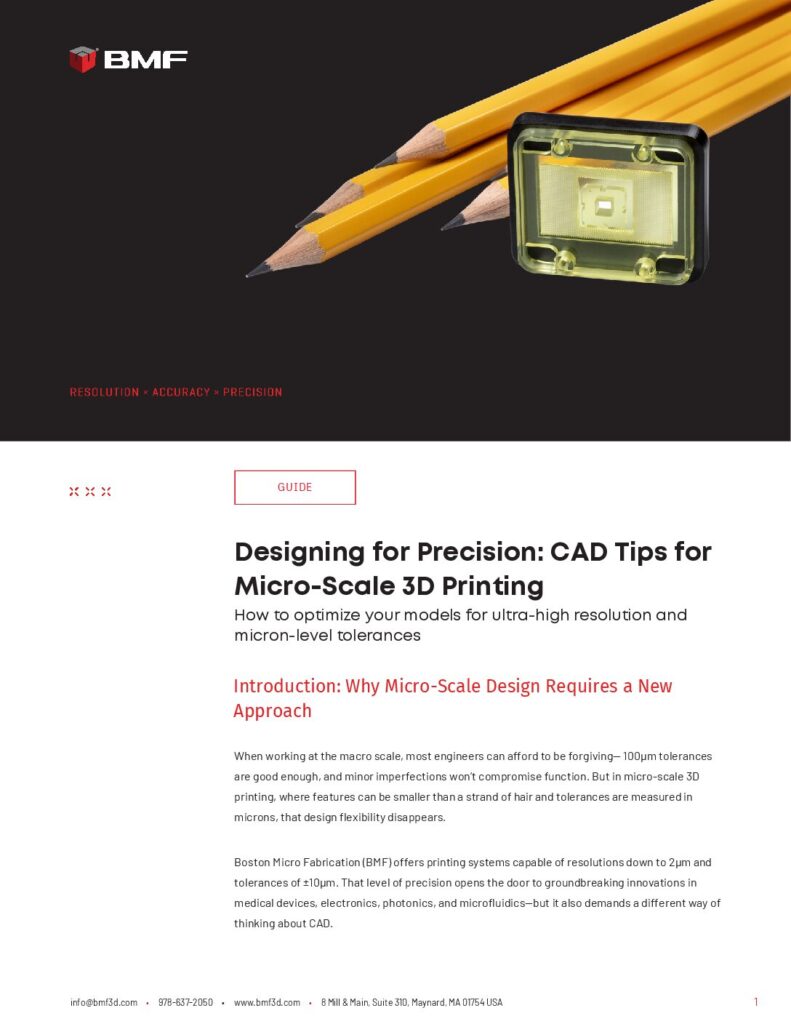
PDF Cover

IEEE Spectrum and Wiley are proud to bring you this white paper, sponsored by Boston Micro Fabrication.

More Information

Micro-scale 3D printing demands a fundamentally different approach to CAD design compared to traditional macro-scale work. With feature sizes smaller than a strand of hair and tolerances measured in single-digit microns, the margin for error is virtually zero. Engineers working in medical devices, electronics, photonics, and microfluidics need to rethink how they handle tolerances, geometry, wall thickness, and support structures when designing at this scale. This whitepaper walks through practical, field-tested tips — from setting appropriate tolerances and reinforcing thin walls to designing functional microfluidic channels and choosing the right materials — so you can reduce failed prints, shorten iteration cycles, and move from concept to validated prototype with confidence.

