


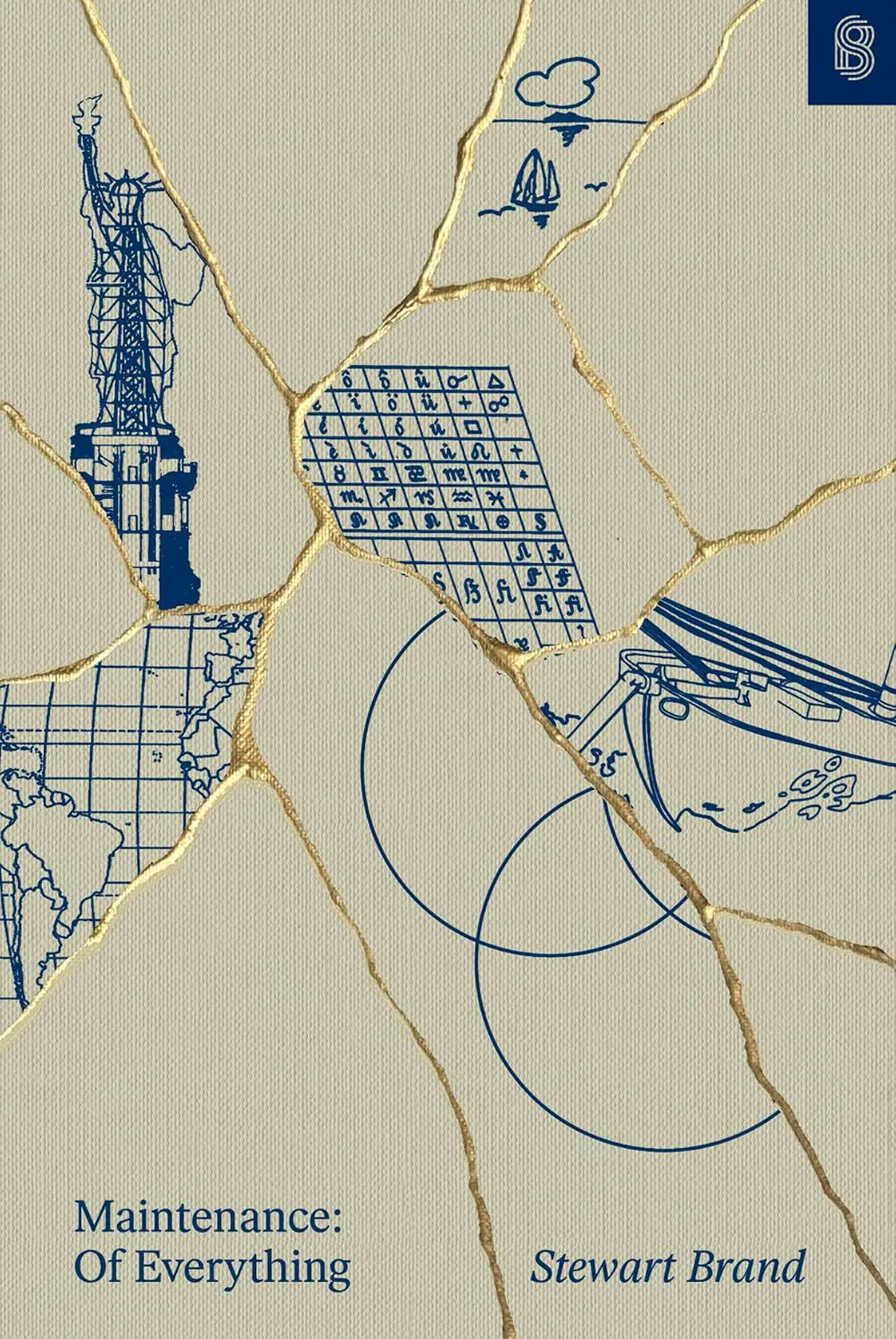
The handsome new book Maintenance: Of Everything, Part One, by the tech industry legend Stewart Brand, promises to be the first in a series offering “a comprehensive overview of the civilizational importance of maintenance.” One of Brand’s several biographers described him as a mainstay of both counterculture and cyberculture, and with Maintenance, Brand wants us to understand that the upkeep and repair of tools and systems has profound impact on daily life. As he puts it, “Taking responsibility for maintaining something—whether a motorcycle, a monument, or our planet—can be a radical act.”
Radical how? This volume doesn’t say. In an outline for the overall work, Brand says his goal is to “end with the nature of maintainers and the honor owed them.”
The idea that maintainers are owed anything, much less honor, might surprise some readers. Actually, maintenance and repair have been hot topics in academia since the mid-2010s. I played some role in that movement as a cofounder of the Maintainers, a global, interdisciplinary network dedicated to the study of maintenance, repair, care, and all the work that goes into keeping the world going.
Brand is right, too, that maintainers haven’t gotten the laurels they deserve. Over the past few decades, scholars have shown that work from oiling tools to replacing worn parts to updating code bases all tends to be lower in status than “innovation.” Maintenance gets neglected in many organizational and social settings. (Just look at some American infrastructure!) And as the right-to-repair movement has shown, companies in pursuit of greater profits have frequently locked us out of being able to do repairs or greatly reduced the maintainable life of their products. It’s hard to think of any other reason to put a computer in the door of a refrigerator.
Some of Brand’s earlier work helped inspire those insights. But his new book makes me think he doesn’t see things that way. For Brand, maintenance seems to be a solitary act, profound but more about personal success and fulfillment than tending to a shared world or making it better.
Born in 1938, Brand is 87 years old. A sense hangs over the book—with its battles against corrosion, rust, and decay, with its attempts to keep things going even as they inevitably falter—of someone looking over life and pondering its end. Maintenance: Of Everything connects to every stage of Brand’s life. It’s worth reviewing where it falls in that arc. Brand has always been interested in tools and fixing things, but rarely has he focused on the systems that need the most care.
More than a half-century ago, Brand was a member of the Merry Pranksters, a countercultural, LSD-centered hippie collective famously led by Ken Kesey, the author of One Flew Over the Cuckoo’s Nest. In 1966, Brand co-produced the Trips Festival, where bands like the Grateful Dead and Big Brother and the Holding Company performed for thousands amid psychedelic light shows.
Brand’s Whole Earth Catalog had a vision that might feel progressive, but its libertarian, rugged-individualist philosophy of remaking civilization alone stood in contrast to more collective social change movements.
In some ways, the Trips Festival set a paradigm for the rest of his life’s work. Brand’s biographers have described him as a network celebrity—someone who got ahead by bringing people together, building coalitions of influential figures who could boost his signal. As Kesey put it in 1980, “Stewart recognizes power. And cleaves to it.”
Brand applied this network logic to the undertaking he will always be best remembered for: the Whole Earth Catalog. First published in 1968 and aimed at hippies and members of the nascent back-to-the-land movement, the publication had the motto “Access to tools.” Its pages were full of Quonset huts, geodesic domes, solar panels, well pumps, water filters, and other technologies for life off the grid. It was a vision that might feel progressive or left-leaning, but the libertarian, rugged-individualist philosophy of eschewing corrupt systems and remaking civilization alone stood in contrast to the more collective movements pushing for deep social change at the time—like civil rights, feminism, and environmentalism.
That vision also led straight to the empowerment that came with new digital tools, and to Silicon Valley. In 1985, Brand published the Whole Earth Software Catalog, the last of the series, and also cofounded the WELL—the Whole Earth ’Lectronic Link, a pioneering online community famous for, among other things, facilitating the trade of Grateful Dead bootlegs. He also wrote a hagiographic book about the MIT Media Lab, known for its corporate-sponsored research into new communications tech. “The Lab would cure the pathologies of technology not with economics or politics but with technology,” Brand wrote. Again, not collective action, not policymaking: tools. And Brand then cofounded the Global Business Network, a group of pricey consulting futurists that further connected him to MIT, Stanford, and the Valley. Brand had literally helped bring about the modern digital revolution.
His attention then turned toward its upkeep. Brand’s 1994 book, How Buildings Learn: What Happens After They’re Built, argued against high-modernist architectural ideas. Nearly all buildings eventually get remade, he argued, but he especially favored cheap, simple structures that inhabitants could easily retool to suit changing needs. In some ways, Brand was recapitulating the liberated—or libertarian—philosophy of the Whole Earth Catalog: People can remake their world, if they have access to tools. In a chapter titled “The Romance of Maintenance,” he asked readers to see the beauty, value, and occasional pleasures of fixer-uppers of all kinds.
This chapter was a touchstone for many of us in the academic subfield of maintenance studies. Researchers in disciplines like history, sociology, and anthropology, as well as artists and practitioners in fields like libraries, IT, and engineering, all started trying to understand the realities and, yes, romance of maintenance and repair. Brand joined and contributed to Listservs, attended conferences, chatted with intellectual leaders. So it’s a bit uncharitable when he writes that his new book is “the first to look at maintenance in general.” He knows better. The real question, though, is what his work has to teach us that others have not said before. In this first volume, the answer is unclear.
Maintenance: Of Everything, Part One is an odd book. If so much of Brand’s thinking has been about access to tools, he now asks, in a more extended way: How are our tools maintained? But where Brand began his career with a catalogue, in this volume we get … what? A digest? An almanac? An encyclopedia? Its form and riotous variety fit no genre easily.
The book has two chapters. The first, “The Maintenance Race,” recounts the story of three men who took part in the Golden Globe, a round-the-world race for solo sailors held in 1968. Each of the sailors, Brand explains, had a different philosophy of maintenance. One neglected it and hoped for the best. He died. Another thought of and prepared for everything in advance, and while he didn’t win the race, he completed it and once held the record for the “world’s longest recorded nonstop solo sailing voyage.” The final sailor won and did so through heroic acts of perseverance; his style was “Whatever comes, deal with it,” Brand explains. Structured like a fairy tale and unremittingly romantic, the story—like most of the anecdotes in the book—focuses on the derring-do of vigorous white guys. The strategy is no secret. Brand’s outline explains: “Start with a dramatic contest of maintenance styles under life-critical conditions—a true story told as a fable.” This myth is meant to inspire.
The second chapter, “Vehicles (and Weapons),” is over 150 pages long. It has five sections, multiple subsections, five subsections designated “digressions,” one called a “subdigression,” two “postscripts,” and several “footnotes” that are not footnotes in a formal sense but, rather, further addenda. At times, it all feels like notes for a future work. Brand makes no apology for the book’s woolliness. “All I can offer here,” he writes, “is to muse across a representative of maintenance domains and see what emerges.” Perhaps the most charitable reading of the potpourri is that it represents the return of a Merry Prankster, offering us a riotous varied light show. It’s a good book to leave on a table and occasionally open to a random page for entertainment. But it often seems as if it does not know what it wants to say or be.
“Vehicles (and Weapons)” begins by paraphrasing two famous works of maintenance philosophy, Robert M. Pirsig’s Zen and the Art of Motorcycle Maintenance and Matthew B. Crawford’s Shop Class as Soulcraft. Maintenance involves both “problem finding” and “problem solving.” While much repair work is marked by anxiety, impatience, and boredom, it also offers positive values and outcomes. “Motorcycle maintainers take heart from what they repair for—the glory of the ride,” Brand writes.
The beauty and triumph of cheapness is a running theme throughout the work, harking back to How Buildings Learn. Henry Ford’s Model T won out over early electric vehicles and hugely expensive luxury vehicles like Rolls-Royce’s Silver Ghost because it was cheap and easier to maintain. The three most popular cars in human history—the Ford Model T, the Volkswagen Bug, and the Lada “Classic” from Russia—all privileged cheapness, “retained their basic design for decades, and … invited repair by the owner.” Or, to be fair, maybe demanded it? For every hobbyist who delighted in being able to self-reliantly keep a VW running, there must have been thousands who appreciated how cheap it was and hated that it broke a lot. Brand never points to social research, like surveys, that might help us know people’s feelings on such matters.
Other sections recount how Americans created interchangeable parts (enabling not only cheap mass production but also easy maintenance), examine how maintenance works with assault rifles and in war, and track the history of technical manuals from the early modern period to the age of YouTube. These stories are solid, but they’re also well known to students of technology, and nearly all are recycled from the work of others, featuring many large block quotes. The volume breaks little new ground.
Brand treats maintenance as an unalloyed good. But the field of maintenance studies has moved on, burrowing into the domain’s ironies, complexities, and difficulties. A simple example: In most cases, it is environmentally far better to retire and recycle an internal-combustion vehicle and buy an electric one than to keep the polluting beast going forever. Maintaining a gas-guzzler or a coal-burning power plant isn’t a radical act but a regressive one. Also, maintenance can become a life-breaking burden on the poor, and it falls inequitably on the shoulders of women and people of color. Keeping existing systems going can be a way of avoiding tough, necessary change—like making technological systems more accessible for people with disabilities. In this volume, Brand is uninterested in such difficult trade-offs. He avoids any question of how politics shapes these issues, or how they shape politics.
This avoidance comes out most clearly in a section of “Vehicles (and Weapons)” that talks about Elon Musk—a character of “unique mastery,” Brand informs us. He tells us that Bill Gates once shorted Tesla’s stock, only to lose $1.5 billion. The lesson is clear: Elon won.
In what political and social vision is money the best way to keep the score? Brand rightly points out that electric vehicles have fewer moving parts and, in that sense, are more maintainable than internal-combustion vehicles. He celebrates Musk most of all because his products “have all proven to be game changers in part because they combine ingenious design with surprisingly low cost.” Again, it’s Brand’s “cheap, available tools” hypothesis. But there’s a real superficiality and lack of follow-through in thinking here: Teslas remain luxury vehicles whose sales have slumped since federal tax subsidies disappeared. The company has faced several right-to-repair lawsuits; there’s even a law review article on the topic. Musk is in no sense a maintenance hero. Yet Brand writes that with his companies, “Musk may have done more practical world saving than any other business leader of his time.” By the time Brand was writing this book, the controversies surrounding Musk for at least flirting with antisemitism, racism, sexism, authoritarianism, and more were quite clear. About this, the book says not a word.
STRIPE PRESS, 2026
For sure, Brand needn’t agree with Musk’s critics, but failing to even broach the subject is tone deaf and out of touch. Others have argued that Silicon Valley’s “Move fast and break things” mentality undermines healthy maintenance. Brand doesn’t raise the idea—even to dismiss it.
It could be that with Maintenance: Of Everything, Part One Brand is just getting going; that in subsequent volumes he’ll have something more coherent to say; that he’ll raise really hard questions and try to answer them. But given his track record, we might reasonably doubt it. Kesey said Brand cleaves to power; he certainly doesn’t question it.
Lee Vinsel is an associate professor of science, technology, and society at Virginia Tech and host of Peoples & Things, a podcast about human life with technology.
此内容由惯性聚合(RSS阅读器)自动聚合整理,仅供阅读参考。 原文来自 — 版权归原作者所有。