



惯性聚合 高效追踪和阅读你感兴趣的博客、新闻、科技资讯
阅读原文 在惯性聚合中打开

推荐订阅源

L
LangChain Blog
The GitHub Blog
The GitHub Blog
Recent Announcements
MyScale Blog
MyScale Blog
P
Proofpoint News Feed
S
Security @ Cisco Blogs
N
News and Events Feed by Topic
H
Hacker News: Front Page
Attack and Defense Labs
S
Secure Thoughts
Microsoft Security Blog
N
Netflix TechBlog - Medium
U
Unit 42
Stack Overflow Blog
Stack Overflow Blog
T
Threat Research - Cisco Blogs
Google Online Security Blog
Spread Privacy
Spread Privacy
Threat Intelligence Blog | Flashpoint
Exploit-DB.com RSS Feed
L
LINUX DO - 热门话题
T
Tenable Blog
博客园 - 叶小钗
D
DataBreaches.Net
freeCodeCamp Programming Tutorials: Python, JavaScript, Git & More
博客园_首页
人人都是产品经理
人人都是产品经理
aimingoo的专栏
aimingoo的专栏
C
Check Point Blog
博客园 - 三生石上(FineUI控件)
量子位
P
Proofpoint News Feed
H
Help Net Security
Blog — PlanetScale
Blog — PlanetScale
宝玉的分享
宝玉的分享
Recorded Future
Recorded Future
The Register - Security
F
Fortinet All Blogs
Engineering at Meta
Engineering at Meta
钛媒体:引领未来商业与生活新知
钛媒体:引领未来商业与生活新知
Last Week in AI
Last Week in AI
S
Schneier on Security
V
Vulnerabilities – Threatpost
雷峰网
雷峰网
Microsoft Azure Blog
G
GRAHAM CLULEY
G
Google Developers Blog
月光博客
月光博客
V
V2EX
T
Troy Hunt's Blog
A
Arctic Wolf

MIT Technology Review

Want to get a data center online quickly? Give it some flex. Why do South Koreans love AI so much? This man with ALS is “the first power user” of a brain implant that lets him speak The Download: cutting AC emissions, and nature’s drug designer These new solid-state ACs promise a cool future. Scientists aren’t so sure. The Download: “reprogramming” aging, and the hidden sense of interoception You do your own time Why “reprogramming” is the buzziest approach to reversing aging right now Inside interoception: The hidden sense of how you feel inside The Download: soccer’s data renaissance and China’s big nuclear plans Google DeepMind is worried about what happens when millions of agents start to interact Job titles of the future: Nature’s drug designer Inside soccer’s data renaissance Why China is betting on big nuclear reactors The Download: the “steroid olympics” and a safer Mythos The “steroid olympics” were a circus—and a window into our culture The Download: whole-body rejuvenation drugs and five things to know about AI Learning to lead in a hybrid human-AI enterprise David Sinclair plans to test whole-body rejuvenation drugs in the XPrize competition Five things you need to know about AI The Download: how the World Cup ball will fly and OpenAI’s “super app” Why this year’s World Cup ball may not fly as far The Download: AI hacking beyond Mythos, and chatbots’ impact on our brains Are AI chatbots making us lose control of our brains? The Meta hack shows there’s more to AI security than Mythos The Download: AI-generated lawsuits and virtual power plants for data centers How courts are coping with a flood of AI-generated lawsuits How virtual power plants could provide energy for data centers The Download: Trump’s new AI order, and smart glasses for warfare The Download: AI can run your admin department now Rehumanizing global health care with agentic AI How small businesses can leverage AI China has approved the world’s first invasive brain-computer chip—here’s what’s next The Download: unlocking lithium and controlling Ebola The deadly Ebola outbreak is proving difficult to control How the Pope’s Magnifica Humanitas offers a template for individuals to meet the AI moment How a new extraction process could unlock the world’s lithium The Download: climate tech goes public and the AI Hype Index returns Climate tech companies are going public. What’s next? The AI Hype Index: AI gets booed in graduation season The Download: keeping up with AI, and the future of IVF Green steel startup Boston Metal is doubling down on critical metals How Chinese short dramas became AI content machines The shock of seeing your body used in deepfake porn Three things in AI to watch, according to a Nobel-winning economist The Download: seafloor science and military chatbots The Download: inside the Musk v. Altman trial, and AI for democracy A blueprint for using AI to strengthen democracy Week one of the Musk v. Altman trial: What it was like in the room Trump’s mass firing just dealt another blow to American science A new US phone network for Christians aims to block porn and gender-related content This startup’s new mechanistic interpretability tool lets you debug LLMs Rebuilding the data stack for AI The Download: DeepSeek’s latest AI breakthrough, and the race to build world models The Download: introducing the 10 Things That Matter in AI Right Now Roundtables: Unveiling The 10 Things That Matter in AI Right Now The new word in home construction could be “plastics” A natural protein may protect the GI tract from infection This tool could show how consciousness works Early life may have breathed oxygen earlier than believed Analog computing from waste heat Get ready for hotter, muggier, stormier summers Recent books from the MIT community AI at MIT Inventor recalls eye imaging breakthrough Pie Day 2026 The Download: bad news for inner Neanderthals, and AI warfare’s human illusion The case for fixing everything How robots learn: A brief, contemporary history Making AI operational in constrained public sector environments Treating enterprise AI as an operating layer The Download: cyberscammers’ banking bypasses, and carbon removal troubles Why having “humans in the loop” in an AI war is an illusion The noise we make is hurting animals. Can we learn to shut up? The quest to measure our relationship with nature Is carbon removal in trouble? The Download: NASA’s nuclear spacecraft and unveiling our AI 10 Cyberscammers are bypassing banks’ security with illicit tools sold on Telegram No one’s sure if synthetic mirror life will kill us all Building trust in the AI era with privacy-led UX Redefining the future of software engineering The Download: the state of AI, and protecting bears with drones NASA is building the first nuclear reactor-powered interplanetary spacecraft. How will it work? Coming soon: 10 Things That Matter in AI Right Now The problem with thinking you’re part Neanderthal Why opinion on AI is so divided Want to understand the current state of AI? Check out these charts. The Download: how humans make decisions, and Moderna’s “vaccine” word games Job titles of the future: Wildlife first responder You have no choice in reading this article—maybe What’s in a name? Moderna’s “vaccine” vs. “therapy” dilemma The Download: an exclusive Jeff VanderMeer story and AI models too scary to release Constellations The Download: AstroTurf wars and exponential AI growth Desalination technology, by the numbers Is fake grass a bad idea? The AstroTurf wars are far from over. Mustafa Suleyman: AI development won’t hit a wall anytime soon—here’s why The Download: water threats in Iran and AI’s impact on what entrepreneurs make Desalination plants in the Middle East are increasingly vulnerable Enabling agent-first process redesign
The Download: China’s brain implant ambitions
Thomas Macaulay · 2026-06-01 · via MIT Technology Review

Skip to Content

Plus: Nvidia is launching its first AI chip for personal computers.

This is today's edition of The Download, our weekday newsletter that provides a daily dose of what's going on in the world of technology.

China has approved the world’s first invasive brain-computer chip—here’s what’s next

Sitting in the courtyard of his house in China’s Henan province last October, Dong Hui decided to try holding a pen. Six years after a car accident left him paralyzed from the neck down, he slowly wrote his name, “Thank you,” and the date.

The breakthrough was made possible by a brain implant called NEO. In March, it became the world’s first invasive brain-computer interface approved for use beyond clinical trials. The approval is expected to accelerate China’s push to become a global leader in brain implants.

Read the full story on how China reached this milestone—and what it means for the future of brain-computer interfaces.

—You Xiaoying

The must-reads

I’ve combed the internet to find you today’s most fun/important/scary/fascinating stories about technology.

1 Nvidia is launching its first AI chip for personal computers
The RTX Spark will power laptops from Dell, HP, Microsoft, and others. (BBC)
+ They’re being designed specifically to run AI agents. (WSJ $)
+ The first devices are set to launch on Windows PCs in the fall.
(CNBC)
+ The move marks a challenge to Apple and Intel.
(FT $)

2 The US is stopping exports of AI chips to Chinese firms abroad
It’s closed a loophole allowing exports to Chinese subsidiaries. (Reuters $)
+ Which may have enabled unlicensed access to Nvidia chips. (Al Jazeera)
+ Export curbs have led China to redesign its chip industry. (MIT Technology Review)

3 Surgeons have transplanted pig liver and kidneys into a living person
The clinically dead recipient’s organs worked for almost five days. (Nature)
+ Pig organs could ease transplant shortages. (Guardian)
+ Putin says organ transplants could grant immortality. (MIT Technology Review

4 The US, Australia, and UK will defend seabed cables with underwater drones
They’re developing the vehicles via the trilateral AUKUS defense ⁠pact. (CNN)
+ Undersea internet cables face growing threats. (BBC)

5 A new study has revealed chatbots’ manipulative ‘dark patterns’ 
It found they prey on emotions to encourage harmful behavior. (404 Media)
+ They can also sway voters better than political ads. (MIT Technology Review)

6 Apple plans to disrupt the traditional glasses market
Its smart glasses target the broader spectacles industry. (Bloomberg $)
+ Smart glasses are also gaining traction in warfare. (MIT Technology Review)

7 AI super PACs are dueling over the midterms
Split between Anthropic and OpenAI, they’re fighting to shape AI regulation. (NYT $)

8 SoftBank has overtaken Toyota as Japan’s most valuable company


The AI boom pushed SoftBank’s market value above $305 billion. (Bloomberg $) 

9 A botnet of more than 17 million devices has been dismantled in Europe
Dutch authorities linked the network to a Russian proxy service. (Ars Technica)

10 Tech leaders are uniting around a transhuman vision for AI
They’re working toward a post-human agenda. (Guardian)

Quote of the day

“It's just been shoved down their throats in secrecy. And that makes them upset.” 

—Legendary environmental activist Erin Brockovich tells "The Jim Acosta Show" why citizens are angry about data centers expanding into their communities.

 One More Thing
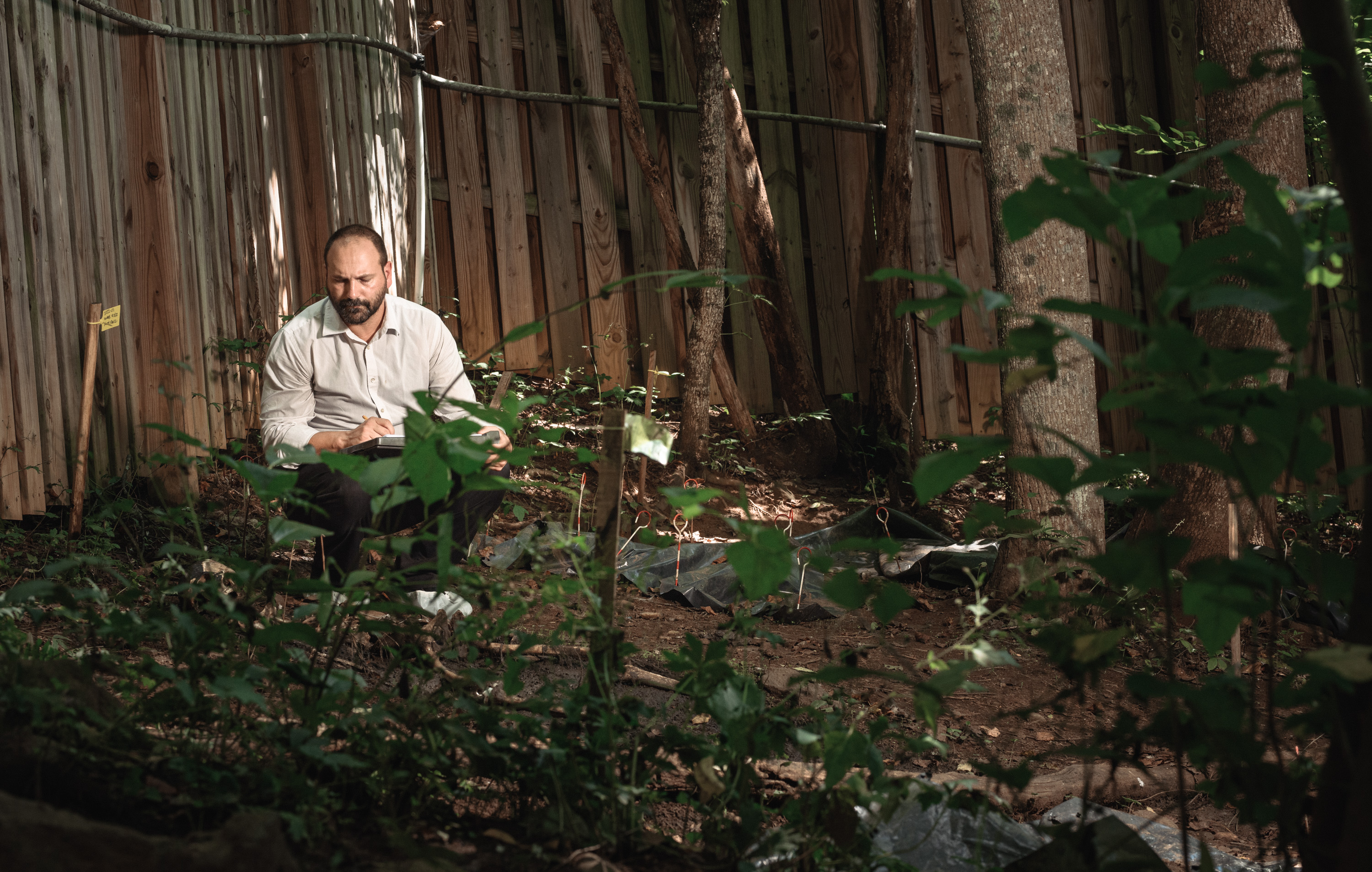
Dr. Nicholas Passalacqua, Forensic Anthropology Facilities Director at Western Carolina University observes a body at the decomp facility.

MIKE BELLEME


What happens when you donate your body to science

Rebecca George doesn’t mind the vultures. At Western Carolina University’s body farm, forensic anthropologists monitor donors—sometimes for years—as they become nothing but bones.

Around 20,000 people donate their cadavers to scientific research and education each year. At anatomy labs and body farms, they help train doctors, advance research, and teach scientists more about the human body long after death.

But what actually happens after a body is donated? Read the full story to find out.

—A.W. Ohlheiser

We can still have nice things

A place for comfort, fun, and distraction to brighten up your day. (Got any ideas? Drop me a line.)

+ This map of moments turns the planet into a shared diary.
+ Let editors curate your ideal podcast moments with this app.
+ Architecture lovers will enjoy this encyclopedia of famous buildings.
+ Get in touch with your emotions through this map exploring more than 100 feelings.

Deep Dive

The Download

Stay connected

Illustration by Rose Wong

Get the latest updates from
MIT Technology Review

Discover special offers, top stories, upcoming events, and more.