


惯性聚合 高效追踪和阅读你感兴趣的博客、新闻、科技资讯
阅读原文 在惯性聚合中打开

推荐订阅源

D
DataBreaches.Net
T
Threatpost
N
News and Events Feed by Topic
PCI Perspectives
PCI Perspectives
V2EX - 技术
V2EX - 技术
D
Docker
G
Google Developers Blog
Microsoft Security Blog
N
News and Events Feed by Topic
cs.AI updates on arXiv.org
Google Online Security Blog
The GitHub Blog
The GitHub Blog
Hacker News - Newest:
Hacker News - Newest: "LLM"
Y
Y Combinator Blog
M
MIT News - Artificial intelligence
Blog — PlanetScale
Blog — PlanetScale
博客园 - 司徒正美
T
Troy Hunt's Blog
Webroot Blog
Webroot Blog
Security Archives - TechRepublic
量子位
Apple Machine Learning Research
H
Help Net Security
F
Full Disclosure
B
Blog
O
OpenAI News
H
Hackread – Cybersecurity News, Data Breaches, AI and More
博客园_首页
Google DeepMind News
Exploit-DB.com RSS Feed
Engineering at Meta
Engineering at Meta
大猫的无限游戏
大猫的无限游戏
Forbes - Security
Forbes - Security
Know Your Adversary
Know Your Adversary
B
Blog RSS Feed
MongoDB | Blog
MongoDB | Blog
Scott Helme
Scott Helme
T
The Exploit Database - CXSecurity.com
博客园 - 聂微东
cs.CV updates on arXiv.org
The Last Watchdog
The Last Watchdog
Recorded Future
Recorded Future
IT之家
IT之家
Project Zero
Project Zero
Stack Overflow Blog
Stack Overflow Blog
小众软件
小众软件
Attack and Defense Labs
L
Lohrmann on Cybersecurity
SecWiki News
SecWiki News
让小产品的独立变现更简单 - ezindie.com

MIT Technology Review

Want to get a data center online quickly? Give it some flex. Why do South Koreans love AI so much? This man with ALS is “the first power user” of a brain implant that lets him speak The Download: cutting AC emissions, and nature’s drug designer These new solid-state ACs promise a cool future. Scientists aren’t so sure. The Download: “reprogramming” aging, and the hidden sense of interoception You do your own time Why “reprogramming” is the buzziest approach to reversing aging right now Inside interoception: The hidden sense of how you feel inside The Download: soccer’s data renaissance and China’s big nuclear plans Google DeepMind is worried about what happens when millions of agents start to interact Job titles of the future: Nature’s drug designer Inside soccer’s data renaissance Why China is betting on big nuclear reactors The Download: the “steroid olympics” and a safer Mythos The “steroid olympics” were a circus—and a window into our culture The Download: whole-body rejuvenation drugs and five things to know about AI Learning to lead in a hybrid human-AI enterprise David Sinclair plans to test whole-body rejuvenation drugs in the XPrize competition Five things you need to know about AI The Download: how the World Cup ball will fly and OpenAI’s “super app” Why this year’s World Cup ball may not fly as far The Download: AI hacking beyond Mythos, and chatbots’ impact on our brains Are AI chatbots making us lose control of our brains? The Meta hack shows there’s more to AI security than Mythos The Download: AI-generated lawsuits and virtual power plants for data centers How courts are coping with a flood of AI-generated lawsuits How virtual power plants could provide energy for data centers The Download: Trump’s new AI order, and smart glasses for warfare The Download: AI can run your admin department now Rehumanizing global health care with agentic AI How small businesses can leverage AI The Download: China’s brain implant ambitions China has approved the world’s first invasive brain-computer chip—here’s what’s next The Download: unlocking lithium and controlling Ebola The deadly Ebola outbreak is proving difficult to control How the Pope’s Magnifica Humanitas offers a template for individuals to meet the AI moment How a new extraction process could unlock the world’s lithium The Download: climate tech goes public and the AI Hype Index returns Climate tech companies are going public. What’s next? The AI Hype Index: AI gets booed in graduation season The Download: keeping up with AI, and the future of IVF Green steel startup Boston Metal is doubling down on critical metals How Chinese short dramas became AI content machines The shock of seeing your body used in deepfake porn Three things in AI to watch, according to a Nobel-winning economist The Download: seafloor science and military chatbots The Download: inside the Musk v. Altman trial, and AI for democracy A blueprint for using AI to strengthen democracy Week one of the Musk v. Altman trial: What it was like in the room Trump’s mass firing just dealt another blow to American science A new US phone network for Christians aims to block porn and gender-related content This startup’s new mechanistic interpretability tool lets you debug LLMs Rebuilding the data stack for AI The Download: DeepSeek’s latest AI breakthrough, and the race to build world models The Download: introducing the 10 Things That Matter in AI Right Now Roundtables: Unveiling The 10 Things That Matter in AI Right Now The new word in home construction could be “plastics” A natural protein may protect the GI tract from infection This tool could show how consciousness works Early life may have breathed oxygen earlier than believed Analog computing from waste heat Get ready for hotter, muggier, stormier summers Recent books from the MIT community AI at MIT Inventor recalls eye imaging breakthrough Pie Day 2026 The Download: bad news for inner Neanderthals, and AI warfare’s human illusion The case for fixing everything How robots learn: A brief, contemporary history Making AI operational in constrained public sector environments Treating enterprise AI as an operating layer The Download: cyberscammers’ banking bypasses, and carbon removal troubles Why having “humans in the loop” in an AI war is an illusion The noise we make is hurting animals. Can we learn to shut up? The quest to measure our relationship with nature Is carbon removal in trouble? The Download: NASA’s nuclear spacecraft and unveiling our AI 10 Cyberscammers are bypassing banks’ security with illicit tools sold on Telegram No one’s sure if synthetic mirror life will kill us all Building trust in the AI era with privacy-led UX Redefining the future of software engineering The Download: the state of AI, and protecting bears with drones NASA is building the first nuclear reactor-powered interplanetary spacecraft. How will it work? Coming soon: 10 Things That Matter in AI Right Now The problem with thinking you’re part Neanderthal Why opinion on AI is so divided Want to understand the current state of AI? Check out these charts. The Download: how humans make decisions, and Moderna’s “vaccine” word games Job titles of the future: Wildlife first responder You have no choice in reading this article—maybe What’s in a name? Moderna’s “vaccine” vs. “therapy” dilemma The Download: an exclusive Jeff VanderMeer story and AI models too scary to release Constellations The Download: AstroTurf wars and exponential AI growth Desalination technology, by the numbers Is fake grass a bad idea? The AstroTurf wars are far from over. Mustafa Suleyman: AI development won’t hit a wall anytime soon—here’s why The Download: water threats in Iran and AI’s impact on what entrepreneurs make Desalination plants in the Middle East are increasingly vulnerable
Enabling agent-first process redesign
2026-04-07 · via MIT Technology Review

Unlike static, rules-based systems, AI agents can learn, adapt, and optimize processes dynamically. As they interact with data, systems, people, and other agents in real time, AI agents can execute entire workflows autonomously.

But unlocking their potential requires redesigning processes around agents rather than bolting them onto fragmented legacy workflows using traditional optimization methods. Companies must become agent first.
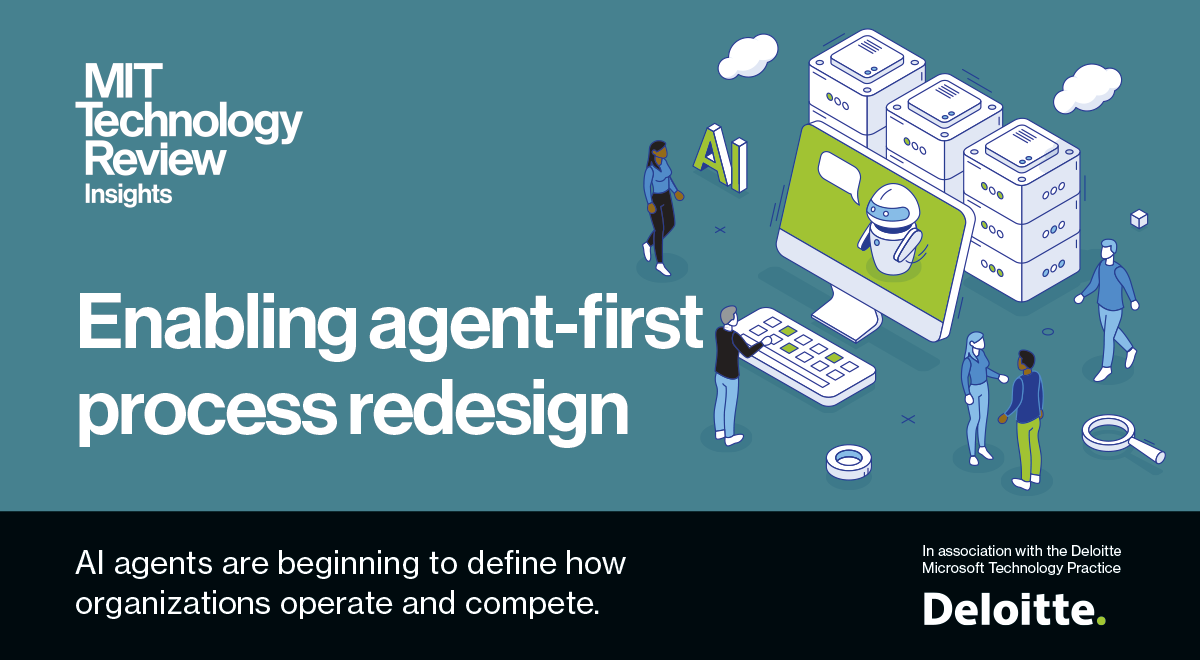
In an agent-first enterprise, AI systems operate processes while humans set goals, define policy constraints, and handle exceptions.

“You need to shift the operating model to humans as governors and agents as operators,” says Scott Rodgers, global chief architect and U.S. CTO of the Deloitte Microsoft Technology Practice.

The agent-first imperative

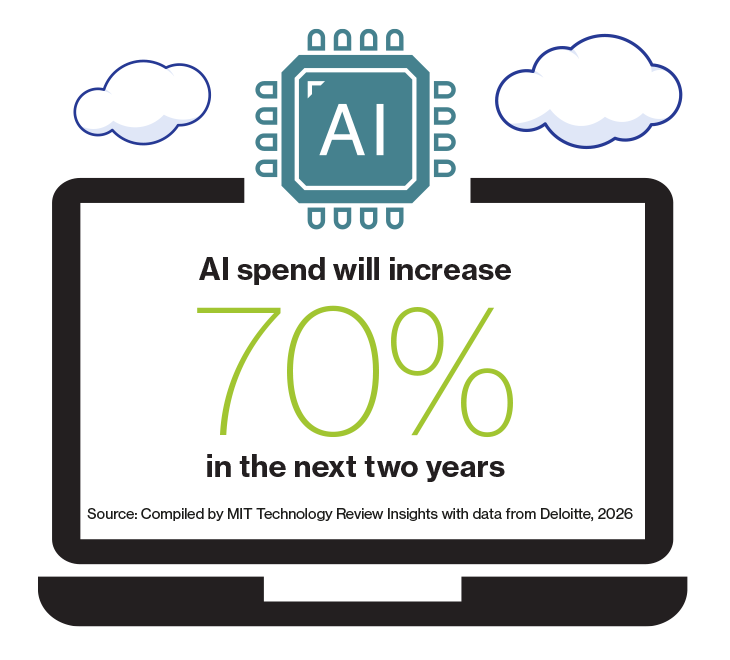
With technology budgets for AI expected to increase more than 70% over the next two years, AI agents, powered by generative AI, are poised to fundamentally transform organizations and achieve results beyond traditional automation. These initiatives have the potential to produce significant performance gains, while shifting humans toward higher value work.

AI is advancing so quickly that static approaches to task automation will likely only produce incremental gains. Because legacy processes aren’t built for autonomous systems, AI agents require machine-readable process definitions, explicit policy constraints, and structured data flows, according to Rodgers.
Further complicating matters, many organizations don’t understand the full economic drivers of their business, such as cost to serve and per-transaction costs. As a result, they have trouble prioritizing agents that can create the most value and instead focus on flashy pilots. To achieve structural change, executives should think differently.

Companies must instead orchestrate outcomes faster than competitors. “The real risk isn’t that AI won’t work—it’s that competitors will redesign their operating models while you’re still piloting agents and copilots,” says Rodgers. “Nonlinear gains come when companies create agent-centric workflows with human governance and adaptive orchestration.”

Routine and repetitive tasks are increasingly handled automatically, freeing employees to focus on higher value, creative, and strategic work. This shift improves operational efficiency, fosters stronger collaboration, and generates faster decision-making—helping organizations modernize the workplace without sacrificing enterprise security.

Download the article.

This content was produced by Insights, the custom content arm of MIT Technology Review. It was not written by MIT Technology Review’s editorial staff. It was researched, designed, and written by human writers, editors, analysts, and illustrators. This includes the writing of surveys and collection of data for surveys. AI tools that may have been used were limited to secondary production processes that passed thorough human review.